
Free tools Windows power users keep installed
One-click scans. No signup required.
iTechGuides is reader-supported. When you buy through links on our site, we may earn an affiliate commission. As an Amazon Associate I earn from qualifying purchases. Learn more
Leap seconds would be replaced by a continuous UTC time scale allowed to drift farther from Earth-rotation time (UT1). Draft Resolution C before the 28th General Conference on Weights and Measures (CGPM) proposes permitting an absolute UT1−UTC difference of up to 3,600 seconds (one hour), instead of inserting a one-second step whenever the difference approaches 0.9 seconds. UT1−UTC would still be published for applications that need precise knowledge of Earth’s rotation.
The one-hour limit and a proposed effective date of 20 May 2027 are not final as of 13 October 2026: the CGPM meeting is under way and must agree to the draft. If adopted, the change would remove discontinuities from the world’s main reference time without stopping anyone from measuring or using Earth-rotation data.
The short answer: continuous UTC, with UT1−UTC reported separately
There is no proposed replacement gadget, new kind of second, or alternative atomic clock. The replacement is a rule change. UTC would continue at the same uniform rate as International Atomic Time (TAI), while the permitted gap between UTC and UT1 would become much larger. Rather than adding or removing a second, international time services would let that gap accumulate and publish its value for specialist users.
Do these 3 things before closing this tab:
1Fix the driver behind crashes, sound loss and screen glitches2Clear out junk files and repair common Windows errors3Scan for outdated or missing drivers - takes under a minuteThat distinction matters because UTC and UT1 answer different questions. UTC is the internationally coordinated reference used to define civil time and synchronize systems. UT1 describes the angle of Earth’s rotation. Earth does not rotate at a perfectly constant rate, so UT1 wanders relative to atomic time. Leap seconds currently make UTC track that wandering closely. The proposal keeps the measurements but stops forcing UTC to follow them in one-second jumps.
#1 Best Overall

- Atomic Wall Clock Never Need Setting: Atomic clock has a built-in receiver that automatically synchronizes itself with the WWVB radio broadcast by the US Government's National Institute (NIST) in Fort Collins, Colorado. The Atomic Clock will always be accurate to within one second as it receives daily WWVB updates. (No Backlight)
- Atomic Clock with Indoor/Outdoor Temp: The Wireless outdoor sensor transmits the outdoor temperature to the atomic clock. The sensor should be placed within 100ft of the clock. Also, clock has a built-in high-quality indoor temperature sensor so that you can read the temperature both indoor and outdoor
- Digital Wall Clock Large Display: Jumbo 2.5 inch Height Time Digital Display - Use as either a wall clock or as a desk clock, it is easy to read, easy to Use and easy to set up. This atomic clock has been designed with absolute simplicity in mind, you can also set it manually. Excellent clocks for seniors, suitable for anyplace in your home or office
- Atomic Clock Digital: 12/24 Hour time formats with accurate and clear second minute and hour display; 4 time zone to choose (PST, MST, CST, EST); auto daylight saving time; temperature display units in Celsius or Fahrenheit
- Digital Wall Clock Battery Operated: Both clock and outdoor sensor are supported by batteries only, no need to plug or charge (Batteries not included). The existed alarm features can wake you up in the morning or help you keep track of dates and days of the week to avoid missing any important meetings or appointments
Three time scales you need to understand
International Atomic Time (TAI)
TAI is the continuous atomic time scale produced by the International Bureau of Weights and Measures (BIPM). It advances uniformly according to an international ensemble of atomic clocks. It has no leap seconds.
Coordinated Universal Time (UTC)
UTC is the international reference and the basis for civil time in most countries. It runs at the same rate as TAI but differs from TAI by an integral number of seconds. That whole-second offset changes when a leap second is introduced under the current system.
Universal Time 1 (UT1)
UT1 is derived from observations of Earth’s angular rotation. It is the scale used when the orientation of Earth itself matters, such as astronomical pointing, satellite operations and geodesy. The published quantity UT1−UTC tells users how far the reference time is from Earth-rotation time.
The Tool Desk
Outbyte Driver Updater FREEFix the driver behind crashes, sound loss and screen glitchesFind Drivers →Outbyte PC Repair FREEClear out junk files and repair common Windows errorsFree Scan →How leap seconds work today
Since 1972, leap seconds have kept UTC close to UT1. Under the rule summarized in the 2022 CGPM resolution, the responsible authorities predict the value of UT1−UTC and schedule a leap second when the difference is expected to approach 0.9 seconds. A positive leap second creates a minute with a 60th second; a negative leap second would remove a second from a minute. The date is announced in advance so national laboratories, network operators and software developers can prepare.
Rank #2

- Atomic Clock Digital - The clock has a built-in receiver that automatically synchronizes itself with WWVB radio broadcast, which will set and update time automatically every midnight, no need to set manually. It has four time zones selectable: EST, PST, MST, CST.
- Digital Wall Clock Battery Operated - This digital clock is supported by 3xAAA battery (Not included). No wires make it can be placed anywhere; and the low battery symbol reminds you to replace the battery in time to avoid getting the wrong time due to low power.
- Digital Wall Clock Large Display - The LCD screen measures 6.2 in x 3.7 in and it displays time, indoor temperature, day and date. Each section is showed separately, allows you to read the content easily and quickly.
- Atomic Clock with Auto DST - With DST on, the time would go forward or backward one hour automatically in daylight saving time, no worry about time changing on that day. If for no need, it could also be turned off, then “AUTO DST” disappears from screen.
- Digital Alarm Clock - The alarm could be turned on or off according to your need, just click the button to set. When alarm is set on, there is a bell icon staying on screen. The icon will disappear if alarm is set off. When alarm goes off, just click any button to stop it on the day.
This arrangement keeps clock time and the rotating Earth nearly aligned, but it introduces a discontinuity into an otherwise uniform reference scale. Different systems have handled that discontinuity in different, uncoordinated ways. Some stop or repeat a timestamp, some smear the extra second over a longer interval, and others apply a special correction. The 2022 resolution identifies those divergent implementations as a synchronization risk for critical infrastructure.
What Draft Resolution C would change
BIPM’s 2026 explanation of Draft Resolution C proposes a maximum absolute UT1−UTC difference of 3,600 seconds, or one hour. The draft would therefore discontinue leap seconds and allow UTC to remain continuous for centuries, according to BIPM’s description. It would not redefine the SI second, replace atomic clocks or abolish UT1.
| Aspect | Current arrangement | Draft proposal |
|---|---|---|
| UTC continuity | UTC can contain a one-second insertion or deletion. | UTC would run continuously without leap-second steps. |
| Relationship to Earth rotation | UTC is kept close to UT1. | UTC may drift farther from UT1; the offset remains available to users. |
| Operational threshold | A leap second is scheduled when UT1−UTC is predicted to approach 0.9 seconds. | No recurring leap-second trigger; the proposed absolute limit is 3,600 seconds. |
| Effect on TAI | UTC differs from TAI by an integral number of seconds, changed by leap seconds. | UTC would retain the same rate as TAI and continue to differ by an integral number of seconds. |
| Status | Existing international practice. | Draft text awaiting CGPM agreement as of 13 October 2026. |
| Proposed effective date | Not applicable. | 20 May 2027, only if the draft is agreed. |
“Maximum absolute difference” means the limit applies in either direction: UT1 could be up to one hour ahead of UTC or up to one hour behind it. The exact operational procedures for distributing UTC and Earth-orientation information would still be handled through the international timekeeping system; the central change is that UTC would no longer be stepped to stay within roughly a second of UT1.
Quick wins for a faster PC:
Scan for outdated or missing drivers - takes under a minuteDriver Scan →Repair Windows errors before they cause bigger problemsFix Now →Why international time authorities want to remove the steps
Discontinuous timestamps are difficult for computers
Most software assumes that a timestamp sequence is monotonic: the next timestamp is later than the previous one by a predictable amount. A leap second violates that assumption. A system can encounter a timestamp that occurs twice, a 60th second that ordinary date-time libraries do not represent, or a missing second if a negative leap second is ever used. Distributed databases, event logs and control systems can disagree about which interpretation is correct.
Rank #3
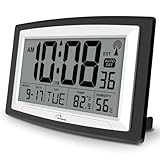
- Atomic Digital Clock Auto Set (No back light) - Using radio frequencies broadcast from NIST’s Colorado , the clock will automatically set to the correct time. Automatically adjusts to Daylight Savings Time while set the DST on.
- Atomic Wall Clocks Battery Operated with Alarm - This digital calendar alarm day clock required 3 “AA” long life batteries (Not included) for operation, no redundant wires, easy to use. Turn on the alarm clock before going to bed, it will wake you up in the morning.
- Clock with Temperature and Humidity - Excellent wall clocks for living room, office, bathroom decor,etc. Help you monitor indoor temperature and humidity to avoid cold. 12/24 hours formats with clear Hours, Minutes and Seconds display; 4 Time Zone to choose.
- Atomic Clock Large Display for seniors - WallarGe atomic clock has been designed with absolute simplicity in mind, you can also set it manually without any more ado. Wall clock or desk clock, large and clear digital display, easy to read.
- Digital Wall Clock with Accurate Date and Time - This digital calendar alarm day clock can help you keep track of dates, days of the week and times to avoid missing any important meetings, appointments or anniversaries, work well for work, study or travel schedule.
Infrastructure has no single implementation method
The 2022 resolution says operators have adopted different methods for handling leap seconds and have not always coordinated them. A network that inserts the extra second exactly at the announced instant can temporarily disagree with one that gradually smears the adjustment. Those differences can trigger false timeouts, ordering errors or loss of synchronization. The resolution specifically names Global Navigation Satellite Systems, telecommunications and energy transmission as areas where such failures could be serious.
A negative leap second would be especially unfamiliar
Positive leap seconds have been used, but a negative leap second has never been inserted. BIPM has reported that specialists have considered the possibility and that either sign creates synchronization risks. A negative leap second is not scheduled or inevitable; it is one reason authorities prefer a continuous reference scale over waiting for an unprecedented deletion to be required.
When could the change take effect?
The 2022 CGPM resolution set the direction: develop a higher permitted UT1−UTC difference and an implementation plan by or before 2035, with the goal of keeping UTC continuous for at least a century. In 2026, BIPM presented Draft Resolution C with the one-hour maximum and 20 May 2027 as the proposed effective date. The International Committee for Weights and Measures (CIPM) endorsed the update for presentation to the CGPM, but that endorsement is not the same as adoption.
The 28th CGPM is scheduled for 13–15 October 2026. On 13 October, the meeting had opened, so the proposal must be described as conditional. Until delegates agree to the resolution and any associated implementation decisions, leap-second practice remains the operative arrangement.
Rank #4

- Atomic Clock with Backlight: Never Need Setting, a built-in receiver that automatically synchronizes itself with the WWVB radio broadcast, it will always be accurate to within one second as it receives daily WWVB updates. Three levels (OFF-LOW-HIGH) backlight helps you to know what time it is without turning the light on late at night
- Large Digital Wall Clock: 14 inches large display with 4.3 inches numbers make this digital wall clock easy to read and it's visible around the entire room, friendly to the elderly and the visually impaired
- Digital Wall Clock Battery Operated: The clock is supported by four AA battery (not included). No wires make it can be placed anywhere; and the low battery symbol reminds you to replace the battery in time to avoid getting the wrong time due to low power
- Digital Clock with Date and Day of the Week: This digital wall clock with backlight not only does it give you the time, you can also get the day, date and current indoor temp at just a glance. And the day and temp display could be chosen to display alone or in turns every 10s
- Multiple Display Formats: Large digital wall clock with backlight makes it easy to know the time, two different time and temperature formats (12/24H; /) are available for your convenience and preference
What would change for ordinary clock users?
Daily civil time would look the same
Phones, computers and public clocks would still display UTC-derived civil time and local time-zone offsets. There would be no visible one-hour jump when the policy begins. The proposal concerns the long-term relationship between UTC and Earth rotation, not the length of an hour or the way time zones are legislated.
UTC timestamps would become easier to process
Systems that store, compare and transmit UTC would no longer need a special leap-second branch. A continuously increasing timeline avoids duplicated or exceptional seconds at the insertion point. This is particularly useful for distributed services whose logs, authentication windows and ordering rules depend on monotonic time.
The Sun would slowly move away from clock noon
Because Earth’s rotation is not uniform, allowing UT1−UTC to grow means UTC would gradually become less closely aligned with the position of the Sun. The proposed limit is one hour, not an immediate one-hour shift. The offset would accumulate over a long period and would be monitored through the published UT1−UTC value. Civil time would remain stable while the Earth-rotation relationship changed gradually.
Recommended Free Tools
What would not change?
- Earth-rotation measurements: UT1 would continue to be determined and distributed.
- Atomic time: TAI would remain the continuous atomic scale, and UTC would continue at its rate.
- Time-zone law: Countries would still decide their civil time and daylight-saving rules.
- Satellite and astronomical calculations: Specialists would still use Earth-orientation parameters, including UT1−UTC, when their applications require them.
- Existing historical timestamps: Past leap seconds would remain part of the historical relationship between UTC and TAI.
Who needs to pay attention?
Telecommunications and network operators
Operators would gain a reference scale without a sudden second being inserted into network clocks. They would still need to obtain authoritative UTC and, where required, Earth-orientation data. Systems that currently test leap-second handling should be updated to reflect the eventual international specification rather than simply deleting those tests.
Best Value

- [Automatic Time Updates] – The Atomic Time Feature conveniently allows the clock to sync with the WWVB radio transmission from Fort Collins, CO, for accurate time updates.
- [Classic design] – With unmatched attention to detail, the WT-3129B is highlighted by a distinctive matted 12-inch black frame with a silver bezel – a statement piece for any home setting.
- [5-Year Battery Life] – A quality set of 3 “AA” batteries will keep the clock running for up to 5 years – an impressive feat offering unparalleled convenience and peace of mind.
- [SIMPLE-SET] Simple adjustable switch to your Time Zone (4 different selections: PT-Pacific, MT-Mountain, CT-Central, ET-Eastern)
- [A Brand You Can Trust] – Family-owned and operated since 1983, La Crosse Technology is the world leader in Atomic Time and Weather Instruments. Designed in La Crosse, WI, our products have unmatched support resources, including printed setup guides, helpful video tutorials, and lifetime access to our USA-based tech support team.
Global Navigation Satellite Systems
GNSS services use carefully defined time scales and Earth-orientation information. A continuous UTC policy could simplify interfaces that exchange UTC timestamps, but each constellation and receiver specification would determine how the change is exposed. Users should follow the notices and interface documentation issued by the relevant service, not assume that every GNSS signal will change on the same date.
Energy transmission and industrial control
Power-grid and industrial systems depend on precise ordering and synchronized measurements. Removing a one-second discontinuity addresses one class of failure, but it does not remove the need for redundant timing sources, holdover clocks, monitoring and a documented response to loss of synchronization.
Software and database developers
Developers should distinguish UTC from monotonic elapsed-time clocks. A policy change does not make a wall clock suitable for measuring durations, and it does not eliminate historical data containing leap-second conventions. Libraries, protocol specifications and database engines will need to document how they represent UT1−UTC and any transition date adopted by the CGPM.
Outdated Drivers Are Slowing You Down
One free scan finds every outdated or missing driver and matches the right update for your exact hardware.Free scan · exact hardware matchPC Slower Than It Used to Be?
A free scan shows the junk files, broken settings and background clutter dragging Windows down - then fixes them in one click.Free scan · Windows 10 & 11How Earth-rotation information would still be used
The proposal separates two jobs that are often conflated. UTC would provide a stable, continuous label for events. UT1−UTC would provide the correction needed when an application cares about Earth’s orientation. An observatory, satellite operator or geodesist could apply the published offset to relate a UTC timestamp to the rotating Earth, just as users already obtain Earth-orientation parameters today.
This is not the same as ignoring rotation. It is closer to keeping a reliable reference clock and publishing a continuously changing conversion to an irregular physical process. The conversion would become larger over time, but it would remain measurable and available.
Questions the proposal does not answer by itself
- The exact distribution format: Draft Resolution C establishes the policy direction and proposed limit; technical services must specify how offset data are disseminated and consumed.
- Every system’s migration plan: Individual GNSS providers, laboratories, telecom operators and software vendors must publish their own compatibility guidance.
- The final date: 20 May 2027 applies only if the CGPM agrees to the draft and associated implementation arrangements.
- The future size of the offset on a particular day: Earth’s rotation varies, so the UT1−UTC value cannot be inferred from the one-hour limit alone.
How to prepare if you operate time-dependent systems
- Inventory your clock assumptions. Find code and hardware that assumes every minute has 60 seconds, compares wall-clock values for elapsed time, or treats UTC as identical to UT1.
- Separate clock labels from durations. Use a monotonic clock for timeouts and elapsed intervals; reserve UTC for timestamps that must be mapped to civil or international reference time.
- Document leap-second behavior. Record whether each component inserts, repeats, smears or ignores a leap second so historical data can be interpreted correctly.
- Track authoritative notices. Follow BIPM, national metrology institutes and the relevant GNSS or protocol authority for the final resolution, effective date and data formats.
- Test both eras. Preserve tests for historical leap-second records while adding tests for continuous UTC and for consuming UT1−UTC values that may be much larger than one second.
- Plan for outages. Keep holdover and cross-check procedures: abolishing leap seconds removes a discontinuity but does not eliminate clock drift, network failures or bad timing data.
Bottom line
If the CGPM approves Draft Resolution C, leap seconds will be replaced by allowing UTC to remain continuous while the permitted UT1−UTC difference expands to as much as 3,600 seconds. Earth’s rotation will still be measured, and its relationship to UTC will still be published. The proposed 20 May 2027 start date and one-hour limit are decisions awaiting agreement, not settled facts as of 13 October 2026.
Quick Recap
Product prices and availability are accurate as of the date/time indicated and are subject to change. Any price and availability information displayed on Amazon at the time of purchase will apply.

