
iTechGuides is reader-supported. When you buy through links on our site, we may earn an affiliate commission. As an Amazon Associate I earn from qualifying purchases. Learn more
Neanderthal-associated spears were sophisticated wooden weapons, not crude sharpened sticks. The best-preserved Schöningen examples were made mostly from slow-growing spruce and shaped with a double taper: their greatest diameter lies in the front half, giving them a forward-heavy balance suitable for flight. A separate, roughly 400,000-year-old spear from Clacton was made of yew.
Experiments with full-size replicas show that trained throwers could hit targets at distances up to about 20 metres, with enough impact energy to be capable of killing prey. Other evidence, including perforated fallow-deer bones from Neumark-Nord, demonstrates close-range thrusting. The safest conclusion is that these weapons supported both throwing and stabbing. The Schöningen makers were Middle Pleistocene hominins; whether they were specifically Neanderthals remains debated.
What the spears were made of
Schöningen: mostly spruce
The Schöningen weapons are the clearest body of evidence for early wooden spear technology. Most of the preserved spears were carved from slow-growing spruce (Picea). At least 10 complete or nearly complete wooden spears are reported from the site in a 2019 Scientific Reports review. Their survival is exceptional because wood normally decays, so the assemblage gives an unusually direct view of how Middle Pleistocene hunting weapons were made.
Spruce was not the only wood present at Schöningen. The wider wooden assemblage includes pine, willow, birch, poplar, larch and other species. That variety shows that hominins used available timber rather than following a single universal recipe. The best-preserved hunting spears, however, are predominantly spruce, making it the material most securely associated with the classic Schöningen form.
#1 Best Overall

- SET OF 6 PREHISTORIC SKULLS || Set of six prehistoric skulls. Consists of Afarenis cranium, Africanus cranium, Habilis cranium, Erectus cranium, Neanderthalensis cranial and Steinheim skull
- LIFE SIZED || Each prehistoric skull is approx. 10" in size
- INCREDIBLE REALISM || Models are hand painted. Realistic details, textures and bony landmarks provide an incredible amount of realism for examining Neanderthal skulls
- DURABLE POLYMER CONSTRUCTION || Made of durable and sturdy plastisol polymer. This washable model is easy to clean and will hold up to years of handling
Clacton: an older yew spear
The approximately 400,000-year-old Clacton spear fragment was made from yew (Taxus). It is an important comparison because it proves that early spear makers selected more than one kind of wood and that the technological tradition predates the Schöningen examples. The Clacton fragment is not a complete weapon, so its exact balance and throwing performance cannot be reconstructed with the same confidence as the Schöningen replicas.
Shape and balance
Schöningen spears taper toward both ends rather than ending in a simple, uniform point. Published specimens have their maximum diameter in the front half. This shifts mass forward, creating a balance that is consistent with a projectile designed to fly point-first. The double taper also distinguishes the weapons from an ordinary branch used only as a thrusting staff.
That geometry does not prove that every spear was thrown on every occasion. A forward-heavy wooden spear can still be used in the hand at close quarters. It does show that throwing was built into the design rather than being an accidental use discovered later.
Crashes, No Sound, or Screen Glitches?
Random freezes, missing sound and display glitches usually trace back to one bad driver. Find and replace yours safely.Free scan · under a minuteWindows Errors? Fix Them Before They Spread
Repair common Windows errors and clear accumulated junk for a smoother, more stable PC - no reinstall needed.Free scan · no reinstall| Example | Approximate age or context | Wood | What the evidence establishes |
|---|---|---|---|
| Schöningen spears | About 300,000 years old in the cited literature | Mostly slow-growing spruce; other woods occur in the wider assemblage | At least 10 complete or nearly complete weapons; double-tapered, forward-heavy form |
| Clacton spear fragment | Approximately 400,000 years old | Yew | Confirms early selection and shaping of a durable hardwood; fragmentary, so performance is less certain |
Were they designed for stabbing, throwing, or both?
Three lines of evidence answer this question together: the physical form of the artifacts, injuries on hunted animals, and controlled tests with replicas. Each addresses a different part of the problem, so it is useful not to treat one type of evidence as a substitute for the others.
| Evidence | Delivery mode indicated | Strength and limitation |
|---|---|---|
| Double-tapered Schöningen shafts with a forward maximum diameter | Compatible with hand throwing as well as thrusting | Direct artifact evidence for design; it cannot reveal how often each mode was used |
| Fallow-deer perforations at Neumark-Nord | Close-range thrusting | Direct injury evidence linked to Neanderthal activity; it represents particular hunting events, not every hunt |
| Replica trials with trained javelin athletes | Hand throwing to about 20 m | Controlled performance evidence; modern athletes demonstrate capability, not prehistoric success rates |
How effective was throwing?
What the replica experiment tested
A 2019 study associated with University College London tested replicas made from Norwegian spruce. Six trained javelin athletes threw two spear weights, 760 grams and 800 grams. The experiment measured whether the replicas could be aimed and delivered with useful speed and impact, rather than merely observing an untrained person toss a light stick.
The athletes struck targets at distances up to 20 metres. The result is best described as an experimentally demonstrated effective range for skilled hand throwers under test conditions. It is not a statement that every Neanderthal could consistently hit a target at 20 metres, nor that 20 metres was a fixed maximum.
Accuracy and distance
The successful hits matter because a spear has to do more than travel through the air: it must arrive point-first and in a position that can penetrate. The Schöningen form’s forward-heavy balance is consistent with that requirement. The study also found overlap between the performance parameters of hand-thrown spears and spears launched with a spearthrower. That overlap indicates that a hand-thrown weapon could reach useful projectile performance without requiring a separate throwing device.
Quick wins for a faster PC:
Repair Windows errors before they cause bigger problemsFix Now →Fix the driver behind crashes, sound loss and screen glitchesFind Drivers →Skill was a major variable. The participants were trained javelin athletes, and the authors concluded that skill materially affects successful use. A distance of roughly 20 metres should therefore be read as a demonstrated capability for practiced throwers using replicas of the archaeological weapons, not as an average hunting distance or a guaranteed hit probability.
Could the impact kill an animal?
University College London’s summary of the experiment states that the replicas delivered significant impact. Their combination of mass, balance and throwing speed produced enough kinetic energy to hit and kill a target. This is an inference about physical capability: the impact was in a lethal range for an appropriately struck animal.
It does not provide a prehistoric kill rate. The experiment did not recreate the full uncertainty of a hunt, including concealment, animal movement, shot placement, repeated throws, weather, terrain and the behavior of a wounded animal. “Effective” therefore means capable of delivering a potentially lethal blow, not proven to have killed a particular percentage of horses or deer.
Rank #2
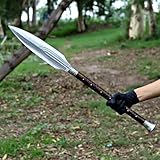
- Authentic Viking Design: Handmade 31" Viking spear inspired by traditional Norse weaponry—perfect for historical collectors, Viking fans, and reenactors. Blade Legnth : 14" Handle : 17"
- PREMIUM CONSTRUCTION: Wooden recurve bow built with high-quality materials and expert craftsmanship for reliable performance
- COMFORTABLE GRIP: Leather-wrapped handle provides superior control and reduces hand fatigue during extended use
- Leather Sheath Included: Comes with a custom-fit leather sheath for safe storage and an authentic warrior look
- Versatile Use: Ideal for medieval decor, Viking-themed gifts, cosplay, LARP, SCA events, or wall displays.
Direct evidence for close-range thrusting
The Neumark-Nord deer
A Nature Ecology & Evolution study examined two fallow-deer skeletons from Neumark-Nord in Germany. The animals date to about 120,000 years ago, and the deposits contain abundant traces of Neanderthal activity. Micro-computed tomography of the bone perforations, combined with ballistic experiments, showed that the wounds were caused by spears used in close-range thrusts.
What’s actually slowing this PC down?
Pick the symptom - the matching free tool is one click away.
This is stronger evidence for stabbing than a spear’s shape alone. The deformation and penetration pattern recorded in the bones is consistent with a weapon driven into an animal from nearby, rather than a projectile arriving after a long flight. It also implies a dangerous encounter in which hunters had to approach close enough to deliver force by body movement.
What close-range use required
A thrusting hunt demanded control, timing and cooperation. Several hunters could pressure or surround an animal, hold it in place, or exploit terrain before one or more spears were driven into the body. The evidence does not identify a single standardized tactic, but it does rule out the idea that Neanderthal spears were exclusively ranged weapons.
Independent reader supportYour contribution helps us test, update, and keep practical guides available for everyone.Could a wooden spear kill a deer or horse?
For deer, the answer is supported by two complementary findings. The Neumark-Nord skeletons preserve actual lethal-looking perforations produced by close-range thrusting, while the throwing experiment shows that a wooden replica could deliver a high-energy impact at distance. Together they establish both a documented stabbing mode and a physically credible throwing mode.
Large prey is also part of the Schöningen context. Excavations produced approximately 16,000 animal bones, including abundant large-herbivore remains. That association shows that the weapons were found in a landscape where big-game hunting was important, but the bones alone do not assign a particular kill to a particular spear or prove that every species was hunted in the same way.
Free tools Windows power users keep installed
One-click scans. No signup required.
For a horse-sized animal, a wooden spear could be lethal if it penetrated a vital area, but the available evidence does not supply a species-specific success rate. The responsible claim is capability, not certainty: the replicas had enough measured performance to support a lethal-impact interpretation, and the archaeological injuries demonstrate that thrusting could cause serious or fatal damage.
Did Neanderthals hunt from a distance?
Distance hunting was likely within the Neanderthal repertoire. Annemieke Milks of the UCL Institute of Archaeology described the findings as evidence that Neanderthals could hunt big game through “a variety of hunting strategies, not just risky close encounters.” She also stated that “distance hunting was likely within the repertoire of hunting strategies of Neanderthals,” while emphasizing behavioral flexibility comparable to that of our own species.
The wording “likely” is important because the oldest Schöningen weapons are not labeled with a species name. They were made by Middle Pleistocene hominins, and the precise attribution of the assemblage is debated. It is accurate to call them Neanderthal-associated or available to Neanderthals. It is not accurate to present the identity of every Schöningen maker as settled fact.
How strong is each conclusion?
- High confidence: Early hominins shaped wooden spears from selected timbers, including spruce at Schöningen and yew at Clacton.
- High confidence: The Schöningen examples have a double-tapered, forward-heavy geometry compatible with projectile use.
- Strong experimental support: Skilled throwers using 760 g and 800 g spruce replicas hit targets at up to 20 m and generated impacts interpreted as potentially lethal.
- Direct archaeological support: Neumark-Nord deer bones preserve close-range spear-thrust injuries associated with Neanderthal activity.
- Qualified attribution: The Schöningen weapons are Middle Pleistocene hominin tools; assigning them exclusively to Neanderthals remains unresolved.
- Unknown: Prehistoric accuracy averages, hunting distances for ordinary users, the number of animals killed per hunt, and the proportion of throws versus thrusts.
The practical answer
Neanderthal-associated spears were carefully shaped wooden weapons, mostly spruce at Schöningen, with yew represented by the older Clacton fragment. Their double-tapered, forward-heavy design made throwing plausible, and controlled trials show that trained users could hit targets to about 20 metres with potentially lethal impact. At the same time, deer-bone injuries prove that comparable spears were thrust at close range. The most defensible picture is a flexible hunting technology: one weapon type that could be thrown when distance offered safety and driven by hand when hunters had to confront prey nearby.
Recommended Free Tools
Quick Recap
Product prices and availability are accurate as of the date/time indicated and are subject to change. Any price and availability information displayed on Amazon at the time of purchase will apply.

