
Recommended Free Tools
iTechGuides is reader-supported. When you buy through links on our site, we may earn an affiliate commission. As an Amazon Associate I earn from qualifying purchases. Learn more
A useful power-bank display answers practical questions: how much charge remains, whether a device is drawing power, how quickly the bank is recharging, and whether a protection mode has activated. Treat the screen as a status tool—not evidence of higher capacity, faster charging, safer cells, or better portability. Choose the bank by capacity, wattage, port-sharing behavior, compatibility, recharge speed, safety features, size, weight, and travel rules, then use the display to monitor those functions.
What a built-in display should tell you
Basic four-light indicators only estimate charge in broad steps. A digital screen can be more useful when it reports a precise or near-precise remaining percentage and shows what is happening at the ports. Before paying extra for a display, identify the status question you regularly need answered.
Remaining battery
A percentage or watt-hour-style estimate is more actionable than a row of LEDs. It helps you decide whether the bank can finish charging a phone, support a work session, or needs to be refilled before leaving. Remember that the number is an estimate: the energy available to your device is lower than the energy stored in the cells because voltage conversion and charging electronics consume some power.
Quick wins for a faster PC:
Clear out junk files and repair common Windows errorsFree Scan →Scan for outdated or missing drivers - takes under a minuteDriver Scan →Repair Windows errors before they cause bigger problemsFix Now →Input and output readings
The most useful advanced screens show whether the bank is accepting input while it recharges and how much power a connected device is drawing. Per-port information is valuable when several cables are attached, because it can reveal that one device is receiving less power than expected or that the bank has switched to a lower shared-output mode.
#1 Best Overall

- 56,800mAh Portable Charger – Multi-Day Power: Built for extended use, this high-capacity power bank keeps your devices charged for days. Compatible with iPhone 18/17/16/15/14/13 series, Samsung Galaxy S25/S24/S23, Google Pixel 9/8/7, Android phones, iPad, tablets, earbuds, and other USB devices. A practical Travel Essential for camping, road trips, outdoor work, power outages, and emergency backup. Not allowed on airplanes due to battery capacity.
- Triple Device Charging with USB-A & USB-C: This portable charger battery pack features 2 USB-A outputs and one two-way USB-C port, so you can charge up to 3 devices at once without waiting. The smart power bank automatically adjusts current output for stable, efficient charging and helps protect connected devices. Ideal for iPhone, Samsung, Android phones, iPad, tablets, and other USB-powered electronics during road trips, long commutes, business meetings, family outings, or power outages.
- 22.5W PD Fast Charging & 10+ Device Charges: This portable charger delivers fast, stable USB-C charging for iPhone 18/17/16/15, Samsung Galaxy S25/S24, Android phones, tablets, and more. The fast charging power bank charges iPhone 17 to about 60% in around 40 minutes, while the 56,800mAh battery pack powers iPhone 17 or Galaxy S25 10+ times, helping reduce battery anxiety during travel, camping, work, and emergencies.
- LED Display & Multi-Layer Safety Protection: The built-in LED digital display shows the remaining battery percentage clearly, so you can check your portable charger power level at a glance. This high-capacity power bank battery pack is designed with safeguards against overvoltage, overheating, short circuits, and overcurrent, helping deliver safe, stable charging for phones, tablets, earbuds, and other USB-powered devices during daily use, travel, and backup power needs.
- Heavy-Duty Backup Power for Outdoor Use: Built as a reliable external battery, this 56,800mAh portable charger power bank provides long-lasting backup power when outlets are not available. The high-capacity battery pack fits in backpacks, gear bags, or emergency kits, making it useful for road trips, hiking, camping, outdoor work, storms, and power outages. Works with your own USB charging cables for flexible everyday use.
Anker’s A1695 is an example of the kind of information to look for: its manufacturer listing says the display reports remaining battery, output, input, and recharge information. Those fields illustrate useful status reporting; they do not establish that every display-equipped bank offers the same measurements.
Protection and health alerts
A screen can also communicate conditions that would otherwise look like a failed cable or dead bank. The A1695 support guide documents low-battery, short-circuit, temperature-protection, and low-battery-health indications. Such alerts are useful for diagnosis, but they are not a guarantee that a product is risk-free. If temperature protection appears, stop using the bank and allow it to return to a normal temperature before trying again, as the support guidance instructs.
Readability and controls
Check whether the screen wakes when you press the power button, when a cable is connected, or both. A display that is difficult to read outdoors, turns off immediately, or requires an awkward button sequence may provide little practical benefit. Look for legible digits, sensible units, and a way to distinguish input from output. Decorative animations do not substitute for those functions.
Capacity: compare mAh and Wh, not mAh alone
Manufacturers usually advertise milliamp-hours (mAh), while airlines and regulators use watt-hours (Wh). The FAA defines the conversion as:
Wh = volts × amp-hours
Convert mAh to amp-hours by dividing by 1,000. A 25,000mAh rating therefore equals 25Ah before voltage is considered. At a nominal cell voltage around 3.6V, that is approximately 90Wh, which is consistent with the 90Wh figure listed for the Anker A1695. Use the maker’s stated Wh value when one is provided, because nominal voltage conventions and pack configurations affect the calculation.
Rank #2
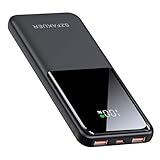
- Ultra-Slim & Light weight Design: At just 0.63 inches thick and 8.11oz, this is the slim and light 10000mAh power bank. Perfect for travel, it easily fits in your pocket or bag without adding bulk.
- 22.5W USB-C Fast Charging: Equipped with USB-C input and output, this power bank supports PD3.0 and QC4+ fast charging, delivering up to 22.5W of power. Charge your iPhone to 65% in just 30 minutes or power up multiple devices quickly.
- 3 Output & Dual Input: Features 3 outputs (2 USB-A + 1 USB-C) and 1 inputs (USB-C ), allowing you to charge up to three devices simultaneously. Ideal for smartphones, tablets, earbuds, and more.
- Wide Compatibility: Works seamlessly with a wide range of devices,Compatible with iPhone 17/16/15/14/13/12, Samsung Galaxy, Google Pixel, iPads, AirPods, Android tablets, and other USB-C devices.
- Advanced Safety & LED Display: Built with an 8-Layer Protection System to prevent overcharging, overheating, and short circuits. The LED digital display shows the remaining battery percentage, so you’re never caught off guard by a low battery.
Why the advertised number is not delivered energy
Capacity describes stored energy under the manufacturer’s rating conditions, not the exact amount that reaches your phone or laptop. The bank must convert its internal cell voltage to the output voltage, and your device converts power again while charging its battery. Cable resistance, temperature, charging behavior, and the bank’s reserve cut-off also affect delivered energy. No independent conversion-loss measurement is established here, so do not promise a specific number of full phone charges from mAh alone.
Match capacity to use
- Day carry: Favor a smaller pack if you mainly need an emergency phone top-up and will carry it daily.
- Long workdays: A larger Wh rating can support several devices, but weight and recharge time usually rise with capacity.
- Camera, handheld-console, or tablet use: Check the device’s required input and estimate energy needs in Wh where possible rather than comparing mAh labels from different voltage systems.
- Laptop use: Confirm both the laptop’s required charging power and whether the bank supports the necessary charging profiles; a large mAh figure alone is not proof of laptop compatibility.
Charging output, port sharing, and real-world speed
Single-port output
Start with the maximum output of the port you will actually use. A laptop that expects 65W may not charge from a port limited to 30W, even if the power bank has a high total-wattage headline. Phones and tablets may accept less than the port’s maximum, so the device and cable determine the final rate.
Multiple-device limits
Peak output often applies only when one port is active. When two or more devices are connected, the bank may divide power or impose a lower aggregate ceiling. A manufacturer listing for the A1695 claims up to 100W per USB-C port and up to 165W total under some multi-device arrangements, with different aggregate limits when three or four devices are connected. Treat those as manufacturer specifications, not independently verified measurements, and read the port-sharing table for the exact combination you intend to use.
For comparisons, record four separate values: maximum output from each relevant port, the total with two devices, the total with three devices, and the total with four devices if stated. A bank that delivers 100W to one laptop may be a poorer travel choice than one that delivers a predictable 65W while also keeping a phone charging.
Power is not the same as charging compatibility
Output wattage is only one part of compatibility. Verify connector type, supported charging protocols, the voltage and current profiles your device accepts, and whether the supplied cable can carry the advertised power. USB-C does not automatically mean laptop charging: some USB-C ports are output-only at lower power, and some laptops require a particular power-delivery profile or proprietary adapter.
Rank #3

- 45W Fast Charge, More Than Phones Why settle for phone-only charging? 45W gives quick power to phones, tablets, handheld consoles, and compatible USB-C cameras—iPhone 17 Pro to 65% and Galaxy S26 Ultra to 75% in 30 min.
- Carry It Daily, Really A power bank only helps if you actually bring it. 27% smaller at 4.4 × 2.7 × 0.7 in and 6.5 oz, P55 slips into pockets, purses, and full bags without the brick-like bulge.
- Your Lanyard Is Your Cable No more digging for a cable before heading out. The detachable nylon-braided USB-C lanyard is 3X tougher than rubber, letting you charge, recharge, and carry with one cord.
- Stand, Light, Power The built-in phone stand keeps your screen propped up for calls, maps, and videos, while the flashlight helps in dark bags, night walks, outages, and travel.
- Power That Lasts Safely 10,000mAh covers real daily backup: up to 2.0 iPhone, 1.2 iPad Air, 20 Apple Watch, or 12 AirPods Pro charges. 18-Layer SmartProtect helps manage heat, current, and voltage.
How to tell whether a power bank can charge your laptop
- Read the laptop’s charger label or manual. Note the required wattage and the connector. If the charger specifies a USB-C power profile, record that profile rather than only the headline wattage.
- Check the bank’s per-port specification. Use the output for the exact USB-C port, not the bank’s maximum total. A 100W total rating is irrelevant if the port connected to the laptop is limited to 30W.
- Confirm the cable rating and connector. A cable included with the bank may support the advertised output, but a cable you already own may not. Replace damaged or visibly underspecified cables.
- Check behavior while the laptop is in use. Some notebooks will charge only while asleep or powered off when the source is below their normal requirement. A bank may show output even while the laptop battery continues to fall slowly.
- Account for other connected devices. Plugging in a phone can reduce the laptop port’s available power under the bank’s sharing rules.
- Verify recharge input separately. A bank that can output 100W may accept substantially less when it is being refilled, so it may take longer than expected to recharge after a laptop session.
If any required profile, port limit, or cable rating is not stated, treat laptop support as unconfirmed rather than assuming that a high wattage number guarantees it.
Do these 3 things before closing this tab:
1Repair Windows errors before they cause bigger problems2Fix the driver behind crashes, sound loss and screen glitches3Clear out junk files and repair common Windows errorsRecharge input and everyday convenience
Look for the bank’s maximum input rating and the connector used to recharge it. A high-capacity pack can be inconvenient if it accepts only low input power and takes most of a day to refill. Check whether the input port is separate from the output ports, whether a charger is included, and whether the display distinguishes incoming power from outgoing power.
The A1695 listing documents USB-C ports and built-in USB-C cables, USB-A, and maximum input ratings. Because connector layouts and ratings can vary by regional listing, verify the exact version sold where you live. Built-in cables reduce what you need to pack, but they also cannot be swapped if they become damaged; check their length, hinge design, and replacement policy.
Portability: capacity must earn its weight
Compare dimensions and weight alongside Wh. The A1695 is listed at 595g and 90Wh. That may be reasonable for a laptop-capable travel pack but excessive for someone who wants an emergency phone charger in a pocket. A screen, extra circuitry, built-in cables, and higher-power components can all add bulk.
Assess the complete carry setup: the bank, its attached cables, your wall charger, and any adapters. A lighter bank with a separate cable may be more practical than a heavier model whose built-in cable does not fit every device. If you carry it daily, test whether it fits the bag pocket you actually use and whether the screen can be read without removing the bank.
The Tool Desk
Outbyte Driver Updater FREEFix the driver behind crashes, sound loss and screen glitchesFind Drivers →Outbyte PC Repair FREEClear out junk files and repair common Windows errorsFree Scan →Rank #4

- 200W Total Output for Professionals:This power bank delivers up to 200W total output. Each USB-C port has its own maximum output: USB-C1 up to 140W, USB-C2 up to 100W. When both ports are used simultaneously, the combined output can reach 200W, making it ideal for photographers, videographers, designers, and gamers, ensuring uninterrupted workflow and entertainment.
- 25000 mAh Capacity: During long-distance travel or camping, this ugreen battery pack can be used as an emergency power supply to provide sufficient power for multiple devices, it is enough to charge an iPhone 17 pro 4.3 times
- Charging 3 Devices at Once: Improving the flexibility of use, when you are at a party, usb c power bank can become a shared resource, everyone can charge their own devices simultaneously, avoiding the inconvenience caused by waiting for charging
- TFT Display:Real-time display of battery level, remaining time, output/input power, voltage, current, and other information, showcasing the charm of technology. Compared to an LCD screen, the display content is more delicate and the colors are richer
- Durable & Safe:After 1000 charge-discharge cycles, the capacity still remains above 80%, multiple protections and professional safety certifications, real-time temperature detection and high-speed heat dissipation ensure worry-free use
Air-travel rules and Wh limits
For U.S. travel, the FAA says lithium-ion spare batteries and power banks up to 100Wh are generally permitted in carry-on baggage. Power banks cannot be placed in checked baggage. The FAA says 101–160Wh units require airline approval and are limited to two spare batteries per person; airlines may impose stricter quantity or Wh limits.
| Rated energy | FAA general guidance | What to do |
|---|---|---|
| Up to 100Wh | Generally allowed in carry-on baggage | Keep it in your hand baggage and check the carrier’s current policy. |
| 101–160Wh | Airline approval required; two-spare-battery limit per person | Obtain approval before departure and confirm the airline’s handling rules. |
| Above 160Wh or unclear rating | Not covered by the ordinary allowance | Ask the airline and relevant aviation authority before traveling; do not place it in checked baggage. |
ICAO announced on 27 March 2026 that new specifications limit power banks to two per passenger and prohibit passengers from recharging them during flights, effective that day. Its announcement states: “Following the improvements agreed today, these devices will now be limited to two per passenger, and passengers will be prohibited from recharging them during flights.” Rules can differ by route, country, or carrier, so verify directly before departure even when the label is below 100Wh.
Safety features and warning signs
Look for documented over-temperature, short-circuit, over-current, and low-battery protections, plus clear instructions for responding to an alert. A display that names the condition is more useful than an unexplained shutdown. Protection circuitry reduces risk during abnormal conditions, but it cannot compensate for crushed cells, water damage, counterfeit chargers, or use outside the maker’s temperature limits.
- Stop charging if the case becomes unusually hot, swells, leaks, or smells abnormal.
- Do not continue using a bank that repeatedly enters temperature-protection mode.
- Keep ports and built-in cables free of metal objects and debris.
- Use a charger and cable that meet the bank’s input requirements.
- Retire a physically damaged pack instead of trying to open or repair it.
A specification example: Anker Power Bank A1695
The A1695 demonstrates how to read a display-equipped product listing without treating it as a universal recommendation. The manufacturer lists the following details:
Free tools Windows power users keep installed
One-click scans. No signup required.
| Specification | Manufacturer-listed detail | How to interpret it |
|---|---|---|
| Capacity | 25,000mAh / 90Wh | Compare the 90Wh figure with travel limits and your device needs. |
| Maximum total output | Up to 165W under specified arrangements | Read the multi-device rules; the headline is not available in every configuration. |
| Single-port output | Up to 100W per USB-C port | Confirm the laptop is connected to a port and profile that support its requirement. |
| Ports and cables | USB-C ports with built-in USB-C cables and USB-A | Check the regional listing for the exact connector layout and cable behavior. |
| Display | Remaining battery, output, input, and recharge information | These fields answer status questions while charging or recharging. |
| Alerts | Low-battery, short-circuit, temperature-protection, and low-battery-health indications | Use alerts to stop or troubleshoot; they are not a risk-free guarantee. |
| Weight | 595g | Include the mass in your daily-carry and travel decision. |
| Input rating | Maximum input ratings are listed by the manufacturer | Verify the exact regional value to estimate recharge time. |
Availability, regional specifications, and suitability vary. The figures above are manufacturer claims, not independent test results.
Best Value
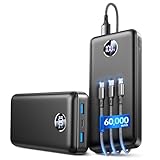
- Large Power Bank Capacity: Engineered with a premium 60,000mAh battery pack, the portable charger delivers multiple full charging cycles to keep your essential devices powered for days. It provides up to 10 full charges for an iPhone, making it a reliable power solution for travel, camping, school, hiking, and emergency use. Stay connected during blizzard power outages, extended beach vacations, and other outdoor adventures.
- Simultaneous 5-Device Charging & Universal Compatibility: Featuring 2 USB-A ports, 1 USB-C port, and an integrated 3-in-1 cable with USB-C, IOS, and Micro-USB connectors, the versatile charger bank can power up to 5 devices at the same time. It is widely compatible with iPhone, Samsung, LG, HTC, Google, Motorola, Xiaomi, Android phones, tablets, cameras, camera flashes, drones, gaming controllers, hearing aids, MP3 players, and most other electronic devices.
- 22.5W Max Speed & Intelligent Digital Display: Maximize charging efficiency with 22.5W fast charging. Supporting PD, QC, SCP, FCP, and AFC protocols, the battery bank can charge your device up to 60% in just 30 minutes, up to 4 times faster than conventional 5W portable phone chargers. The integrated digital display provides precise battery percentage tracking, so your powerbank is always ready when you need it.
- Compact & Durable On-the-Go Design: Measuring just 15 × 7.5 × 2.8 cm and weighing 15.5 oz, the high-capacity portable charger power bank fits easily into a backpack, handbag, or crossbody bag. Built with a premium scratch-resistant outer shell, the durable battery bank withstands daily travel, commuting, and demanding outdoor environments better than fragile glossy battery chargers.
- Multi-Safety Architecture: Protect your valuable electronics from electrical risks. Equipped with an advanced AI intelligent chipset, the portable charging bank provides comprehensive overcharge protection, short-circuit protection, and temperature regulation for safer, more reliable charging.What You Get: 1* power bank, 1* 3-in-1 USB cable, and 1* user manual
A practical buying checklist
- Write down every device you expect to charge and its connector and required input power.
- Choose a target Wh capacity, then check the corresponding mAh rating at the stated voltage.
- Confirm the per-port output and the aggregate output for your likely number of connected devices.
- Check charging protocols, cable ratings, included cables, and the bank’s own recharge input.
- Decide whether the display provides remaining charge, input/output data, and useful protection alerts rather than decoration.
- Compare weight and dimensions with the complete cable-and-charger kit you will carry.
- For travel, verify the printed Wh rating, carry-on requirement, airline approval threshold, and current carrier rules.
- Read the safety instructions and make sure you know what each warning means before relying on the bank.
Common buying mistakes
Choosing the biggest mAh number
Different internal voltages make mAh comparisons misleading. Use Wh and account for conversion losses and the output your devices can accept.
Assuming peak wattage is always available
Manufacturers may quote a single-port maximum or a best-case total. Port sharing can reduce every connected device’s power, so inspect the combination table.
Equating USB-C with laptop support
Connector shape does not confirm the required charging profile, cable capability, or per-port wattage. Verify all three.
Ignoring recharge time
A large bank with a low input limit can be unavailable when you need it. Compare input power as carefully as output power.
Treating a warning screen as a repair diagnosis
Protection alerts tell you to stop or change conditions; they do not make continued use safe. Follow the manufacturer’s instructions and replace damaged hardware.
Checking travel rules only once
Airlines and aviation authorities can add conditions. Recheck the policy for your carrier and route shortly before departure, even if the bank is rated at 100Wh or less.
The decision rule
Buy the display only when its information will change what you do. Then select capacity in Wh, verified per-port and shared output, device-compatible protocols and cables, a practical recharge input, manageable weight, documented protections, and a travel-eligible rating. The screen should confirm those choices in use—not distract from them.
Quick Recap
Product prices and availability are accurate as of the date/time indicated and are subject to change. Any price and availability information displayed on Amazon at the time of purchase will apply.

