
Free tools Windows power users keep installed
One-click scans. No signup required.
iTechGuides is reader-supported. When you buy through links on our site, we may earn an affiliate commission. As an Amazon Associate I earn from qualifying purchases. Learn more
Verify the engine’s identity and build records before judging its price or condition. Chevrolet identifies its 427 crate engine as a big-block V8, so treat a seller’s “427 small-block” as a custom stroker or aftermarket combination unless the seller can document the exact parts and measurements. There is no single factory identification or universal tolerance set established for every custom 427 small-block build.
First, establish what the seller means by “427 small-block”
Displacement alone does not identify an engine’s architecture or prove how it was built. Chevrolet’s current product page describes its 427 cubic-inch (7.0 L) crate engine as a Chevy Big-Block V8, with a 4.250-inch bore and 3.750-inch stroke. Those figures describe that specific big-block crate engine—not a small-block stroker advertised as a 427.
That distinction is the first issue to resolve, not a technicality to leave until after you negotiate. The listing phrase may be shorthand for a custom or aftermarket combination, but it does not, by itself, tell you which block was used, what rotating assembly is inside, or whether the finished displacement was measured and documented. No universal factory 427 small-block identification or standard parts recipe for all such builds is established. Ask the seller to explain exactly what they mean by “small-block” and “427,” then verify the answer against records and physical evidence.
The Tool Desk
Outbyte PC Repair FREERepair Windows errors before they cause bigger problemsFix Now →Outbyte Driver Updater FREEFix the driver behind crashes, sound loss and screen glitchesFind Drivers →Ask the seller to identify the block manufacturer and casting, and to provide the actual bore and stroke plus the crankshaft and piston specifications. Request the build sheet and machine-shop invoices, including the displacement calculation and the identity of the builder. If records are incomplete, make the sale conditional on verification by an independent engine machine shop. Do not assume that a “427” badge, listing description, or one casting mark proves the displacement or combination.
#1 Best Overall

- Accurate Digital Indicator:Neoteck bore gauge set comes with a digital indicator with diameter range: 0 - 0.5 inch (0 - 12.7 mm); Resolution: 0.0005 inch (0.01 mm). Use After Zero Setting - Before measuring, be sure to adjust the pointer of the dial indicator to the ‘’0’’ setting and select the measuring head of the appropriate size for measurement
- Precise Bore Gauge Set:Bore Gauge Measuring diameter range:2-6 inch(50-160mm), Measures deep:5.9 inch (150mm), Accuracy:0.0005 inch(0.01mm). Super Precision Deep Measuring Bore Gauge - Two-point contact is used to detect geometric diameter measurement problems such as ovality and taper
- Self-Centering and User-Friendly:The bore gauge is Self-Centering for fast and accurate measurement, also, the insulated grip allows for easier measuring and is easily adjustable. It is widely used for measuring the inner hole size of various processing techniques
- Sturdy and Professional:All-metal clamping device, fastening the meter head, stable and accurate, sturdy. Insulated grip, comfortable to hold, effective heat insulation, safe and reliable. Sealed gauge head, aluminum housing, glass mirror cover, dustproof, clear scale, intuitive data, sturdy and wear-resistant
- Complete Set with Storage Case:Neoteck bore gauge set includes 1*0.5 inch Digital Indicator; 1* A set of measuring accessories; 1*Measuring rod; 12*Different Specifications of Gauge:50 mm(Has Been Installed in Measuring Rod) , 55 mm, 60 mm, 65 mm, 70 mm, 75 mm, 80 mm, 85 mm, 90 mm, 95 mm, 100 mm, 105 mm , 1* Storage Case, which is ideal for deep engine cylinder measurement (NOTE PLEASE: The 50 mm Measuring Probe has been Installed on the Measuring Rod!)
Check the block numbers and provenance
Photograph the block casting number and date, assembly stamp or suffix, and partial VIN if present. Compare all available marks with a reputable Chevrolet V8 identification reference and the seller’s claimed donor vehicle or application. The Chevrolet engine-code identification guide cautions that suffix codes can recur across engine types and years; a suffix by itself is not conclusive identification.
Take clear, legible photographs before the engine changes hands. Include the locations of the marks as well as close-ups, so that the shop or reference you consult can see what was recorded. A photo is evidence to cross-check, not a substitute for reading the marks correctly or establishing what components are currently in the engine. If a number is obscured, damaged, or unavailable, record that fact and ask the seller whether other paperwork identifies the block.
Ask for supporting paperwork that ties the physical engine to its history: the original donor or purchase records where available, build sheet, parts receipts, and machine-shop invoices. Look for agreement between the block identification, claimed application, listed components, and stated displacement. Treat unexplained mismatches as questions to resolve before payment, not as details to fill in after the sale.
Do not let a familiar-looking code end the inquiry. The identification guide specifically warns that suffix codes can recur across different engine types and years. Cross-check the casting and date information, assembly marks, any partial VIN, and the seller’s stated donor or application together. If those clues do not line up, ask what explains the discrepancy and request documentation. A code that supports one part of the story does not automatically prove the rest of it.
Ask for the build specifications in writing
A useful seller packet should identify the parts and machine work that determine what the engine is and what condition it is in. Ask for:
- Block manufacturer, casting number and date, and any known donor application.
- Measured bore and stroke, plus the calculation used to claim 427 cubic inches.
- Crankshaft, connecting-rod, and piston specifications.
- Cylinder heads, camshaft, and valvetrain components.
- Oiling-system details, balancing records, and machine work performed.
- Assembly information, builder identity, prior use, and receipts or warranty paperwork, if applicable.
- A clear list of what is included in the sale, such as accessories or other attached components.
These records help an independent shop determine whether the components and claimed displacement fit together. If the seller cannot document a key specification, ask the shop to verify it rather than relying on an estimate or verbal assurance.
Ask for actual measured bore and stroke rather than a displacement number repeated from an advertisement. Also ask who measured them, when the measurements were taken, and whether they appear in the machine-shop paperwork. No universal formula of parts or factory recipe for every custom small-block 427 is established, so the point is to connect the claimed displacement to the documented block, crankshaft, rods, and pistons. If a seller can only repeat “it’s a 427” without identifying those parts or providing a calculation, the central claim remains unverified.
Do these 3 things before closing this tab:
1Repair Windows errors before they cause bigger problems2Fix the driver behind crashes, sound loss and screen glitches3Clear out junk files and repair common Windows errorsRank #2

- 【Accurate & High Precision Measurements】Achieve precise results with our bore gauge, featuring a measuring range from 50 mm to 160 mm (2-6 inches) in diameter, and an impressive accuracy of 0.01 mm (0.0005 inches). Whether you're working on deep engine cylinders or intricate mechanical projects, our dial bore gauge ensures reliable and consistent readings for every measurement
- 【Superb Performance for Geometric Measurements】Equipped with a two-point contact design, this cylinder bore gauge excels at detecting geometric issues like ovality and taper. No more guessing—get clear, accurate results every time, even when measuring deep and challenging bore depths of up to 150 mm (6 inches). The dial bore gauge set offers professional-level precision in your hands
- 【User-Friendly & Efficient Design】Designed with ease in mind, our dial bore gauge is self-centering for quick, accurate measurements. The insulated handle ensures a comfortable, slip-free grip, while the adjustable heads allow you to fine-tune measurements for different sizes. It’s the perfect tool for fast, professional-grade measurements in any workshop
- 【Durable & Long-Lasting Quality】Crafted from high-quality aluminum alloy, our bore gauge is built to last. The chrome-plated handle and sturdy ABS storage case add durability and convenience, while the sealed gauge head keeps dust and debris out, ensuring that your tool remains in top condition for years to come. This dial bore gauge set is a reliable companion for any serious technician
- 【Complete Kit for Comprehensive Measurement】The bore gauge set comes with 12 different measuring heads, allowing you to easily measure a variety of diameters and depths. From 50 mm to 105 mm, you’ll have everything you need for both small and large scale projects. Whether you’re measuring cylinder bores or other mechanical components, this complete dial bore gauge set ensures that you’re fully equipped for every task
Read the records as a set. A parts receipt may identify a component but not prove it is installed in the engine being sold. A build sheet may describe an intended combination but not, on its own, show the present condition of the block. Machine-shop invoices and written measurements can help bridge those gaps. Ask the seller to explain how each document relates to this particular engine and note any missing links for the independent inspector to resolve.
Inspect the block and cylinder bores
A visual inspection can reveal obvious corrosion, damage, scoring, or gouging, but it cannot establish internal dimensions or rule out hidden cracks. GM service information for 1990–2009 cars describes checking coolant jackets for cracks and cylinder bores for scratches or gouging. Use those as basic inspection points, not as a complete procedure or a specification for every custom stroker.
When looking at an engine in person, ask to see the areas an inspector needs to evaluate and describe any obvious damage or corrosion to the shop. A clean exterior does not establish that coolant jackets are crack-free, and a visible look at a cylinder does not supply its measured bore dimensions. Conversely, a visual concern is a reason to request a qualified inspection, not a basis for inventing a diagnosis. Keep appearance, measured condition, and documented history as separate lines of evidence.
For a valuable purchase, have a qualified engine shop inspect the block and cylinders. GM’s service information names a cylinder bore gauge as a required tool for bore inspection, but measurement is only useful when the inspector knows the exact block and build specifications and can interpret the results. A tool in an inexperienced buyer’s hands does not certify a block.
Request written bore measurements and the specification against which the shop compared them. There is no established universal tolerance for all custom 427 small-block combinations; the relevant limits depend on the particular block and build. If the seller cannot provide the builder’s or machine shop’s specifications, get an appropriate shop to determine what inspection and measurements are needed before agreeing to buy.
Ask the inspector to make the comparison explicit: what block and build specifications were available, what measurements were taken, and what standard was used to interpret the results. GM’s service information naming a bore gauge does not supply a single acceptable measurement limit for every aftermarket or custom stroker. Do not borrow a number from another engine listing or treat one generic threshold as universal. If the exact build specification cannot be found, ask the shop what additional information or work is needed before it can give a meaningful opinion.
A dial bore gauge is a relevant tool for this kind of measurement, but its presence is not a shortcut around professional inspection. The inspector needs to know how to use and interpret it and must compare results with specifications that fit the exact build. If you are a buyer rather than an experienced engine inspector, treat a tool purchase as optional; the more useful decision is to arrange a written assessment from a qualified machine shop.
Rank #3

- ACCURATE MEASUREMENTS: This Bore Gage Features A Dial Indicator With A Graduations Of 0.0005" And A Measuring Depth Of 9.5"
- EXTENDED RANGE: This 2-6" Bore Gage, With A Two-Point Contact System, Is Used For Measuring Hole Diameters And To Detect Geometry Abnormalities. The Carbide-Tipped Anvil Contact Points Provide Extended Wear & Improved Abrasion Resistance
- SELF-CENTERING: The Easily Adjustable Bore Gage Is Self-Centering For Fast And Accurate Measurements
- USER-FRIENDLY: The Insulated Grip Allows For easier measuring and is easily adjustable
- SET INCLUDES: This bore gages comes with a protective fitted case and 2 Inch extension
Arrange a cold inspection or running demonstration
Ask whether the assembled engine can be inspected cold and, if it is installed or otherwise ready to run, demonstrated running. A running demonstration can add useful evidence, but it does not replace documentation or an internal inspection. Have an independent mechanic record relevant observations and measurements rather than accepting a seller’s description of the engine as “strong” or “healthy.”
What’s actually slowing this PC down?
Pick the symptom - the matching free tool is one click away.
Confirm in advance what access the seller will allow. If the engine cannot be inspected cold, cannot be run, or cannot be taken to an independent shop, establish why and decide whether the remaining uncertainty is acceptable to you. No single inspection format is prescribed for every sale. The practical approach is to ask for a cold inspection where possible, a running demonstration if the assembled engine can be run, and independent written findings instead of relying on verbal assurances.
Do not apply a generic pass/fail number for compression, leak-down, oil pressure, or temperature to an undocumented custom build. No threshold for every such engine is established. Ask the builder or inspecting shop what measurements are appropriate for the documented combination, how they were taken, and whether the results meet that build’s requirements.
Keep the test results attached to the specific engine and its build documentation. If the seller supplies numbers without identifying who took them, the conditions of the test, or the specification they are intended to meet, ask the independent mechanic whether they can be used meaningfully. No universal thresholds for compression, leak-down, oil pressure, or temperature on these custom engines are established, so avoid turning an isolated reading into a pass/fail verdict. A qualified inspector can say which measurements are appropriate for the known combination and what the results do—and do not—show.
Use the same comparison standard for multiple engines
If you are choosing among several listings, compare the evidence on the same axes rather than letting a lower asking price stand in for missing information.
Recommended Free Tools
| What to compare | What to ask for |
|---|---|
| Block identity and history | Photographs of casting and date marks, assembly stamp or suffix, partial VIN if present, and provenance records. |
| Displacement and components | Documented bore and stroke, displacement calculation, and crank, rod, and piston specifications. |
| Condition | Written inspection findings, bore measurements, and the exact build specifications used to interpret them. |
| Build documentation | Build sheet, receipts, machine-shop invoices, and records for heads, camshaft, valvetrain, oiling, balancing, and machine work. |
| Inspection access | Whether the engine can be inspected cold and, if assembled, demonstrated running; whether an independent shop can inspect it. |
| Remaining work | The shop’s assessment of additional machining or repairs needed and the scope of that work. |
Ask for the same records and inspection scope for each candidate. That makes it easier to distinguish a documented engine from one whose price assumes unverified claims.
When comparing, separate facts from unknowns. One engine may have clearer provenance while another has more complete build invoices; one may be available for a cold inspection or running demonstration while another is not. Record which parts of the story are documented, which are based only on the seller’s account, and which still need shop verification. This does not create a technical rating by itself, but it keeps a missing document from being mistaken for a favorable condition finding.
Rank #4

- Engineered for machinists and engine builders, this dial bore gauge delivers ultra-precise readings for measuring cylinder wear, taper, and out-of-round conditions. Ideal for professional engine rebuilding and machining operations.
- Wide Range & Compatibility: Measures bore sizes from 2" to 6", perfect for various applications, including engine cylinders, sleeve fitment, and more.
- Features a high-contrast dial with 0.001" graduations, allowing fast and accurate interpretation of measurements—even in dim garage or workshop environments.
- Durable Construction: Built with premium stainless steel for reliable performance and durability during extended use in professional settings.
- Includes multiple extension rods, anvils, spacers, and a precision dial indicator. Comes in a durable molded storage case for organized transport and protection—ideal for engine builders and machinists.
Include remaining work in the comparison, but do not assume a cost that cannot be substantiated. Ask the shop to describe the scope of any additional inspection, repair, or machining it believes is needed and request a quote directly from that shop. No reliable purchase-price range, inspection fee, or machining cost is available for these varied custom builds. A quote tied to the actual block and findings is more useful than a generic estimate or a seller’s reassurance that any needed work will be minor.
Independent reader supportYour contribution helps us test, update, and keep practical guides available for everyone.Keep the overheating bulletin in its proper scope
GM’s surfaced overheating bulletin applies to a specific diagnosis on 1980–84 Series 10–60 trucks equipped with Mark IV 366, 427, and 454 engines. In that context, it describes checking cylinder-head coolant passages for blockage. It is not a general pre-purchase checklist for every 427, and it should not be applied to a small-block stroker merely because its advertised displacement is 427.
The limitation matters because a bulletin for a defined truck, model-year range, and Mark IV engine context is not evidence that every advertised 427 has the same issue or needs the same procedure. If the engine is from one of the applications covered by the bulletin, ask the inspector to decide whether that information is relevant to the specific vehicle and engine. Otherwise, do not use it as a substitute for identification, build records, or the block and cylinder inspection appropriate to the actual combination.
Questions to resolve before paying
- Can the seller document the block, assembly, and claimed donor or application?
- What are the measured bore and stroke, and which parts produce the stated displacement?
- Are build records and machine-shop specifications available for the exact combination?
- Will the seller allow an independent shop to inspect the block and provide written measurements?
- Can the engine be inspected cold or demonstrated running, and what measurements support the condition claims?
- What exactly is included, and what work does the inspecting shop say remains?
Before paying, make sure the answers are specific enough for a third party to verify. For example, “the machine shop built it” is a lead to follow up, not the same as an invoice identifying the work and parts. “It is a 427” is a claim to reconcile with bore, stroke, and component records. “It runs great” is a seller’s description, not a substitute for an independent inspection and written findings.
If key answers are missing, price the engine as an unverified project rather than as a documented, ready-to-use 427. Make any purchase contingent on the inspection and records you need to confirm what is being sold. Because no typical prices or costs for inspection and machining are established, get estimates for the specific work remaining instead of assuming that missing documentation or an unresolved measurement will be inexpensive to address.
Frequently Asked Questions
How do I know if a 427 Chevy is really a small-block?
Do not rely on the advertised displacement or a badge. Chevrolet’s cited 427 crate-engine example is explicitly a big-block. For an advertised small-block 427, ask for the block manufacturer and casting, measured bore and stroke, crankshaft and piston specifications, displacement calculation, and build records. Have an independent engine shop verify the combination if those records are incomplete.
What numbers should I check on a used Chevy engine?
Photograph the block casting number and date, assembly stamp or suffix, and partial VIN if present. Cross-check the marks against a reputable Chevrolet V8 identification reference and the claimed donor or application. A suffix code alone is not conclusive because codes can recur across engine types and years.
Best Value
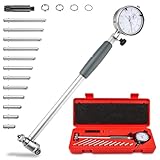
- 2"-6" Wide Measuring Range: Covers small engine cylinders to large diesel bores (50mm-150mm), ideal for automotive repair, engine rebuilding, and industrial machining
- 0.001" Ultra-High Accuracy: Features a precision dial bore indicator, ensuring repeatable measurements within ±0.001" for detecting cylinder wear, taper, or out-of-roundness
- Geometric deformation detection experts: Three-point synchronized feedback technology generates roundness/cylindricity/taper data at the touch of a button for quick diagnosis of out-of-round or taper wear
- User-Friendly Design: Dial bore gauge set includes a balanced dial indicator with clear markings, plus extension rods for quick adjustments. No batteries needed
- Package includes: 1 bore gauge, 4 washers, 12 anvils, 1 extension rod, 1 manual, 1 plastic case
How can I tell if a block is cracked?
A visual check can reveal obvious damage but cannot rule out hidden cracks. GM service information calls for checking coolant jackets for cracks. For a valuable purchase, have a qualified engine shop inspect the block; do not treat exterior appearance as proof that the block is sound.
What should I ask the seller before buying a stroker engine?
Ask for the build sheet, machine-shop invoices, block identity, measured bore and stroke, displacement calculation, crank/rod/piston specifications, builder identity, and records for heads, camshaft, valvetrain, oiling, balancing, and machine work. Also ask what is included, whether the engine can be inspected cold or demonstrated running, and whether an independent shop may inspect it.
Is there one bore tolerance I can use for every 427 small-block?
No universal tolerance for every custom 427 small-block combination is established. Request written bore measurements and the exact build or machine-shop specification used to interpret them. If that specification is missing, ask a qualified shop to determine what inspection is appropriate.
Quick wins for a faster PC:
Scan for outdated or missing drivers - takes under a minuteDriver Scan →Clear out junk files and repair common Windows errorsFree Scan →Can I use compression, leak-down, oil-pressure, or temperature readings as a pass/fail test?
Not by applying a generic number to every custom build. Universal thresholds for these measurements are not established. Ask the builder or independent inspecting shop which measurements suit the documented combination and whether the results meet its requirements.
What should I budget for inspection or machining?
Typical inspection or machining prices are not established. Ask a local qualified engine shop for a quote based on the exact engine, the records available, and the inspection findings. Compare the scope of remaining work across engines rather than assuming a generic cost.
The Bottom Line
Buy the evidence, not just the “427 small-block” label. Verify the block identity and provenance, connect measured bore and stroke to the documented parts, and have a qualified independent shop inspect the block and cylinders against specifications for that exact build. There is no universal tolerance or reliable generic cost figure for every custom combination, so resolve missing records and remaining work with the seller and shop before paying.
Quick Recap
Product prices and availability are accurate as of the date/time indicated and are subject to change. Any price and availability information displayed on Amazon at the time of purchase will apply.

