
Recommended Free Tools
iTechGuides is reader-supported. When you buy through links on our site, we may earn an affiliate commission. As an Amazon Associate I earn from qualifying purchases. Learn more
To get the most from a 240Hz OLED monitor, your PC needs two things: a video output that can carry the monitor’s chosen resolution, refresh rate and color mode, plus enough game-rendering performance for the frame rates you actually want. Those are separate requirements. A computer can send a 240Hz signal while a game renders 90, 140 or 200 frames per second; the display’s refresh-rate label does not guarantee 240 FPS.
Start with the monitor’s signal requirements
Read the exact model’s manual or specification table before choosing hardware. Resolution, input type, HDR, color depth and compression support can change which connection is required. Port numbers alone are not a safe shortcut because manufacturers can implement different modes on different inputs.
| Monitor example | Native mode cited by the manufacturer | Connection detail | What the specification proves |
|---|---|---|---|
| LG UltraGear 27GX704A-B | 2560 × 1440 at up to 240Hz | DisplayPort 1.4 or HDMI 2.1 graphics output | The display can accept that mode when the computer and configuration support it; LG cautions that actual refresh rates may vary with graphics specifications and configuration. |
| MSI MAG 274QP QD-OLED X24 | 2560 × 1440 at up to 240Hz | HDMI or DisplayPort; MSI lists a DisplayPort 1.4a cable in the box | Either listed input can carry the manufacturer’s specified QHD refresh mode on this model. |
| MSI MPG 272URX QD-OLED | 3840 × 2160 at 240Hz | DisplayPort 2.1a UHBR20 for 4K 240Hz without DSC | This is a signal-bandwidth capability claim, not evidence that a GPU renders every game at 240 FPS. |
| AOC monitor documented in its manual | 2560 × 1440 at 240Hz, 10-bit RGB or YCbCr 4:4:4 | DisplayPort 1.4 HBR3 with a DSC-enabled graphics card | DSC can be required for a particular resolution, refresh, color format and monitor implementation; it is not a universal requirement for every 240Hz OLED. |
Use the discrete graphics card’s output for a gaming PC. A motherboard HDMI or DisplayPort socket normally connects to the processor’s integrated graphics, not the powerful GPU that renders your games. The motherboard output is appropriate only when you deliberately run the display from integrated graphics and have verified that it supports the required mode.
Refresh rate and game FPS are different limits
A 240Hz panel refreshes every 4.17 milliseconds when it receives a full-rate signal. Your game may deliver frames less frequently. At 120 FPS, a new rendered frame arrives every 8.33 milliseconds; at 180 FPS, every 5.56 milliseconds. Variable-refresh-rate support can synchronize scanout to changing frame delivery, but it cannot create missing frames.
#1 Best Overall

- 27" QHD DISPLAY: Immerse yourself in stunning visuals with a 27-inch QHD (2560x1440) resolution, delivering crisp detail and vibrant colors.
- 240Hz REFRESH RATE & 0.03ms RESPONSE TIME: Enjoy smooth, blur-free gameplay with a lightning-fast 240Hz refresh rate and ultra-low 0.03ms (GtG) response time.
- HDR400 TRUE BLACK: Experience deeper blacks and brighter highlights with HDR400 True Black certification, enhancing contrast and visual realism.
- QD OLED TECHNOLOGY: Quantum Dot OLED panel ensures rich colors with 147.6% sRGB and 110.2% DCI-P3 color gamut coverage, providing stunning color accuracy
- ADAPTIVE-SYNC TECHNOLOGY: Eliminate screen tearing and stuttering with Adaptive-Sync compatibility, ensuring a seamless and fluid gaming experience.
Therefore, decide whether your goal is a stable high frame rate, the lowest practical latency, or 240 rendered FPS in a particular game. Competitive games at reduced settings may reach very high rates on a midrange system, while a graphically intensive single-player game with ultra settings and ray tracing may remain far below 240 FPS on the fastest available hardware. Always attach a performance claim to a named game, resolution and settings.
Choose the GPU from your games and resolution
QHD (2560 × 1440) at 240Hz
QHD is a substantially lighter rendering target than 4K, so it is the more attainable route to very high frame rates. There is no single GPU model that guarantees 240 FPS across all QHD games. Look up current benchmarks for the titles you play, the graphics preset, ray-tracing options, upscaling mode and the frame-rate range you consider acceptable.
Rank #2

- LG UltraGear OLED Goes Glossy - Experience ultra-smooth, tear-free gameplay with up to 240Hz refresh rate and 0.03ms response time on a glossy, bright 27” QHD OLED display. React instantly, spot every detail, and outpace your opponents in every frame with outrageous speed and clarity.
- Next-Level OLED Brightness, for Next-Level Play - The brilliant OLED display brings every scene to life with jaw-dropping color and intensity. Delivering a standard 275 nits of brightness and peaking at 1300 nits, your games shine with vivid clarity—keeping dark corners detailed, explosions dazzling, and the action always visible no matter the environment.
- VESA DisplayHDR True Black 400 - An OLED display with VESA DisplayHDR True Black 400 and a 1.5M:1 contrast ratio deliver deep blacks and dazzling highlights, so you catch every hidden detail in dark scenes and every spark in the bright ones. With up to 98.5% DCI-P3 color, your worlds burst with vibrant intensity—making every game feel more alive.
- Three UL Certifications. One Clear Advantage for Eye Comfort. - This UltraGear OLED display is three times UL-certified—for Anti-Glare, Flicker-Free, and Low Blue Light. Combined with a glossy finish, the display helps reduce distractions, keep your view crisp, and maintain visual comfort—so you can stay focused and perform at your best, even during extended gaming sessions.
- 27” OLED Brilliance with up to 240Hz of Game-Changing Speed - Experience ultra-smooth, tear-free gameplay with up to 240Hz refresh rate on a glossy, bright 27” QHD OLED display.
- Esports or older games: reduced settings can make high average FPS realistic, but CPU limits and frame-time spikes may become the dominant problem.
- Modern AAA games: high or ultra presets, dense worlds and ray tracing can make the GPU the limiting component even at QHD.
- Consistency matters: compare 1% lows and frame-time graphs, not only an average-FPS number. A 240Hz display does not feel consistently responsive if frametimes oscillate sharply.
A 2026 CPU comparison notes that the bottleneck generally shifts toward the GPU as resolution rises, while CPU performance still matters at very high frame rates and in CPU-heavy games. Use that as a reason to balance the system rather than to buy a particular processor without knowing your games and budget. Driver releases and game patches can materially change benchmark results.
4K (3840 × 2160) at 240Hz
Native 4K quadruples the pixel count of 1080p and places a much heavier workload on the GPU than QHD at the same settings. Reaching 240 FPS is a selective target for optimized or less demanding games, not a universal expectation for new releases at high settings.
Rank #3

- OLED Makes All The Difference: With a display of these mammoth-like proportions, everything must look good. The WQHD quantum dot OLED display with true 10Bit is obligated to offer stunning contrast, cinematic color. Image retention-refresh keeps the images from sticking.
- AMD FreeSync Premium Technology: Say “goodbye” to stuttering and tearing. With AMD FreeSync Premium, the monitor’s frames are synced with the graphics card’s frames, which eliminates screen tearing and provides the smoothest gaming experience.
- Fast and Furious: If you want seamless gameplay at ridiculous levels of speed, you’ve come to the right place. With an 240Hz refresh rate and 0.03ms (G to G) response time, your sessions will be fluid, unbroken and unmatched – with little to no ghosting.
- Brilliant Colors: With the DCI-P3 99% color gamut, Delta E<2, and HDR10, colors are practically bursting out of the screen. Enjoy the best imagery your games have to offer!
- Center of Vision: At 26.5-inches, the X27U is directly in your field of view. Considered a hallmark of eSports tournaments, this is the perfect size to gain an edge over your opponents. The addition of a ZeroFrame design also removes the bezels – giving you have even more visibly over every match and every movement your rivals make.
First verify that the monitor and graphics card support the required 4K 240Hz input mode. The cited MSI 4K model specifies DisplayPort 2.1a UHBR20 for 4K 240Hz without DSC. A card with a suitable output can still fall short of the game’s rendering demand. To raise performance, lower expensive settings such as ray tracing, use the game’s supported upscaling mode, or choose a lower internal render resolution. Treat frame generation separately from conventionally rendered frames: generated images can raise the displayed count, but they do not equal the same input latency or rendering workload as 240 independently rendered frames.
CPU, memory and platform balance
At QHD and 4K, the GPU often determines the maximum frame rate, but a weak or overloaded CPU can prevent the GPU from being fed quickly enough. This is most visible in simulation-heavy games, large multiplayer matches, high-refresh esports titles and situations where the GPU is already rendering at low settings.
Rank #4
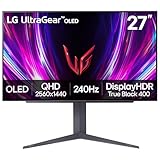
- 240Hz Refresh Rate - Gear up for smooth gameplay with an ultra-fast 240Hz OLED display. The faster speed lets you respond quickly to opponents and stay a step ahead of the competition. Plus, enjoy smoother scenes with less lag or ghosting thanks to LG UltraGear OLED's nearly instantaneous 0.03ms (GtG) response time.
- VESA DisplayHDR True Black 400 & 1.5M:1 contrast ratio - VESA DisplayHDR True Black 400 certified means this monitor meets industry standards for brightness as well as deep, rich black color expression. With a 1.5M:1 contrast ration, the benefit for gaming impeccable color and image detail in dark scenes for a stunning visual experience.
- NVIDIA G-SYNC Compatible and AMD FreeSync Premium Pro - Officially validated by NVIDIA as G-SYNC Compatible and equipped with AMD FreeSync Premium Pro means this UltraGear provides smooth, fast action that reduces screen tearing and stutter. Never miss a frame of the action as you clinch your victories.
- Anti-Glare / Low Reflection OLED - Play with less distractions thanks to an anti-glare screen that minimizes light reflections and lets you concentrate on winning.
- 2 Year UltraGear OLED Warranty - Game with peace of mind. This UltraGear OLED gaming monitor is protected by a two year limited warranty covering internal and functional parts and labor, including OLED Display Panel. See Warranty Information on this page for all warranty details.
What to prioritize
- Current gaming CPU: choose a processor with strong per-core performance and enough cores for your games, operating system and background applications. A universal model recommendation would be misleading without a title list and budget.
- Memory capacity and speed: use a modern dual-channel memory platform appropriate to the CPU and motherboard. Capacity should cover the games you run alongside voice chat, browsers and recording software; avoid making capacity or frequency the sole upgrade when the GPU is saturated.
- Stable frame times: monitor CPU utilization by core, GPU utilization, temperatures and frametime graphs. Low total CPU utilization can hide one saturated game thread.
- Power and cooling: sustained high FPS keeps both CPU and GPU busy. Adequate cooling and a power supply sized for the chosen graphics card help prevent clock reductions and instability.
For a QHD esports build, spending everything on the largest GPU can be wasteful if the game is CPU-limited at reduced settings. For 4K high-detail gaming, moving up the GPU range usually produces a larger gain than a small CPU upgrade once the processor is already keeping frame times stable.
DisplayPort, HDMI, DSC and color depth
Do you need DisplayPort 2.1?
Not automatically. The LG QHD example specifies DisplayPort 1.4 or HDMI 2.1 for up to 240Hz, and the MSI QHD example lists both HDMI and DisplayPort for 2560 × 1440 at 240Hz. DisplayPort 2.1 becomes relevant when a particular monitor uses it for an uncompressed high-bandwidth mode, such as the cited 4K 240Hz implementation.
Best Value

- 27 Inch OLED Gaming Monitor with QD-OLED Technology - Experience true blacks and infinite contrast with advanced QD-OLED panel, delivering ultra-vivid colors (147% sRGB / 110% DCI-P3) for immersive gaming and content.
- 240Hz 1440p Gaming Monitor for Ultra-Smooth Performance - Play at peak performance with 240Hz refresh rate and ultra-fast 0.03ms response time, reducing motion blur and ghosting for competitive gaming.
- QHD 1440p Resolution with HDMI 2.1 Connectivity - Crisp 2560x1440 resolution with HDMI 2.1 and DisplayPort 1.4 supports high refresh rate gaming on PC, PS5, and Xbox Series X.
- G-SYNC Compatible for Tear-Free Gaming - Enjoy smooth, stutter-free gameplay with adaptive sync technology that reduces screen tearing and improves responsiveness.
- Height Adjustable Gaming Monitor with USB Hub - Ergonomic stand with height, tilt, swivel, and pivot adjustment plus USB 3.2 hub, VESA mount compatibility, and Flicker-Free technology for extended comfort.
Buy for the monitor’s documented input mode and the outputs on your GPU. A newer-numbered cable does not increase game performance by itself, and a cable cannot compensate for a graphics card or monitor port that lacks the required mode.
When DSC enters the picture
Display Stream Compression (DSC) is a link-level compression feature used to fit some high-resolution, high-refresh signals within the available bandwidth. The AOC manual’s QHD 240Hz 10-bit RGB/YCbCr 4:4:4 mode requires a DSC-capable graphics card over DisplayPort 1.4 HBR3. That condition applies to the documented monitor and mode; other displays may support the same headline refresh rate with different color or compression requirements.
Check all of these items together:
- the monitor input and its supported resolution/refresh combinations;
- the GPU output standard and DSC support, if the manual calls for it;
- the selected 8-bit or 10-bit color mode and chroma format;
- HDR and variable-refresh-rate settings, which can change the available mode list.
Set up the connection and verify 240Hz
- Connect the monitor to a video output on the discrete GPU, not the motherboard, unless integrated graphics are intentional.
- Use the input and cable type listed for the monitor’s desired resolution, refresh rate and color mode. Keep the supplied cable when it meets those specifications; the cited MSI QHD model includes a DisplayPort cable.
- Install the current graphics driver for your GPU, then reboot if the installer requests it.
- In the operating system’s display settings, select the monitor, choose its native resolution and set the highest available refresh rate. Do not assume the operating system selected 240Hz automatically.
- Open the GPU driver control panel and confirm the same native resolution, refresh rate, color depth and output format. Some drivers expose a PC-resolution list separately from television timings.
- Use the monitor’s on-screen information display to verify the incoming resolution and refresh rate. Enable adaptive sync or the monitor’s variable-refresh option only after the basic 240Hz mode works.
- Launch a game and check an in-game frame counter plus a frametime graph. The monitor can report 240Hz while the game renders substantially fewer frames.
Diagnose common 240Hz problems
240Hz is missing from the settings
- Confirm that the cable is connected to the GPU and that the chosen monitor input supports 240Hz.
- Check whether the current resolution, HDR, 10-bit color or chroma setting excludes the high-refresh mode.
- Read the manual for DSC requirements and verify that the GPU supports DSC when required.
- Update the graphics driver, power-cycle the monitor and inspect the GPU control panel for alternate PC timings.
The image runs at 240Hz but games stay below 240 FPS
This is a rendering limit, not a failed monitor connection. Identify whether GPU utilization is near full, one CPU thread is saturated, or a frame-rate cap is active. Then change the relevant game settings, upgrade the limiting component or accept a lower frame-rate target while retaining the panel’s low-latency capability.
What’s actually slowing this PC down?
Pick the symptom - the matching free tool is one click away.
Black screens, flicker or intermittent signal
- Reseat both ends of the cable and test the monitor’s other supported input.
- Remove unnecessary adapters, docks and extension cables while troubleshooting.
- Temporarily disable HDR, 10-bit output or DSC-dependent modes to isolate a bandwidth or compatibility issue.
- Recheck the monitor and GPU specifications rather than assuming that every cable marketed with a higher version number supports every mode.
A practical buying checklist
Before ordering components, write down the exact monitor model and answer these questions:
- Is the native panel 2560 × 1440 or 3840 × 2160?
- Which input supports 240Hz, HDR and the desired color depth simultaneously?
- Does that mode require DSC?
- Which games matter, and at what presets, ray-tracing settings and upscaling modes?
- Is the target a stable minimum, a high average, or genuinely close to 240 rendered FPS?
- Do benchmark results show GPU saturation or a CPU/frame-time limit?
- Does the graphics card have the required output, and is the included cable suitable?
- Is the power supply and cooling system appropriate for sustained gaming load?
Recheck current GPU rankings, drivers, game patches and product availability when you make the purchase: they change faster than the monitor’s published specification. The strongest plan is a balanced build tied to named workloads, not a promise that a particular CPU/GPU pair will deliver 240 FPS in every game.
Quick Recap
Product prices and availability are accurate as of the date/time indicated and are subject to change. Any price and availability information displayed on Amazon at the time of purchase will apply.

