
iTechGuides is reader-supported. When you buy through links on our site, we may earn an affiliate commission. As an Amazon Associate I earn from qualifying purchases. Learn more
A data center is suitable for AI when its power delivery, cooling, rack space, network, storage, resilience, and operating model match the workload you actually plan to run. A large building or a high site-level megawatt figure is not enough: power must reach the intended racks, heat must be removed at the required density, and the facility must support the cluster’s data movement, uptime objective, commissioning, and growth.
Start with the AI workload, not the building
Suitability is a systems decision. Begin by defining what the facility will run and how it will run it:
- Workload type: training, inference, batch processing, or a mixed environment.
- Hardware: the exact server, accelerator, memory, storage, and networking configuration.
- Deployment size: the number of systems and racks in the first phase, plus the planned expansion phase.
- Operating profile: expected utilization, duty cycle, maintenance windows, and whether demand is steady or bursty.
- Performance objective: completion time, latency, availability, and data-transfer requirements.
Do not size the facility by assuming every server continuously draws its maximum nameplate power. The 2023 ASHRAE Handbook explains that workload-based projections are more accurate than projections based only on the maximum power of a server family. Use equipment-specific electrical and thermal data, then model the planned utilization and growth horizon.
The Tool Desk
Outbyte PC Repair FREERepair Windows errors before they cause bigger problemsFix Now →Outbyte Driver Updater FREEFix the driver behind crashes, sound loss and screen glitchesFind Drivers →There is no universal GPU count or rack-density threshold that independently makes a site suitable. The answer depends on the equipment, workload, service objective, and the facility’s ability to deliver power and remove heat at the same time.
#1 Best Overall

- POWER AND CHARGE: This rack mount power strip provides an additional 8 NEMA 5-15 outlets (120V/15A) and features a 6ft (1,8m) long cord so you can plug your devices in while leaving the rack mobile
- 1U RACK DESIGN: Compatible with all 19" server racks 4 inches or deeper, this horizontal-mount power distribution unit fits many network racks and has an integrated power cord; ANSI/EIA RS-310-D standard
- EASY INSTALLATION: This IT-grade rackmount PDU features a rugged steel chassis, LED indicators for ground and surge protection, and lets you control the power state with power and reset switches
- PROTECTS YOUR EQUIPMENT: This rack mountable 8-outlet (120V) power strip features a built-in circuit breaker and reset switch, ensuring a dependable performance of your networking equipment
- THE IT PRO'S CHOICE: Designed and built for IT Professionals, this rack PDU is backed for 2-Years, including free lifetime 24/5 multi-lingual technical assistance
Validate utility power and the path to each rack
Confirm deliverable capacity and interconnection timing
Site-level megawatts do not prove that the required power can be delivered to an AI room. Confirm the utility’s available capacity, the interconnection process, the expected energization date, and any upgrade work required on the grid or substation. ASHRAE site-planning guidance treats power and grid capacity as early feasibility questions, because a delayed interconnection can determine the project schedule before construction begins.
Obtain written answers for the initial load, the full planned load, the ramp between phases, and the conditions attached to each increase. A nominal capacity that is unavailable until a future transmission or substation project is complete should not be counted as present-day capacity.
Trace power from the service entrance to the IT load
At facility level, review the complete electrical chain:
Quick wins for a faster PC:
Repair Windows errors before they cause bigger problemsFix Now →Scan for outdated or missing drivers - takes under a minuteDriver Scan →Clear out junk files and repair common Windows errorsFree Scan →- Utility service, transformers, switchgear, and protection coordination.
- Uninterruptible power systems, generators, fuel systems, and transfer equipment where the service objective requires them.
- Distribution paths, busways, floor power, and rack-level power-delivery equipment.
- Voltage, connector, breaker, and monitoring requirements of the selected servers and accelerators.
- Capacity reserved for startup currents, maintenance bypasses, failed components, and the next deployment phase.
Redundancy should be selected against the AI service objective and risk profile, not a label alone. A highly redundant upstream design can still fail an installation if a particular room lacks the needed circuits or if rack distribution cannot support the accelerator configuration.
Use intelligent rack distribution where it helps operations
ASHRAE’s integrated-design material identifies intelligent power distribution units (PDUs) as part of rack power-distribution considerations. A PDU is an infrastructure component, not a guarantee of suitability. Match its electrical rating, connectors, approvals, branch-circuit arrangement, and monitoring functions to the actual rack design. Monitoring should support load visibility, alarms, capacity planning, and maintenance without exceeding the electrical limits of the distribution system.
Design electrical and thermal systems together
AI accelerators turn delivered electrical power into heat. As rack power rises, the cooling architecture, heat-rejection plant, piping, controls, and operating procedures must be designed with the electrical plan rather than added afterward. ASHRAE’s AI facility guidance emphasizes coordinated electrical, mechanical, and IT design for this reason.
Rank #2

- 100-125V/15A Basic Power Distribution Unit (PDU) delivers AC power to data centers, network closets, and other electrically demanding applications
- OUTPUT: 10 Rear NEMA 5-15R Outlets; INPUT: NEMA 5-15P straight plug with 15 ft power cord
- VERSATILE RACKMOUNT OPTIONS: Allows for the PDU to be installed vertically or horizontally
- ADDITIONAL FEATURES: Network-grade plugs and outlets, durable metal housing, and cord retention tray
- 3-YEAR LIMITED WARRANTY (This unit does not provide surge suppression)
Use rack-power ranges as screening guidance
Uptime Intelligence describes these practical, indicative ranges for common approaches. They are operational guidance, not mandatory limits, and the page does not state a publication date:
| Cooling approach | Indicative rack power | What the range means |
|---|---|---|
| Perimeter air cooling | Generally up to about 20–25 kW per rack | Some older systems may support only about 10–15 kW per rack. |
| Close-coupled air cooling | Typically up to about 50 kW per rack | Higher-density zones are possible when the air path and heat rejection are designed for them. |
| Liquid cooling | Typically used above 50 kW per rack | The IT equipment and facility must support the selected liquid approach. |
| Total or near-total liquid cooling | Around 150 kW per rack or more | Uptime Intelligence says this level will require total or near-total liquid cooling. |
These figures should screen options, not approve a design. Actual suitability depends on inlet temperatures, airflow, containment, heat-rejection capacity, equipment layout, control strategy, and the operating environment. A facility should be evaluated against the specific rack heat load rather than a marketing claim about maximum density.
Check the existing air system before assuming a retrofit works
For air-cooled systems, measure or model supply airflow, return paths, containment, fan capacity, pressure relationships, and the heat-rejection plant. Confirm that adjacent racks, cable paths, and maintenance clearances will not disrupt the intended air pattern. Older rooms designed around 10–15 kW racks may need substantial electrical and mechanical changes before they can host denser AI equipment.
Specify liquid cooling from the IT equipment outward
Liquid cooling is not a single universal technology. First confirm which approach each server and accelerator supports, such as cold plates or immersion. Then validate:
- Required coolant flow and allowable pressure drop.
- Water or coolant quality and filtration requirements.
- Supply and return temperatures specified by the equipment manufacturer.
- Manifolds, quick-disconnects, hoses, leak detection, and service clearances.
- Coolant distribution units (CDUs), facility-water loops, heat exchangers, pumps, controls, and isolation arrangements.
- Procedures for filling, draining, component replacement, spill response, and planned maintenance.
ASHRAE notes that equipment requirements vary by configuration and that water quality affects long-term reliability. Do not select a single liquid-cooling class or supply temperature as universally correct; compatibility and system design govern.
Size networking and storage for data movement
Training clusters can move enormous datasets and model states between accelerators, servers, storage, and control systems. Inference may prioritize predictable latency, service isolation, or geographic placement instead. The correct network and storage architecture therefore follows the workload’s communication pattern and performance objective.
Rank #3

- RACK MOUNTABLE: This 1U Rackmount PDU power strip fits 19" standard server racks and cabinets, featuring a 1U horizontal rack mount form factor that ensures compatibility with all 19" server racks.
- 15A Overload Protection Switch: Provides overload protection by interrupting the circuit when the load exceeds the rated current.
- HEAVY-DUTY: The power distribution unit features a heavy-duty construction, meticulously designed with robust components and housed in a durable aluminum alloy casing, ensuring a sturdy and long-lasting performance for reliable power management.
- POWER CORD: The power distribution unit comes equipped with a 6-foot (1.8 meter) 14AWG power cord, providing flexible placement options and extended reach for versatile installation in various settings.
- Commitment: ElecVoztile is dedicated to delivering superior products and outstanding customer service. Should you encounter any issues, please do not hesitate to reach out to us for immediate assistance.
Define the required data sources, checkpoint frequency, dataset size, concurrency, failover behavior, and retention policy. Then have the design team size the compute fabric, storage paths, management network, and external connectivity together. ASHRAE’s integrated-design material describes complex networking topologies and specialized fiber as considerations for AI rack integration.
No single fabric, bandwidth, or latency target is established for every AI workload. A facility comparison that lists only a carrier count or a nominal port speed is incomplete unless it explains how that connectivity serves the proposed cluster and expansion plan.
Test resilience, commissioning, and daily operations
Match resilience to the service objective
Assess power, cooling, network, storage, and control-system resilience against the consequence of an outage. Decide which failures the AI service must ride through, which can be handled by restarting jobs, and which require a second site or a separate availability zone. Redundancy in one subsystem does not compensate for a single point of failure in another.
Free tools Windows power users keep installed
One-click scans. No signup required.
Commission the integrated system
Commissioning should demonstrate that the installed AI hardware, power distribution, cooling, controls, and network perform together under expected and abnormal conditions. Include functional tests for load changes, loss and restoration of utility power, cooling-unit failure, pump or CDU isolation, network-path failure, alarms, and safe shutdown behavior. Record measured results, operating limits, and the actions required when a test does not pass.
The ASHRAE AI Data Center Energy Performance Framework, announced by ASHRAE, PNNL, and NEMA on June 10, 2026, provides a framework for evaluating AI data-center energy performance. Its overview explicitly states: “What this framework does not do is establish mandatory requirements or supersede applicable codes and standards.” Applicable building, electrical, fire, environmental, and occupational requirements remain controlling.
Plan for operations, not just installation
AI facilities need ongoing performance monitoring, preventive maintenance, energy management, spare parts, trained technicians, and clear ownership of the liquid and electrical systems. Operating procedures should cover filter and coil maintenance where applicable, coolant sampling and water treatment, leak response, firmware and control changes, capacity alarms, and safe service of energized or liquid-connected equipment.
Rank #4
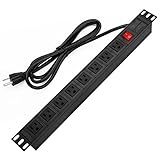
- 【Rack Mount Power Strip】: This PDU power strip surge protector equipped 8 wide space outlets (125V/15A), providing enough space between the sockets to large plugs. 8 in 1 power strip, features a 6 ft long cord so you can plug your devices in while leaving the rack mobile
- 【1U Rack Mount Design】: 19 inch power strip compatible with all 19” server racks. The power distribution unit is designed for rack enclosure, garage, workshop, office, cabinet, work bench, wall mount, under counter and other mount installation applications, provides a neat look to your work station
- 【Metal Wall Mount Power Strip】: The 1U PDU can be mounted horizontally or Vertically in any server rack 19" in depth, and features a rugged steel casing to ensure maximum durability;Equipped 4 screws to help mount and provided several mount way, you can release the screws on both sides and rotate the mounting bracket to the right angle for installation
- 【Protects Your Equiement】: Our rackmount Power Strip features a built-in circuit breaker,and covered ON/OFF switch,300 Joules surge protector designed, it will automatically cut power to protect connected devices when voltage surge is overwhelming,ensuring dependable performance of vital data center equipment,Rackmount Surge Protector provides critical power protection for data centers and network closets
- 【Warranty and Customized products】: 12-month warranty. Our factory specializes in power strips socket production, we provide product customization services for various outlets and extension cord,If you have any problem, please contact us without hesitate, we are always for you
Evaluate site, resources, and expansion constraints
Feasibility extends beyond the building shell. Compare:
What’s actually slowing this PC down?
Pick the symptom - the matching free tool is one click away.
- Utility connection feasibility and the schedule for each power phase.
- Permitting, environmental review, construction constraints, and local stakeholder requirements.
- Climate and the resulting heat-rejection and free-cooling opportunities or limitations.
- Water availability, discharge requirements, treatment needs, and drought or conservation constraints.
- Energy availability, price exposure, emissions requirements, and backup-fuel logistics.
- Fiber routes, carrier access, and physical separation of diverse network paths.
- Room for additional electrical, cooling, storage, and network equipment as the cluster grows.
ASHRAE site-planning guidance says site selection should align with workload requirements and account for resource and stakeholder factors. Local studies are required for a named parcel; general guidance cannot certify a particular site.
Can an existing data center support GPU servers?
Sometimes. ASHRAE includes retrofit and modernization in its framework, but that does not mean every existing facility can accommodate every AI cluster. A retrofit is credible only after a capability review of the utility connection, room distribution, rack clearances, cooling and heat rejection, network paths, structural loading, fire protection, controls, permits, and operating expertise.
Start with a representative rack or small pilot zone. Verify actual electrical draw, inlet temperatures, airflow or coolant performance, alarm behavior, maintenance access, and network throughput under the intended workload. Use the measured results to decide whether to expand, redesign the room, add liquid-cooling infrastructure, or select another site.
Compare facilities with a decision matrix
When comparing candidate facilities, score the same evidence for the initial deployment and every planned expansion phase:
Recommended Free Tools
| Decision area | Questions to answer |
|---|---|
| Power delivery | How much capacity is energized now, how much is contractually deliverable, and when can each additional phase be connected? |
| Rack distribution | Can the room deliver the required voltage, circuits, connectors, monitoring, and maintenance paths to the planned racks? |
| Cooling and heat rejection | What rack heat load is supported today, by which method, with what operating limits and expansion work? |
| IT compatibility | Do the selected servers and accelerators support the proposed air, cold-plate, or immersion design? |
| Network and storage | Can the site provide the workload-specific topology, fiber diversity, storage paths, and external connectivity? |
| Resilience | Which power, cooling, network, and control failures are tolerated, and how are they tested? |
| Resources and permits | Are water, energy, environmental approvals, construction permits, and local requirements on the critical path? |
| Operations | Is there expertise for high-density racks, liquid systems where used, commissioning, monitoring, and maintenance? |
| Expansion | Is there physical, electrical, cooling, network, and utility capacity for the growth horizon? |
Do not reduce the decision to one PUE value, one Tier label, or one rack-density number. Those figures cannot substitute for proof that the proposed workload can be powered, cooled, connected, commissioned, and operated at the required scale.
Quick Recap
A practical readiness sequence
- Document the workload: hardware bill of materials, utilization profile, rack count, performance goals, and growth phases.
- Obtain utility evidence: present capacity, interconnection requirements, energization dates, and conditions for expansion.
- Map the electrical path: service entrance through room distribution and rack-level circuits, including protection and redundancy.
- Model the heat load: compare rack and room loads with the actual air, close-coupled, or liquid-cooling architecture.
- Verify equipment compatibility: electrical ratings, inlet conditions, coolant specifications, connectors, clearances, and service procedures.
- Design data movement: compute fabric, storage, management, external links, fiber diversity, and failure behavior.
- Check site constraints: permits, climate, water, energy, environmental impacts, network routes, and construction schedule.
- Commission a representative zone: test integrated performance under normal load and defined failure scenarios.
- Approve expansion only on evidence: use measured capacity, operating limits, and documented remediation—not assumptions from a facility label.
Product prices and availability are accurate as of the date/time indicated and are subject to change. Any price and availability information displayed on Amazon at the time of purchase will apply.

