
iTechGuides is reader-supported. When you buy through links on our site, we may earn an affiliate commission. As an Amazon Associate I earn from qualifying purchases. Learn more
A suitable humanoid-robot battery is not simply the pack with the most watt-hours. It must store enough energy for the mission, deliver brief actuator and computer power peaks without dangerous voltage sag, remain inside a controlled temperature range, and fail without igniting or destabilizing the robot. That requires a complete system: cells, enclosure, sensors, battery-management software, protection hardware, cooling, charging equipment and a serviceable mechanical layout.
Why humanoid robots are unusually demanding battery loads
A humanoid robot spends energy in several different ways at once. Motors repeatedly accelerate and decelerate joints, balance controllers react to disturbances, computers process vision and motion plans, and pumps, fans or grippers add auxiliary loads. Walking, standing up, carrying an object and catching a stumble can create short power spikes that are far higher than the average power over a shift.
That makes energy and power separate design requirements. Energy, measured in watt-hours (Wh) or kilowatt-hours (kWh), determines how long the robot can operate. Power, measured in watts or kilowatts, determines whether it can perform a demanding movement at a particular instant. A large-capacity pack with inadequate discharge capability can still suffer voltage collapse, brownouts or a protective shutdown when several actuators peak together.
Do these 3 things before closing this tab:
1Repair Windows errors before they cause bigger problems2Scan for outdated or missing drivers - takes under a minute3Clear out junk files and repair common Windows errorsThe pack also sits on a moving, balancing machine. Extra cells increase endurance but add mass, occupy valuable volume and can move the center of mass away from the robot’s intended location. A battery that looks excellent on a cell datasheet may be unsuitable once its enclosure, busbars, cooling plates, fuses, contactors, sensors and BMS are included.
#1 Best Overall

- Battery Specifications:Dimensions: 36*10*65mm/ 1.42*0.39*2.56inch;Battery Weight(Single): 49g; Capacity: 3000mAh; Plug: JST1.25; Discharge Rate: 1C. Make Sure Device Polarity Matches with Battery Pack Connector Before Purchase.1.Battery Size; 2.Connector Model;3.Connector Size; 4.Connector Polarity - THIS IS NOT UNIVERSAL!!! (It will cause a shortage if the polarity of the battery connector does not match your device.)
- Reliable Performance: Our 3.7 volt rechargeable lithium polymer battery provides reliable performance with long life. It is no fire, no explosion or no leakage after vibration and collision.Each lipo battery comes equipped with a built-in protection board that prevents overcharging, over-discharging, overcurrent, overheating, and short circuits. Enjoy peace of mind while using our lithium polymer battery, knowing that it is designed with advanced safety features.
- Application:Our batteries are perfect for ESP3 projects or a small Internet of Things (IoT) project. Also suitable for battery replacement of DIY 3.7V electronic products, mobile energy storage, power supply, LED light, wireless Bluetooth game headset, Bluetooth speaker, outdoor video and audio electronic scale, GPS Watch recorder, USB Fan tester, dash cam controller, gaming controller, electric toy car, mouse and keyboard, Wi-Fi smart home system, digital camera, e-book, and so on.
- Storage & Usage:When storing lithium polymer batteries for a long time, please keep the battery in a state of 40%-60%. We recommend to charge the battery every 3 months receipt of the battery and maintain the voltage 3.7-4.0V. Store battery in cool and dry place.
- Easy Installation with Micro JST1.25 Connector: The 3000mAh lithium polymer battery feature a Micro JST1.25 connector and a wire of about 70mm, making installation simple and convenient. Upgrade your devices effortlessly with our user-friendly design, ensuring a secure connection for maximum performance.(NOTE!!! The maximum operating current of this battery is only about 1.5A, Can Not be used for unmanned vehicles, model aircraft or other products that require high current)
How much energy does a humanoid robot need?
Use the mission, not a universal kWh number
There is no single battery size for every humanoid. A warehouse demonstrator, a research platform and an industrial robot may have very different walking speeds, payloads, duty cycles and charging opportunities. Start with an energy budget for the intended mission:
- Measure or estimate average electrical power for locomotion, manipulation, compute, cooling and auxiliary equipment.
- Multiply that average by the required operating time.
- Add energy for acceleration peaks, cold starts, reserve state of charge and battery aging.
- Convert the result into usable pack energy rather than nominal cell energy.
Usable energy is lower than the nameplate value because the control system normally reserves upper and lower state-of-charge limits. The pack must also retain adequate voltage at the end of discharge and after capacity has declined with age.
What current research targets indicate
A 2026 review in Advanced Science reports that some humanoid-robot application cases can require more than 10 kWh. It also discusses a future volumetric energy-density target above 1,000 Wh/L. These are application-level and next-generation targets, not a specification that every robot needs today.
Quick wins for a faster PC:
Repair Windows errors before they cause bigger problemsFix Now →Fix the driver behind crashes, sound loss and screen glitchesFind Drivers →The same review says that a fourfold increase in energy density, producing a 10 kWh-class system, could enable a half-marathon on current mechatronic systems. It further notes that improvements in mechanical and computing efficiency could make an eight-hour manufacturing shift possible. Those outcomes depend on the robot’s design and duty cycle; they are not guaranteed runtimes for a particular pack.
A current manufacturer example
Figure AI states that its F.03 battery provides 2.3 kWh and enables five hours of runtime at peak performance. This is a vendor-reported result for that robot and its definition of peak performance, not a general humanoid benchmark. It is useful because it shows how a relatively compact robot can pair a multi-kilowatt-hour pack with a stated work period, while also illustrating why runtime claims must always include operating conditions.
Rank #2

- Battery Specifications:Dimensions: 34*10*52mm/ 1.34*0.39*2.08inch;Battery Weight(Single): 34g; Capacity: 2000mAh; Plug: PH2.0; Discharge Rate: 1C. Make Sure Device Polarity Matches with Battery Pack Connector Before Purchase.1.Battery Size; 2.Connector Model;3.Connector Size; 4.Connector Polarity - THIS IS NOT UNIVERSAL!!! (It will cause a shortage if the polarity of the battery connector does not match your device.)
- Reliable Performance: Our 3.7 volt rechargeable lithium polymer battery provides reliable performance with long life. It is no fire, no explosion or no leakage after vibration and collision.Each lipo battery comes equipped with a built-in protection board that prevents overcharging, over-discharging, overcurrent, overheating, and short circuits. Enjoy peace of mind while using our lithium polymer battery, knowing that it is designed with advanced safety features.
- Application:Our batteries are perfect for ESP3 projects or a small Internet of Things (IoT) project. Also suitable for battery replacement of DIY 3.7V electronic products, mobile energy storage, power supply, LED light, wireless Bluetooth game headset, Bluetooth speaker, outdoor video and audio electronic scale, GPS Watch recorder, USB Fan tester, dash cam controller, gaming controller, electric toy car, mouse and keyboard, Wi-Fi smart home system, digital camera, e-book, and so on.
- Storage & Usage:When storing lithium polymer batteries for a long time, please keep the battery in a state of 40%-60%. We recommend to charge the battery every 3 months receipt of the battery and maintain the voltage 3.7-4.0V. Store battery in cool and dry place.
- Easy Installation with Micro PH2.0 Connector: The 2000mAh lithium polymer battery feature a Micro PH2.0 connector and a wire of about 70mm, making installation simple and convenient. Upgrade your devices effortlessly with our user-friendly design, ensuring a secure connection for maximum performance.(NOTE!!! The maximum operating current of this battery is only about 1.5A, Can Not be used for unmanned vehicles, model aircraft or other products that require high current)
Power delivery: surviving the peaks
Specify both continuous and burst power. Continuous current covers the sustained load during walking or work; burst current covers events such as rising from the floor, lifting, resisting a push or rapidly changing direction. The design must keep the DC bus inside the motor drives’ allowable range during those events.
Important comparison values include:
- Maximum continuous and short-duration discharge current.
- Internal resistance and the resulting voltage sag at the expected current.
- Allowable cell and bus temperatures during a burst.
- Peak-load duration, repetition rate and recovery time.
- Converter and motor-controller efficiency across the load range.
Power capability is not the same as a marketing C-rating. A rating may depend on test temperature, cutoff voltage, burst duration or a particular manufacturer definition. Validate a candidate pack against the robot’s measured current waveform, wiring losses and thermal limits. If the battery reaches its protection threshold during a brief movement, a larger energy capacity will not solve the problem; lower resistance, more parallel cells, a higher-power chemistry or a redesigned power bus may be required.
Recommended Free Tools
Safety is a complete system property
Cell chemistry and containment
Lithium-ion cells store substantial energy in a small volume, so safety cannot be assigned to chemistry alone. The pack needs physical spacing, insulation, a robust enclosure, controlled vent paths, temperature sensing and a way to isolate a failed section. Mechanical damage from a fall or collision must not turn into an electrical short.
Figure AI says its F.03 battery was required to “must not emit flames should a catastrophic failure of a single cell occur.” That statement illustrates an engineering objective: contain or manage a single-cell failure so it does not become a robot-level fire. It is a product requirement for that battery, not a universal certification claim for all humanoid packs.
Temperature control
Heat comes from cell resistance, busbars, connectors, converters and motor loads. Cooling may use forced air, liquid channels, conductive plates or structural paths into the chassis. The design must remove heat during repeated peaks without exposing cells to cold spots, condensation or excessive gradients.
Rank #3
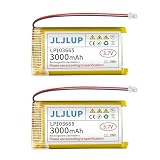
- Battery Specifications:Dimensions: 36*10*65mm/ 1.42*0.39*2.56inch;Battery Weight(Single): 49g; Capacity: 3000mAh; Plug: JST1.25; Discharge Rate: 1C. Make Sure Device Polarity Matches with Battery Pack Connector Before Purchase.1.Battery Size; 2.Connector Model;3.Connector Size; 4.Connector Polarity - THIS IS NOT UNIVERSAL!!! (It will cause a shortage if the polarity of the battery connector does not match your device.)
- Reliable Performance: Our 3.7 volt rechargeable lithium polymer battery provides reliable performance with long life. It is no fire, no explosion or no leakage after vibration and collision.Each lipo battery comes equipped with a built-in protection board that prevents overcharging, over-discharging, overcurrent, overheating, and short circuits. Enjoy peace of mind while using our lithium polymer battery, knowing that it is designed with advanced safety features.
- Application:Our batteries are perfect for ESP3 projects or a small Internet of Things (IoT) project. Also suitable for battery replacement of DIY 3.7V electronic products, mobile energy storage, power supply, LED light, wireless Bluetooth game headset, Bluetooth speaker, outdoor video and audio electronic scale, GPS Watch recorder, USB Fan tester, dash cam controller, gaming controller, electric toy car, mouse and keyboard, Wi-Fi smart home system, digital camera, e-book, and so on.
- Storage & Usage:When storing lithium polymer batteries for a long time, please keep the battery in a state of 40%-60%. We recommend to charge the battery every 3 months receipt of the battery and maintain the voltage 3.7-4.0V. Store battery in cool and dry place.
- Easy Installation with Micro JST1.25 Connector: The 3000mAh lithium polymer battery feature a Micro JST1.25 connector and a wire of about 70mm, making installation simple and convenient. Upgrade your devices effortlessly with our user-friendly design, ensuring a secure connection for maximum performance.(NOTE!!! The maximum operating current of this battery is only about 1.5A, Can Not be used for unmanned vehicles, model aircraft or other products that require high current)
A proposed Chinese national project titled “Technical requirements for energy management system of humanoid robots” lists battery temperature control from 0 to 45 °C. Because this is a proposed project rather than an adopted global rule, treat that range as a draft benchmark. Actual allowable temperatures depend on the selected cells, charging rate and the manufacturer’s limits.
Electrical protection and fault isolation
Protection normally combines cell-level monitoring, current sensing, fuses or electronic limits, contactors, pre-charge circuitry and an emergency shutdown path. A fault in one module should not leave the full bus energized when isolation is required. Connectors need touch-safe shielding and a defined sequence for power, communication and pre-charge.
What the battery-management system must do
The BMS is the control and diagnostic layer that makes a cell array usable. A humanoid-robot BMS should provide:
- Individual cell-voltage and temperature measurement.
- State-of-charge (SOC) and state-of-health (SOH) estimation.
- Passive or active cell balancing during charging and, where appropriate, operation.
- Over-voltage, under-voltage, over-current and over-temperature protection.
- Charge and discharge limits that change with temperature, age and SOC.
- Contactor, fuse and pre-charge coordination.
- Communications to the robot controller, charger and service tools.
- Event logs, fault codes and a controlled shutdown path.
Renesas describes a humanoid-robot battery-management and power-control arrangement that includes cell balancing and monitoring, charge/discharge protection, pack voltage and current sensing, communications, auxiliary power and active cooling. Those functions show why a bare cell string is not a finished robot battery.
The proposed Chinese project lists SOC estimation error of no more than 5% and DC-DC conversion efficiency of at least 95%. These figures are useful axes for comparing systems, but they remain associated with that proposal. Ask vendors how accuracy was measured, over what temperature range, after what aging history and at which SOC levels.
Rank #4

- Battery Specifications:Dimensions: 36*10*65mm/ 1.42*0.39*2.56inch;Battery Weight(Single): 49g; Capacity: 3000mAh; Plug: JST1.25; Discharge Rate: 1C. Make Sure Device Polarity Matches with Battery Pack Connector Before Purchase.1.Battery Size; 2.Connector Model;3.Connector Size; 4.Connector Polarity - THIS IS NOT UNIVERSAL!!! (It will cause a shortage if the polarity of the battery connector does not match your device.)
- Reliable Performance: Our 3.7 volt rechargeable lithium polymer battery provides reliable performance with long life. It is no fire, no explosion or no leakage after vibration and collision.Each lipo battery comes equipped with a built-in protection board that prevents overcharging, over-discharging, overcurrent, overheating, and short circuits. Enjoy peace of mind while using our lithium polymer battery, knowing that it is designed with advanced safety features.
- Application:Our batteries are perfect for ESP32 projects or a small Internet of Things (IoT) project. Also suitable for battery replacement of DIY 3.7V electronic products, mobile energy storage, power supply, LED light, wireless Bluetooth game headset, Bluetooth speaker, outdoor video and audio electronic scale, GPS Watch recorder, USB Fan tester, dash cam controller, gaming controller, electric toy car, mouse and keyboard, Wi-Fi smart home system, digital camera, e-book, and so on.
- Storage & Usage:When storing lithium polymer batteries for a long time, please keep the battery in a state of 40%-60%. We recommend to charge the battery every 3 months receipt of the battery and maintain the voltage 3.7-4.0V. Store battery in cool and dry place. Please contact us if you have any questions or concerns with the product via Amazon message. Storage & Usage:When storing lithium polymer batteries for a long time, please keep the battery in a state of 40%-60%. We recommend to charge the battery every 3 months receipt of the battery and maintain the voltage 3.7-4.0V. Store battery in cool and dry place.
- Easy Installation with Micro JST1.25 Connector: The 3000mAh lithium polymer battery feature a Micro JST1.25 connector and a wire of about 70mm, making installation simple and convenient. Upgrade your devices effortlessly with our user-friendly design, ensuring a secure connection for maximum performance.(NOTE!!! The maximum operating current of this battery is only about 1.5A, Can Not be used for unmanned vehicles, model aircraft or other products that require high current)
Which battery chemistry is appropriate?
| Chemistry or design | Potential advantage | Trade-off for a humanoid | Current role |
|---|---|---|---|
| Conventional liquid-electrolyte lithium-ion | Balanced energy density, power, cycle life, cost and manufacturing maturity | Requires careful thermal, electrical and mechanical protection | Practical baseline for current systems |
| Lithium iron phosphate (LFP) | Generally stronger thermal stability and cycle life | Lower gravimetric energy than many high-energy lithium-ion options | Useful where durability and abuse tolerance outweigh maximum runtime |
| High-nickel lithium-ion | Higher energy density can reduce pack mass | More demanding thermal and abuse management | Candidate where mass is the dominant constraint |
| Lithium-metal or solid-state designs | Potentially higher energy density and improved safety potential | Manufacturing maturity, temperature behavior and power-density challenges | Next-generation development, not a universal replacement |
Cell chemistry should be selected with the complete mission in mind. A lower-energy chemistry may win if its cycle life, thermal behavior and available power reduce downtime and cooling mass. A higher-energy chemistry may win when every kilogram matters, provided the enclosure, BMS and abuse controls can meet the robot’s risk requirements.
Independent reader supportYour contribution helps us test, update, and keep practical guides available for everyone.Pack architecture, balance and serviceability
Centralized versus distributed packs
A centralized pack simplifies wiring, protection and maintenance, but concentrates a large mass in one location. Distributed modules can place energy near the torso, hips or other structurally suitable areas and improve balance. They add harnesses, connectors, multiple protection zones and more complex thermal paths.
Designers should evaluate the loaded robot’s center of mass, moment of inertia, cable flexing, crash exposure and access for inspection. Pack volume includes not only cells but also cooling channels, insulation, service clearances and connector bend radii.
Swappable modules
Swappable batteries can increase uptime while higher-energy chemistries mature. A replacement module must be keyed so it cannot be inserted incorrectly, mechanically retained against impact and connected without damaging pins or causing uncontrolled inrush. The robot also needs a communication handshake that verifies identity, SOC, temperature and pack health before enabling the bus.
Decide whether swapping occurs with the robot powered down or through a deliberately engineered hot-swap system. Include pre-charge, interlocks, thermal-interface repeatability and a procedure for isolating a pack that is hot, damaged or reporting an error. A quick physical swap is not useful if technicians must wait for a cooling period or run a lengthy recalibration.
Best Value

- Charging Method: Recommended charging current is 0.6A, the maximum does not exceed 1.5A. The discharge current is recommended 0.6A, and the maximum does not exceed 1.5A
- Overcharge Protection: When charging the battery, when the voltage reaches the highest battery voltage (4.2V), the protection board will automatically power off and shut down, indicating that it will not continue to charge when fully charged, forms overcharge protection
- Over-discharge Protection: When the battery is about to run out and the voltage is as low as 3.0V, the protection board will also be turned off and can no longer be discharged, forming an over-discharge protection effect t
- Short Circuit Protection: When an accidental short circuit occurs, the protection board will automatically shut down within a few milliseconds and will not be powered on again. Note that the cell is short-circuited (not through the protection board). The protection board will also fail due to continuous high current, or the components are heated and damaged
- Widely Application: With JST 1.25 plug, these lithium polymer batteries can be used for development board whose plug is SH1.25-2, such as ESP32 LoRa V3, ESP32 LoRa V4, Wireless Tracker, Mesh Node T114, Mesh Node T096 and electronic devices
How to evaluate a candidate pack
- Define the duty cycle. Record average power, peak current, peak duration, operating temperature, payload and required shift length.
- Calculate usable energy. Apply SOC limits, reserve energy, conversion losses and expected end-of-life capacity rather than using nominal cell watt-hours.
- Check voltage compatibility. Match nominal, maximum-charge and minimum-discharge voltage to the motor drives, computers and DC-DC converters.
- Verify transient performance. Compare continuous and burst current, internal resistance and measured voltage sag with the robot’s peak-load waveform.
- Audit thermal behavior. Confirm cooling capacity, sensor placement, temperature limits and fault responses during repeated peaks and charging.
- Inspect protection and diagnostics. Require balancing, SOC/SOH estimation, current limits, isolation hardware, communications and event logging.
- Review mechanical integration. Check dimensions, mass distribution, fasteners, impact protection, cable routing and service access.
- Plan charging and aging. Specify charge time, balancing behavior, allowable charging temperature, storage SOC, cycle-life assumptions and replacement criteria.
Compare candidates at the pack level using usable Wh/kg and Wh/L, including the enclosure, BMS and cooling. Also compare cycle life, calendar aging, depth-of-discharge limits, swap time, connector ratings, supply maturity, compliance obligations and total service cost.
Is a 6S LiPo suitable for a humanoid robot?
A 6S lithium-polymer pack can be useful for a prototype or bench test, but it is not a universal humanoid-robot battery. A documented search example is “6S 22.2V 5000mAh LiPo battery pack.” Spektrum’s SPMX50006S50 is specified as a six-cell, 22.2 V, 5,000 mAh Smart LiPo with a 50C maximum continuous-discharge rating, 660 g mass and 111 Wh energy. The energy figure follows from 22.2 V multiplied by 5 Ah and is a nominal value.
An HRB manual for a similar 6S, 22.2 V, 5,000 mAh pack lists 50C continuous and 100C burst discharge, with EC5 power and JST-XH balance connectors. Those ratings are product-specific and do not establish that the pack is safe in a humanoid chassis.
Free tools Windows power users keep installed
One-click scans. No signup required.
Before connecting any hobby pack, verify:
- Bus voltage at full charge and at the robot’s low-voltage cutoff.
- Continuous and burst current against connector, wire, fuse and cell limits.
- A balancing charger matched to the cell count and chemistry.
- Impact-resistant enclosure, insulation and a controlled thermal path.
- BMS or telemetry compatibility, because a balance lead alone is not a complete robot safety system.
- Pre-charge, emergency isolation and charging procedures appropriate to the robot.
Use such a pack as a controlled prototype component, never as a drop-in substitute for an engineered humanoid battery.
The practical definition of “suitable”
A battery is suitable when its usable energy meets the mission, its transient power keeps the bus stable, its mass and volume preserve balance, and its BMS, cooling and protection keep every operating and fault state within defined limits. The best choice may be a modular liquid-electrolyte lithium-ion system today, a more cycle-stable chemistry for a high-duty platform, or a future lithium-metal or solid-state design when manufacturing and power-density constraints are resolved. What matters is validated pack-level behavior, not the headline number on a cell label.
Quick Recap
Product prices and availability are accurate as of the date/time indicated and are subject to change. Any price and availability information displayed on Amazon at the time of purchase will apply.

