
Free tools Windows power users keep installed
One-click scans. No signup required.
iTechGuides is reader-supported. When you buy through links on our site, we may earn an affiliate commission. As an Amazon Associate I earn from qualifying purchases. Learn more
Promethium’s first ionization energy is 5.58187 ± 0.00004 eV for a neutral atom in the gas phase, according to the NIST Atomic Spectra Database (version 5.12). Rounded for ordinary reference tables, that is about 5.582 eV. NIST’s June 2024 periodic table displays the rounded value as 5.5820 eV.
The current value in one sentence
The best current evaluated value to quote is 5.58187 ± 0.00004 eV. It describes the energy required to remove the first, least tightly bound electron from a neutral promethium atom in its ground state, producing Pm+ and a free electron. The value is not the energy needed to remove an electron from an already charged promethium ion.

For a general chemistry explanation, about 5.582 eV is sufficiently precise. For a data table, calculation, or comparison of published determinations, retain the uncertainty and identify the source: NIST Atomic Spectra Database version 5.12 (2024, with an output reference date of 2026-10-01).
What “first ionization energy” means for promethium
Ionization energy is defined for an isolated atom or ion in the gas phase. The first ionization energy starts with an electrically neutral atom and removes one electron:
#1 Best Overall

- Periodic Table of Elements Poster Chart
- High-quality 3 MIL lamination for added durability
- Easy to read, clear font for optimum learning
- Tear Resistant
- 18" x 24"
Pm(g) → Pm+(g) + e−
For promethium, the NIST entry refers specifically to neutral Pm in its ground state. NIST lists the ground configuration as [Xe]4f5 6s2 and the ground level as 6H°5/2. Those labels matter because an excited atom, a different electronic configuration, or an ion that already has a positive charge would have a different threshold.
The word “first” therefore identifies the starting charge state, not merely the first number in a list. The second ionization energy would remove an electron from Pm+, and later ionizations would begin with still more highly charged species. Those are separate quantities and should not be substituted for the neutral-atom value.
Why two NIST tables can show different-looking numbers
NIST presents the same evaluated result at different levels of precision for different uses. The Atomic Spectra Database gives the value and its uncertainty as 5.58187 ± 0.00004 eV. The June 2024 periodic table gives 5.5820 eV. The latter is a rounded display value, not a second measurement with independent evidence.
Quick wins for a faster PC:
Scan for outdated or missing drivers - takes under a minuteDriver Scan →Clear out junk files and repair common Windows errorsFree Scan →Rounding changes the number of visible digits but not the underlying result. The periodic-table entry keeps four digits after the decimal point, while the database output preserves more digits and states the uncertainty explicitly. When you copy a value into a calculation or a technical report, use the database figure if the uncertainty matters. When you need a compact periodic-table-style entry, 5.5820 eV is the appropriate rounded form.
Rank #2

- Large Format: Generously sized at 54" x 35", providing a comprehensive view of the periodic table for easy reference and study.
- Educational Content: Clearly labeled with atomic numbers, symbols, names, and atomic masses for all elements, facilitating effective learning and understanding of chemistry.
- Vibrant Colors: High-quality printing with vibrant colors enhances visibility and makes the poster visually appealing in educational settings.
- Durable Construction: Made from sturdy material with a thickness of 0.011 inches, ensuring durability and resistance to wear and tear.
- Versatile Use: Suitable for classrooms, laboratories, and home study spaces, catering to students, educators, and science enthusiasts interested in exploring chemical elements.
Displayed digits should not be interpreted as proof that every element has been measured to the same precision. Each element’s entry reflects its own measurements and evaluation history. For promethium, the unusually small uncertainty in the modern NIST value is part of the information and should travel with the number whenever precision is discussed.
Promethium ionization-energy values compared
| Source and date | Reported first ionization energy | How to interpret it |
|---|---|---|
| NIST Atomic Spectra Database, version 5.12 (2024; output reference date 2026-10-01) | 5.58187 ± 0.00004 eV | Current evaluated database value for neutral ground-state promethium |
| NIST periodic table, June 2024 | 5.5820 eV | Rounded presentation of the modern value |
| Worden, Solarz, Paisner, and Conway, 1978, as listed by the NIST Chemistry WebBook | 5.582 ± 0.010 eV | Historical laser-spectroscopy determination with a larger stated uncertainty |
| National Bureau of Standards compilation, 1960 | 5.554 ± 0.020 eV | Older compilation summarizing an earlier determination |
The table is a comparison of reported values, not a claim that the older measurements were useless. Their uncertainty ranges overlap the modern result differently, and the modern database evaluation incorporates the historical record into a later, more precise reference value.
Why older tables may say 5.55 eV
Older chemistry and physics references commonly show a value near 5.55 eV because they reproduce earlier measurements or compilations. The 1960 National Bureau of Standards compilation listed 5.554 ± 0.020 eV. The NIST Chemistry WebBook also records a 1978 laser-spectroscopy result of 5.582 ± 0.010 eV, along with still older determinations around 5.55 eV.
Do these 3 things before closing this tab:
1Scan for outdated or missing drivers - takes under a minute2Clear out junk files and repair common Windows errors3Fix the driver behind crashes, sound loss and screen glitchesThese entries are not necessarily typographical errors. They differ in measurement date, experimental method, uncertainty, and whether the number is a direct determination or a later evaluation. A modern database can retain more digits after assessing a body of measurements, while a historical handbook may preserve the precision available when it was compiled.
Rank #3
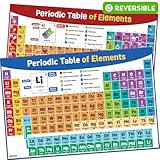
- More Than Just Science. Simplify complex concepts with a unique, reversible 1pc Periodic Table Poster for classroom use that presents all the scientific information kids need to know simply and clearly - sparking interest by making Chemistry relatable and interesting.
- Large, Reversible 2025 Updated Design with Color-Coded Element Groups. This fun 2-in-1 Periodic Table of Elements Poster for classroom use is fully up to date and based on 2025 IUPAC standards, showing a scientifically accurate standard table on one side and an illustrated version on the other with practical real-world uses of the elements. Each 24” x 16” large periodic table poster is color-coded according to element groups to enhance visual clarity, encourage a broad understanding and simplify learning.
- Vibrant, Engaging Visuals That Stimulate Interest. Featuring bright, colorful periodic table wall art learning posters designs that captivate children's attention, its eye-catching colors and illustrations encourage engagement without being overstimulating, ensuring distraction-free learning. Beautiful and engaging classroom decor that can be seen even from a distance.
- Clear, User-Friendly Back to School Supplies That are Easy to Understand. Our classroom educational posters utilize large, clear fonts in a clean layout for easy readability and seamless learning. Information is presented in a simple, straightforward layout that helps students grasp key concepts and easily remember details. Pair with periodic table flashcards for quicker learning.
- Reusable, Durable & Waterproof PVC Science Posters. Premium-quality Chemistry posters and back to school decorations made of waterproof PVC plastic, eliminating the need for lamination. Sturdy & durable with clear UV printing and a matte finish, it looks great and matches any room aesthetic. An engaging educational tool that will last for years without needing to repurchase. Order Periodic Table for Kids Now!
When two references disagree, do not select the value with the most attractive number of digits automatically. First identify whether each source is reporting an original experiment, a historical compilation, or an evaluated database result. Then compare the stated uncertainty and the source’s date or version. For promethium, that process explains why 5.554 eV appears in older material while 5.58187 eV is the current NIST reference value.
How to read the ± uncertainty
The notation 5.58187 ± 0.00004 eV communicates both a central value and an uncertainty associated with the NIST evaluation. It does not mean that every promethium atom has a slightly different first ionization energy within that interval. The quantity is a physical threshold for a specified quantum state; the ± term describes the precision or uncertainty of the reported determination.
Writing only “5.58187 eV” drops information that is important when comparing sources. Writing “5.58 eV” is acceptable for a broad introductory explanation, but it intentionally discards detail. A practical convention is:
Windows Errors? Fix Them Before They Spread
Repair common Windows errors and clear accumulated junk for a smoother, more stable PC - no reinstall needed.Free scan · no reinstallOutdated Drivers Are Slowing You Down
One free scan finds every outdated or missing driver and matches the right update for your exact hardware.Free scan · exact hardware match- Use 5.58187 ± 0.00004 eV in technical data work where the NIST evaluation and uncertainty are relevant.
- Use 5.582 eV in normal prose when a rounded value is easier to read.
- Use 5.5820 eV when reproducing the June 2024 NIST periodic-table display.
- Label values such as 5.554 ± 0.020 eV as historical rather than silently presenting them as current.
The electronic state behind the number
NIST identifies neutral promethium’s ground configuration as [Xe]4f5 6s2. The bracketed [Xe] represents the xenon core; the remaining notation specifies five electrons in the 4f subshell and two in the 6s subshell. NIST gives the corresponding ground level as 6H°5/2.
Rank #4

- COMPREHENSIVE SET: Package includes 2 educational chemistry posters featuring the periodic table of elements and essential chemistry reference information
- EDUCATIONAL VALUE: Perfect visual aid for high school and college students, featuring clear and detailed chemistry equations and reference charts
- CLASSROOM READY: Ideal for science classrooms, study rooms, or dorm rooms to provide quick access to important chemistry concepts
- REFERENCE MATERIAL: Functions as a helpful cheat sheet for chemistry formulas, equations, and periodic table information all in one convenient display
- VISUAL LEARNING: Clear and organized layout makes complex chemistry concepts easier to understand and remember
Specifying the state prevents an important category error. Ionization energy depends on the atom’s electronic state. Removing an electron from a neutral atom in an excited state can require a different amount of energy than removing one from the ground state. The quoted NIST number is therefore best written as the first ionization energy of neutral, ground-state promethium, not as a state-independent number for every possible Pm atom.
What the NIST value does—and does not—tell you
The value answers a narrowly defined reference question: how much energy is required to ionize one neutral promethium atom in the gas phase for the first time. It does not provide the second or third ionization energies, a bulk-metal work function, a solution redox potential, or the energy needed to ionize a promethium compound. Those measurements use different physical systems and conventions.
It also does not imply that promethium is commonly handled as a laboratory gas. Ionization-energy tables are atomic reference data. Their purpose is to support spectroscopy, atomic-structure calculations, plasma modeling, and consistent comparison among elements—not to prescribe a routine handling procedure for a sample.
A reliable way to cite the value
A complete citation in prose should include the number, uncertainty, species, state, and source version. For example:
Best Value
“The first ionization energy of neutral ground-state promethium is 5.58187 ± 0.00004 eV, according to the NIST Atomic Spectra Database, version 5.12.”
If you are discussing a classroom periodic table, state that NIST’s June 2024 table rounds the value to 5.5820 eV. If you are explaining historical discrepancies, identify the older value and its source year instead of blending it into the modern figure.
Common mistakes to avoid
- Confusing first and later ionizations: the quoted value starts with neutral Pm, not Pm+ or another ion.
- Treating a rounded table entry as a new experiment: 5.5820 eV is a compact display of the modern value.
- Dropping the uncertainty: the ±0.00004 eV term is part of the NIST report.
- Presenting historical values without dates: 5.554 ± 0.020 eV belongs to a 1960 compilation and should be labeled accordingly.
- Ignoring the electronic state: the NIST number applies to neutral promethium in its ground configuration, [Xe]4f5 6s2.
- Using “ionization energy” for a different property: bulk work functions, molecular ionization energies, and solution potentials are not interchangeable with this atomic gas-phase quantity.
Which value should you use?
- For a current scientific reference, use 5.58187 ± 0.00004 eV and name NIST Atomic Spectra Database version 5.12.
- For a readable sentence or a general table, round it to about 5.582 eV.
- For consistency with NIST’s June 2024 periodic-table layout, write 5.5820 eV.
- When reproducing an older source, retain its original value and uncertainty, such as 5.582 ± 0.010 eV (1978) or 5.554 ± 0.020 eV (1960 compilation), and mark it as historical.
The central fact is straightforward: modern NIST data place promethium’s first ionization energy at 5.58187 eV, with an evaluated uncertainty of 0.00004 eV. The surrounding qualifiers—neutral atom, gas phase, ground state, source version, and rounding—are what make that number scientifically meaningful.
Recommended Free Tools
Quick Recap
Product prices and availability are accurate as of the date/time indicated and are subject to change. Any price and availability information displayed on Amazon at the time of purchase will apply.

