
What’s actually slowing this PC down?
Pick the symptom - the matching free tool is one click away.
iTechGuides is reader-supported. When you buy through links on our site, we may earn an affiliate commission. As an Amazon Associate I earn from qualifying purchases. Learn more
Programmable networking silicon is hardware whose packet processing or infrastructure services can be controlled or extended through software. In an AI cluster, it can move traffic through the network fabric or take selected networking, storage, and security work off server CPUs. Those roles can help keep data moving efficiently, but a chip’s stated capacity does not by itself guarantee faster model training: results depend on the complete cluster design and workload.
What programmable networking silicon means
The term covers more than one kind of device. At one end are programmable switch ASICs, which process and forward traffic between servers and other systems across the network fabric. At the server boundary are DPUs and SmartNICs, which combine network connectivity with processing capabilities to handle selected infrastructure tasks that might otherwise consume host CPU resources.
| # | Preview | Product | Price | |
|---|---|---|---|---|
| 1 |
|
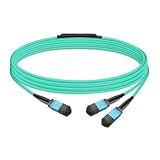
Gvdlink NMFP7E20 Optical Multimode Splitter Fiber Cable 5m (16.4ft) MPO12 to 2xMPO12 LSZH OM4 for... | $49.00 | Buy on Amazon |
These devices are related, but they are not interchangeable. A switch moves traffic through the fabric; a DPU or SmartNIC can perform services close to the server’s network interface. Some products combine networking with programmable cores or accelerators, while switch silicon is designed for high-capacity fabric forwarding. NVIDIA describes BlueField as a platform combining a high-speed network interface with programmable Arm cores and accelerators. Cisco describes Silicon One as a programmable architecture spanning switches and routers. These are vendor examples, not an exhaustive taxonomy or an independent product ranking.
The word “programmable” does not mean every buyer writes packet-processing code from scratch. It indicates that software can configure, control, or extend processing and infrastructure capabilities. The particular software model varies by product. For NVIDIA BlueField and ConnectX infrastructure capabilities, the associated platform is DOCA; a buyer should examine the software and operating tools required for the features they plan to use.
#1 Best Overall
- The MFP7E20-Nxxx cable for NVIDIA, is a multimode, 4-channel-to-two 2-channel splitter fiber cable. The Multiple Push On, 12 fiber, Angled Polished Connectors (MPO-12/APC) uses 8 active fibers to transmit light and 4 inactive fibers as strength members. The Angled Polished Connector has a 8-degree polished angle to deflect internal optical back reflections from entering the transceivers and distorting the signal quality
- The 4-channel end is inserted into a Twin port OSFP, 800Gb/s transceiver. The 2-channel ends are inserted into two, single-port 400Gb/s OSFP and/or QSFP112 transceivers which with only 2 fibers can output 200G rates. Two splitter fiber cables are used in the twin-port OSFP transceiver enabling four, 2-channel ends to four transceivers.
- The fibers are “crossover”, Type-B cables enable directly attaching two transceivers together and allow the transmit laser fiber on pin 1 to “crosses over” and align with pin 12 of the opposite fiber end transceiver photodetector.
- The typical usecase is linking OSFP switches to in ConnectX-7 network adapters and/or BlueField-3 Data Processing Units (DPUs) in compute and storage servers.
- Rigorous cable production testing ensures best out-of-the-box installation experience, performance, and durability. For NVIDIA’s optical solutions provide short, medium, and long reach scalability for all topologies, utilizing innovative optical technologies to enable high signal integrity and reliability
Why the distinction matters in an AI cluster
AI clusters connect accelerators, servers, storage systems, and network links so that data and work can move among them. A cluster can have powerful GPUs yet still depend on how quickly and reliably data reaches them, how the network handles traffic, and how much server CPU capacity is consumed by infrastructure services.
Programmable networking silicon addresses different points in that chain. Switch ASICs provide the fabric paths between machines. DPUs and SmartNICs can process selected networking, storage, or security functions at the server. The potential value is therefore architectural: moving traffic effectively and handling infrastructure work efficiently can help the rest of the system serve accelerators. It is not a universal promise of higher GPU utilization or shorter training runs.
It helps to think of the cluster as a coordinated system rather than a collection of isolated headline numbers. A switch capacity specification concerns the switch; a network-interface rate concerns a server-side connection; neither alone describes the rate at which an application moves useful data end to end. The topology, configuration, traffic patterns, software, and operation of the installed system all affect the result.
How it can help: three mechanisms
Moving traffic through the fabric
Programmable switches provide switching and routing capacity for scale-out links between cluster systems. Cisco positions its Silicon One G-Series for AI scale-out networking. On Cisco’s U.S. product page, the G300 is specified at 102.4 Tbps and the G200 at 51.2 Tbps. These are product capacity specifications, not application-throughput measurements or proof of a training-time improvement. See Cisco’s Silicon One product information.
A stated switching capacity describes a device specification; it does not tell you how a particular AI workload will perform across a complete network. The observed result also depends on the cluster’s topology, configuration, software, traffic patterns, and operations.
For a comparison, treat the G300 and G200 figures as specifications that distinguish product capacity classes, not as a direct ranking of the speed an AI job will achieve. To assess a real cluster, ask how the switch fits the planned fabric and what evidence exists for the target workload. The cited vendor materials do not provide independent, comparable workload benchmarks for those products.
Offloading server infrastructure work
A DPU or SmartNIC can handle selected networking, storage, and security tasks near a server’s network interface, reducing the infrastructure work assigned to its host CPU. NVIDIA describes BlueField as a networking platform that combines a network interface with Arm cores and accelerators; its DOCA software platform is used to configure BlueField and ConnectX infrastructure capabilities. NVIDIA characterizes DPUs as offloading, accelerating, and isolating data-centric tasks. Learn more from the BlueField platform page and DOCA overview.
The Tool Desk
Outbyte PC Repair FREERepair Windows errors before they cause bigger problemsFix Now →Outbyte Driver Updater FREEScan for outdated or missing drivers - takes under a minuteDriver Scan →Offload is useful only in relation to the actual services a deployment runs and the way they are assigned. It should not be treated as an automatic increase in application performance: the specific workload and system configuration determine whether the freed host resources or other capabilities matter.
In practical evaluation, identify which infrastructure functions are expected to run on the DPU or SmartNIC and which remain on the host. Then verify that the software supports the intended configuration and that the deployment can be operated and debugged by the team responsible for the cluster. Programmability and offload can create options, but the relevant question is whether those options solve a specific system need.
Supporting data movement and isolation
NVIDIA’s HGX reference architecture describes BlueField-3 SuperNICs with connectivity of up to 400 Gb/s, RDMA and RoCE acceleration, and secure multi-tenant use. That figure is a vendor device specification in a reference-architecture context, not a guaranteed end-to-end rate for every installation. The architecture describes intended capabilities; observed benefits depend on configuration and workload. See the HGX AI Factory components documentation.
These details illustrate why connection rate, data-movement features, and isolation are separate evaluation dimensions. A nominal rate is not the same as application throughput; RDMA and RoCE support are capabilities to assess in the planned deployment; and secure multi-tenant use is a stated design capability, not a blanket guarantee about a customer’s security posture. Confirm the relevant implementation and configuration for the system being considered.
Quick wins for a faster PC:
Scan for outdated or missing drivers - takes under a minuteDriver Scan →Repair Windows errors before they cause bigger problemsFix Now →Fix the driver behind crashes, sound loss and screen glitchesFind Drivers →Why the whole system determines the result
Networking silicon is one component in a system of compute, network interfaces, switches, links, storage, software, and management. NVIDIA’s GB300 NVL72 reference architecture, for example, brings together compute, BlueField-3 DPUs, ConnectX-8 SuperNICs, Spectrum-X Ethernet, NVLink, and management software. The example illustrates that cluster networking performance is designed across coordinated components and topology, rather than supplied by a single chip in isolation. The NVL72 AI Factory abstract describes that scalable-unit architecture.
The causal chain is conditional: a suitable fabric can move data between systems, while server-side offload can reduce selected host infrastructure work. Those capabilities may help a cluster serve accelerators efficiently. The official product materials and reference designs cited here describe capabilities and system designs; they do not establish an independent, workload-spanning benchmark proving that programmable networking silicon generally raises GPU utilization or shortens model training.
This distinction matters when translating a product description into a business case. “Designed for AI scale-out,” “up to” a stated connection rate, or support for a feature such as isolation describes capability or positioning. It does not specify the effect on every cluster, model, or training run. A meaningful evaluation needs evidence for the workload and deployment conditions that matter to the buyer, rather than an inference from a chip specification alone.
How to evaluate a solution for a cluster
There is no neutral vendor ranking established by the product information cited here. Compare components by their role and by fit with the system you intend to build, rather than treating headline capacity as a standalone verdict.
Recommended Free Tools
- Placement: Determine whether the device sits in the fabric as a switch or at the server as an adapter, DPU, or SmartNIC.
- Work performed: Identify whether it handles packet forwarding, storage movement, security, tenant isolation, or a combination of services.
- Performance evidence: Separate stated line rates and switching capacities from measured behavior on your workload. A specification is not a benchmark result.
- Software model: Check the APIs, SDKs, configuration options, and operational tools available, and determine whether deployment relies on an integrated vendor stack. For example, NVIDIA presents DOCA as the software platform for configuring BlueField and ConnectX infrastructure capabilities.
- Cluster fit: Confirm compatibility with the selected Ethernet or InfiniBand fabric, servers, accelerators, storage systems, and topology. For a specialized product such as a BlueField-3 DPU, verify fit for the specific server and intended deployment rather than assuming general compatibility.
- Operational trade-offs: Programmability and offload can add capabilities, but introduce software, deployment, power, management, and debugging considerations. Their scale varies by system; the product materials cited here do not quantify these trade-offs across vendors.
A practical review can start with the architecture diagram: mark which components forward traffic through the fabric and which run functions at the server edge. Next, map the intended services to the device that will handle them. Finally, check system compatibility and identify how performance will be validated after deployment. This sequence keeps a switch’s fabric role distinct from a DPU’s server-side role and avoids assuming that purchasing one device automatically supplies a complete networking design.
The cited materials do not provide purchase price or comparative cost data, so a cost comparison cannot be responsibly inferred from the capacity figures. For a procurement decision, request current pricing and deployment requirements for the exact configuration and account for the associated software, power, management, and operational considerations. Those factors are system-specific and are not quantified in the cited materials.
Independent reader supportYour contribution helps us test, update, and keep practical guides available for everyone.Specifications are not application guarantees
Product figures can help identify the intended class of hardware, but they need to be read with their qualifications. Cisco’s U.S. page lists G300 capacity of 102.4 Tbps and G200 capacity of 51.2 Tbps. NVIDIA’s current product and reference-architecture materials describe BlueField-3 platform connectivity up to 400 Gb/s and BlueField-4 platform connectivity at 800 Gb/s. These are vendor specifications, not independent comparative results or predictions of a particular application’s speed.
The BlueField figures are from undated current materials accessed in 2026; product specifications can change. Check the linked vendor pages for the current configuration and its precise specification before making a deployment decision. None of these numbers alone establishes end-to-end cluster throughput, workload performance, or training-time savings.
Free tools Windows power users keep installed
One-click scans. No signup required.
When comparing a switch capacity with a server-side connection figure, do not read the units as interchangeable measures of the same thing. The figures apply to different types of products and roles. They can inform design questions, but a useful comparison must preserve the distinction between fabric switching capacity, an interface’s stated connectivity, and measured application behavior.
Practical takeaway
Think of programmable networking silicon as a set of complementary tools: switch ASICs move traffic across the fabric, while DPUs and SmartNICs can offload infrastructure functions at the server. Their value in AI clusters comes from how well those roles fit the complete network and server design, including data movement, topology, software, compatibility, and operations. Treat vendor capacity figures as specifications and evaluate application benefits against the workload you plan to run.
Frequently Asked Questions
What is the difference between a programmable switch and a DPU or SmartNIC?
A programmable switch ASIC forwards traffic across the network fabric. A DPU or SmartNIC sits at the server boundary and can handle selected networking, storage, or security functions that might otherwise use the host CPU. They address different parts of a cluster and are not interchangeable.
Does programmable networking silicon automatically make AI training faster?
No. Better data movement or offloading selected host infrastructure work can help a system serve accelerators efficiently, but the cited materials do not establish a general training-time gain. Results depend on workload, topology, configuration, software, and operations.
What do the 102.4 Tbps, 51.2 Tbps, and 400 Gb/s figures mean?
Cisco lists 102.4 Tbps for Silicon One G300 and 51.2 Tbps for G200 as switch capacity specifications. NVIDIA’s HGX reference architecture describes BlueField-3 SuperNIC connectivity of up to 400 Gb/s. These figures refer to product capabilities, not equivalent measures or guaranteed application throughput.
What software is used with NVIDIA BlueField?
NVIDIA describes DOCA as the software platform for configuring BlueField and ConnectX infrastructure capabilities. Buyers should check the APIs, tools, configuration requirements, and operational model for the specific deployment.
Is a BlueField-3 DPU compatible with any server?
Compatibility should be confirmed for the specific server and intended deployment. The cited materials do not establish universal compatibility, so do not assume a specialized enterprise product will fit every system.
How much does programmable networking silicon cost?
The cited materials do not provide pricing or comparative cost data. Request current pricing for the exact device and configuration, and assess deployment, software, power, management, and operational requirements separately.
The Bottom Line
Programmable networking silicon can support AI clusters through two distinct roles: switches move traffic across the fabric, while DPUs and SmartNICs can offload selected server-side infrastructure work. Specifications and vendor reference architectures show intended capabilities, not guaranteed application gains. Evaluate fit, software, workload evidence, and operational requirements across the complete cluster.
Quick Recap
Product prices and availability are accurate as of the date/time indicated and are subject to change. Any price and availability information displayed on Amazon at the time of purchase will apply.

