
Quick wins for a faster PC:
Scan for outdated or missing drivers - takes under a minuteDriver Scan →Repair Windows errors before they cause bigger problemsFix Now →Fix the driver behind crashes, sound loss and screen glitchesFind Drivers →iTechGuides is reader-supported. When you buy through links on our site, we may earn an affiliate commission. As an Amazon Associate I earn from qualifying purchases. Learn more
Embodied AI is artificial intelligence built into a physical system that can sense the world, decide what to do, act through a body, and use the results to guide what happens next. A voice assistant such as Alexa is primarily a cloud-based voice service: you speak, it processes the request, and it replies or controls connected services. Alexa can run on a physical speaker and can command smart-home devices, but a speaker that hears a request is not automatically an embodied AI system. The decisive question is whether the AI itself continuously perceives and changes its surrounding physical environment through sensors and actuators.
What embodied AI means
The most precise current definition comes from ITU-T Recommendation F.748.66 (approved December 14, 2025). It defines embodied AI as “Artificial intelligence integrated into physical systems that interact autonomously with and adapt to the physical world.”
That sentence has three important parts:
- Integrated into a physical system: the AI is connected to hardware that can sense, compute and act. The body may be a robot, vehicle, drone, industrial machine or another device.
- Interact with the physical world: the system receives information from its surroundings and produces physical effects, such as moving, grasping, steering or opening something.
- Adapt: what the system observes after an action can influence later decisions. Adaptation can be narrow and task-specific; it does not imply human-level learning or general intelligence.
Embodiment is therefore a capability and architecture, not a product shape. A humanoid is one possible body, but it is no more a required form than a car, robotic arm or quadcopter.
What makes a system “embodied”?
In its framework, the ITU describes a physical body as more than an outer shell. It can include perception sensors, computing hardware, execution mechanisms, drive systems and an energy supply. The associated AI pipeline covers perception, decision-making, execution, interaction and learning.
#1 Best Overall
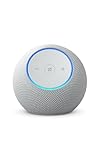
- Meet Echo Dot Max: Experience rich room-filling sound that automatically adapts to your space and fine-tunes playback. Features a built-in smart home hub and Omnisense technology for highly personalized experiences.
- Music to your ears: With nearly 3x the bass versus Echo Dot (2022 release), it fits beautifully in any space, delivering your personal sound stage with deep bass and enhanced clarity. Listen to streaming services, such as Amazon Music, Apple Music, Spotify, and SiriusXM. Encore!
- Do more with device pairing: Connect compatible Echo smart speakers and smart displays in different rooms, or pair with a second Echo Dot Max to enjoy even richer sound
- Simple smart home control: Set routines, pair and control lights, locks, and thousands of smart home devices that work with Alexa without needing a separate smart home hub. With Omnisense technology, you can activate routines via temperature or presence detection.
- Say goodbye to drop-offs and buffering: With eero Built-in, Echo Dot Max doubles as a mesh wifi extender, adding up to 1,000 sq. ft. of wifi coverage to your existing eero network.
Perception
Sensors turn physical conditions into data. Depending on the task, those sensors may include cameras, depth sensors, microphones, touch sensors, force or torque sensors, wheel encoders, inertial units, lidar, temperature probes or proximity sensors. A system does not need every sensor type. It needs the sensors appropriate to the environment and task.
Decision-making
Software interprets sensor data, estimates what is happening, chooses an action and may plan several steps. A warehouse robot might identify a pallet, calculate a route and select a pickup sequence. More advanced systems can combine language and vision with spatial and temporal reasoning, but a marketing label alone does not prove that those abilities work reliably in every setting.
Execution
Actuators turn decisions into movement or other physical changes. Examples include motors that drive wheels, joints that move an arm, grippers that hold objects, brakes that slow a vehicle, or valves that regulate a process. Speech or a screen response is output, but it is not physical execution in the same sense as moving a body or manipulating an object.
Feedback and adaptation
After acting, the system can observe the outcome: an object may have slipped, a doorway may be blocked, or a person may have entered the path. Feedback can trigger a correction or a new plan. The term “adapt” should be read carefully. Some systems adjust only within a programmed operating range; others update policies from experience. Embodied AI does not guarantee online learning, broad autonomy or independent goals.
How Alexa differs
Amazon describes Alexa as a cloud-based voice service available through Amazon and third-party devices. Its central interface is speech: the user asks a question or gives a command, the service interprets it, and Alexa responds with audio, information or an action through an integrated service.
Rank #2

- Your favorite music and content – Play music, audiobooks, and podcasts from Amazon Music, Apple Music, Spotify and others or via Bluetooth throughout your home.
- Alexa is happy to help – Ask Alexa for weather updates and to set hands-free timers, get answers to your questions and even hear jokes. Need a few extra minutes in the morning? Just tap your Echo Dot to snooze your alarm.
- Keep your home comfortable – Control compatible smart home devices with your voice and routines triggered by built-in motion or indoor temperature sensors. Create routines to automatically turn on lights when you walk into a room, or start a fan if the inside temperature goes above your comfort zone.
- Do more with device pairing – Fill your home with music using compatible Echo devices in different rooms, or create a home theatre system with Fire TV.
- Say goodbye to drop-offs and buffering - With eero Built-in, Echo Dot doubles as a mesh wifi extender, adding up to 1,000 sq. ft. of wifi coverage to your existing eero network.
Alexa can be installed in a physical speaker, vehicle or appliance, and it can control lights, locks and other connected equipment. Those facts do not make every Alexa interaction embodied AI. The speaker is a physical host, while the voice service is primarily handling language and service requests. The distinction is whether the AI itself has an ongoing perception-and-action loop in the surrounding world.
For example, “Set a timer for 10 minutes” requires speech recognition, language understanding and a software response. A mobile robot that detects a cup, plans a path around a chair, reaches for the cup, senses its grip and places it on a table is performing embodied interaction. Voice could be the command channel for that robot, but voice is only one input to a larger physical control system.
Outdated Drivers Are Slowing You Down
One free scan finds every outdated or missing driver and matches the right update for your exact hardware.Free scan · exact hardware matchWindows Errors? Fix Them Before They Spread
Repair common Windows errors and clear accumulated junk for a smoother, more stable PC - no reinstall needed.Free scan · no reinstallEmbodied AI versus a voice assistant at a glance
| Comparison axis | Voice assistant such as Alexa | Embodied AI system |
|---|---|---|
| Primary input | Spoken requests, plus information from connected services and device context | Environmental input from cameras, depth, touch, force, motion and other task-specific sensors; voice may also be available |
| Primary output | Speech, text, information or commands sent to software and connected devices | Movement, manipulation, steering or another physical action, often alongside speech or a display |
| Feedback | Usually confirms a request or returns a result from a service | Observes what happened in the environment and can adjust a plan or action |
| Environment | A voice interface and digital services, even when hosted in a physical speaker | A changing physical setting with objects, obstacles, surfaces, people and constraints |
| Autonomy | Typically waits for a request or a configured trigger, then performs a defined service action | May navigate, plan and act with varying degrees of independence; the actual level must be verified for the specific system |
| Learning and adaptation | Personalization and service-side improvements do not necessarily change physical behavior | May adapt to sensor feedback, task conditions or prior experience; not every system learns online |
| Typical failure | Misheard speech, misunderstood intent or an unavailable service | Localization errors, blocked paths, poor object recognition, unsafe contact, grasp failure or an incorrect recovery decision |
These are comparison questions rather than strict product categories. A voice assistant can be a control interface for an embodied robot, and an embodied machine can include a conversational assistant. The same product may contain both subsystems.
Examples of embodied AI bodies
The ITU framework includes several possible physical forms:
- Humanoid robots: machines with human-like body arrangements for environments designed around people.
- Quadruped robots: legged platforms that can traverse terrain where wheels are unsuitable.
- Robot arms: fixed or mobile manipulators used for picking, assembly, inspection or service tasks.
- Autonomous vehicles: cars, delivery vehicles, agricultural machines or other vehicles that sense and act while moving.
- Drones: aircraft that perceive conditions and control flight through their onboard systems.
Microsoft Research uses “physical AI” for the closely related idea of systems that interact with and learn from the physical world through sensory inputs and actions. Its examples of physical tasks include opening doors, picking up objects and navigating around obstacles. Terminology varies: “embodied AI” and “physical AI” often overlap, so identify the definition being used when a vendor or paper uses one of them.
Rank #3

- Your favorite music and content – Play music, audiobooks, and podcasts from Amazon Music, Apple Music, Spotify and others or via Bluetooth throughout your home.
- Alexa is happy to help – Ask Alexa for weather updates and to set hands-free timers, get answers to your questions and even hear jokes. Need a few extra minutes in the morning? Just tap your Echo Dot to snooze your alarm.
- Keep your home comfortable – Control compatible smart home devices with your voice and routines triggered by built-in motion or indoor temperature sensors. Create routines to automatically turn on lights when you walk into a room, or start a fan if the inside temperature goes above your comfort zone.
- Do more with device pairing – Fill your home with music using compatible Echo devices in different rooms, or create a home theatre system with Fire TV.
- Say goodbye to drop-offs and buffering - With eero Built-in, Echo Dot doubles as a mesh wifi extender, adding up to 1,000 sq. ft. of wifi coverage to your existing eero network.
Why a robot is not automatically embodied AI
A robot label tells you that a machine has actuators or mechanical capabilities; it does not establish how much intelligence is present. Microsoft notes that robots are typically machines equipped with actuators for specific tasks. A factory arm that repeats a fixed trajectory can be highly useful without perceiving a changing scene or adapting its plan.
When evaluating a claimed embodied-AI system, separate the hardware from the intelligence:
- Hardware: What sensors, actuators, processors and power sources are installed?
- Control: Are actions fixed scripts, feedback controllers, learned policies or a mixture?
- Autonomy: Which decisions can the system make without a person, and within what boundaries?
- Adaptation: Can it recover from variation, or does it stop when conditions differ from a programmed case?
- Learning: Is learning performed during operation, during offline training, or not at all?
- Safety: What happens when confidence is low, a person enters the workspace or a sensor fails?
A system may be embodied while remaining narrow, supervised and conservative. Those limits are engineering characteristics, not evidence that the system is mislabeled.
Can Alexa and embodied AI work together?
Yes. Voice and embodiment describe different layers. Voice is a communication modality; embodiment is the connection between AI, physical sensing and physical action.
Voice as a command channel
A person could say “bring the box from the shelf,” while a robot uses cameras, depth sensing and force feedback to locate, grasp and carry it. The voice request supplies intent; the embodied controller handles perception, planning, execution and recovery.
Do these 3 things before closing this tab:
1Scan for outdated or missing drivers - takes under a minute2Repair Windows errors before they cause bigger problems3Fix the driver behind crashes, sound loss and screen glitchesRank #4

- Your favorite music and content – Play music, audiobooks, and podcasts from Amazon Music, Apple Music, Spotify and others or via Bluetooth throughout your home.
- Alexa is happy to help – Ask Alexa for weather updates and to set hands-free timers, get answers to your questions and even hear jokes. Need a few extra minutes in the morning? Just tap your Echo Dot to snooze your alarm.
- Keep your home comfortable – Control compatible smart home devices with your voice and routines triggered by built-in motion or indoor temperature sensors. Create routines to automatically turn on lights when you walk into a room, or start a fan if the inside temperature goes above your comfort zone.
- Do more with device pairing – Fill your home with music using compatible Echo devices in different rooms, or create a home theatre system with Fire TV.
- Say goodbye to drop-offs and buffering - With eero Built-in, Echo Dot doubles as a mesh wifi extender, adding up to 1,000 sq. ft. of wifi coverage to your existing eero network.
Physical devices as smart-home endpoints
Alexa can send commands to lights, thermostats or locks. In that arrangement, Alexa is coordinating services, while each endpoint performs its own device-level action. Whether the overall setup qualifies as embodied AI depends on where perception, decision-making and adaptation occur. A thermostat following a fixed rule is not equivalent to a mobile system that perceives a room and autonomously changes its behavior in response.
Why the boundary matters
Calling every voice-controlled device “embodied AI” hides important differences in sensing, safety and autonomy. Conversely, saying Alexa has no physical component is also inaccurate: Amazon documents the service on physical devices. The useful test is the AI’s role in the physical loop, not whether the product has a casing or accepts spoken commands.
A practical test for classifying a system
Use these questions when a product description is vague:
- What does it sense? Look for environmental sensors, not only a microphone receiving a command.
- What can it physically change? Identify motors, wheels, arms, flight controls or other actuators.
- Does it close the loop? After acting, does it observe the result and use that observation?
- How much can it initiate? Determine whether it waits for every instruction or can pursue a defined task on its own.
- How does it handle variation? Check documented behavior around obstacles, unfamiliar objects, lighting changes and sensor uncertainty.
- What evidence supports learning? Distinguish a trained model, a scripted routine, online adaptation and a research demonstration.
If the answers show environmental sensing, physical action and feedback-driven control, the system fits the practical meaning of embodied AI. If the answers show speech recognition and service responses only, it is better described as a voice assistant, even when it runs on a physical device.
Embodied AI, physical AI and intelligent agents
The terminology sits within a wider field. ISO/TR 9241-810:2020 discusses physically embodied robotic and autonomous-vehicle systems alongside interactive software agents and agents that act without active user input. This framing treats embodiment as one dimension of intelligent systems, alongside how an agent interacts with people and how independently it acts.
Best Value

- Meet Echo Dot Max: Experience rich room-filling sound that automatically adapts to your space and fine-tunes playback. Features a built-in smart home hub and Omnisense technology for highly personalized experiences.
- Music to your ears: With nearly 3x the bass versus Echo Dot (2022 release), it fits beautifully in any space, delivering your personal sound stage with deep bass and enhanced clarity. Listen to streaming services, such as Amazon Music, Apple Music, Spotify, and SiriusXM. Encore!
- Do more with device pairing: Connect compatible Echo smart speakers and smart displays in different rooms, or pair with a second Echo Dot Max to enjoy even richer sound
- Simple smart home control: Set routines, pair and control lights, locks, and thousands of smart home devices that work with Alexa without needing a separate smart home hub. With Omnisense technology, you can activate routines via temperature or presence detection.
- Say goodbye to drop-offs and buffering - With eero Built-in, Echo Dot Max doubles as a mesh wifi extender, adding up to 1,000 sq. ft. of wifi coverage to your existing eero network.
That distinction helps avoid a common mistake: treating “embodied” as a synonym for consciousness, human-like reasoning or a humanoid appearance. It refers to the relationship between an AI system and a physical environment. Intelligence, autonomy, learning ability and reliability still have to be assessed separately.
What current robotics models add—and what they do not prove
Some recent vision-language-action systems are designed to connect language and visual reasoning with robot actions. For example, Google’s Gemini Robotics ER documentation describes models that can support perception, spatial and temporal reasoning, multistep planning and orchestration of robots and tools. The documentation reported ER 2 as the latest model at the time it was updated in July 2026 and said ER 1.6 was deprecated on August 31, 2026.
Those statements describe documented model capabilities and availability, not a guarantee of dependable performance in every robot, workplace or home. Real-world behavior depends on sensors, calibration, mechanical design, control software, network conditions, safety limits and the task environment. A demonstration or preview model should not be treated as proof of unsupervised field reliability.
The Tool Desk
Outbyte Driver Updater FREEFix the driver behind crashes, sound loss and screen glitchesFind Drivers →Outbyte PC Repair FREEClear out junk files and repair common Windows errorsFree Scan →Benefits and risks of adding embodiment
What embodiment enables
- Tasks that require reaching, carrying, steering, inspection or navigation.
- Responses to physical conditions that cannot be represented adequately by a text command alone.
- Closed-loop operation in which the system checks outcomes rather than assuming an action succeeded.
- Natural-language interaction combined with spatial and mechanical behavior.
What embodiment makes harder
- Physical mistakes can damage equipment, property or people, rather than merely returning an incorrect sentence.
- Sensor noise, occlusion, slippery objects, changing lighting and unexpected obstacles complicate perception.
- Latency, limited battery capacity, connectivity loss and mechanical wear affect behavior.
- Testing must cover rare conditions and safe recovery, not only normal demonstrations.
- Privacy and security concerns extend to cameras, microphones, location data and control of physical devices.
For that reason, a credible description should state the operating environment, supervision requirements, safety mechanisms and known limitations instead of implying that embodiment automatically delivers general-purpose intelligence.
The bottom line
Embodied AI is AI that participates in a physical perception-and-action loop: it senses the world, decides, acts through a body and uses feedback to handle changing conditions. Alexa is primarily a cloud-based voice service that understands speech and returns information or commands, although it can run on physical devices and control smart-home equipment. They can be combined, but they are not interchangeable labels. To tell them apart, examine the sensors, actuators, feedback, autonomy and adaptation of the specific system—not its voice interface, casing or robot branding.
Quick Recap
Product prices and availability are accurate as of the date/time indicated and are subject to change. Any price and availability information displayed on Amazon at the time of purchase will apply.

