
Crashes, No Sound, or Screen Glitches?
Random freezes, missing sound and display glitches usually trace back to one bad driver. Find and replace yours safely.Free scan · under a minuteWindows Errors? Fix Them Before They Spread
Repair common Windows errors and clear accumulated junk for a smoother, more stable PC - no reinstall needed.Free scan · no reinstalliTechGuides is reader-supported. When you buy through links on our site, we may earn an affiliate commission. As an Amazon Associate I earn from qualifying purchases. Learn more
A small nuclear reactor is generally an advanced fission reactor that produces up to about 300 megawatts of electricity (MWe) per unit. It is often called a small modular reactor, or SMR: “small” describes its output relative to conventional large reactors, while “modular” refers to a design approach that can use factory-made components or modules transported to a site. The 300 MWe benchmark is common, not a universal legal cutoff.
What counts as a small nuclear reactor?
The International Atomic Energy Agency (IAEA) describes small modular reactors as advanced reactors with electrical capacity up to 300 MWe per unit. The OECD Nuclear Energy Agency (NEA) uses a similar threshold, describing SMRs as reactors below 300 MWe. These are useful general definitions, but authorities may set different boundaries for specific rules or programs.

For example, a U.S. Nuclear Regulatory Commission fee regulation defines the relevant class by licensed thermal power: no more than 1,000 megawatts thermal (MWt) per module, corresponding to an SMR generating 300 MWe or less per module. A U.S. Code provision for infrastructure planning defines an SMR as an advanced reactor with rated capacity below 300 electrical megawatts. The U.S. Department of Energy’s Gen III+ SMR program, meanwhile, uses a program-specific range of 50–350 MWe-equivalent per unit. None of those context-specific definitions replaces the general rule of thumb.
Sources: IAEA, NEA, NRC fee regulation, 42 U.S.C. § 18751, and the DOE Gen III+ program Q&A.
#1 Best Overall

- Luminous DIY Arc Reactor Model: This DIY assembly kit features a bright blue LED light. The finished MK1 Arc Reactor emits an impressive glow, making it a standout piece for desk decorations or computer case modifications
- Engaging DIY Assembly Kit: The arc reactor model comes as a disassembled kit with detailed instructions. Enjoy the hands-on building experience, with spare essential components included for a successful assembly
- USB-Powered with Acrylic Stand: Includes a USB power cable with a convenient on/off switch and a clear acrylic display stand. Easily power the light-up reactor via any 5V adapter, power bank, or computer
- Versatile Creative Decor: Perfect as a unique nightlight or for various projects like electric vehicle lighting upgrades. This LED arc reactor kit sparks creativity, allowing you to personalize your space
- Assembly & Power Requirements: Glue is required (not included) for assembly. The MK1 reactor model requires a standard 5V USB charging adapter (not included) to illuminate the blue light
What does “modular” mean?
Modularity refers to manufacturing and deployment: components or modules may be fabricated in factories and transported for installation at a site. Some concepts also use multiple reactor modules, allowing capacity to be added in units rather than built all at once as one very large reactor.
That approach is intended to support serial production, deployment flexibility, and potentially more manageable construction. It does not guarantee a lower total cost or shorter schedule. Licensing, financing, suppliers, site conditions, construction, and the project’s scale all affect outcomes.
Are all SMRs the same technology?
No. SMR is a size-and-deployment category, not the name of one reactor design. Designs include familiar light-water reactors as well as concepts using gas, liquid metal, or molten salt as coolants. Fuel types and configurations also vary; some designs use high-assay low-enriched uranium (HALEU), which is enriched above the low-enriched uranium used by most operating reactors.
Quick wins for a faster PC:
Clear out junk files and repair common Windows errorsFree Scan →Fix the driver behind crashes, sound loss and screen glitchesFind Drivers →Rank #2
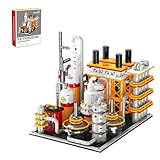
- 【Modular Oil Refinery – Combine or Display Alone】This model features a detailed oil refining plant with tanks, towers, and reactors. It’s the second module in the petroleum engineering series, and can be displayed alone or combined with the oil pump (JJ9221) and storage terminal (JJ9223) to build a complete industrial layout.
- 【Easy Assembly with Realistic Scale】Comes with 734 high-quality ABS bricks and a printed instruction manual. The finished model measures 10.08" (L) × 7.8" (W) × 8.58" (H), ideal for shelf display or integrating into a larger brick city.
- 【Multi-Tower Industrial Detail】Includes complex piping systems, catalytic towers, distillation columns, and refining control units—all accurately presented to simulate a realistic refinery structure. A perfect building challenge for fans of industrial and mechanical design.
- 【Ideal Display Model for Kids & Adults】Whether used as a shelf display or part of a miniature brick city, this module brings industrial realism to any setting. Perfect for those who enjoy mechanical builds or urban diorama enthusiasts.
- 【Great Gift for Engineers & Brick Lovers】Makes an excellent gift for birthdays, holidays, or special occasions. A thoughtful choice for fans of construction toys, STEM, or oil & gas-themed models.
The IAEA’s catalogue covers multiple design families and stages of development. Its broad catalogue includes small reactor designs that do not strictly meet the SMR definition, so inclusion in a catalogue should not be treated as proof that a reactor is an SMR or is commercially operating.
Sources: U.S. Energy Information Administration (EIA) and the IAEA 2024 SMR catalogue.
What might a small nuclear reactor be used for?
SMRs are considered for electricity generation on national grids and for smaller grids, remote communities, or sites with limited transmission infrastructure. Developers and researchers also consider non-electric uses, including industrial process heat, combined heat and power, desalination, and hydrogen production.
Rank #3
- Exquisite Appearance: This is a simple MK1 Arc Reactor model with an integrated blue LED light that emits an impressive glow, whether during the day or at night.
- Disassembled Kit: This reactor comes as a DIY assembly kit with a detailed instruction to ensure you can successfully complete the assembly.
- Complete Accessories: Including a USB power cable with a switch and a simple acrylic stand. Additionally, essential components come with spares for replacement in case of damage during assembly.
- Home Decor Piece: Used for various creative projects, such as computer case modifications, electric vehicle lighting upgrades, or as a unique nightlight or desk decoration. Arouse your creativity and imagination to personalize your decor.
- Notes: Glue is required (Not Included) during the assembly process. You will also need to provide your own 5V USB charging adapter, or you can power it by connecting to a power bank or computer.
These are potential applications, not capabilities shared by every design. Whether a reactor can meet a particular need depends on its design, customer requirements, fuel availability, licensing, local infrastructure, and project economics.
What’s actually slowing this PC down?
Pick the symptom - the matching free tool is one click away.
Sources: EIA and the IAEA International Conference on Small Modular Reactors and their Applications.
How is an SMR different from a microreactor?
Microreactor thresholds vary too, so the authority and context matter. EIA says microreactors are generally 20 MW or less. A U.S. statutory provision sets a ceiling of no greater than 50 MW for a microreactor in that provision’s context. These definitions do not establish one worldwide dividing line between microreactors and SMRs.
Rank #4

- Highly Accurate 1:1 Replica – This Arc Reactor Model with Light is meticulously designed based on the MK3 Generation Ark Palladium Reactor, featuring precise mechanical detailing and a metallic finish for an authentic sci-fi aesthetic
- Interactive Light-Up Effect – Insert the included palladium element plate to activate the glowing Arc Reactor light, a must-have for technology enthusiasts and collectors
- Premium Craftsmanship – Built with high-quality materials, this high-tech decorative item showcases intricate mechanical lines and a durable metal-plated exterior, making it a standout desk accessory or display piece
- Sci-Fi Ambiance & Versatile Display – The cool blue glow creates an immersive atmosphere, perfect for enhancing your workspace, gaming room, or as a creative model for cosplay and movie-themed decor
- Ideal Gift for Fans – Whether as a birthday present, anniversary surprise, or a treat for yourself, this collectible Ark Palladium Reactor is a unique gift for collectors and tech lovers
Sources: EIA specifications reviewed as of February 2026 and 42 U.S.C. § 18751.
Independent reader supportYour contribution helps us test, update, and keep practical guides available for everyone.Do small size and passive features make SMRs automatically safer or cheaper?
No general conclusion follows from the category alone. Some designs use passive or inherent safety features, such as natural circulation to cool a reactor under certain conditions. Such features are design-specific; they do not establish that every SMR is safer than a large reactor or eliminate the need for regulation, operators, security, emergency planning, or waste management.
Likewise, factory production and smaller units are proposed ways to improve flexibility or reduce upfront capital requirements, not proof of lower lifetime costs or faster delivery. Safety and economics must be assessed for the specific design and project, including licensing, fuel qualification and supply, construction, financing, and waste arrangements.
Sources: European Commission, IAEA, and DOE.
What should you compare when evaluating two SMR designs?
Capacity alone does not tell you whether one project fits a particular site or customer. Compare the designs on the same practical dimensions:
- Output: net electrical capacity per module and total plant output; whether the design can also supply heat.
- Technology and fuel: reactor type, coolant, fuel type, and the availability and qualification of its fuel supply.
- Readiness: licensing and demonstration status in the jurisdiction where it is proposed.
- Delivery plan: what will be factory-made, how it will be transported, and how construction and additional modules are planned.
- Project fit: site, grid, customer needs, safety case, waste-management arrangements, and project-specific economics.
Useful references include the EIA overview, the IAEA catalogue, and the IAEA conference program, which covers technical and deployment issues including safety, regulation, safeguards, siting, and fuel cycles.
Quick Recap
Product prices and availability are accurate as of the date/time indicated and are subject to change. Any price and availability information displayed on Amazon at the time of purchase will apply.

