
iTechGuides is reader-supported. When you buy through links on our site, we may earn an affiliate commission. As an Amazon Associate I earn from qualifying purchases. Learn more
Ground-penetrating radar (GPR) can reveal buried features when they create a detectable contrast with surrounding material, but it does not identify every object or prove that an area is clear. Its results depend on what is buried, how deep it is, the soil or material around it, the antenna and survey setup, and the skill of the people interpreting the scan.
What a GPR scan actually shows
Ground-penetrating radar sends electromagnetic energy into the ground or another material and records energy reflected back toward an antenna. Reflections occur where electrical properties change, especially dielectric permittivity and electrical conductivity. A boundary between two materials, an object and its backfill, or a void and the material around it may produce a visible response.
That response is evidence of a contrast or anomaly—not a label saying “pipe,” “cavity,” or “rock.” Different objects can produce similar-looking signals, and one object can look different in different settings. Interpretation therefore draws on the scan pattern, the expected target, the site conditions, and other available information. When a decision has serious consequences, an image alone should not be treated as definitive identification.
The Tool Desk
Outbyte PC Repair FREERepair Windows errors before they cause bigger problemsFix Now →Outbyte Driver Updater FREEScan for outdated or missing drivers - takes under a minuteDriver Scan →GPR is useful because it can investigate below a surface without first digging or cutting into it. But “non-invasive” does not mean “all-seeing”: the method only detects features that produce a usable signal and that the survey can resolve.
#1 Best Overall

- TECHNOLOGY: The Uig ground scanner works with three professional scanning and imaging technologies with a multi-functional imaging sensor with modern and highly effective technologies supported by a lightweight movable arm to facilitate scanning and imaging of targets, in addition to the option of distinguishing metals and voids with two different sounds.
- SIZE AND WEIGHT: The Uig ground scanner is characterized by its small size, and lightweight, which makes it preferred by prospectors, due to its ease of use in exploration and searches for precious metals, buried treasures, and voids in the ground.
- ACCURACY: High speed and accuracy in detecting targets underground.
- EFFECTIVE: Very effective in scanning targets inside ancient archaeological walls.
- LANGUAGES: A list of several languages supported by the application attached to the device, namely: (English – Arabic – Spanish – French – German – Portuguese).LANGUAGES: A list of several languages supported by the application attached to the device, namely: (English – Arabic – Spanish – French – German – Portuguese).
What GPR can reveal
Some buried utilities, including nonmetallic pipes
GPR may respond to metallic and nonmetallic utilities if a pipe or line differs sufficiently from the surrounding soil or backfill. The Federal Highway Administration (FHWA) describes a strong response for metal or steel, a medium-to-strong response for PVC and concrete, and weaker responses for some electrical and fiber-optic lines. These are general response categories, not guarantees for a particular installation: the FHWA cautions that results are highly site-specific.
That means GPR can help locate a plastic water pipe, but it cannot promise to find every plastic pipe. Detectability depends on factors such as the pipe’s size and depth, its contents and condition, the surrounding material, and whether the signal can distinguish it from nearby features. A utility that produces too little contrast, lies beyond the useful penetration depth, or is obscured by another feature may not show clearly.
Layers and features in pavement and concrete
FHWA describes GPR applications for identifying pavement layers and features such as dowels and reinforcement, as well as investigating some defects or voids. In concrete, the scan can reveal responses from objects or boundaries that contrast electrically with the surrounding material. It does not make concrete transparent in the way an optical window is: the useful result depends on the material, the target, the antenna, and the survey conditions.
Recommended Free Tools
A defect or void may be detectable when it contains a meaningful pocket of air or water that produces a contrast. Even then, the reflected signal may not show the void’s bottom. If the lower boundary is missing or unclear, estimating the void’s internal thickness can be difficult. A visible anomaly can help identify where further investigation is warranted without establishing the exact shape or extent of a defect.
Bedrock depth and fracture zones
USGS reports describe using GPR to image bedrock depth and fracture zones. This works only when the signal can travel to the feature and return with enough strength to be interpreted. A subsurface interface that is theoretically detectable may still be out of reach if overlying material attenuates the signal.
Rank #2

- HIGHLY PRECISE DEVICE: Experience the power of deep seeking and ground penetrating radar technology. This device rapidly detects dozens of meters downward to quickly distinguish between valuable and non-valuable gemstones.
- LONG RANGE DETECTION: This hand held detector features a full digital system locating diamonds and 18 different species of gemstones in the ground with extreme accuracy. Maximum capacity amounts to 3000 meters in distance and 120 meters in depth, with a 10-hour battery life.
- NEWLY DESIGNED SYSTEM: System features include large and small diamond search systems as well as a search system specifically designed for gemstones.
- INDUSTRY LEADERS: Detector Power has over 10 years of experience so it’s no surprise that our products lead the industry in design and functionality. We put the power of detecting into your hands!
- AUTHORIZATION AND GUARANTEE: When purchasing a product from us, prior bank authorization may be necessary to prevent order cancellation. Please confirm this with your bank before your purchase in an effort to avoid order delays. Detector Power lives up to our reputation of excellence through a guaranteed manufacturer's warranty on all products. We are also proud to offer a hassle-free 15-day return policy to our valued customers.
What GPR cannot reliably establish
That every utility or object has been found
A survey is not proof that the surveyed area contains no other buried features. FHWA warns that utility surveys may fail to detect every utility of interest. Size, depth, material, condition, backfill, nearby features, surface conditions, and survey coverage can all affect whether a line is visible. A clear-looking scan therefore does not certify a site as utility-free.
For excavation or construction planning, treat GPR as one source of evidence rather than a substitute for the applicable utility-locating and verification process. FHWA’s utility guidance calls for calibration with other non-destructive evaluation (NDE) methods and ground-truth activities. The right corroboration depends on the decision and the site; the scan should not be used by itself to justify a high-consequence assumption about what is underground.
What’s actually slowing this PC down?
Pick the symptom - the matching free tool is one click away.
What is directly below metal
Metal reflects virtually all incident radar energy, according to FHWA. A metal object or layer can consequently obscure features beneath it. A strong response from a metal surface does not mean the material below that surface has been inspected successfully; the barrier may prevent a useful signal from reaching it and returning.
Deep targets in every type of soil
There is no single dependable depth figure for GPR. Conductive clay-rich material can limit imaging of deeper interfaces, and significant moisture can weaken the signal. Greater depth is possible under some conditions than others, but a number quoted without specifying the target and site can mislead.
USGS identifies attenuation as the primary depth constraint for this shallow, high-resolution method. In a separate water-body context, USGS reports that GPR cannot penetrate electrically conductive water or subsurface sediments. That finding describes those conductive conditions; it should not be turned into a claim that every body of water or every wet site has identical behavior.
Rank #3
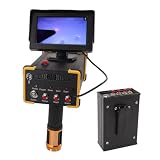
- 15m Deep Detection & 1000m Long-Range Scanning: Professional-grade underground metal detector reaches up to 15 meters (49 feet) in depth and covers a long-range search area of 1000 meters (3280 feet). Ideal for locating gold, silver, copper, and other in vast outdoor areas
- Microcomputer Control with Self-Calibration System: Built-in microcomputer control chip unit enables automatic calibration and self-checking before each use. The intelligent system scans and detects quickly, significantly improving working efficiency for treasure hunters and professional prospectors.
- High-Sensitivity Detection with Fast Response: Features excellent sensitivity and stability with rapid inductive response speed. The advanced detection technology accurately identifies different metal types, reducing false signals and saving you time during searches
- Durable ABS Construction with Portable Design: Crafted from lightweight yet sturdy ABS material for long-lasting durability in the field. Compact and ergonomic design makes it easy to carry during extended treasure expeditions.
- Versatile Use for Treasure, , & Jewelry : Perfect for professional gold prospecting, , collecting, and jewelry recovery. Whether you're exploring historic sites, beaches, or remote wilderness, this metal detector delivers reliable performance
A definitive object identity from an image alone
GPR records electrical-property contrasts, not object names. A response may be consistent with a buried pipe or another feature without proving which one it is. Context, expert interpretation, additional survey methods, and, where appropriate, physical verification can help resolve uncertainty. If no corroboration is performed, the result should remain an interpreted anomaly rather than a confirmed object.
What determines how far and how clearly GPR can see
Soil, moisture, and surrounding materials
Moisture and clay can attenuate radar signals and reduce useful penetration. Conductive materials are especially limiting because they weaken the energy available to travel through the material and return from a deeper boundary. Conditions can vary over short distances, so a setup that produces useful results in one part of a site may perform poorly in another.
Salts in concrete can also interfere with GPR data, according to FHWA’s pavement guidance. External electromagnetic radiation may degrade some data. These factors help explain why the same kind of target can yield different results from one site to another—and why a generic depth promise is not a sound basis for choosing a survey.
Antenna frequency: depth versus detail
Antenna frequency involves a tradeoff. Lower-frequency antennas generally penetrate farther but provide less detail; higher-frequency antennas generally resolve finer features at shallower depths. Choosing between them means matching the equipment to the likely target depth and size, not simply choosing the highest or lowest frequency available.
| FHWA example | Depth described | How to read it |
|---|---|---|
| 100 MHz antenna | Up to 100 ft | An application example in FHWA utility guidance, not a promise for a particular site or target. |
| 400 MHz antenna | Up to 12 ft | An application example in FHWA utility guidance, not a universal maximum or guaranteed result. |
The figures illustrate the depth/detail tradeoff; they do not establish that a particular pipe, void, or geologic boundary will be visible at those depths. Actual performance depends on target characteristics and site conditions as well as frequency.
Do these 3 things before closing this tab:
1Fix the driver behind crashes, sound loss and screen glitches2Clear out junk files and repair common Windows errors3Scan for outdated or missing drivers - takes under a minuteRank #4

- UIG GROUND SCANNER latest scan technique to find treasure & metals | exclusively at Detectors Shop
- We offer you the most advanced and unique technology in the world, which integrates three different imaging systems in a single device specialized in the exploration and search of metals, treasures, archaeological graves, tunnels, caves, and voids in the ground with ease and great precision, in addition to conducting accurate scans of ancient and archaeological walls.
- After great efforts, scientific research and field experiments carried out by GER Detect in cooperation with UIG Detectors.
Deployment, coverage, and interpretation
Ground-coupled antennas are pulled over or kept close to the surface to support in-depth data collection. Air-coupled systems can collect data at higher speeds and are less affected by surface conditions. The choice is a practical part of the survey design: speed, surface interaction, target depth, and the information needed all matter.
Coverage also matters. A scan only records along the paths surveyed; spacing and density influence what can be resolved between those paths. For a useful comparison between survey proposals, ask how the plan addresses the expected target size and depth, antenna frequency, scan-line coverage, site conductivity and moisture, and how findings will be checked. The available guidance does not establish a single scan spacing suitable for every site.
Collection is only one part of the work. FHWA states that advanced expertise and training are required for data collection, processing, and interpretation. A system’s ability to record a signal does not by itself make the resulting image self-explanatory. Operator experience and the method used to interpret and corroborate responses are material to the reliability of the conclusions.
Independent reader supportYour contribution helps us test, update, and keep practical guides available for everyone.How to decide whether a GPR survey fits your question
Start with the decision you need to make, not a depth number from a product description. A survey suited to locating a shallow reinforcement bar is not automatically suited to finding a deeper utility or mapping a bedrock interface. Before relying on results, work through these questions with the survey provider:
- What is the target? Specify what you are trying to locate or characterize, including its likely material and approximate size if known. A steel line, a PVC pipe, a small cable, and a void need not produce equally strong responses.
- How deep might it be? Compare the expected depth with the likely penetration under the actual soil or material conditions; do not treat a published example as a site guarantee.
- What might weaken or block the signal? Discuss clay-rich or wet ground, conductive materials, salts in concrete, electromagnetic interference, and metal that could hide features beneath it.
- What resolution is needed? Ask whether the target calls for the greater penetration generally associated with lower frequency or the finer detail generally associated with higher frequency.
- How will the area be covered? Clarify the scan paths and coverage density needed for the question. A feature outside the surveyed paths cannot be ruled out from those data.
- How will a response be checked? For utility work, FHWA calls for calibration with other NDE methods and ground-truth activities. Establish how uncertain or consequential findings will be corroborated before making a decision based on them.
If the question is whether a site is completely clear, GPR alone cannot provide that assurance. If the question is whether a particular feature may be present, GPR may provide useful evidence when the feature and conditions are suitable, provided the result is interpreted with its limits in view.
Best Value
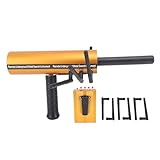
- EXCELLENT SENSITIVITY AND STABILITY: This metal detector delivers exceptional sensitivity and stability, ensuring accurate and reliablity metal detection in various terrain and depth conditions.
- POWERFUL AND INTELLIGENT FEATURES: The advanced modular design and intelligent functionality of this detector provide powerful, convenient, and efficient scanning and detection capabilities for an enhanced metal detecting experience.
- REMOTE SEARCH SYSTEM: Equipped with a remote search system and accurate detection system, this detector breaks through traditional detection methods, providing optimal depth and accuracy for metal detection.
- MICROCOMPUTER CONTROL: The detector features a calibration system with a microcomputer control chip unit, allowing for quick and convenient scanning and detection, greatly enhancing efficiency for metal detecting enthusiasts.
- METAL DETECTION SOLUTION: This device represents the most advanced and practical metal detection method currently available, offering an excellent solution for all your metal detection needs.
Practical answers to common GPR questions
Can ground-penetrating radar see through concrete?
GPR can detect some features and boundaries within concrete, including reinforcement and dowels in FHWA-described pavement applications. It does not see through every concrete slab or identify everything inside it. Salts can interfere, and a defect may be apparent only when it contains a meaningful air or water pocket. A scan may also fail to show the bottom of a void, making its thickness hard to determine.
How deep can ground-penetrating radar detect?
There is no universal maximum. FHWA gives examples of 100 MHz antennas reaching up to 100 ft and 400 MHz antennas up to 12 ft in its utility guidance, but those are application examples, not guaranteed depths. Conductive clay-rich ground, moisture, the target itself, and other site conditions can make useful penetration much shallower.
Can GPR find plastic water pipes?
It can respond to PVC when the pipe creates enough contrast with its surroundings. FHWA categorizes PVC as having a medium-to-strong response in its utility guidance, while emphasizing that response is highly site-specific. That is a possibility, not a guarantee that every plastic pipe will be detected.
Quick wins for a faster PC:
Repair Windows errors before they cause bigger problemsFix Now →Fix the driver behind crashes, sound loss and screen glitchesFind Drivers →What can block or weaken a GPR signal?
Conductive clay-rich material, significant moisture, salts in concrete, and external electromagnetic radiation can reduce data quality or useful penetration. Metal reflects virtually all incident energy and can obscure what lies below it. The effect of any one condition depends on the site and target.
Quick Recap
Product prices and availability are accurate as of the date/time indicated and are subject to change. Any price and availability information displayed on Amazon at the time of purchase will apply.

