
The Tool Desk
Outbyte PC Repair FREERepair Windows errors before they cause bigger problemsFix Now →Outbyte Driver Updater FREEFix the driver behind crashes, sound loss and screen glitchesFind Drivers →iTechGuides is reader-supported. When you buy through links on our site, we may earn an affiliate commission. As an Amazon Associate I earn from qualifying purchases. Learn more
Edge computing puts some computing and analytics next to factory machines, sensors, cameras, and control systems instead of sending every data point to a distant cloud first. In a smart factory, that placement can support faster local monitoring, selective data transfer, and continued operation when a cloud connection is slow or unavailable. It does not automatically improve yield, uptime, latency, or security: those outcomes depend on the workload, network, controls, hardware, and engineering decisions around the edge system.
What edge computing means in a smart factory
“Edge” describes where a computation happens. A sensor, programmable controller, industrial gateway, on-site server, or rugged industrial PC can be an edge location when it processes information close to the equipment that produced it. The system may still use a plant data center or public cloud; edge computing is usually a distribution choice, not a replacement for every central system.
A typical arrangement has three layers:
- Devices and control equipment: sensors, robots, machines, cameras, programmable logic controllers (PLCs), and other instruments generate measurements and events.
- Edge nodes: gateways or industrial computers collect, encrypt, integrate, filter, store, and analyze selected data near the production line.
- Plant or cloud services: historians, enterprise applications, model-training systems, dashboards, and long-term storage receive the information that needs broader scope or more computing capacity.
NIST’s description of “intelligent edge” combines computing, analytics, and connectivity so that responses can be made closer to where data is captured. The exact split varies by application. A machine may execute an immediate interlock locally, an edge node may score a quality model, and a cloud service may train a new model from many plants’ historical data.
Free tools Windows power users keep installed
One-click scans. No signup required.
How an edge system processes factory data
1. Capture and normalize signals
Machines and sensors produce values at different rates and in different formats. An edge gateway can acquire those signals, apply timestamps, convert protocols, and associate readings with a work order, batch, tool, or production step. Integration with existing controllers and networks is often the hardest practical part, because a new computer must not interfere with deterministic control traffic.
#1 Best Overall
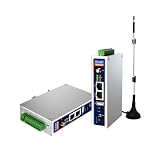
- IPC Based ARM: Cortex-A7@1.2GHz, RAM 512M, ROM 8G
- Ubuntu OS: Ubuntu 22.04 environment, original Node-RED
- Edge Computing: WukongEdge engine, multiple fieldbus protocol
- Diverse I/O interface: 2* RS485, 2*CAN FD, 2*Ethernet port, 1*USB
2. Protect and reduce the data stream
Before data leaves the cell, software can encrypt it, remove unnecessary fields, aggregate high-frequency readings, or retain only events and features needed by an application. This can reduce bandwidth and exposure, but filtering must be designed carefully: discarding raw information may make later diagnosis or model retraining impossible. Define retention and replay requirements before deciding what to keep.
3. Analyze locally
Local applications can calculate thresholds, detect an abnormal pattern, compare a measurement with a recipe, or run a machine-learning inference model. They can notify an operator, create a maintenance event, pause a process under an approved safety design, or pass a result to a supervisory system. An edge computer should not be allowed to replace a certified safety function merely because it responds quickly; safety-rated controls and plant procedures still govern hazardous actions.
4. Coordinate with plant and cloud systems
Selected events, summaries, and model outputs can flow to a manufacturing execution system, historian, enterprise application, or cloud platform. Cloud services can perform computationally intensive analysis, aggregate information across lines, and train models continuously. Updated models or policies can then be validated, versioned, and delivered to edge nodes. This creates a feedback loop without requiring every raw sample to travel off-site.
Why processing near production can help
Response time and local autonomy
Shorter network paths can make a local decision more responsive and less dependent on a wide-area connection. This matters when a line must flag a defect during the current operation, coordinate several machines, or continue a limited function during an outage. The benefit is an engineering objective, not a guaranteed latency figure. Measure the complete path—from sensor acquisition through computation, decision logic, and actuator response—under realistic load.
Rank #2

- Made for the Industrial Pro: Works with the Pro Label Tool app1 for professional industrial label designs
- Hands-Free Printing: Attach to belt, ladder, or rack with optional accessories3—ideal for tight spaces on the jobsite.
- Database Accuracy: Use existing databases2 to print industrial labels, barcodes and QR codes quickly while reducing errors.
- Durable Labels: Laminated labels up to ~1 inch wide withstand industrial environments.
- PC Connectivity: Use micro-USB to charge the Li-ion battery or connect to a PC to design and print from P-touch Editor4.
Reliability and resilience
A plant can design an edge application to keep essential monitoring or control-adjacent functions running when a cloud link is interrupted. Local buffering can preserve records for later synchronization. Reliability still depends on redundant power, storage, networking, software updates, environmental protection, and a tested recovery procedure. One unprotected edge box can become a new single point of failure.
Bandwidth and data handling
High-rate vibration, vision, and acoustic streams can be expensive or impractical to transmit continuously. Local feature extraction or event-based transmission can preserve useful information while sending less data. The trade-off is that local processing adds compute, storage, and lifecycle work, and aggressive filtering can remove evidence needed for root-cause analysis.
Wireless work-cell economics
NIST’s 2019 factory-work-cell report notes that wireless automation can reduce capital costs associated with conduit, cables, networking equipment, and installation labor. That observation applies to the wireless automation design discussed in the report, not to every edge project. Edge deployments can add gateways, rugged computers, software integration, cybersecurity controls, support contracts, and skilled labor. Prepare a site-specific total-cost estimate rather than assuming that “edge” means cheaper.
Practical manufacturing use cases
Process-efficiency monitoring
An edge application can compare cycle times, idle periods, energy readings, and machine states at the line. It may identify recurring bottlenecks and publish a concise event to a plant dashboard. The value comes from a defined action—such as changing a sequence or scheduling maintenance—not from collecting data without an operating response.
Rank #3

- Fanless compact PC: Thermal reference design, wider temperature support -20 ~ 60°C with 0.7m/s airflow
- Designed for industrial interfaces: 2* RJ-45 GbE(1 for POE-PSE 802.3 af); 1* RS-232/RS-422/RS-485; 4* DI/DO; 1* CAN; 3* USB3.2; 1* TPM2.0 (Module optional)
- Hybrid connectivity: Support 5G/4G/LTE/LoRaWAN/GPS(Module optional) with 1* Nano SIM card slot
- Flexible mounting: Desk, DIN rail, wall-mounting, VESA
- Certifications: FCC, CE, RoHS, UKCA
In-line quality detection
Vision or sensor models can inspect a part while it is still at the station. Local inference can return a pass, fail, or review result quickly enough for the next process step. Establish how the model handles uncertain cases, how operators can override it, and how images or measurements are retained for traceability. Edge processing alone is not evidence of a lower defect rate; that result must be demonstrated for the specific line and acceptance criteria.
Condition and predictive maintenance
Vibration, temperature, current, and pressure signals can be combined locally to detect a deviation from a machine’s normal pattern. The edge node can open a work request or send a feature vector to a central analytics service. Maintenance teams need clear thresholds, false-alarm handling, and a way to verify that a predicted condition actually corresponds to a repairable failure mode.
Operational and cybersecurity monitoring
Unexpected commands, configuration changes, unusual traffic, or equipment behavior can be screened near the control network. A local alert may allow an operator or security team to isolate a segment while broader investigation occurs centrally. Detection logic must be coordinated with incident-response procedures so that an automated action does not stop a process unsafely.
Edge and cloud: deciding what runs where
NIST treats cloud and edge processing as complementary. Use the operational requirement, not a slogan, to place each workload.
Rank #4

- Supercharged AI Performance: Powered by NVIDIA Jetson Orin NX 16GB, delivers up to 157 TOPS in MAXN Super Mode — ideal for vision AI, robotics, autonomous machines, and generative AI workloads.
- Advanced Thermal Engineering for Full-Power Operation: Equipped with a vacuum copper heat pipe system, ultra-low thermal resistance medium, and high-emissivity black-coated surface combined with high-performance active cooling — ensuring stable full compute power even at 60°C ambient temperature.
- Energy-Efficient & Flexible Power Modes: Adjustable power profile from 10W to 40W, enabling a perfect balance between performance and efficiency for edge AI computing in diverse environments.
- Industrial-Grade Reliability & Design: Ruggedized for operation from -20°C to 60°C at 40W (up to 65°C at 25W), providing dependable performance in industrial automation and outdoor AI deployments.
- Rich Connectivity & AI-Ready Platform: Features 2×RJ45, SIM slot, 4×USB 3.2, HDMI 2.1, CAN, M.2 Key E/M, Mini-PCIe, and 4×CSI camera ports — supporting multi-camera vision, IoT, and robotics projects. Pre-installed with JetPack 6.2 and 128GB NVMe SSD, fully compatible with NVIDIA Isaac, ROS 1/2, and Hugging Face frameworks.
| Workload or function | Often suitable location | Reason and caution |
|---|---|---|
| Safety interlocks and deterministic machine control | Dedicated local control equipment | Requires certified, predictable behavior; do not substitute a general-purpose edge application for a safety system. |
| Fast anomaly checks, inspection inference, and event filtering | Edge node or on-machine computer | Keeps the decision near the data source; validate timing, accuracy, and failure behavior. |
| Cross-line dashboards and historical reporting | Plant server or cloud | Benefits from centralized context and retention; tolerate network delay where operations allow. |
| Large-scale model training and fleet analytics | Cloud or central data center | Provides more compute and a wider data set; send only the data permitted by policy and regulation. |
| Temporary operation during a connectivity outage | Edge with local storage | Define the allowed degraded mode, buffer limits, and reconciliation process before deployment. |
Some functions require both locations. For example, a cloud service can train and approve a model, while an edge node performs inference and reports confidence scores. Version control, rollback, and approval gates prevent an untested model from being deployed to production equipment.
Engineering requirements that determine success
Latency, availability, and scale
Write measurable requirements for each signal and response: allowable acquisition delay, decision time, maximum jitter, uptime target, recovery time, and number of concurrent devices. NIST identifies high-reliability, low-latency, scalable distributed edge computing as a factory-automation challenge. Adding an edge computer does not satisfy those requirements unless the full network, software, and control path is engineered and tested to them.
Network and radio coexistence
Wireless cells may share a finite electromagnetic spectrum with other networks. Plan channel use, interference management, authentication, roaming behavior, and fallback paths. Wired and wireless segments should be mapped to the actual control and data flows. Test performance while neighboring equipment, traffic bursts, and electromagnetic conditions are present; a laboratory result is not a plant guarantee.
What’s actually slowing this PC down?
Pick the symptom - the matching free tool is one click away.
Interoperability and integration
Inventory PLCs, robots, sensors, historians, manufacturing systems, identity services, and time sources before selecting hardware or software. Confirm supported protocols, data models, timestamp accuracy, and write permissions. NIST identifies factory integration and standards support as continuing challenges, so treat compatibility as a design deliverable rather than an assumption.
Best Value

- We make the World's Only Surface Pro Stands to Lift Your Surface Pro without removing the keyboard. Compatible with all Surface Pros.
- 【Ideal for Reducing Neck Pain】Looking down at the Surface Pro Screen can cause severe Neck Pain. Lifting your screen reduces the pressure on your neck.
- 【Look Better in Online Meetings】Lifting your camera and screen gives you a more flattering angle reducing the unwanted double chin effect.
- 【Compact & Travel Friendly | Lightweight | Height Adjustable】Weighing in at less than 10 oz and folding down to the size of the Surface Pro, its great for life on the on. Adjustable to 10 different height positions.
- 【Now even Stiffer and more Robust】We took the Surface Pro Stand and made it 400% stiffer for those that want to type WITHOUT a Bluetooth Keyboard. Its time you got a Laptop Stand for your Surface Pro.
Environmental and lifecycle fit
A computer on a factory floor may face dust, vibration, heat, humidity, electrical noise, washdown procedures, and restricted maintenance access. Select an industrially suitable enclosure, storage, power arrangement, mounting method, and interface set for the site. “Rugged” is a category, not a universal rating; verify the environmental and certification requirements for the installation. Also plan patching, spare units, firmware support, backup, observability, and end-of-life replacement.
Independent reader supportYour contribution helps us test, update, and keep practical guides available for everyone.Cybersecurity is part of the edge architecture
Connected industrial devices collect and transmit vital manufacturing information. Increased connectivity can also create more opportunities for cyberattack. Protect the edge node and the systems around it as operational technology, not as an isolated office computer.
- Define trust boundaries: document which devices may communicate, which services may write to controls, and where plant, enterprise, and internet-facing networks are separated.
- Use strong identity and least privilege: authenticate devices and operators, restrict administrative access, and remove default credentials.
- Protect data in transit and at rest: encrypt communications, secure keys, and control access to buffered and historical data.
- Maintain integrity: sign or otherwise verify software, configurations, and machine-learning models before deployment; keep an auditable version history.
- Monitor and recover: collect security and operational logs, test alert paths, maintain offline recovery material, and rehearse operation when an edge node or network segment is unavailable.
NIST’s Cybersecurity Framework Version 1.1 Manufacturing Profile is a voluntary, risk-based resource. It is intended to enhance—not replace—the standards and guidelines a manufacturer already uses. It should guide risk management rather than be presented as a mandatory certification.
How to plan an edge deployment
- Choose one bounded production problem. Define the event, decision, operator action, success measure, and consequences of a wrong or missing result.
- Map the data and control path. Record sources, rates, protocols, timestamps, destinations, retention needs, and every system that can affect the process.
- Set engineering targets. Specify latency, jitter, availability, throughput, storage, recovery time, environmental conditions, and cybersecurity controls.
- Decide the workload split. Keep only time-critical or connectivity-sensitive functions local; place aggregation, long-term storage, and heavy training where they fit operational and governance requirements.
- Prototype without disrupting production. Use read-only connections or a representative test cell first. Compare edge results with trusted measurements and record false positives, false negatives, and resource use.
- Validate under plant conditions. Test interference, traffic peaks, power interruptions, cloud disconnection, device failure, software rollback, and operator procedures.
- Roll out with governance. Approve model and software versions, document changes, train staff, monitor drift, and review whether the original operational measure improved.
Standards work and what it does—and does not—prove
IEEE P2805.5 describes protocols for machine learning on edge-computing nodes supported by industrial clouds, with examples spanning discrete manufacturing, batch control, and process control. IEEE P2805.6 describes a cloud-edge collaborative industrial-automation architecture for similar classes of use. These are standards-development and recommended-practice references. Their existence does not prove that a particular product, plant, or deployment conforms; verify conformance and interoperability claims directly.
Limits, costs, and common mistakes
- Assuming lower latency: A distant sensor, congested switch, inefficient code, or slow actuator can dominate total response time.
- Creating another data silo: If edge data cannot be reconciled with plant records, teams may lose traceability instead of gaining it.
- Ignoring updates: An edge fleet needs asset inventory, patch windows, backups, vulnerability handling, and a supported hardware lifecycle.
- Over-collecting sensitive data: Minimize and govern production data, especially when it leaves the site or crosses organizational boundaries.
- Buying hardware before defining interfaces: Compute capacity is only one requirement; connectors, protocols, environmental ratings, timing, and support matter equally.
- Promising universal savings or quality gains: The cited NIST and IEEE material describes capabilities, requirements, and examples, not a transferable percentage improvement in productivity, downtime, or yield.
The most defensible business case compares the complete alternative designs: equipment and installation, integration, networking, software, cybersecurity, maintenance, training, downtime risk, and measurable operational benefit. An edge design is worthwhile when its local decisions solve a defined problem better than a cloud-only or existing plant architecture.
Quick Recap
Product prices and availability are accurate as of the date/time indicated and are subject to change. Any price and availability information displayed on Amazon at the time of purchase will apply.

