
Quick wins for a faster PC:
Repair Windows errors before they cause bigger problemsFix Now →Fix the driver behind crashes, sound loss and screen glitchesFind Drivers →iTechGuides is reader-supported. When you buy through links on our site, we may earn an affiliate commission. As an Amazon Associate I earn from qualifying purchases. Learn more
Oven-safe means the manufacturer has identified a specific bakeware item as suitable for oven use under stated conditions. It does not mean every dish made from the same material can tolerate every temperature, heating mode, or accessory. To check a dish, identify the exact product, read its current care instructions, confirm the permitted oven type and temperature, and inspect the dish for damage. If you cannot identify the item or verify its instructions, do not guess from its appearance.
Oven-safe is a product rating, not a material guarantee
The words “oven-safe” apply to an identified product and the conditions supplied by its maker. A glass, ceramic, metal, or silicone appearance is not proof that the item can go into an oven. Manufacturing method, decoration, handles, coatings, lids, thermal properties, and intended appliance all matter.
Even two dishes sold under the same brand may have different limits. A marking may also be incomplete: an oven symbol can indicate intended use without stating a maximum temperature or excluding broilers, grills, stovetops, or other direct-heat sources. Treat the symbol as a prompt to find the full instructions, not as the entire safety specification.
Pyrex Home’s US FAQ, for example, says its glass bakeware is designed for a completely preheated conventional or convection oven at any temperature called for in a baking recipe when its safety and usage instructions are followed. The same guidance excludes direct heat such as a stovetop or broiler. That is a statement about Pyrex Home products, not every glass dish.
#1 Best Overall

- 6-PIECE BAKEWARE SET: 6-piece set of 3 oven-safe glass baking dishes and 3 lids for making casseroles, desserts, stews, and more
- FOOD-SAFE BOROSILICATE GLASS: Made with BPA-free borosilicate glass; microwave and freezer-safe; oven safe up to 752°F, tolerates thermal shock up to 270°F
- BAKE AND SERVE SET: Includes non-slip, stackable storage lids for easy travel and serving
- DISHWASHER-SAFE: Dishwasher-safe for quick and convenient cleaning after use; place lids on top rack
- DISH SIZES: 7.8 x 6.6 x 2.2 in. (0.26gal); 11 x 7.8 x 2 in. (0.42gal); and 15.3 x 9.4 x 2.6 in. (0.95gal)
How to check a dish before using it
- Find the identification. Examine the base, rim, handle, packaging, or original paperwork for a manufacturer name, model number, reference code, or product name. Photograph any stamped marks so you can search them accurately.
- Locate the current manufacturer instructions. Use the maker’s official product page or care-and-use document for that exact model. Do not substitute instructions for a similar-looking dish.
- Confirm the oven type. Check whether the item is approved for a conventional oven, convection oven, toaster oven, air fryer, or another appliance. Approval for one appliance does not automatically cover the others.
- Confirm the temperature rule. Look for a maximum use temperature, a recipe-temperature restriction, or a warning about particular settings. Note whether a number is a feature rating, a laboratory or design specification, or an actual operating instruction.
- Check direct-heat exclusions. Look specifically for stovetop, hob, broiler, grill, salamander, burner, or flame restrictions. These heat a surface or one area much more intensely than ordinary oven baking.
- Check every component. Read separate instructions for lids, knobs, handles, seals, decorations, and racks. A dish can be oven-rated while an attached or supplied component is not.
- Inspect before each use. Do not use glass with chips, cracks, deep scratches, or a partially broken edge. Damage can change how the item responds to heating and cooling.
- Follow thermal-shock precautions. Use the maker’s rules for moving the dish between cold and hot environments, placing it on surfaces, and adding liquids. Abrupt temperature changes can damage glass even when the oven temperature itself is within the stated limit.
What temperature information really tells you
There is no universal oven-safe temperature ceiling. The number belongs to a particular product, market, and set of instructions. The following examples illustrate why numbers must not be transferred from one item to another.
| Product guidance | Temperature information | How to interpret it |
|---|---|---|
| Pyrex Home US glass bakeware FAQ | No numeric ceiling is given for use according to the stated instructions. | Use a completely preheated conventional or convection oven and follow the product’s safety directions; do not infer that every temperature or oven mode is allowed. |
| Pyrex UK Inspiration rectangular glass dish, reference 294B000 | The page lists a 350°C maximum feature, while its usage tips warn that conventional-oven use above 300°C may damage the glass. | These are not interchangeable statements. Follow the item’s current usage warning rather than treating the larger feature number as a routine cooking limit. |
| International Cookware guidance for marked Pyrex prepware | A 180°C maximum is stated for the described range of glass articles with markings and/or lids. | That limit applies to that product guidance and should not be applied to unrelated glass bakeware. |
A recipe temperature is not automatically a dish rating. If a recipe calls for a very hot oven, verify that the exact dish permits that temperature under the same heating mode. If the instructions contain a lower operating warning and a higher feature or design number, use the more restrictive operating instruction unless the manufacturer gives a later clarification.
Oven use is different from direct heat
Many failures happen when “oven-safe” is treated as “safe anywhere heat is present.” A conventional or convection oven surrounds the dish with hot air. A stovetop burner, hob, broiler, or grill can deliver concentrated heat to one surface or edge. That difference can create severe temperature gradients.
- Stovetop and hob: Do not place an oven-rated glass or ceramic baking dish directly on a burner unless its instructions expressly permit it.
- Broiler and grill: A broiler heats from a nearby element and can expose the top surface to intense direct radiation. Pyrex Home’s US guidance excludes broiler use for its glass bakeware.
- Toaster ovens and air fryers: Their small chambers, exposed elements, and close clearances can produce conditions unlike a full-size oven. Check the exact dish and appliance guidance.
- Microwave use: Microwave suitability is a separate rating. A dish may be microwave-safe but not suitable for an oven, or vice versa.
Product pages may use terms such as “oven safe,” “not suitable for hobs,” or “not for direct heat.” Read each statement together; none should be silently broadened into a general approval for all appliances.
Lids, handles, decorations, and accessories can change the answer
The container and its cover may have different ratings. Pyrex Home says its plastic lids must not be placed in a conventional or convection oven because they can melt. Remove a lid only when the manufacturer’s instructions say the dish itself may be heated uncovered and explain how to handle the lid.
Rank #2

- PREMIUM LARGE BAKING PAN SET: Our baking dishes are made of borosilicate glass, can be used in microwave, oven, freezer and dishwasher
- TIGHT FITTING LIDS: 8-piece baking dishes set includes 4 baking dishes and 4 gray plastic tight fitting lids, which are designed to keep your food fresher longer. Made with a special non-slip design, you can stack these 4 containers with lids on top of each other in your fridge or freezer for space saving storage. Also they are sloshproof to stop spilling while storing or on the go. The ideal set for baking, serving and storing food
- ELEGANT DESIGN: The clear glass baking pan makes a nice, attractive presentation for enjoyable baking time, a charming decoration in your dining table and kitchen. It also lets you monitor the baking process, serve your meals in a stylish and elegant fashion and easily identify leftovers
- CONVENIENT HANDLES: The edge of the bakeware is round and smooth, with a widened, thickened, and anti-scalding handle design, providing a secure grip while taking to and from the oven
- VERSATILE USE: This bakeware set includes 4 pieces bakeware of difference dimensions ( includes the ears' size): 1Quart (10 x 5.9 x 1.8-inch), 1.7Quart (11.6 x 6.7 x 2.1-inch), 2.3Quart (13.6 x 8.1 x 2.1-inch), and 3.2Quart (15.5 x 9.3 x 2.1-inch). Great for baking desserts, casseroles, stews, lasagna, spaghetti, brownies,chicken, meat, beef, fish, veggies, and all your favorite delicacies, as a serving dish for added convenience and reheating leftovers and etc
Also check removable handles, silicone grips, clips, gaskets, painted or metallic decorations, and adhesive labels. A dish may be oven-rated while a decorative finish discolors, a seal deforms, or a handle exceeds its own limit. If the instructions give separate limits for the base and accessories, apply the lower limit to the assembled setup.
Glass safety: thermal shock and damage
Glass can be suitable for home baking yet vulnerable to abrupt temperature changes. Avoid moving a hot dish directly onto a cold, wet, or very hard surface when the manufacturer warns against it. Do not pour cold liquid into a hot glass dish, set a chilled dish into a fully heated oven unless the instructions specifically allow that use, or place a hot dish into a freezer. Use a dry trivet or another surface approved by the maker.
What’s actually slowing this PC down?
Pick the symptom - the matching free tool is one click away.
Inspect the item every time. Pyrex Home says not to continue using glassware that is chipped, cracked, or deeply scratched. International Cookware likewise advises avoiding sudden temperature changes and checking periodically for chips or bumps. Damage may be difficult to see around a rim or handle, so run your eyes around the entire piece before filling it.
Do not try to “test” an unidentified dish by heating it gradually or at a low temperature. A test does not establish a safe limit, and failure can occur without an obvious warning.
Glass type does not replace the instructions
People often assume that one glass type is automatically safe at any baking temperature and another is automatically unsafe. The manufacturer’s product guidance is more useful than a material label alone. Pyrex Home says both soda-lime and borosilicate glass can be suitable for home cooking when its use and care instructions are followed, while noting differences in impact resistance and resistance to extreme thermal changes.
Rank #3

- 7x11 INCH: Includes (1) 7x11x2.75 inch glass baking dish with BPA-free plastic lid. This deep baking dish is essential to have in any kitchen as they are versatile in use from prepping to baking and storing.
- GO DEEPER: At up to 50% deeper than the Pyrex basics dishes you know and love, there’s more room to get creative. Deeper size stops spillovers, and more importantly, holds more of the good stuff for your parties and gatherings.
- SNUG FIT LID: Perfectly fitting and BPA-free plastic lid is freezer, microwave, and top-rack dishwasher safe. No need to hold back when warming your food or storing your leftovers for tomorrow.
- GLASS BAKEWARE: High-quality non-pourous glass is pre-heated oven, microwave and freezer safe. Have a peace of mind when storing your food, resisting stains, flavors and odors. Worry less about scrubbing hard to get rid of stains or smells, and enjoy the versatile convenience of this glass bakeware set.
- PYREX IS THE #1 BRAND OF GLASS BAKEWARE*: Loved for generations, experienced cooks and beginners alike have reached for Pyrex brand glassware products, because they’re affordable, durable, and great for all their cooking, serving and storing needs. Source: The NPD Group / Retail Tracking Service, dollars and units, 12 ME December 2022
That distinction matters, but it does not create a universal temperature chart. A borosilicate label does not authorize broiling, stovetop use, or an oven temperature that the product page excludes. Likewise, soda-lime glass should be judged by the instructions for the exact item rather than rejected solely because of its composition.
What to do with unmarked, secondhand, or inherited bakeware
An unmarked dish has no reliable, item-specific operating specification. Age, thickness, color, weight, and a familiar-looking shape cannot establish oven safety. Even a recognizable brand name is insufficient if the model and instructions cannot be confirmed.
Try to identify it by photographing the base and comparing any code, logo, or dimensions with the manufacturer’s current catalog. If identification remains uncertain, contact the manufacturer with clear photos and every mark you can find. Until the maker confirms the permitted use, choose a replacement with accessible, explicit instructions. The cost of replacing an uncertain dish is lower than the risk of breakage, burns, or food loss.
Independent reader supportYour contribution helps us test, update, and keep practical guides available for everyone.How to compare two bakeware choices
When you have two real products to choose between, compare the operating details rather than ranking materials in the abstract.
| Comparison point | Question to ask | Why it matters |
|---|---|---|
| Temperature | What is the maximum operating temperature, and is the number a use instruction or merely a feature rating? | A larger printed number may not be the permitted everyday cooking limit. |
| Heating mode | Is it approved for conventional and convection ovens? Are toaster ovens, air fryers, broilers, grills, or hobs excluded? | Different appliances deliver heat differently. |
| Components | Are lids, handles, seals, and decorations rated for the same conditions? | The weakest component limits the assembled item. |
| Thermal shock | What does the maker say about cold food, preheating, hot surfaces, liquids, and cooling? | Sudden temperature changes can damage glass even below an oven’s nominal temperature. |
| Traceability | Can you identify the exact model and retrieve current care instructions? | Clear documentation makes safe use and replacement decisions possible. |
Quick preheating and serving checklist
- Identify the exact dish and read its current instructions.
- Verify the oven mode and temperature for this recipe.
- Remove any lid or accessory that the instructions exclude.
- Confirm the dish is free of chips, cracks, and deep scratches.
- Do not place it on a burner, under a broiler, or on another direct-heat source unless expressly approved.
- Avoid sudden temperature changes and use a suitable dry surface when removing hot glass.
- Stop using the dish if it becomes damaged or if its identity and instructions can no longer be established.
Common mistakes and the safer response
“It has an oven symbol, so any oven setting is fine.”
Use the symbol only as the starting point. Find the temperature, mode, and direct-heat restrictions in the full instructions.
Do these 3 things before closing this tab:
1Scan for outdated or missing drivers - takes under a minute2Clear out junk files and repair common Windows errors3Fix the driver behind crashes, sound loss and screen glitchesRank #4
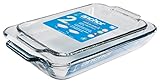
- INCLUDES: This glass bakeware set contains (1) 2-quart and (1) 3-quart baking dish, both made of crystal clear glass.
- DURABLE: This tempered glass bakeware set is microwave, pre-heated oven, refrigerator, freezer, and dishwasher safe; plastic lids are BPA free and safe to clean on the top rack of dishwasher.
- SAFE: Anchor Hocking baking glass is healthier than metal and plastic. It will not warp, stain, retain smells, or leach dangerous chemicals into food.
- FIVE YEAR : Backed by a protective limited five-year , this tempered glass bakeware set promises to impress for many years to come.
- MADE IN THE USA
“The recipe uses 230°C, so every glass dish can handle 230°C.”
Recipe temperature describes the food, not every container. Check the exact dish’s operating limit and warnings.
“The dish survived last time, so it is safe.”
Previous success does not override a missing rating, hidden damage, or a different starting temperature. Recheck the item before each use.
“The lid came with the dish, so it can stay on in the oven.”
Accessories can have separate limits. Plastic lids, in particular, may melt even when the glass base is oven-rated.
“A thick, heavy, or old dish must be stronger.”
Appearance does not establish the manufacturer’s testing or permitted conditions. Identify the model or replace it with clearly documented bakeware.
The practical rule
Use a dish in an oven only when you can connect that exact item to the maker’s instructions for the intended temperature and heating mode. Keep direct heat, accessories, thermal shock, and visible damage as separate checks. Where instructions conflict or identification is uncertain, follow the more restrictive stated use or do not use the dish until the manufacturer clarifies it.
Quick Recap
Product prices and availability are accurate as of the date/time indicated and are subject to change. Any price and availability information displayed on Amazon at the time of purchase will apply.

