
iTechGuides is reader-supported. When you buy through links on our site, we may earn an affiliate commission. As an Amazon Associate I earn from qualifying purchases. Learn more
To estimate home printing cost per page, divide the price of replacement ink by its stated page yield; add paper cost separately if you want a per-sheet materials estimate. That figure is not the full cost of owning a printer: include the printer’s purchase price when comparing long-term expense. Manufacturer yield claims are estimates based on particular methods and print modes, not a promise of what every household will get.
The available figures support useful examples from the Epson EcoTank ET-2800 and Canon PIXMA G3270, but their yield methods differ, and current matched ink prices are not established here. They therefore do not support a definitive five-printer ranking or a like-for-like cost-per-page winner.
How do you calculate printer cost per page?
For ink alone, use:
Ink cost per page = replacement ink price ÷ stated page yield
For ink plus paper, add the paper price per sheet:
Ink-and-paper cost per page = ink cost per page + (paper pack price ÷ number of sheets)
#1 Best Overall

- Innovative Cartridge-Free Printing ― High-capacity ink tanks mean no more tiny, expensive ink cartridges; Epson’s exclusive EcoFit ink bottles make filling easy and worry-free
- Impressive Print Quality ― Unique Micro Piezo Heat-Free Technology produces sharp text – plus impressive color photos and graphics – on virtually any paper type
- Zero Cartridge Waste – By using an EcoTank printer, you can help reduce the amount of cartridge waste ending up in landfills
- Built-in Scanner & Copier ― High-resolution flatbed scanner and a color display for easy document copying and navigation
HP illustrates the arithmetic with hypothetical figures: a $30 bottle divided by a hypothetical 6,000-page yield equals $0.005, or half a cent, for ink alone. Its separate hypothetical example of $10 for 100 sheets of paper works out to $0.10 per sheet, making the combined example $0.105 per page. These are examples in HP’s cost-per-page guide, not current prices for a particular printer or supplies. HP’s cost-per-page guide also notes that expense changes with ink and paper prices, monochrome versus color printing, and paper type.
For a real comparison, use current prices for compatible replacement ink checked on the same date and the matching manufacturer yield. Keep black and color calculations distinct: color printing uses multiple inks and generally costs more than black-only printing. If you print photos or documents with heavy color coverage, a yield figure based on ordinary document pages may not predict your household’s output.
What do the Epson ET-2800 and Canon G3270 yield figures show?
These two ink-tank all-in-ones offer concrete manufacturer figures, but their stated yields use different bases. Treat each as a company estimate, not an independent test, and do not rank them by dividing an ink price by these yields as if both yields came from one shared test.
Rank #2

- THE LAST PRINTER YOU'LL EVER NEED – Set it up once and print with confidence; no complicated maintenance, just easy, reliable printing you can count on
- FULLY LOADED WITH SAVINGS – Best for low-cost, high-volume printing—up to 3 years of HP Ink included; get up to 6,000 color or black pages right out of the box
- KEY FEATURES – Print, copy and scan, plus borderless prints, mobile and wireless printing
- MESS-FREE REFILL – Replenish ink with HP's easy-access, mess-free refill system; simply plug the ink bottles into this cartridge-free ink tank and let them drain—no squeezing, no spilling
- BEST PRINT QUALITY, PERIOD – Sharper text, richer colors, only with HP Smart Tank
| Printer | Manufacturer-stated black yield | Manufacturer-stated color yield | Basis and qualification |
|---|---|---|---|
| Epson EcoTank ET-2800 | 4,500 pages | 7,500 pages | Epson’s T522 replacement-ink estimate using its ISO/IEC 24712 pattern methodology. Epson says actual results vary; some ink is used during initial setup. Epson ET-2800 product page |
| Canon PIXMA G3270 MegaTank | 6,000 pages in default mode; up to 8,300 in economy mode | 7,700 pages in default or economy mode | Canon’s approximate document-page figures. Economy-mode figures apply through the Windows/Mac driver or the printer’s copy setting. Canon MegaTank product-family page |
Epson EcoTank ET-2800
Epson describes the ET-2800 as a wireless color all-in-one with scan and copy. The yields above refer to replacement T522 ink, not a guarantee for the ink supplied in the box. Epson says some included ink is consumed during initial setup and that actual yield varies with images, settings, temperature, humidity, infrequent printing, or printing predominantly in one color. Its “up to 2 years” included-ink estimate is based on average monthly document volume of about 125 pages; it is not a universal estimate of how long a household’s ink will last. See Epson’s product details and its ET-2800 guide for yield and bottle information.
The guide lists compatible bottle numbers as 522120 black, 522220 yellow, 522320 magenta, and 522420 cyan. It also identifies images, settings, paper, printing frequency, and temperature as factors affecting actual yield. Check the exact bottle compatibility and current price before calculating a cost per page.
Canon PIXMA G3270 MegaTank
Canon reports approximate G3270 yields of 6,000 black and 7,700 color document pages in default mode. It lists up to 8,300 black and 7,700 color pages in economy mode through the Windows/Mac driver or printer copy setting. Canon also says one GI-21 set is equivalent by yield to 30 each of its standard-capacity PG-260 black and CL-261 color cartridges. These are Canon’s comparisons and estimates, not independently verified household results. Check Canon’s MegaTank product-family information for the stated basis.
Rank #3

- INNOVATIVE CARTRIDGE-FREE PRINTING — No more dealing with tiny, expensive ink cartridges; With this wireless printer each ink bottle set is equivalent to about 80 individual cartridges²
- LESS FREQUENT INK REPLACEMENT — Replacement ink bottles don't have to be changed nearly as often as ink cartridges¹; Color printer lets you print up to 4,500 black and white pages and 7,200 color³
- PRINT FOR LONGER — Up to 2 years of ink in the box⁴ (and with every replacement ink set) for fewer out-of-ink frustrations; This home printer keeps printing longer
- HIGH CAPACITY INK TANKS – Printer, scanner and copier utilizes Epson’s exclusive EcoFit ink bottles, making the refill process easy and worry-free
- ZERO CARTRIDGE WASTE — By using an Epson EcoTank printer you can help reduce the amount of cartridge waste ending up in landfills; Cartridge-free printer utilizes ink bottles for more convenience and less waste
Why can your actual cost differ from the estimate?
A yield divided into an ink price is useful for comparing supplies on paper, but actual household output may differ because the number is tied to a manufacturer’s test method, print mode, and stated type of page. The Epson and Canon figures above are not directly interchangeable: Epson gives an ISO-pattern yield, while Canon reports approximate document-page yields and specifies default and economy modes.
Recommended Free Tools
- Page content: Images and color-heavy documents can consume ink differently from the pages used for a yield estimate.
- Print settings and mode: A mode change can affect the manufacturer’s stated yield, as Canon’s separate default and economy figures illustrate.
- Print frequency and maintenance: Infrequent printing and maintenance can affect realized output; Epson explicitly includes infrequent printing among its yield caveats.
- Setup ink: Some ink may be consumed before the printer is ready for regular use, reducing the amount available for subsequent pages.
- Paper choice: Paper type changes the materials cost, and a paper-per-sheet calculation should use the paper you actually buy.
HP’s Smart Tank information offers additional manufacturer context, not an independent comparison with Epson or Canon. HP says bottle yields can reach up to 6,000 black and 8,000 color pages depending on model; its page qualifies yields by ISO/IEC 24711 or HP testing methodology, continuous printing, and setup ink use. See HP’s Smart Tank page. Those figures should not be treated as a cross-brand result or applied to every Smart Tank model.
Independent reader supportYour contribution helps us test, update, and keep practical guides available for everyone.How should you compare the full cost of home printing?
Ink cost per page answers only one part of the buying question. To compare the cost of owning two printers, keep the hardware price separate from the running cost and choose a realistic print volume and time horizon. A break-even comparison is meaningful only when it states those assumptions.
Rank #4
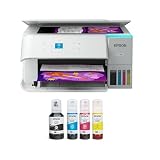
- STRESS-FREE PRINTING — Epson EcoTank comes with enough ink to print up to 6,600 pages black/5,500 color¹⁰ for fewer out-of-ink frustrations. Each replacement ink bottle set is equivalent to about 80 cartridges¹¹
- SIMPLE INK REFILLING — Supersized ink tanks and uniquely keyed EcoFit bottles make refilling ink simple—no mess, no stress and no ink bottle mix-ups
- THE WORLD’S #1 SELLING SUPERTANK PRINTER² — Epson invented EcoTank to revolutionize the way people print; we’ve sold 100 million EcoTanks worldwide⁷ and this is our 7th generation of cartridge-free printers
- ADVANCED PRODUCTIVITY FEATURES — Fast 15 black/8 color ISO ppm print speeds with zero warmup time, built-in scanner, 100-sheet paper tray, auto duplex printing and a 1.44" color display for easy navigation
- STUNNING PRINT QUALITY — High 4800 x 1200 dpi print resolution for exceptional photos and text; enjoy amazing image quality on a wide range of media
- Choose the printers and compatible replacement supplies. Verify the bottle or cartridge numbers from the manufacturer rather than assuming supplies are interchangeable.
- Record current US prices on the same date. Use prices for the compatible supplies you would actually purchase; do not combine prices gathered at different times.
- Calculate black and color ink costs separately. Divide each replacement supply price by the corresponding stated yield, and label the manufacturer’s yield basis and mode.
- Add paper only if comparing page-material cost. Divide the paper pack price by its sheet count, then add that per-sheet amount to the ink figure.
- Account for the printer itself. Compare purchase price alongside expected monthly volume and the length of time you expect to keep the printer; do not imply that ink-only cost includes hardware.
- Check whether the features fit your use. Consider scanning and copying, duplex printing, paper handling, connectivity, and whether color or photo output matters to your household. These are buying criteria, not a tested feature ranking of the two examples above.
Is there enough evidence to name five best home printers?
No. The figures presented here establish two product examples, not five comparable current US models. They also do not establish matched, current prices for the compatible inks needed to calculate a defensible cross-model ranking. Calling either example a cost-per-page winner—or naming five winners—would overstate what these figures show.
A reliable five-pick review would need official product, yield, and consumable information for five candidates; current US ink prices checked on the same date; and a disclosed calculation that preserves each manufacturer’s yield method and mode. Without those inputs, the useful conclusion is how to calculate and interpret cost per page, not a ranked shortlist.
Quick wins for a faster PC:
Fix the driver behind crashes, sound loss and screen glitchesFind Drivers →Repair Windows errors before they cause bigger problemsFix Now →Scan for outdated or missing drivers - takes under a minuteDriver Scan →Quick Recap
Product prices and availability are accurate as of the date/time indicated and are subject to change. Any price and availability information displayed on Amazon at the time of purchase will apply.

