
What’s actually slowing this PC down?
Pick the symptom - the matching free tool is one click away.
iTechGuides is reader-supported. When you buy through links on our site, we may earn an affiliate commission. As an Amazon Associate I earn from qualifying purchases. Learn more
The numbered ring on a drill-driver is an adjustable clutch for screwdriving. Lower numbers make the clutch release at lower resistance; higher numbers let the tool apply more torque before releasing. The numbers are relative positions for that particular model—not universal foot-pound or newton-metre measurements.
Start at a low setting, drive a test screw, and increase one step at a time until the fastener stops at the desired depth. Turn the collar to the drill symbol when drilling holes; that position normally locks or bypasses the screwdriving clutch.
What the clutch numbers actually control
A drill-driver clutch is a torque-limiting coupling between the motor and the chuck. While you press the trigger, the motor turns the gearbox and chuck. When resistance at the bit reaches the clutch’s release point, the clutch slips, producing the familiar clicking sound instead of continuing to force the screw deeper.
The numbered collar selects that release range. A low number releases with relatively little resistance, which helps prevent stripped screw heads, crushed drywall and overdriven screws. A high number permits more turning force for larger fasteners or harder material. DEWALT describes the numbers 1–15 on one mode-selection collar as a torque range for screwdriving: higher numbers provide higher torque and allow larger fasteners to be driven.
#1 Best Overall

- Powerful 20 V Motor and 2 x 1.5 Ah Battery: Equipped with a robust 20 V motor and 2 Li-ion battery, this cordless drill delivers smooth power for various drilling and driving tasks;Its rechargeable battery ensures you're always ready for next project
- 2 Variable Speed Settings for Versatility: With two speed options (0-400, 0-1500 RPM ), this drill provides ultimate control over your applications; Perfect for both delicate tasks and heavy-duty jobs, you can easily adjust the speed to match your needs
- Robust 266 In-lb (30 N.m) Torque and 21+1 Settings: With a maximum torque of 266 In-lb (30 N.m) and 21+1 adjustable settings, this drill excels in precision and ease; It prevents over-tightening and protects your materials with its precise torque control
- Comprehensive 34-Piece Drill Kit: You’ll get a 20 V cordless drill with battery and charger, 4 wood bits, 4 twist bits, extension bar, flexible shaft, 10 short screwdriver bits, 10 long screwdriver bits, and a screw anchor set- all essentials in one set
- Effortless Precision with LED Illumination: Lightweight and user-friendly, this electric drill features an LED light to illuminate your workspace for precise drilling in dark or tight areas; Its effortless operation and intuitive controls make it perfect for both beginners and pros
The clutch does not regulate the drill’s speed. Speed is controlled by the trigger and, on many tools, a separate gearbox switch. The clutch controls how much twisting force is allowed before the mechanism slips.
Are “10” or “20” universal torque values?
No. A setting marked 10 is not a specification such as 10 foot-pounds or 10 newton-metres. Each manufacturer calibrates its collar for a particular tool, gearbox and clutch design. Even two drills from the same brand can use different scales.
For example, DEWALT manuals for several models use positions 1–15. Bosch documents 26 positions on the HDH181/DDH181: torque increases from 1 through 25, followed by a drill position that locks the clutch. Bosch’s PS31N is listed with “Precision 20+1 clutch settings,” meaning 20 numbered screwdriving positions plus a drill position, and a published maximum torque of 265 in-lbs.
Recommended Free Tools
| Example | Clutch scale documented | What the source establishes |
|---|---|---|
| DEWALT DCD800/DCD805 | 1–15 | Higher positions provide more torque and suit larger fasteners. |
| Bosch HDH181/DDH181 | 1–25 plus drill | Torque rises through 25; the drill position locks the clutch. |
| Bosch PS31N | 20+1 | 20 precision clutch settings, a drill position, 265 in-lbs maximum torque and a two-speed transmission. |
These scales cannot be converted into a reliable cross-brand chart. Clutch calibration, selected gear, battery charge, bit friction, screw dimensions and the material being drilled all change the point at which a clutch slips. The owner’s manual for your exact model is the authority for its positions.
Rank #2
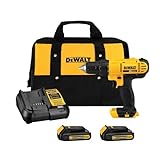
- Lightweight design fits into tight areas
- High performance motor delivers 300 unit watts out (UWO) of power ability completing a wide range of applications
- High speed transmission delivers two speeds (0-450 & 1,500 rpm) for a range of fastening and drilling applications
- 1/2' single sleeve ratcheting chuck provides tight bit gripping strength. Ergonomic handle delivers comfort and control
How to choose a clutch setting for screws
Use the lowest setting that reliably seats the fastener at the required depth. This gives the clutch room to protect the material and the screw if resistance changes. DEWALT’s guidance is to begin with lower torque settings and advance toward higher ones to avoid damaging the workpiece or fastener.
- Identify the fastener and material. Note the screw diameter, length, head type and whether you are driving into drywall, softwood, hardwood, plastic or another substrate.
- Set the gearbox before the clutch. Use the low-speed range when you need extra turning force, such as for a large screw or dense wood. Use the higher range for smaller screws and faster work when the tool and fastener allow it.
- Choose a low clutch position. Start near the low end of the numbered range. A low starting point is especially important for small screws, soft materials and decorative hardware.
- Drive a test screw. Use a scrap piece of the same material, or an inconspicuous location. Keep the bit straight and use moderate trigger pressure so the result reflects the setting rather than a sudden burst of speed.
- Inspect the result. The head should be flush when that is the intended finish, or at the specified depth for countersunk screws. Threads should hold without crushing the surrounding material.
- Adjust in single steps. If the screw stops proud, raise the clutch one step and try again. If it sinks too far, strips or damages the surface, lower the setting. Repeat the test rather than changing several positions at once.
- Repeat when conditions change. A different screw coating, bit, battery state, pilot-hole size or section of wood can require a new setting.
Useful starting points
| Job | Starting approach | Adjustment rule |
|---|---|---|
| Small screws in softwood | Begin near the low end. | Increase one step until the head is seated without sinking. |
| Drywall fasteners | Use a low setting and a controlled trigger. | Stop when the head reaches the intended surface depth; lower the setting if the paper face tears. |
| Large screws or dense hardwood | Use low gear and a higher clutch position only after a test. | Increase gradually; use a pilot hole when the fastener or material requires it. |
| Delicate hardware or plastic | Start at the lowest practical position. | Raise only enough to overcome resistance and avoid cracking or deforming the part. |
The exact number for any row is deliberately not universal. A position that works on one drill may overdrive the same screw on another.
Should the clutch be used when drilling holes?
Normally, no. Move the mode collar to the drill symbol or drill position before drilling wood, metal or masonry. On the Bosch example, this position locks the clutch for drilling and heavy-duty driving. DEWALT separately instructs users to turn the mode collar to the drill symbol for drilling.
The Tool Desk
Outbyte Driver Updater FREEFix the driver behind crashes, sound loss and screen glitchesFind Drivers →Outbyte PC Repair FREERepair Windows errors before they cause bigger problemsFix Now →With the clutch locked or bypassed, the tool can deliver continuous torque instead of clicking as bit resistance rises. Select a suitable bit, speed range and trigger pressure for the material. A clutch position intended for screwdriving can stop a bit prematurely, especially when the bit encounters a hard spot.
Rank #3

- Ergonomically Designed: Work in tight areas with a compact design that gets into tough spots
- Both tools are designed to fit into difficult to reach spaces
- Complete a wide range of applications with a high-performance motor that delivers up to 300 UWO, and an impact driver delivering up to 1,400 in-lbs of torque
- Both the DEWALT impact driver and drill driver feature integrated LED work lights with a convenient 20-second delay, ensuring enhanced visibility in dimly lit or challenging work areas
- One-Handed Loading - Keep one hand free with a 1/4 in. hex chuck that accepts 1 in. bit tips
Some combination tools add a hammer-drill symbol. That is a separate mode for compatible masonry work; use the bit type and operating instructions specified for your model. Do not assume that a drill symbol or hammer symbol has the same behavior on every brand.
How the gearbox and clutch work together
The gearbox selects a broad speed-and-torque range; the clutch fine-tunes the allowable torque within screwdriving mode. A low gear turns more slowly and gives the motor greater mechanical advantage. A high gear turns faster but generally provides less available turning force.
For a small screw, high gear and a low clutch setting may give quick, controlled driving. For a large screw, low gear with a carefully tested clutch position gives better control. Changing gears does not replace changing the clutch: the same numbered setting can behave differently in first and second gear because the gearbox changes the torque delivered to the clutch.
Do not move a mechanical gearbox switch while the trigger is running. Release the trigger and let the chuck stop, then select the other range according to the tool’s instructions.
Rank #4

- High-Performance Power Drill Set: FADAKWALT cordless drill with superior motor, 180 in-lbs (19 N.m) of max torque is perfect for drilling wood, metal, plastics, and all screw driving tasks at home; Precise control settings prevent stripping
- 21+1 Position Clutch: 21+1 torque settings (0-650 RPM ) of power drill can provide more precise torque or speed adjustment as required, which helps to prevent sinking a screw too deep, stripping out the head of a screw or even breaking a screw shaft
- Ergonomic Design: Compact and lightweight, with a superior motor, minimizes fatigue in most daily screwing and drilling tasks; The rubber grip ensures comfort for one-handed operation; The LED light and electric brake ensure precise work in dark areas
- Package List: You will get, 1 x Cordless Drill ,1 x Charger,1 x Magnetic Flexible Shaft, 1 x Extension Bar for Sticking on Fastener,3 x Wood Drill Bits,3 x Masonry Drill Bits,10 x 25 mm screwdriver bits, 1 x Screw anchor set
- Customer Service: If your Cordless Power Drill has quality problems or have any questions, please feel free to contact with us, we are always here
What to do when the result is wrong
The screw stops above the surface
- Increase the clutch one or two positions and retry on a test piece.
- Confirm that the bit fits the screw head and is not worn.
- Check whether the material is harder than the test material or whether a pilot hole is undersized.
- Use low gear for a large fastener if the tool is laboring in high gear.
The screw sinks too far
- Lower the clutch setting and reduce trigger pressure.
- Check the screw length and countersink design; a clutch cannot correct an unsuitable fastener.
- For drywall, stop before the paper face tears. A torn face loses holding strength and may require relocating the fastener.
The head strips or the bit cams out
- Stop immediately and replace the damaged bit or fastener.
- Use the correct bit profile and maintain straight pressure along the screw axis.
- Lower the clutch before trying another screw. A higher setting can continue applying force after the bit has lost engagement.
The drill clicks continuously
- The clutch position may be too low for the fastener or material; raise it gradually.
- The battery may be nearly depleted, or the bit may be binding.
- Verify that the collar is not between positions. If you are drilling, select the drill symbol rather than a numbered screwdriving position.
Stalling, kickback and electronic protection
A clutch click is controlled slip; a stall is different. A stall occurs when the bit or chuck cannot turn, often because a bit binds in a hole or a fastener suddenly encounters extreme resistance. DEWALT warns that an overloaded drill can stall with a sudden twist and advises releasing the trigger immediately.
Keep both hands available when the tool or job allows, brace the work securely and keep your body out of the likely rotation path. Do not hold a spinning chuck or try to stop it by hand. Remove the battery before clearing a jam or changing a bit.
Some models add an electronic anti-rotation feature. DEWALT describes its E-Clutch as sensing tool motion and reducing motor torque to a manageable level when necessary. This is a safety aid, not a replacement for the mechanical clutch, correct gear selection or controlled technique. The presence and behavior of electronic protection vary by model.
Do these 3 things before closing this tab:
1Scan for outdated or missing drivers - takes under a minute2Repair Windows errors before they cause bigger problems3Fix the driver behind crashes, sound loss and screen glitchesWhat the number cannot tell you
A collar number does not reveal the exact torque delivered at the bit, the remaining battery capacity or whether a screw will hold in a particular substrate. It also does not account for friction from a coated screw, a magnetic bit holder, a worn bit or a hole that is out of alignment.
Best Value

- Optimal Performance: 20V MAX* lithium-ion battery always ready for your next project
- 24-Position Clutch: Help achieve control and precision with the 24 clutch positions when drilling
- Soft-Grip Handle: Soft and comfortable grip when in use
- Versatile 100-piece Kit: Includes a wide variety of bits and accessories for drilling and driving tasks
- POWERCONNECT BATTERY SYSTEM: The interchangeable battery system means you can use one battery for multiple different tools
Published maximum torque is a separate specification and should not be confused with an individual clutch position. For example, Bosch lists 265 in-lbs maximum torque for the PS31N while also listing 20+1 clutch settings. That maximum describes the tool’s capability under the manufacturer’s stated conditions; it is not a promise that setting 20 produces 265 in-lbs.
How to compare drill-drivers by their clutch systems
If you are choosing a cordless drill driver, compare the features that affect control rather than counting numbers alone:
- Clutch count and range: More positions can provide finer adjustment, but only if the calibration suits your work.
- Published maximum torque: Useful for comparing capacity when the manufacturer states how it was measured; it does not replace a test screw.
- Gearbox speeds: Two-speed transmissions provide separate fast and high-force ranges.
- Mode positions: Check for dedicated drill and, where relevant, hammer-drill modes.
- Chuck and battery platform: Match the chuck capacity and battery system to the bits, runtime and jobs you expect.
- Safety features: Electronic anti-rotation or overload systems can reduce the consequences of a bind-up, but they do not eliminate the need for safe handling.
The Bosch PS31N illustrates why several specifications should be considered together: its listing combines 20+1 clutch settings, 265 in-lbs maximum torque and two gearbox speeds. Another drill may use 15 positions yet be the better choice for a particular task because of its ergonomics, battery system, chuck or safety controls.
Free tools Windows power users keep installed
One-click scans. No signup required.
A simple rule to remember
For screwdriving, start low and increase until the fastener is seated correctly. For drilling, select the drill position. Treat the numbers as a model-specific control scale, not as a measurement unit, and retest whenever the screw, bit, material, gear or battery condition changes.
Quick Recap
Product prices and availability are accurate as of the date/time indicated and are subject to change. Any price and availability information displayed on Amazon at the time of purchase will apply.

