
iTechGuides is reader-supported. When you buy through links on our site, we may earn an affiliate commission. As an Amazon Associate I earn from qualifying purchases. Learn more
Urban barn owls mainly eat whatever small mammals are abundant in the open spaces around a city. In Penang, introduced barn owls took mostly Norway rats and house shrews; in Tel Aviv, one breeding pair ate mainly Levant voles and house mice in cropland beside housing. Those results show why there is no single “city diet.” Local prey, nearby habitat, owl population and sampling method all matter.
Barn owls usually hunt at dusk and dawn. They fly slowly and low over grass or crops, listen for movement, then hover or drop into vegetation to seize prey. Their pellets provide a useful record of what they swallowed, but a pellet sample from one site or pair cannot describe every urban owl.
What do barn owls eat in cities?
Small mammals are the consistent foundation of the barn owl diet. The exact species changes with geography and with the habitats available around a roost. A city owl may hunt a vacant lot, a roadside verge, a campus lawn, a drainage margin, a farm field or a backyard edge rather than feeding inside a dense block of buildings.
Windows Errors? Fix Them Before They Spread
Repair common Windows errors and clear accumulated junk for a smoother, more stable PC - no reinstall needed.Free scan · no reinstallOutdated Drivers Are Slowing You Down
One free scan finds every outdated or missing driver and matches the right update for your exact hardware.Free scan · exact hardware matchTwo urban studies illustrate the difference clearly:
#1 Best Overall

- REAL OWL PELLETS FOR HANDS-ON LEARNING – Dissect 4 genuine owl pellets and uncover real animal bones. An ideal science education kit designed to deliver tactile, lab-based biology exploration. Encourages curiosity, investigation, and discovery.
- ENGAGING SCIENCE EDUCATION ACTIVITY – Explore key biology concepts through an immersive owl pellet dissection experience. Ideal for high school classroom use (15+), the kit fosters skills in observation, analysis, and hands-on learning.
- INCLUDES DISSECTION TOOLS FOR FOUR PARTICIPANTS – Each kit comes with 4 plastic tweezers and 4 wooden probes, making it perfect for group lab activities. Great for educators, science laboratories, or collaborative research environments.
- PDF BONE CHARTS FOR EASY IDENTIFICATION – Features downloadable full-color PDF bone identification charts to help users accurately match and identify bones. Designed to enrich the learning process and reinforce biological structure knowledge.
- SCIENCE EDUCATION FOR TEENS AND ADULTS – Created for learners aged 15 and older. Supports advanced exploration of animal biology, ecosystems, and anatomical structures in a responsible and age-appropriate way.
| Location and birds | Setting and sample | Main findings | How to interpret it |
|---|---|---|---|
| Penang, Malaysia; introduced Southeast Asian barn owls (Tyto alba javanica) | Urban pellets; 62 individual pellets in the reported sample | Commensal rodent pests made up 95.49% of prey biomass. Norway rats accounted for 65.37% and house shrews 30.12% of biomass. | A strong local signal of rodents and shrews, not a universal urban percentage. |
| Tel Aviv, Israel; one breeding pair of Tyto alba | Pellets collected during the 2005 and 2006 breeding seasons; the pair hunted cropland adjoining residential areas | Six small-mammal species made up 99.3% of the diet. Levant voles represented 48.1% and house mice 32.9% of prey specimens. | The birds were urban-associated, but much of their hunting occurred in farmland next to the homes. |
The Penang figures come from Saufi and colleagues’ study in the Journal of Urban Ecology (read the study). The Tel Aviv results are from Charter, Izhaki, Shapira and Leshem’s account in the Wilson Journal of Ornithology (read the paper record).
How the British figures fit
For Britain as a whole, the Barn Owl Trust lists field voles as 45% of the reported diet, common shrews as 20% and wood mice as 15%. Those proportions are a national summary on the Trust’s species-information page, not an estimate for towns or cities. They provide useful context, but they should not be substituted for a local urban sample.
Across all of these examples, “what barn owls eat” means prey that can be caught efficiently in the surrounding landscape. A city label describes where people live or where the nest is located; it does not guarantee that every prey item came from a built-up core.
Why can two city owl diets look so different?
Differences between urban sites are expected rather than contradictory. Four variables are especially important:
Rank #2

- PREPARED FOR CLASSROOM USE Heat treated pellets are prepared for classroom use and are widely used by teachers, camps, and science organizations.
| Variable | Why it changes the apparent diet | Questions to ask |
|---|---|---|
| Local prey availability | Owls take common, accessible mammals. A rat-rich campus can produce a very different pellet mix from a vole-rich field. | Which mammals are actually abundant at the site? |
| Nearby habitat | Open grass, cropland, rough margins and yards offer hunting space; walls and roads may simply surround those patches. | Was the owl hunting fields, verges, gardens or only built surfaces? |
| Region and owl population | Prey communities and barn owl populations differ between continents. The Penang birds were introduced T. a. javanica; the Tel Aviv birds were reported as T. alba. | Are species, subspecies and climate being kept distinct? |
| Sampling scope | A pellet count from one nest, pair or season records a narrow window. Larger or longer samples can show more variety. | How many owls, pellets and seasons were included, and are percentages by biomass or by prey specimens? |
Percentages also use different denominators. Penang’s 65.37% Norway-rat figure is a share of prey biomass, whereas Tel Aviv’s 48.1% Levant-vole figure is a share of prey specimens. Those numbers cannot be ranked as if they measured the same thing.
Where do barn owls hunt in an urban landscape?
Barn owls need open hunting surfaces more than they need wilderness. Their urban range is best understood as a mosaic: a nest or daytime roost may be in a building, while the actual foraging circuit runs across grass, fields, drainage corridors or lightly managed edges.
Open grass and roadside margins
In the Penang study, introduced owls were observed hunting open grass near roadsides, settlements and shop backyards. These strips can support rats, shrews and other small mammals while giving an owl room to fly low and turn. A roadside sighting therefore does not mean the bird is hunting on the traffic lane; it may be working the vegetated margin.
Cropland beside housing
The Tel Aviv pair hunted croplands next to a residential area. Their case is a reminder that a “city owl” may obtain most of its food outside the dense built core. Housing can provide nest cavities or nearby perches, while adjoining agriculture supplies the prey.
Rank #3
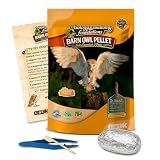
- PREPARED FOR CLASSROOM USE Heat treated pellets are prepared for classroom use and are widely used by teachers, camps, and science organizations.
Buildings as roosts and launch points
Barns, abandoned structures and other quiet buildings can function as roosting or nesting places. The available studies do not show that barn owls routinely search indoor rooms, parking garages or sealed city centers for food. They point instead to open patches embedded in the built environment.
How do barn owls locate and catch prey?
The Barn Owl Trust describes a hearing-led hunting style. Its guidance says: “Relying mostly on sound to locate prey, they fly low (up to about 3 metres) and slowly, back and forth across suitable habitat until they hear a small mammal below.” (Barn Owl hunting and feeding.)
- Choose suitable open habitat. The owl patrols grass, crops or rough margins where a mammal can be reached from the air.
- Fly low and slowly. The Trust gives a height of up to about 3 metres for this searching flight. This is specialist guidance, not a measured average for every urban bird.
- Listen for movement. Barn owls rely mostly on sound, allowing them to detect prey that is hidden under vegetation or operating in low light.
- Pause, hover or alter the approach. The Trust notes that an owl may hover before pouncing or drop directly into grass.
- Seize and swallow the prey. Small mammals are generally swallowed whole, leaving indigestible material to be expelled later as a pellet.
Activity is most common around dusk and dawn according to the Trust. Seeing an owl in daylight does not prove it is hunting then; it may be commuting, disturbed or moving between roosts. Likewise, a quiet night does not show that no hunting occurred.
What’s actually slowing this PC down?
Pick the symptom - the matching free tool is one click away.
What do barn-owl pellets reveal?
Barn owls swallow prey whole and later regurgitate compact pellets containing indigestible bones, hair and feathers. By separating and identifying those remains, biologists can estimate which prey species were represented in a sample. That is why pellets are central to both the Penang and Tel Aviv diet studies.
Rank #4

- CLASSROOM SIZE: Pack of 50 large owl pellets perfect for educational dissection activities and classroom experiments
- AUTHENTIC SPECIMENS: Real barn owl pellets allowing students to discover and study actual prey remains and small animal bones
- EDUCATIONAL VALUE: Enables hands-on learning about food chains, predator-prey relationships, and owl dietary habits
- COMPLETE KIT: Contains everything needed for pellet dissection activities in classroom settings
- SPECIMEN SIZE: Large-sized pellets provide ample material for thorough examination and bone identification
What a pellet sample can tell you
- Which prey remains were present at the sampled roost or nest.
- Relative representation of species under the study’s chosen measure, such as biomass or number of prey specimens.
- Changes in diet between sites or seasons when sampling designs are comparable.
What it cannot tell you by itself
- The complete diet of every barn owl in the city.
- Exactly where each prey item was caught.
- How many hunting flights occurred or how far an owl travelled.
- Whether consuming a pest species reduced that pest’s population.
A pellet is evidence of ingestion, not a GPS record. A sample dominated by rats may reflect the prey around one nest, a particular season or the areas that owl used most often. It should be read with the number of pellets, number of owls, dates and habitat description.
Do urban barn owls control rat populations?
They can consume rats, and the Penang sample contained a very high share of commensal rodent pests. That establishes predation, not reliable city-wide pest control. The Penang authors describe biological-control potential but call their results preliminary and note that the effectiveness of reducing pest populations remains debated (Saufi et al., 2020).
Population control requires more than showing that an owl ate a rat. Researchers would need to measure pest abundance before and after owl activity, account for reproduction and immigration, and compare areas with and without the owls. Pellet percentages alone do not provide that test. It is therefore accurate to say barn owls may remove individual rodents, but not to promise that installing nest boxes or attracting owls will solve an urban rat problem.
Do these 3 things before closing this tab:
1Repair Windows errors before they cause bigger problems2Scan for outdated or missing drivers - takes under a minute3Clear out junk files and repair common Windows errorsWhat urban risks have been documented?
Urban living can expose barn owls to hazards as well as food. A British Columbia study examined habitat use across a rural-to-urban gradient and assessed habitat loss, rodenticide exposure and road mortality. Its fieldwork took place in the Lower Mainland from May 2010 through June 2014 (read the study PDF).
Best Value

- CLASSROOM SIZE: Pack of 100 small owl pellets perfect for educational dissection activities and classroom experiments
- AUTHENTIC SPECIMENS: Real barn owl pellets allowing students to discover and study actual prey remains and small animal bones
- EDUCATIONAL VALUE: Enables hands-on learning about food chains, predator-prey relationships, and owl dietary habits
That work is valuable context for thinking about city owls, but it does not quantify risk for every urban area. Local traffic volume, poison use, building design, prey supply and the amount of remaining open habitat can differ sharply between cities. A barn owl hunting beside a road in Penang, for example, should not automatically be assigned the same exposure profile as a bird in British Columbia.
How to evaluate a claim about a “city owl diet”
When a wildlife report gives a striking percentage, check the details before generalizing it:
- Identify the birds. Confirm the species or subspecies and whether they are resident, introduced or breeding birds.
- Locate the hunting habitat. Note whether the site includes cropland, grass, wetlands, yards, roadside verges or mostly buildings.
- Check the sample. Look for the number of owls, pellets, nests and sampling seasons.
- Read the denominator. “Percent of biomass” and “percent of prey specimens” answer different questions.
- Separate diet from control. Eating a pest is not the same as lowering its population across a neighborhood.
- Keep the geography attached. A Penang result, a Tel Aviv result and a British national summary should remain labeled as such.
This checklist prevents the most common mistake: treating one well-documented local pattern as a universal rule for all urban barn owls.
The practical answer for city residents
If you see a barn owl quartering a field beside apartments or hear one calling near a roadside, the bird is probably using the city’s remaining open habitat as a hunting ground. It may be taking rats, shrews, mice or voles, depending on what that particular landscape supplies. Its low, quiet flight and dusk activity are normal hunting adaptations, not evidence that it is searching every building.
The strongest conclusion supported by the available studies is specific rather than sweeping: urban barn owls are small-mammal hunters that exploit open patches within a built landscape, and their diets can differ dramatically between cities. Pellets can document those local differences, while broader claims about universal diets or dependable rat control require evidence beyond a single nest, pair or season.
Quick Recap
Product prices and availability are accurate as of the date/time indicated and are subject to change. Any price and availability information displayed on Amazon at the time of purchase will apply.

