
The Tool Desk
Outbyte Driver Updater FREEFix the driver behind crashes, sound loss and screen glitchesFind Drivers →Outbyte PC Repair FREERepair Windows errors before they cause bigger problemsFix Now →iTechGuides is reader-supported. When you buy through links on our site, we may earn an affiliate commission. As an Amazon Associate I earn from qualifying purchases. Learn more
A 65W USB-C Power Delivery (PD) charger can be a practical single charger for many Apple devices. “65W” is the charger’s maximum output, not an amount it forces into every device. USB PD negotiates an approved voltage and current with the connected iPhone, iPad or Mac, and the device draws only what its charging system can use.
That makes 65W suitable for many USB-C MacBook Air models, some 14-inch MacBook Pro configurations, and shared charging for iPhone and iPad. It is not an equal replacement for the 140W adapter specified for a 16-inch MacBook Pro, and a Mac designed around 67W, 70W or 96W may charge more slowly when you are working on it. The cable, charger compliance and port-sharing design matter as much as the headline wattage.
What “65W USB-C PD” actually means
USB-C describes the connector. USB Power Delivery is the negotiation system carried over that connector. A 65W PD charger advertises the power combinations it can provide, and the Apple device requests a compatible combination. The charger then supplies that negotiated level rather than automatically delivering 65W.
Quick wins for a faster PC:
Fix the driver behind crashes, sound loss and screen glitchesFind Drivers →Clear out junk files and repair common Windows errorsFree Scan →Scan for outdated or missing drivers - takes under a minuteDriver Scan →For example, an iPhone may request far less than 65W, while a MacBook can request substantially more than a phone but still less than the charger’s ceiling. The device, cable and charger must all support the requested mode. If any one of them has a lower limit, that limit controls the result.
#1 Best Overall

- USB C Laptop charger:Watt: 65W 45W Input :100-240V 1.5A 50-60Hz Output:5V-3A or 9V-3A or 15V-3A or 20V -3.25A,Connector:USB Type-C; VJYUIJAY Laptop Charger Fast charging Compatible with More USB C laptops,For use with compatible devices only,Do not exceed the rated power,Use certified cables,and Avoid placing in enclosed, high-temperature areas
- VJYUIJAY Computer Charger Type C Compatible with ThinkPad L390 L480 L490 L580 L590 E480 E580 E585 E490 E590 P51s P52s P43s P53s ,T470 T470s T480 T480s T490 T495 T590, X270 X380 X390 X395 X1 Carbon 5th 6th 7th Generation;Yoga S730 720 730 910 920 720-12IKB 720S-13IKB 730-13IKB 910-13IKB 920-13IKB, X270 X280 X380 X390 X395 Yoga, X1 Tablet 2nd 3rd;Flex 11 chromebook ,13 Chromebook 2nd Generation;100e 300e 500e C330 C340 S330 S340 C930 C940 C740 Yoga
- VJYUIJAY Laptop Charger Type C Compatible with Chromebook X360 11 12 14 15;14a-na0020nr 14a-na0010nr 14b-ca0013dx 14b-ca0010nr 14b-ca0015cl 14b-ca0023dx 14b-ca0025cl 14b-ca0036nr 14c-ca0000 14-ca0053dx 14-ca0043cl 14-ca003cl 14-ca0065nr 14-ca061dx 11-ae051wm 11-ae001tu 11-ae027nr 11-ae001nr 11-ae002nr 11-ae010nr 11-ae020nr 11-ae027nr;Spectre X2 X360/Elite X2/Pavilion X2/Elite x2 1012 G1 1012 G2 210 /Envy X2
- VJYUIJAY Chromebook Charger Type C Compatible With Chromebook 3100 3300 3380 3400 3500 5190 5300 5400 7200 7300,Latitude 5420 5520 5320 7410 7310 2-in-1 P28T P29T P30T P86F;XPS 12 9250 XPS 13 9300 9310 9350 9360 9370 9380 XPS 15 9550;3310 2-in-1 3390 2-in-1 5175 2-in-1 7200 2-in-1 7210 2-in-1
- VJYUIJAY 65W USB C Laptop Charger Compatible with Spin 11 13 R13 15 311 315 CP311 CP713 C933 CB5-312T R751T SF713 SP714 CB311 CB314 CB314 CB514 CB515 CB714 CB715 CP5-471 CP311 CP315 CP511 CP713 R721 R751 R752T R851
- 65W is a ceiling: it describes the maximum output available from the charger under its stated conditions.
- PD is negotiated: the device and charger agree on an allowed voltage and current combination.
- The device controls demand: connecting an iPhone to a 65W charger does not make the iPhone consume 65W.
- One port is not always the whole charger: multi-port models can reduce the power available to each port when several devices are connected.
Apple’s support guidance, published July 6, 2026, says a USB-C Mac can be charged with any USB-C power adapter or display that supports USB PD. Apple also says a USB-C Mac can use an adapter with higher or lower wattage than the recommended adapter. Using at least the model’s recommended minimum generally gives the best experience, especially while the computer is under load.
Which MacBook models can use 65W?
Compatibility and ideal performance are different questions. A 65W PD adapter can be electrically compatible with a Mac that recommends a higher-wattage adapter, but charging may be slower and the battery may continue to discharge during demanding work.
| Apple laptop group | Apple-listed adapter classes | What to expect from 65W PD |
|---|---|---|
| MacBook Air introduced in 2022 or later | 30W, 35W, 67W or 70W, depending on model and configuration | Works with USB-C PD. Models designed around 30W or 35W have more headroom; models listed at 67W or 70W can charge more slowly during heavy use. |
| 14-inch MacBook Pro introduced in 2021 or later | 67W, 70W or 96W, depending on model and configuration | Within USB-PD compatibility, but below some recommended wattages. Expect slower charging under sustained workloads. |
| 16-inch MacBook Pro introduced in 2021 or later | 140W | 65W is not an equivalent replacement for peak charging performance. It may power or charge the Mac more slowly, particularly while it is busy. |
The wattage figures above are Apple’s named adapter classes for those model groups. Exact behavior still depends on the individual Mac, its battery state, temperature, workload and the charger’s PD profiles.
MacBook Air: where 65W is most practical
Many recent MacBook Air models are the easiest fit for a 65W charger. A model listed with a 30W or 35W adapter has a charger ceiling well above its normal requirement. A model listed with 67W or 70W can still use 65W, but the small shortfall may be noticeable when compiling code, exporting video, running virtual machines or otherwise loading the processor while charging.
Rank #2

- The Only Charger You Need: Say goodbye to your old power bricks. Anker 715 Charger (Nano II 65W) has the power you need to fast charge your phone, tablet, and USB-C notebook from a single tiny charger.
- High-Speed Charging: Charge a 2020 MacBook Air in less than 2 hours, a MacBook Pro 13ʺ at full speed, an iPhone 13 up to 3× faster than with an original 5W charger, and charge the latest Samsung phones at full speed with Samsung Super Fast Charging.
- Downsized Design: At 58% smaller than an original 61W USB-C charger, and with a foldable plug, Anker Nano II takes up less space while giving you just as much power.
- Powered by GaN II Technology: With a 100% increase in operating frequency, an innovative stacked design, and an upgraded circuit board structure, GaN II technology makes our latest charger smaller without sacrificing a drop of power.
- What You Get: Anker 715 Charger (Nano II 65W) / Anker Nano II 65W, welcome guide, our worry-free 18-month warranty, and friendly customer service (cable not included).
If your Air is asleep or lightly used, the difference may be difficult to notice. Under sustained load, macOS can prioritize system power over rapid battery replenishment. “Compatible” therefore does not mean “same charging speed as the Apple-specified adapter.”
14-inch MacBook Pro: compatible, but check the recommendation
Recent 14-inch MacBook Pro models are listed with 67W, 70W or 96W adapters. A 65W PD charger remains below each of those named classes, although Apple’s USB-C guidance permits a lower-wattage adapter. It is reasonable as a travel or emergency charger, and it can be a compact everyday option if you accept slower charging.
For a workday involving intensive CPU or graphics use, choose a charger that meets at least the wattage Apple lists for your exact configuration. A 65W unit should not be presented as a full-performance substitute for a 96W adapter.
16-inch MacBook Pro: do not treat 65W as a 140W replacement
Apple lists a 140W adapter for 16-inch MacBook Pro models introduced in 2021 or later. A 65W charger can be useful for low-load situations if the Mac accepts the negotiated connection, but it cannot provide the same peak charging performance. Expect substantially slower replenishment, and be prepared for the battery level to fall during demanding work.
Rank #3

- the Only Charger You Need: Say goodbye to your old chargers. Anker 735 Charger (Nano II 65W) has the power you need to fast charge your phone, tablet, and USB-C notebook from a single charger.
- High-Speed Charging: Connect a single device to get a 65W max charge—that’s enough to power up a 2020 MacBook Pro 13″ at full speed. And when you connect three devices, power will be distributed efficiently between ports to ensure you get the best charge.
- Compact Design: Power up to 3 devices with a charger that’s roughly the size of an AirPods Pro case.
- Powered by GaN II Technology: With a 100% increase in operating frequency, an innovative stacked design, and an upgraded circuit board structure, GaN II technology makes our latest charger smaller without sacrificing a drop of power.
- What You Get: Anker 735 Charger (Nano II 65W) / PowerPort III 3-Port 65W Pod, welcome guide, our worry-free 18-month warranty, and friendly customer service.
Will a 65W charger fast-charge an iPhone?
It can, provided the charger is USB-PD compliant and the cable and iPhone support the desired mode. The iPhone limits its own draw, so a 65W adapter is not “too much” merely because its maximum output is higher than the phone’s requirement.
Apple’s adapter guidance identifies 20W adapters with several iPad generations and says an 18W USB-C adapter can fast-charge iPhone 8 or later. Those figures describe adapter classes, not a universal charging rate for every iPhone. A 65W PD charger can supply the required negotiation while the phone requests its own lower level.
Apple’s current iPhone guide (2026) adds model-specific requirements: iPhone 17, iPhone 17 Pro, iPhone 17 Pro Max and iPhone Air require at least 40W for fast charging. For faster wired charging on iPhone 18 Pro and iPhone 18 Pro Max, Apple says to use a cable rated for 60W or more and an adapter capable of supplying 60W or more. These are feature- and model-specific instructions, so check the guide for the exact iPhone and charging mode you have.
Free tools Windows power users keep installed
One-click scans. No signup required.
What “fast charging” does not tell you
There is no single percentage or minutes-to-full figure that applies to every iPhone connected to a 65W charger. Charging speed changes with the model, battery state, temperature, cable, charger profile and whether the phone is being used. The phone also reduces power as the battery approaches full to manage heat and charging conditions.
Rank #4

- [One Charger. Less to Carry] Nearly 30% smaller than Apple’s 70W charger, it stays snug without blocking nearby outlets. Charge 3 devices at once; foldable prongs tuck away to prevent snags and scratches.
- [65W Laptop-Ready Power] Charge a 14" MacBook Pro to 52%, iPhone 17 Pro to 67%, or Galaxy S26 Ultra to 78% in 30 min. Ready for cameras, drones, handhelds, and more.
- [A Complete Pro Charging Kit] Includes a 5ft 100W nylon-braided USB-C cable built for everyday bends and pulls, with extra reach for desks, bedsides, hotels, and travel.
- [Smart Power, Port by Port] USB-C1 delivers 65W solo; C1+C2 gives 45W+20W, C1+A 45W+18W, C2+A shares up to 15W, and all 3 run at 45W + 15W shared.
- [Stable Power, Without the Guesswork] TempGuard checks heat 1,000×/sec to help reduce heat-related slowdowns and interruptions, limiting excess heat exposure for more battery-friendly charging.
Can a 65W charger charge an iPad?
Yes, a compliant USB-C PD charger can charge iPad models that accept USB-C power. Apple states that Mac USB-C power adapters and compliant third-party adapters can charge iPhone and iPad. The iPad negotiates its own draw, so the charger’s 65W maximum does not force the tablet to take that much.
Apple’s adapter overview lists 20W adapters with several iPad generations. That is a useful indication that many iPads operate well below 65W, but it is not a promise that every iPad has the same charging behavior. An iPad may charge more slowly if the cable is limited, the charger is sharing power with another port, or the tablet is being used heavily.
Choosing the right cable for 65W charging
The cable can become the limiting component. Use a USB-C cable explicitly rated for the power and charging mode required by the device. For a 65W Mac connection, select a cable whose stated rating meets or exceeds the negotiated power; a cable rated only for lower-power charging can prevent the Mac from receiving the charger’s full capability.
Recommended Free Tools
For a Mac that uses MagSafe 3, follow Apple’s specified MagSafe 3 cable and USB-C adapter combination. Compatible Macs can also support USB-C charging, but the port and cable arrangement you choose affects convenience and available charging modes.
Best Value
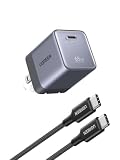
- Advanced AVS Fast Charging for iPhone 18 Pro Series: Supports multiple fast-charging protocols, including the latest AVS protocol for dynamic power adjustment. Charge your iPhone 18 Pro Max to approximately 50% in just 15 minutes, making it an ideal charging companion for iPhone 18 Pro and iPhone 18 Pro Max
- Ultra-Compact and Effortlessly Portable: Measuring just 1.22×1.30×1.59 inches, this charger features an ultra-compact design with foldable prongs for convenient travel. It fits into your pocket without feeling bulky, making it ideal for everyday carry. Whether you're commuting, traveling, or on a business trip, it ensures you can conveniently charge your devices anytime, anywhere
- GaN Technology – Small Yet Safe: UGREEN's tiny cube charger features the latest-generation GaN chip, making charging safer than ever. Thermal Guard technology prevents overheating, so you can enjoy fast charging with complete peace of mind. Plus, 8 active and passive protections (over-temperature, short-circuit, over-voltage, etc.) ensure worry‑free use
- Sleek finish and practical: This charger features a sleek, minimalist design with a starry silver-gray matte finish. The USB-C port panel is covered in translucent frosted glass, while the lower section is precision-engraved with 24 fine ridges—enhancing grip and adding a touch of sophistication. It’s more than a power adapter; it’s a desktop ornament that elevates your space
- One for all: This single charger powers nearly all your devices — from iPhone 12 through 17, Galaxy S23 to S26, Galaxy A and Z series, Pixel 7 to 10, to iPad Air/Pro, AirPods, MacBook Air/Neo/Pro, Steam Deck, and countless other USB-C gadgets. One power source. All covered
For iPhone 18 Pro and iPhone 18 Pro Max faster wired charging, Apple’s current guidance requires a cable rated for 60W or more. A cable that physically fits but lacks the necessary rating may fall back to a lower charging mode.
- Read the cable’s power rating rather than judging by connector shape.
- Replace cables with damaged insulation, bent contacts or intermittent connections.
- Use a cable long enough to avoid strain on the device port and charger.
- When a multi-port charger shares power, verify that the cable remains rated for the power assigned to its port.
Safety and compliance checks
Apple warns that non-compliant adapters may pose safety risks. Choose a charger that complies with applicable regional and international safety standards and that identifies the manufacturer, electrical ratings and certification information. Avoid unmarked units or listings that provide only a “65W” headline without electrical specifications.
Before connecting
- Confirm the charger supports USB Power Delivery, not merely USB-C as a connector type.
- Check the exact Mac, iPad or iPhone model’s recommended wattage and any model-specific fast-charge requirement.
- Confirm the cable rating is sufficient for the intended device and mode.
- If the charger has multiple ports, read its power-sharing table. A port may provide 65W alone but less when another port is occupied.
- Inspect the plug, cable and device port for damage, debris or unusual heat.
During charging
A warm charger or device can be normal, particularly at high output, but excessive heat, a burning smell, buzzing, discoloration or repeated connect-and-disconnect cycles is not. Unplug the equipment and replace the suspect charger or cable. Do not cover a power brick or use it where ventilation is blocked.
How to choose a 65W USB-C PD charger
“65W” alone does not identify the best charger for an Apple setup. Compare the specifications that determine whether the advertised output is useful in your situation.
| Specification | Why it matters |
|---|---|
| Maximum single-port wattage | Shows whether one port can actually deliver the power your Mac may request. |
| Number of ports and power sharing | Determines whether connecting an iPhone or iPad reduces the power available to the Mac. |
| USB-PD profile support | Controls which voltage and current combinations the charger can negotiate with Apple devices. |
| Cable included and cable rating | Prevents a lower-rated cable from limiting the charger or a model-specific fast-charge mode. |
| Physical size and plug design | Affects portability, outlet clearance and travel convenience. |
| Regional safety certification | Provides evidence that the charger meets applicable electrical-safety requirements for your location. |
| Warranty and support | Defines how defects or early failure are handled. |
| Price | Should be weighed against port count, included cable, certification and warranty; it does not predict charging speed by itself. |
For a one-charger travel setup, search specifically for a “65W USB-C PD charger,” then verify the port-sharing details, cable inclusion, plug region, warranty and safety certification. If you routinely use a 16-inch MacBook Pro at high load, select a charger sized for that Mac instead of treating 65W as a universal replacement.
Troubleshooting slow or failed charging
The Mac says it is charging, but the battery still falls
- Check whether the Mac’s recommended adapter is above 65W. A 67W, 70W, 96W or 140W design can consume more power under load than a 65W charger supplies.
- Disconnect other devices from a multi-port charger and retest; power sharing may have reduced the Mac’s allocation.
- Use a cable rated for the required power and inspect both USB-C connectors.
- Reduce the workload temporarily. If the battery rises when the Mac is idle, the charger is likely functional but undersized for the active workload.
The iPhone or iPad does not show expected fast charging
- Verify that the charger supports USB PD rather than only basic USB output.
- Check the exact device guide. iPhone 17-series fast charging requires at least 40W, while faster wired charging on iPhone 18 Pro models requires a 60W-or-higher adapter and cable.
- Try a known-good, correctly rated cable.
- Remove other devices from the charger to rule out power sharing.
- Allow the device to cool. Temperature and battery state can reduce charging power even when the charger is adequate.
The charger repeatedly disconnects
Replace the cable first if it is worn or loose, then test another compliant PD charger. Persistent disconnections, abnormal heat or visible damage indicate that the charger or device port should be taken out of service rather than repeatedly reset.
Bottom line for a shared Apple setup
A compliant 65W USB-C PD charger is a sensible shared charger for many MacBook Air models, numerous iPhone and iPad combinations, and some 14-inch MacBook Pro use. It negotiates lower power safely with smaller devices, so 65W is not excessive for an iPhone. The trade-off is laptop performance: Macs listed for 67W, 70W or 96W may charge more slowly, and a 16-inch MacBook Pro listed for 140W will not receive equivalent peak charging. Match the charger and cable to the exact device, workload and charging feature rather than assuming the 65W label guarantees a particular charge time.
Do these 3 things before closing this tab:
1Fix the driver behind crashes, sound loss and screen glitches2Repair Windows errors before they cause bigger problems3Scan for outdated or missing drivers - takes under a minuteQuick Recap
Product prices and availability are accurate as of the date/time indicated and are subject to change. Any price and availability information displayed on Amazon at the time of purchase will apply.

