
iTechGuides is reader-supported. When you buy through links on our site, we may earn an affiliate commission. As an Amazon Associate I earn from qualifying purchases. Learn more
There is no universal winner. Mobile robots can reduce walking and move shelves, bins, carts or parcels between work areas; conveyors provide continuous movement on a fixed path; people remain essential for inspection, grading, exceptions and disposition decisions. The right choice depends on your return volume, item mix, layout, software and the share of work that is transport versus judgment.
Public examples report substantial gains, but they use different sites, units and workflows. No controlled, same-site study establishes that robots are faster or cheaper than conveyors or manual processing for every returns operation. Compare the complete workflow—receiving, scanning, inspection, disposition, transport, restocking, exception handling and systems support—not a machine’s headline speed.
What each approach actually automates
Returns processing has two separate jobs that are often confused:
Do these 3 things before closing this tab:
1Clear out junk files and repair common Windows errors2Scan for outdated or missing drivers - takes under a minute3Repair Windows errors before they cause bigger problems- Decision work: identify the item, inspect condition, grade it, determine whether it can be resold, repaired, liquidated or recycled, and record the disposition.
- Movement work: carry the item or container between receiving, inspection, storage, packing and outbound destinations.
A sorter can route an item without deciding whether it is sellable. A robot may bring a shelf or tote to an associate, or carry a parcel to a destination, while a person still performs the inspection. A conveyor moves goods continuously but normally needs scanners, controls and people at induction and downstream stations. Manual processing combines judgment and movement, making it flexible but sensitive to walking distance, staffing and work design.
#1 Best Overall

- Industrial-Grade Stainless Steel: Our belt conveyor boasts a sturdy stainless steel build, ensuring long-term durability and stability in any industrial setting. It is treated with special surface processing to optimize rust resistance and wear resistance.
- PVC Conveyor Belt: With wear-resistant and anti-static properties, this PVC flat conveyor belt, measuring 59" x 15.7" and 0.08" thick, efficiently handles items of various sizes. The rotating screw provides precise adjustment of belt tension, while infinitely adjustable support feet ensure the belt remains stable in any working environment.
- Multi-Adjustment System: Our flat conveyor belt system features adjustable speeds from 30 to 120 rotations per minute, with the ability to run in both directions. With the rotating screw and height-adjustable support feet, it adapts like a charm to different tasks and environments!
- Efficient Motor: Our electric PVC conveyor comes with a high-performance motor equipped with automatic overheating protection. It shuts down at 115℃ (239℉) to prevent damage and restarts after cooling to 71.6℃ (160.9℉), ensuring continuous operation without the need for monitoring and improving production line efficiency.
- Industry Compatibility: From chemical plants to pharmaceutical factories, food factories to auto parts plants, our PVC conveyor is tailor-made for various industries, meeting strict security, hygiene, and efficiency standards. Boost productivity, reduce downtime, and keep the workflow smooth with our conveyor system!
How a complete returns workflow should be compared
1. Receiving and identification
Measure dock-to-scan time, barcode or label-read rate and the labor required to open parcels and reconcile customer or carrier records. A fast transport system does not help if unscannable items accumulate at receiving.
2. Inspection and grading
Record the time per item, the percentage requiring a second review and the accuracy of the grade. Apparel, electronics, hazardous goods and damaged packaging can have very different inspection requirements. Unless a specific system demonstrates automated grading, assume a trained person remains responsible for the decision.
3. Disposition and routing
Disposition may send an item to sellable stock, repair, vendor return, liquidation, recycling or a quarantine area. Track how often rules change and how many exceptions need a supervisor. Robots and conveyors can execute destinations supplied by software; they do not replace the disposition policy.
4. Restocking or resale preparation
Measure the time from inspection to inventory availability, including relabeling, repacking, cleaning and quality checks. Delayed restock can cost more than slow travel because the item remains unavailable for sale.
5. Exception handling
Count missing labels, mixed totes, serial-number mismatches, fraud reviews, damaged goods and blocked lanes. Report exception rate and resolution time separately from normal-case throughput. Flexible manual work may outperform a highly automated line when exceptions dominate.
Rank #2
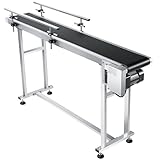
- Industrial-Grade Stainless Steel: Our belt conveyor boasts a sturdy stainless steel build, ensuring long-term durability and stability in any industrial setting. It is treated with special surface processing to optimize rust resistance and wear resistance.
- PVC Conveyor Belt: With wear-resistant and anti-static properties, this PVC flat conveyor belt, measuring 59" x 7.8" and 0.08" thick, efficiently handles items of various sizes. The rotating screw provides precise adjustment of belt tension, while infinitely adjustable support feet ensure the belt remains stable in any working environment.
- Multi-Adjustment System: Our flat conveyor belt system features adjustable speeds from 30 to 120 rotations per minute, with the ability to run in both directions. With the rotating screw and height-adjustable support feet, it adapts like a charm to different tasks and environments!
- Efficient Motor: Our electric PVC conveyor comes with a high-performance motor equipped with automatic overheating protection. It shuts down at 88℃ (190.4℉) to prevent damage and restarts after cooling to 80℃ (176℉), ensuring continuous operation without the need for monitoring and improving production line efficiency.
- Industry Compatibility: From chemical plants to pharmaceutical factories, food factories to auto parts plants, our PVC conveyor is tailor-made for various industries, meeting strict security, hygiene, and efficiency standards. Boost productivity, reduce downtime, and keep the workflow smooth with our conveyor system!
Robots, conveyors and people: side-by-side
| Decision axis | Mobile or robotic systems | Conveyor-based systems | Manual processing |
|---|---|---|---|
| Movement and routing | Can change routes or bring goods, bins or shelves to people; capability depends on the vehicle, payload, fleet software and integration. | Provides predictable continuous movement on a designed path; changing routes can require physical redesign. | People and carts adapt routes immediately, but walking and cart travel increase with volume and distance. |
| Sortation versus inspection | May transport or sort. Do not infer automated grading or disposition unless the deployed system proves it. | Transports items and can feed sortation equipment; inspection decisions generally remain at stations. | Handles varied inspection and exception work directly, with throughput limited by staffing and ergonomics. |
| Throughput evidence | Deployment reports exist for returns putaway and goods-to-person work, but units and workflows differ. | No directly comparable returns-line figure was established in the available evidence. | A historical returns-putaway baseline is available for one Superdry site only. |
| Flexibility | Software routes and modular fleets can support layout changes; charging, traffic rules and integration constrain that flexibility. | Best suited to stable, high-volume flows with known destinations; expansion may require construction and controls changes. | Highly adaptable to low-volume, irregular or frequently changing work, but additional volume usually requires more labor or space. |
| Systems and exceptions | Needs fleet orchestration, warehouse-management interfaces, scanning and recovery procedures. Human judgment still resolves unusual items. | Needs scanners, programmable logic, destination logic, sensors and downstream handling. A jam can affect an entire line. | Can resolve unusual conditions at the station, but hand-written or manual system updates create variability. |
| Total cost evidence | No current, comparable public installed-cost or payback benchmark was established. | No comparable public installed-cost or payback benchmark was established. | Labor, space, peak staffing, errors and throughput must be measured locally; no universal cost benchmark applies. |
What the published deployment figures do—and do not—show
The following examples are useful for forming questions, not for promising results at another facility. Each number has a specific operator, site, unit and time period.
| Operator and source date | Reported result | How to interpret it |
|---|---|---|
| nGroup returns putaway, Locus Robotics customer case study, undated and accessed in 2026 | Productivity rose from 124 to 285 lines per hour, described as a 229% increase; the operation put away close to 1 million units monthly. | Vendor-reported performance for one operation. “Lines per hour” is not equivalent to items or parcels per hour, and the baseline and work mix may not match yours. |
| Happy Returns hub in Pennsylvania, Geekplus case study, 2024 | Reported 65% increase in process accuracy and 50% increase in item-processing efficiency during the first month of a 150-robot deployment at a 91,500-square-foot return hub. Items sent to retailers reportedly shipped 35% faster. | Dated vendor report from one facility and an early deployment period. The measures, baseline and definitions should be verified before modeling a business case. |
| DHL eCommerce Solutions robotic sortation, announcement, 2022 | Configurations handled more than 1,000 parcels and packages per hour. DHL reported an 80% labor-efficiency increase for Sort-to-Bag in Atlanta, routing parcels to 80 final-mile ZIP-code destinations and handling parcels up to 15 pounds. | Parcel-sortation evidence, not a benchmark for inspection, grading or returns disposition. Throughput and labor figures describe DHL’s configurations and operation. |
| Superdry returns putaway in Burton-upon-Trent, Warehousing Ireland trade report, 2020 | Reported throughput rose from under 100 units per hour to 300–350 per hour after a Hikrobot carrier deployment; 99% of returns were reportedly processed and redispatched within 24 hours. | Historical trade-case-study reporting from one site. The figures are units per hour, unlike the nGroup lines-per-hour measure, and should not be ranked directly. |
| Operations-research model, Schrotenboer, Wruck, Vis and Roodbergen, 2019 | Modeled large-scale instances showed 10–15% cost savings when returned-product restocking was integrated into regular order-picking routes. | A model result, not observed savings from buying robots or conveyors. Results depend on handling costs, routing and other assumptions; the paper also modeled savings from order splitting. |
DHL executive Scott Ashbaugh described a robotic-arm pilot as having “a near zero error rate and packages sorted on average in 3.6 seconds.” That is DHL’s quoted description of its pilot, not an independently audited comparison. Superdry logistics director Gordon Knox said, “This was a wake-up call on the level of flexibility we required,” explaining the value placed on adaptable automation in that deployment.
Are robots faster than conveyors?
Only a matched test can answer that for a particular line. Conveyor speed is generally predictable once induction, spacing, scanning and destination lanes are balanced. Robots can avoid long walks and dynamically choose routes, but travel time includes pickup, drop-off, traffic, charging and waiting for an available station. A robot fleet may be faster for many short, changing routes; a conveyor can be faster for a dense, stable stream between fixed points.
Compare the same unit and conditions: items per hour at induction, completed dispositions per hour, or sellable units returned to inventory per hour. Do not compare nGroup’s lines per hour with DHL’s parcels per hour or Superdry’s units per hour as if they were interchangeable. Include queue time, jams, robot unavailability, scanner failures and downstream labor.
When a robotic system is a good fit
- Returns volume is high enough that walking, cart travel or repetitive transport consumes a measurable share of paid time.
- The layout is constrained or changes often, making a fixed conveyor expansion difficult. Superdry’s case described modular expansion and operation in a constrained mezzanine; that is one deployment report, not a guarantee.
- Work arrives in batches or destinations change frequently, so software-directed routing has value.
- There is a reliable warehouse-management, returns-management and inventory interface. Locus reported an integration with Optoro in the nGroup deployment; integration effort remains site-specific.
- Safety, charging, traffic management, network coverage and recovery from blocked paths can be engineered and staffed.
Robots are less compelling when most labor is skilled inspection, when volume is low or highly irregular, or when the proposed fleet would spend much of each shift waiting for people, inventory decisions or replenishment.
Rank #3

- Industrial-Grade Stainless Steel: Our belt conveyor boasts a sturdy stainless steel build, ensuring long-term durability and stability in any industrial setting. It is treated with special surface processing to optimize rust resistance and wear resistance.
- PVC Conveyor Belt: With wear-resistant and anti-static properties, this PVC flat conveyor belt, measuring 47" x 7.8" and 0.08" thick, efficiently handles items of various sizes. The rotating screw provides precise adjustment of belt tension, while infinitely adjustable support feet ensure the belt remains stable in any working environment.
- Multi-Adjustment System: Our flat conveyor belt system features adjustable speeds from 30 to 120 rotations per minute, with the ability to run in both directions. With the rotating screw and height-adjustable support feet, it adapts like a charm to different tasks and environments!
- Efficient Motor: Our electric PVC conveyor comes with a high-performance motor equipped with automatic overheating protection. It shuts down at 88℃ (190.4℉) to prevent damage and restarts after cooling to 80℃ (176℉), ensuring continuous operation without the need for monitoring and improving production line efficiency.
- Industry Compatibility: From chemical plants to pharmaceutical factories, food factories to auto parts plants, our PVC conveyor is tailor-made for various industries, meeting strict security, hygiene, and efficiency standards. Boost productivity, reduce downtime, and keep the workflow smooth with our conveyor system!
When conveyors are a good fit
- Items move repeatedly between a small number of fixed points with stable volume and dimensions.
- You can justify permanent floor space, guarding, controls, maintenance access and a designed destination network.
- Induction and downstream stations can keep pace, preventing accumulation at one scanner or inspection bench.
- Destinations and packaging standards are stable enough that physical changes will be infrequent.
Conveyors can be combined with scanners, diverters, chutes or a parcel sorter. That combination still does not decide sellability; people or validated software rules must handle inspection and disposition.
When manual processing is the rational choice
Manual work is often the most economical starting point for low volume, seasonal peaks, unusual products and high exception rates. Associates can open a damaged parcel, compare serial numbers, test a device, repackage an item and choose a nonstandard destination without waiting for a system rule. The trade-off is variability: walking, lifting, data entry, handoffs and fatigue can limit throughput and accuracy.
Improve a manual process before buying equipment by measuring station placement, cart routes, batch size, scan points, ergonomic risks and the reasons for rework. A simple change such as placing high-frequency destinations closer to inspection may deliver more value than automating a low-volume lane.
How much labor can automation save?
There is no defensible universal percentage. Automation changes the task mix rather than eliminating every role. A robot may remove walking and cart movement while adding fleet supervision, battery management, exception recovery and maintenance. A conveyor may reduce transport labor but require induction, jam clearing and controls support.
Build a task-level baseline for a representative period:
Quick wins for a faster PC:
Repair Windows errors before they cause bigger problemsFix Now →Scan for outdated or missing drivers - takes under a minuteDriver Scan →Clear out junk files and repair common Windows errorsFree Scan →Rank #4

- Robust Industrial Frame: This heavy stainless steel conveyor platform handles demanding factory tasks with absolute ease. The polished framework keeps the long industrial conveyor belt tracking perfectly straight during continuous plant shifts and heavy material sorting operations.
- Smooth Drive Mechanism: Reduce warehouse noise using a balanced conveyor belt roller mechanism that delivers consistent torque. The inner transmission system keeps the conveyor table moving steadily under maximum loads, which prevents sudden package jerking or line stalls.
- Fully Adjustable Guides: Customize line widths easily on this modern pvc belt conveyor to prevent package dropping. The side rails lock above the conveyor belts surface tightly to maintain clean, unobstructed paths for various box shapes and industrial product lines.
- Durable Material Choice: Rely on the oil-resistant conveyor belt material that prevents stretching over extended operations. The flexible texture allows the conveyor machine to maintain high accuracy and smooth object gliding during fast, continuous inkjet printing tasks.
- Operational Safety Control: Safeguard your workshop personnel with the built-in overheat protection module on the motor. The system manages power to the conveyor unit dynamically to prevent thermal damage, electrical fires, and motor degradation during extreme summer heat waves.
- Paid minutes per received item, separated into opening, scanning, inspection, packing, transport, system entry and rework.
- Units per labor hour by disposition class, not just an average across easy and difficult returns.
- Walking distance, cart trips, queue time and time waiting for a station or decision.
- Exception percentage, second-review percentage, misroutes, inventory adjustments and customer-impacting errors.
- Peak staffing, overtime, temporary labor and the time required to train new associates.
Then model which minutes the proposed system removes and which new tasks it creates. Treat the 80% labor-efficiency figure reported for DHL’s Atlanta Sort-to-Bag operation and the other case-study percentages as deployment-specific, not as expected headcount reductions.
Cost and return-on-investment model
Public evidence does not provide a current, comparable installed cost or payback period for robots, conveyors and manual returns processing. A local model should include:
- Equipment, installation, controls, scanners, safety systems and site modifications.
- Software licenses, integration, testing, cybersecurity and ongoing support.
- Labor displaced from transport and labor added for induction, supervision, maintenance and exceptions.
- Energy, charging, spare parts, preventive maintenance and eventual replacement.
- Floor-space opportunity cost, lease changes and downtime during installation.
- Benefits from faster restock, fewer errors, lower travel, reduced overtime and higher peak capacity.
Use a sensitivity analysis for return volume, peak-to-average ratio, wage rates, exception rate, uptime and restock value. The 10–15% savings modeled by Schrotenboer and colleagues came from integrating returned-product restocking into regular order-picking routes; it should not be entered as the expected saving from any particular robot or conveyor purchase.
Independent reader supportYour contribution helps us test, update, and keep practical guides available for everyone.A practical pilot and measurement plan
- Define the unit of success. Choose completed dispositions, sellable units available in inventory or another outcome that matters to the business. Record items per hour separately from lines, parcels and labor hours.
- Segment the workload. Group returns by size, condition, inspection complexity, destination and packaging. Exclude neither difficult exceptions nor peak periods.
- Map the baseline. Time receiving, inspection, movement, restock, rework and system entry for multiple shifts. Record queue, downtime and error causes.
- Design the comparison. Use the same item mix, staffing rules, shift length and service-level target for the existing process and the proposed system. If a same-site controlled comparison is impossible, state that limitation.
- Test integration before scaling. Validate return authorization, barcode and serial-number data, inventory updates, disposition rules, destination messages and recovery after network or equipment failure.
- Measure normal and exception flow. Report throughput, accuracy, exception rate, downtime, maintenance minutes, travel reduction, labor task mix and restock latency separately.
- Review safety and human factors. Check pedestrian interaction, lifting, workstation height, noise, emergency stops, charging areas and training time.
- Make a scale decision. Scale only if the measured benefit remains after software, maintenance, supervision, space and peak-capacity costs are included.
Common failure modes and fixes
Comparing incompatible numbers
Symptom: a parcel-per-hour claim is compared with units-per-hour or lines-per-hour. Fix: normalize the item definition, destination, shift and workflow before calculating a difference.
PC Slower Than It Used to Be?
A free scan shows the junk files, broken settings and background clutter dragging Windows down - then fixes them in one click.Free scan · Windows 10 & 11Outdated Drivers Are Slowing You Down
One free scan finds every outdated or missing driver and matches the right update for your exact hardware.Free scan · exact hardware matchAutomating transport while inspection remains the bottleneck
Symptom: robots deliver totes faster, but inspection queues grow. Fix: measure station capacity and add decision-support, staffing or better work allocation before increasing transport speed.
Best Value

- 1. Premium Components: The main body of electric PVC Conveyor is made of stainless steel and the conveyor belt is made of high-anti-static industrial-grade PVC imported from Italy, which is both durable and anti-static, suitable for the transportation of various materials. Belt conveyor adopts a double guardrail design, which not only enhances operational safety but also effectively ensures the stability of transportation.
- 2. Clear Specification Parameters: The length of this PVC flat conveyor belt is 82.6inches and the width is 11.8inches, equipped with a 250W adjustable speed motor, speed range 0-18 meters per minute, rated voltage 110V/60Hz, meeting the requirements of conventional production and conveying.
- 3. Flexible Operation: Packaging Machine Long PVC Belt Conveyor supports speed adjustment, equipped with an electronic governor featuring automatic speed and steady speed circuit, ensuring high stability. Simple operation, conveyor machine with double guardrail can flexibly adjust the speed according to actual production needs, adapt to different working scenarios and is easy to control.
- 4. Wide Range of Applications: This PVC flat conveyor belt mainly used for conveying various materials such as glass bottles, plastic bottles, and paper boxes. Double Guardrails belt Conveyor can also be used in conjunction with inkjet printers for printing and engraving production dates, batch numbers, anti-counterfeiting labels, patterns and other processes.
- 5. High Production Efficiency: Heavy duty stainless steel motorized belt conveyor can reduce manual operations, accelerate the speed of material flow, save time and labor costs and effectively lower production input costs.
Ignoring exceptions
Symptom: a normal-case demonstration looks excellent, while damaged or unscannable returns stop the line. Fix: create an explicit exception lane, ownership, service-level target and manual bypass.
Underestimating integration
Symptom: equipment moves items, but inventory or disposition records are wrong. Fix: test every message, retry path, duplicate scan and reconciliation report with production-like data.
Designing for average volume
Symptom: capacity is adequate most days but fails during promotional or holiday peaks. Fix: model peak arrivals, temporary labor, buffer space and a fallback process.
The Tool Desk
Outbyte PC Repair FREEClear out junk files and repair common Windows errorsFree Scan →Outbyte Driver Updater FREEFix the driver behind crashes, sound loss and screen glitchesFind Drivers →Assuming flexibility without proving it
Symptom: a fleet cannot reach a changed station, or a conveyor requires expensive reconstruction for a new destination. Fix: run layout and routing scenarios, price physical changes and document the time to add a station or destination.
Decision checklist
- Do you know the percentage of labor spent moving items versus inspecting them?
- Are destinations, item dimensions and arrival patterns stable enough for fixed equipment?
- What is the measured exception rate, and can the proposed system bypass exceptions safely?
- Which system owns the disposition decision and inventory update?
- What happens during a robot outage, conveyor jam, scanner failure or network interruption?
- Can you measure accuracy, restock latency and completed dispositions—not only machine speed?
- Have you included integration, maintenance, training, space, safety and peak-capacity costs?
- Is the evidence a vendor or operator case study, a model, or an independently controlled measurement?
Bottom line for operations leaders
Choose robots when dynamic transport and reduced walking address a measured constraint; choose conveyors when a stable, dense flow justifies fixed infrastructure; retain or improve manual work when judgment and exceptions dominate. Many effective designs combine them: people inspect and decide, software records disposition, and robots or conveyors move the resulting containers. The defensible investment decision comes from a same-workflow pilot with local data—not from ranking isolated headline speeds.
Quick Recap
Product prices and availability are accurate as of the date/time indicated and are subject to change. Any price and availability information displayed on Amazon at the time of purchase will apply.

