
Do these 3 things before closing this tab:
1Repair Windows errors before they cause bigger problems2Fix the driver behind crashes, sound loss and screen glitches3Clear out junk files and repair common Windows errorsiTechGuides is reader-supported. When you buy through links on our site, we may earn an affiliate commission. As an Amazon Associate I earn from qualifying purchases. Learn more
Voyager 2 launched first and is the only spacecraft to visit Uranus and Neptune. Voyager 1 took a faster route past Jupiter and Saturn, then crossed the heliopause first. Both probes remain active in interstellar space, but their distances and working instruments change over time, so those figures must be read from NASA’s dated live-status data.
Voyager 1 and Voyager 2 at a glance
| Category | Voyager 1 | Voyager 2 |
|---|---|---|
| Launch date | September 5, 1977 | August 20, 1977 |
| Planetary route | Jupiter and Saturn | Jupiter, Saturn, Uranus, and Neptune |
| Heliopause crossing | August 25, 2012 | November 5, 2018 |
| Current distance | Continuously changing; read NASA’s live vital-signs table and record whether the figure is from Earth or the Sun, plus the retrieval date and time. | Continuously changing; use the same NASA table, reference point, and timestamp as for Voyager 1. |
| Science instruments currently listed as operating | Magnetometer and plasma wave subsystem, according to NASA’s status update dated April 17, 2026. | Cosmic ray subsystem, magnetometer, and plasma wave subsystem, according to NASA’s status update dated April 17, 2026. |
The central difference is mission design: Voyager 2 completed the four-planet outer-planet tour, while Voyager 1 used a shorter, faster trajectory to Jupiter and Saturn and reached the space beyond the Sun’s heliosphere first. The table combines fixed historical facts with live operational information, so the distance and instrument rows should always be read with their date attached.


How to use this comparison
There are two kinds of answers in a Voyager comparison. A historical answer, such as which probe visited Neptune, remains stable. A status answer, such as how far a probe is from Earth or which sensors are powered, is a time-stamped observation. Treating both as if they were permanent specifications is the most common source of confusion.
Recommended Free Tools
For a fair comparison, use the same NASA status page, read both spacecraft at the same moment, and identify the reference point for every distance. Also distinguish the original payload from the smaller group of instruments that NASA currently lists as operating. Those simple rules prevent a rounded old distance or an outdated instrument list from being presented as current.
#1 Best Overall
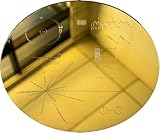
- Material: Mirrored Acrylic; Dimensions: 12in, 18in or 24in wide and 1/8" (0.125in) thick; Made In California, USA
- Cosmic Design: Mirrored gold finish with embossed NASA logo and planet Earth, perfect for space enthusiasts.
- Multifunctional: Use as conversation starter, display piece, or gift for science lovers and Carl Sagan fans.
- Unique Gift: A thoughtful present for physics buffs, astronomers, and anyone fascinated by space exploration.
- Commemorative Magnet: Celebrate the iconic 'Golden Record' carried by Voyager spacecraft, featuring sounds of Earth.
Why there are two Voyager missions
The probes were built as closely related spacecraft for an extended study of the outer solar system and the environment beyond it. Their science payloads were designed to examine several kinds of phenomena rather than perform one experiment. NASA describes the combined suite as covering imaging, ultraviolet and infrared observations, radio astronomy, photopolarimetry, magnetic fields, plasma, low-energy charged particles, plasma waves, and cosmic rays.
That common design makes a direct comparison useful, but it does not mean the two spacecraft have identical experiences. Their launch dates, flight paths, planetary encounters, heliopause crossings, power budgets, and instrument survival histories differ. A related design allowed the missions to address similar questions, while the different trajectories exposed each probe to a different sequence of planets and outer-space conditions.
Launch order and flight paths
Voyager 2 launched first
Voyager 2 left Earth on August 20, 1977. Its trajectory enabled encounters with Jupiter and Saturn and then continued outward to Uranus and Neptune. That sequence made it the only spacecraft to visit all four of those outer planets. The name can therefore be misleading: Voyager 2 is the earlier launch, even though Voyager 1 is numbered first.
What’s actually slowing this PC down?
Pick the symptom - the matching free tool is one click away.
Voyager 1 launched later but arrived ahead
Voyager 1 launched on September 5, 1977, 16 days after Voyager 2. It followed a faster, shorter route to Jupiter and Saturn. The route did not continue to Uranus or Neptune, but the reduced itinerary helped Voyager 1 reach the heliopause before its sister spacecraft.
“Faster” in this context describes the spacecraft’s route and arrival sequence, not a permanent ranking in every measure of distance or speed. NASA’s live table gives an estimated speed relative to the Sun, while a distance comparison depends on whether the measurement is made from Earth or from the Sun. Those are separate quantities.
Which spacecraft visited each planet?
| Planet | Voyager 1 | Voyager 2 |
|---|---|---|
| Jupiter | Yes | Yes |
| Saturn | Yes | Yes |
| Uranus | No | Yes |
| Neptune | No | Yes |
Voyager 2’s Uranus and Neptune encounters are the defining feature of its planetary mission. Voyager 1’s defining distinction is not an additional planet, but the speed of its route and its earlier transition into interstellar space.
NASA’s mission overview reports that the two spacecraft together explored 48 moons. That is a combined mission total, not a count for either probe individually. It should not be used to claim that one Voyager alone explored 48 moons.
Why Voyager 1 did not continue to Uranus and Neptune
The two spacecraft were sent on different trajectories. Voyager 1’s shorter route concentrated on Jupiter and Saturn, whereas Voyager 2’s route continued to the two more distant ice giants. The resulting division of labor is why the probes are complementary rather than interchangeable: one supplied the first close encounters with Uranus and Neptune, and the other reached the heliopause earlier.
What “interstellar space” means here
The heliosphere is the enormous region influenced by the solar wind and the Sun’s magnetic environment. The heliopause is the boundary at its edge. Crossing that boundary is what NASA uses to mark a spacecraft’s entry into interstellar space; it does not mean the probe has left the solar system’s gravitational influence or reached another star.
Voyager 1 crossed the heliopause on August 25, 2012. Voyager 2 crossed it on November 5, 2018. The dates are separated by more than six years because the probes traveled on different trajectories and encountered different conditions along the edge of the heliosphere.
Thus, “in interstellar space” is a statement about the local space environment measured beyond the heliopause. It is not a claim that either spacecraft has completed a journey to another stellar system. Their continuing measurements are valuable precisely because they sample the boundary and the medium beyond it from two different paths.
Where are Voyager 1 and 2 now?
NASA’s live status page reports each probe’s distance from Earth, distance from the Sun, estimated speed relative to the Sun, and one-way radio-light time. These are moving measurements, not permanent specifications. Earth itself is moving around the Sun, so the Earth-referenced and Sun-referenced distances are not interchangeable.
The question “Where are Voyager 1 and 2 now?” therefore needs a date, a time, and a reference point. A value measured from Earth can differ from one measured from the Sun even when both are displayed on the same page. The difference reflects the changing geometry of Earth’s orbit as well as the probes’ continuing outward travel.
How to report a current distance accurately
- Open NASA’s live Voyager vital-signs table.
- Identify the row for Voyager 1 or Voyager 2.
- Choose whether you are reporting distance from Earth or distance from the Sun; do not combine the two.
- Copy the displayed value and its unit.
- Record the page’s retrieval date and time in UTC or clearly state the time zone.
- If comparing the probes, read both rows at the same time and use the same reference point.
- Preserve the displayed precision instead of silently converting it into a more precise-looking number.
A rounded number copied without a timestamp can become misleading quickly. A useful comparison therefore looks like “distance from Earth, retrieved on [date and time]” rather than presenting an undated figure as though it were fixed. If a reader checks the page later, a changed value is expected, not evidence that either article or spacecraft has malfunctioned.
Why one-way light time matters
One-way light time is the approximate delay for a radio signal to travel from a probe to Earth. It explains why commands and returned measurements are not instantaneous. NASA lists this value alongside distance and speed so readers can see the communications delay associated with the current geometry.
Free tools Windows power users keep installed
One-click scans. No signup required.
Light time is also a useful reality check on the scale of the mission. A longer one-way delay means that an instruction, a telemetry response, or a status change cannot be handled like a real-time conversation. The value changes as the Earth-probe geometry changes, just as the distance does.
Rank #3
- Material: Mirrored Acrylic; Dimensions: 12in, 18in or 24in wide and 1/8" (0.125in) thick; Made In California, USA
- Cosmic Design: Mirrored gold finish with embossed NASA logo and planet Earth, perfect for space enthusiasts.
- Multifunctional: Use as conversation starter, display piece, or gift for science lovers and Carl Sagan fans.
- Unique Gift: A thoughtful present for physics buffs, astronomers, and anyone fascinated by space exploration.
- Commemorative Magnet: Celebrate the iconic 'Golden Record' carried by Voyager spacecraft, featuring sounds of Earth.
Mission instruments: original capability versus surviving hardware
“The instruments on Voyager” can mean two different things: the original science suite installed at launch, or the smaller set that still operates today. Confusing those categories makes the probes appear to have more active capability than NASA currently reports.
Original science areas
| Science area | What it measures in broad terms |
|---|---|
| Imaging | Visible-light pictures of planets, moons, rings, and other targets. |
| Ultraviolet measurements | Ultraviolet radiation used to study atmospheric and space environments. |
| Infrared measurements | Infrared energy that reveals thermal and compositional information. |
| Radio astronomy | Natural radio emissions from planetary and space environments. |
| Photopolarimetry | Light intensity and polarization, useful for studying particles and surfaces. |
| Magnetic fields | The strength and direction of magnetic fields around planets and in space. |
| Plasma | Charged-gas conditions in the solar wind and interstellar environment. |
| Low-energy charged particles | Lower-energy ions and electrons moving through the surrounding space. |
| Plasma waves | Electrical and magnetic wave activity in the surrounding plasma. |
| Cosmic rays | High-energy particles arriving from astrophysical sources and energetic solar events. |
This broad suite supported both planetary flyby science and later heliosphere research. Instruments that were essential near a planet are not necessarily the best use of power once a probe is far beyond the planetary tour. Imaging, for example, belongs to the original capability list, but it is not listed among the operating science systems in the April 17, 2026 status update.
Instruments NASA lists as operating
| Probe | Operating instruments listed by NASA | Status qualification |
|---|---|---|
| Voyager 1 | Magnetometer; plasma wave subsystem | Status shown in NASA’s April 17, 2026 update; it can change as power and hardware conditions evolve. |
| Voyager 2 | Cosmic ray subsystem; magnetometer; plasma wave subsystem | Status shown in NASA’s April 17, 2026 update; it can change as power and hardware conditions evolve. |
NASA’s table lists many other instruments as off. “Off” does not necessarily mean an instrument never worked; it may have been deliberately disabled to conserve electricity, or its performance may have degraded beyond useful operation. An instrument can therefore be part of the spacecraft’s historical science story without being part of its present-day data stream.
Quick wins for a faster PC:
Scan for outdated or missing drivers - takes under a minuteDriver Scan →Clear out junk files and repair common Windows errorsFree Scan →The April 17, 2026 listing gives Voyager 2 one more operating science system than Voyager 1 at that moment. That is a snapshot of operational status, not a judgment that Voyager 2 was always the more capable spacecraft or that the difference will remain unchanged.
Why instruments are being switched off
Radioisotope power declines
Each spacecraft uses radioisotope thermoelectric generators, or RTGs, to produce electricity from the heat released by radioactive decay. The electrical output falls over time. NASA’s FAQ states that each generator’s electrical output decreases by about 4 watts per year. The figure describes the long-term decline of the generator system; it is not a promise that every year’s measured output will differ by exactly 4 watts.
Power is allocated to the highest-value science
Mission engineers must keep the spacecraft warm enough, maintain communications, and operate selected science systems within a shrinking power budget. NASA says engineers prioritize fields-and-particles instruments for ongoing heliosphere and interstellar studies. Magnetometers, plasma-wave sensors, and cosmic-ray instruments directly address the environment the probes are now traveling through, while other systems can be turned off.
This explains why the phrase “instrument suite” needs a qualifier. The complete suite describes what the spacecraft was designed to do; the operating list describes what the remaining power and hardware condition allow at a particular time. Those two lists answer different reader questions.
A shutdown can be the least damaging choice
In NASA’s April 17, 2026 update, Voyager mission manager Kareem Badaruddin said: “While shutting down a science instrument is not anybody’s preference, it is the best option available.” NASA reported that Voyager 1’s Low-Energy Charged Particles experiment was shut down to conserve power. The decision illustrates why the current-instrument comparison must be dated rather than treated as a permanent specification.
Rank #4
Voyager 1 versus Voyager 2: which is “better”?
There is no single winner because the probes were optimized by their trajectories and mission phases. “Better” depends on whether the question concerns planetary coverage, an earlier heliopause crossing, or the number of science systems NASA currently lists as operating.
| If your question is… | The answer is… | Why |
|---|---|---|
| Which one launched first? | Voyager 2 | Its launch was on August 20, 1977; Voyager 1 followed on September 5. |
| Which one reached interstellar space first? | Voyager 1 | It crossed the heliopause on August 25, 2012, before Voyager 2’s November 5, 2018 crossing. |
| Which one went to Uranus? | Voyager 2 | Its route continued beyond Saturn to Uranus. |
| Which one went to Neptune? | Voyager 2 | It alone completed the Neptune encounter. |
| Which one has more currently listed instruments? | Voyager 2 | NASA’s April 17, 2026 table lists three operating science systems for Voyager 2 and two for Voyager 1. |
| Which one is farther away today? | Check NASA’s live table at the same timestamp | Distance changes continuously, and the answer depends on whether you measure from Earth or from the Sun. |
Voyager 1 is the better answer for “which reached the heliopause first,” while Voyager 2 is the better answer for “which visited more of the outer planets.” Neither result makes the other mission less important; they reflect deliberate differences in route and scientific opportunity.
The Golden Record carried by both spacecraft
Both Voyagers carry the Golden Record, a 12-inch gold-plated copper disk created as a physical message about Earth for any distant discoverer that might encounter the spacecraft. It is part of both probes’ cultural and historical legacy, not an operating science instrument.
The disk should not be confused with a commercially available product. NASA’s description establishes the spacecraft artifact’s format and materials, but it does not establish a particular retail pressing, edition, or replica. Any modern reproduction needs its own edition and authenticity description. A listing should be identified accurately as an edition or replica rather than implying that it is the disk installed on a spacecraft.
What the mission cost figure means
NASA’s fact sheet reports a historical mission cost of $865 million. That figure includes the launch, operations through the Neptune encounter, and the spacecraft’s nuclear batteries. It is a scope-specific historical total, not a current replacement cost, annual operating budget, or inflation-adjusted price.
The number also covers the mission scope described by NASA, so it should not be divided between the two probes or compared directly with a modern project budget without additional accounting. It is most useful as a historical figure showing the scale of the original program, not as a price tag for keeping either spacecraft operating today.
Independent reader supportYour contribution helps us test, update, and keep practical guides available for everyone.A concise timeline
| Date | Event |
|---|---|
| August 20, 1977 | Voyager 2 launches. |
| September 5, 1977 | Voyager 1 launches. |
| Voyager 2 planetary sequence | Jupiter, Saturn, Uranus, then Neptune. |
| Voyager 1 planetary sequence | Jupiter, then Saturn. |
| August 25, 2012 | Voyager 1 crosses the heliopause. |
| November 5, 2018 | Voyager 2 crosses the heliopause. |
| April 17, 2026 | NASA’s cited instrument-status update lists Voyager 1’s magnetometer and plasma-wave subsystem, and Voyager 2’s cosmic-ray subsystem, magnetometer, and plasma-wave subsystem as operating. |
The timeline shows why launch order and arrival order should not be conflated. Voyager 2 departed first and followed the longer planetary itinerary; Voyager 1 departed later, used the faster route, and reached the heliopause first.
PC Slower Than It Used to Be?
A free scan shows the junk files, broken settings and background clutter dragging Windows down - then fixes them in one click.Free scan · Windows 10 & 11Outdated Drivers Are Slowing You Down
One free scan finds every outdated or missing driver and matches the right update for your exact hardware.Free scan · exact hardware matchHow to interpret future status updates
- Check the date first. A status page can change when engineers alter the power plan or a subsystem degrades.
- Separate distance from direction. A distance from Earth is not the same measurement as a distance from the Sun.
- Separate “installed” from “operating.” The original payload was much larger than the set currently powered.
- Keep the probe and mission phase in view. Planetary-flyby instruments and interstellar-environment instruments serve different priorities.
- Use combined figures carefully. The 48-moon total belongs to both missions together, not to one spacecraft.
- Report communications delay with distance when useful. One-way light time gives readers a practical sense of how long a signal takes to travel.
- Do not treat an old rounded value as live. Recheck NASA’s vital-signs table whenever a current distance or speed is quoted.
Voyager 1 and Voyager 2 are therefore best understood as complementary missions. Voyager 2 has the broader planetary itinerary, Voyager 1 has the earlier heliopause crossing, and both continue to return scientifically useful measurements with a reduced, power-conscious instrument set.
Best Value

- Space exploration memorabilia design. The Sounds Of Earth Voyager Golden Record Vinyl Phone Grip
- Vintage Vinyl Record Music Phone Grip for space and alien lovers. Classic Phonograph Vinyl Record Players Design smartphone holder for girls and for boys, for men and for women and for kids.
- Adhesive backing attaches the PopGrip to your case or device. Will not stick to silicone, leather, waterproof, or highly textured cases. Works best with smooth, hard, plastic cases.
- Not compatible with wireless charging
- Printed top is swappable with other compatible PopGrip models. Just press flat, turn 90 degrees until you hear a click and remove to swap.
Frequently Asked Questions
Where are Voyager 1 and Voyager 2 now?
NASA’s live Voyager status page gives each probe’s distance from Earth and from the Sun, estimated speed relative to the Sun, and one-way light time. Because those values change continuously, report the reading with its reference point and retrieval date and time.
Which Voyager went to Neptune?
Voyager 2. It visited Jupiter and Saturn before continuing to Uranus and Neptune. Voyager 1’s route ended with its Jupiter and Saturn encounters.
Which spacecraft reached interstellar space first?
Voyager 1 crossed the heliopause on August 25, 2012. Voyager 2 crossed on November 5, 2018.
Are both Voyagers in interstellar space?
NASA uses each spacecraft’s heliopause crossing to mark entry into interstellar space. That does not mean either probe has left the solar system’s gravitational influence or reached another star.
Which Voyager has more working instruments?
In NASA’s April 17, 2026 status update, Voyager 2 had three listed operating science systems—cosmic ray, magnetometer, and plasma wave—while Voyager 1 had two: magnetometer and plasma wave. Status can change as power and hardware conditions evolve.
Why are Voyager instruments being turned off?
Their radioisotope thermoelectric generators lose electrical output over time. NASA says each generator’s output decreases by about 4 watts per year, so engineers prioritize fields-and-particles systems and shut down other equipment to conserve power.
Do both spacecraft carry the Golden Record?
Yes. Each carries a 12-inch gold-plated copper disk intended as a physical message about Earth. The artifact is separate from the probes’ scientific instruments.
The Tool Desk
Outbyte Driver Updater FREEFix the driver behind crashes, sound loss and screen glitchesFind Drivers →Outbyte PC Repair FREERepair Windows errors before they cause bigger problemsFix Now →How much did the Voyager mission cost?
NASA’s fact sheet gives a historical total of $865 million, including launch, operations through the Neptune encounter, and the spacecraft nuclear batteries. It is not a current or inflation-adjusted cost.
How many moons did the Voyagers explore?
NASA’s mission overview reports 48 moons explored by the two spacecraft combined. That is not an individual total for either Voyager.
The Bottom Line
Voyager 2 launched first and alone visited Uranus and Neptune; Voyager 1 took a faster Jupiter-and-Saturn route and crossed the heliopause first. For present-day distance and instrument claims, use NASA’s live table with a timestamp because both measurements and operating hardware change.
Quick Recap
Product prices and availability are accurate as of the date/time indicated and are subject to change. Any price and availability information displayed on Amazon at the time of purchase will apply.

