
iTechGuides is reader-supported. When you buy through links on our site, we may earn an affiliate commission. As an Amazon Associate I earn from qualifying purchases. Learn more
Validate classified-ad photos on the server at intake, constrain how they are decoded and transformed, store them under application-generated identifiers, and serve them so uploaded content cannot execute as code. These are four distinct trust boundaries: passing one does not make a photo safe at the next.
1. Intake: decide what the feature accepts
Start with the marketplace’s actual needs and define a narrow allowlist of image formats and a maximum upload size. Treat both the submitted filename and the browser-provided Content-Type as untrusted claims: an allowed extension or MIME label does not prove that the bytes are a safe image.
Perform validation on the server, even if the browser checks files for a faster user experience. Decode filenames appropriately before applying extension rules, and use established parsing and content-validation methods rather than ad hoc regular expressions. OWASP’s Input Validation Cheat Sheet recommends validating input against defined expectations; its File Upload Cheat Sheet emphasizes defense in depth because no single check reliably validates user content.
- Require authentication and authorize the specific user to create or change photos for the listing.
- Enforce request-size limits and per-user limits to curb abuse and storage exhaustion.
- Reject formats and sizes the feature does not need instead of accepting a broad range “just in case.”
2. Parsing and transformation: limit the work
Opening an image is a resource-consuming operation. A small compressed file can expand into a very large image, so limit both uploaded bytes and decoded pixel dimensions. OWASP ASVS 5.0’s file-handling requirements call for rejecting images larger than the permitted pixel size as a safeguard against pixel-flood attacks. See ASVS 5.0 V5 File Handling.
#1 Best Overall

- The easiest way to scan photos and documents. Supports 3x5, 4x6, 5x7, and 8x10 in sizes photo scanning but also letter and A4 size paper. Optical Resolution is up to 600 dpi ( PS: two setting: 300dpi/ 600dpi).
- Fast and easy, 2 seconds for one 4x6 photo and 5 seconds for one 8x10 size photo@300dpi. You can easily convert about 1000 photos to digitize files in one afternoon and share with your family or friends.
- More efficient than a flatbed scanner. Just insert the photos one by one and then scan. This makes ePhoto much more efficient than a flatbed scanner.
- Powerful Image Enhancement functions included. Quickly enhance and restore old faded images with a click of the mouse.
Use maintained image-parsing libraries, handle malformed-file errors, and check that the parsed content corresponds to the claimed format. Signature or magic-byte checks can contribute to validation, but should not stand alone: they do not replace successful, bounded parsing and other controls.
Consider decoding and re-encoding accepted images into normalized output. Rewriting may reduce the chance that unwanted data survives, but it is not a guarantee that the result is safe. Keep image-processing dependencies securely configured and updated, and isolate the processing step from high-privilege application functions where the architecture permits.
Rank #2

- HIGH-SPEED PERSONAL PHOTO SCANNER¹ — Scan thousands of photos as quickly as 1 photo per second at 300 dpi ²; Further increasing your efficiency, this Epson picture scanner also allows you to batch-scan up to 36 photos at a time
- PRESERVE YOUR PRICELESS PHOTOS — Photo scanner for transforming old pictures to digital fast; Restore, organize, protect, and share your special photos; Scan Polaroid photos, panoramas, postcards, and photos up to 8 x 10 in
- SHARE STORES FOR FUTURE GENERATIONS — After scanning your photos with this Epson FastFoto scanner, use the Epson FastFoto app³ to add voice and text over your photos, or create slideshows right from your smartphone
- PRECISE PICTURE IMAGING SYSTEM — When you use this wireless, high-speed scanner you can bring new life to old photos with the help of auto enhancement, color restoration, red-eye reduction, de-skew, crop, and rotate
- SINGLE-STEP TECHNOLOGY — With this double sided scanner you can capture both the image and any handwritten notes on the back of a photo in a single scan; Duplex scanner's functionality helps you preserve what matters
If you use automated malware scanning or an external scanning service, account for confidentiality: unpublished or private listing photos may be disclosed to that service. Decide whether that data flow is acceptable before sending files.
What’s actually slowing this PC down?
Pick the symptom - the matching free tool is one click away.
3. Storage and access control: use application-owned identities
Assign each accepted file a storage name or identifier generated by the application. Never turn a user-supplied filename into a filesystem path. Where practical, keep uploaded files on a separate host; otherwise, store them outside the webroot and grant only the filesystem access the application needs.
Rank #3

- Scanner type: Document
- Connectivity technology: USB
- With Auto Scan Mode, the scanner automatically detects what you're scanning
- Digitize documents and images
Make upload status and permissions explicit. States such as pending, approved, rejected, and deleted can help structure a workflow, but they are implementation choices rather than prescribed OWASP labels. Enforce authorization for listing owners and for administrative or moderation actions, and set byte-size and account quotas.
Choose retention and deletion rules based on the operator’s policy and applicable jurisdiction. The OWASP sources cited here do not establish a universal retention period.
Rank #4
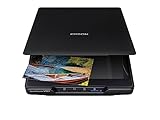
- Amazing image clarity and detail — 4800 dpi optical resolution (1), ideal for photo enlargements
- Epson ScanSmart software included (4) — easily scan photos, artwork, illustrations, books, documents and more
- One-touch scanning (2) — scan in fewer steps with easy-to-use buttons (2)
- Restore color to faded photos — with one click, Easy Photo Fix technology makes it simple
- Scan books and photo albums — high-rise, removable lid
4. Retrieval: serve only the intended image
When a listing requests a photo, resolve an application-controlled identifier to the stored object; do not expose a user-controlled path. Return an appropriate image content type and make serving behavior consistent with the validated output. Ensure that a public upload cannot execute as server-side code when requested directly. Separating the upload host from the application host can further reduce the impact of content-handling risks.
For public listings, provide a way to report abuse and a moderation process appropriate to the service. Automated scanning does not replace human review where review is needed, and a successful technical validation does not establish that a photo is lawful or appropriate to publish.
Best Value

- Scan Photos in Seconds – Quickly digitize printed photos and preserve your memories for a lifetime.
- Handles Multiple Photo Sizes – Scan 3"×5", 4"×6", 5"×7", 8"×10", small 1"×1" photos, and panoramic images up to 12".
- High-Quality Resolution Options – Choose between crisp 300 DPI or ultra-high 600 DPI scanning for archival-quality images.
- Clean & Protect Delicate Photos – Keep photos pristine with the photo cleaning kit that includes a bellow-based blower, microfiber cloth and anti-static soft brush. Protect fragile prints and safely scan with the protective carrier sheet.
- Import Your Existing Digital Photos – Upload images from Apple Photos, Google Photos, digital cameras, memory drives, and more to keep everything together in Picture Studio by AMBIR.
How to assess an implementation
Compare design choices against the controls the marketplace actually needs, rather than treating a single file check or tool as a complete solution.
- Format coverage: Which formats are required, and how are their bytes and decoded content validated?
- Resource limits: What are the maximum upload size and decoded dimensions, and are both enforced?
- Isolation: How are parsing and storage separated from high-privilege application functions?
- Access and moderation: Who can upload, replace, approve, reject, retrieve, or report a photo?
- Lifecycle: How are storage, delivery, quotas, retention, and deletion handled?
OWASP’s guidance supports a layered approach, not a guarantee from any one control. Safe acceptance at upload and safe public delivery are separate decisions; both need controls.
Quick Recap
Product prices and availability are accurate as of the date/time indicated and are subject to change. Any price and availability information displayed on Amazon at the time of purchase will apply.
The Tool Desk
Outbyte Driver Updater FREEScan for outdated or missing drivers - takes under a minuteDriver Scan →Outbyte PC Repair FREEClear out junk files and repair common Windows errorsFree Scan →
