
Quick wins for a faster PC:
Scan for outdated or missing drivers - takes under a minuteDriver Scan →Repair Windows errors before they cause bigger problemsFix Now →Fix the driver behind crashes, sound loss and screen glitchesFind Drivers →iTechGuides is reader-supported. When you buy through links on our site, we may earn an affiliate commission. As an Amazon Associate I earn from qualifying purchases. Learn more
USB-C and 3.5 mm headphones differ mainly in where audio is converted from digital to analog. A conventional 3.5 mm connection receives an analog signal from the device’s audio circuitry. USB-C headphones normally receive digital USB audio and perform conversion in the headset, while a USB-C-to-3.5 mm digital adapter performs conversion in the dongle. Neither connector guarantees better sound: the device, DAC, amplifier, headphones, fit, tuning, and software implementation determine the result.
USB-C and 3.5 mm at a glance
| Comparison point | 3.5 mm wired headphones | USB-C wired headphones |
|---|---|---|
| Signal at the headphone plug | Analog audio | Usually digital USB audio |
| Where digital-to-analog conversion happens | Inside the host device before the jack | Inside the headset or its USB-C electronics |
| Adapter when the device has no matching port | USB-C-to-3.5 mm digital adapter can preserve the headphones | No adapter is needed if the device supports the headset’s USB audio mode |
| USB-C analog accessory mode | Not applicable to the plug itself | Separate, optional implementation; never assume every USB-C port supports it |
| Microphone and button operation | Depends on the jack wiring, headset and device | Depends on the USB headset, operating system and adapter implementation |
| Charging-port availability | Leaves the device’s USB-C port free | Uses the USB-C port unless a compatible pass-through solution is used |
The connector shape is therefore only the starting point. For a purchase or upgrade, check the exact host device, headset features and adapter design rather than treating “USB-C” or “3.5 mm” as a sound-quality rating.
How the two signal paths work
3.5 mm: the device supplies analog audio
With ordinary passive 3.5 mm headphones, the phone, tablet or computer reads digital audio, converts it with its internal digital-to-analog converter (DAC), and drives the resulting analog waveform through the headphone jack. The plug carries that already-converted signal to the headphone drivers. The jack’s output stage, noise performance, amplifier capability and electrical match with the headphones all affect the result.
Because conversion and amplification are handled by the host, the headphones themselves can be electrically simple. A 3.5 mm headset can still contain a microphone and inline buttons: those functions use additional contacts and wiring in the plug, and support depends on the device and headset standards.
#1 Best Overall

- SUPERIOR COMFORT — Unlike traditional circular ear buds, the design of EarPods is defined by the geometry of the ear. Which makes them more comfortable for more people than any other ear bud–style headphones.
- HIGH-QUALITY AUDIO — The speakers inside EarPods have been engineered to maximize sound output and minimize sound loss, which means you get high-quality audio.
- BUILT-IN REMOTE — EarPods with USB-C plug also include a built-in remote that lets you adjust the volume, control the playback of music and video, and answer or end calls with a pinch of the cord.
- COMPATIBILITY — Works with all devices that have a USB-C port.
- INTEGRATED MICROPHONE — A built-in microphone precisely captures your voice while you’re on the phone, taking a FaceTime call, or summoning Siri — so you’re always heard loud and clear.
USB-C: the accessory can contain the audio electronics
USB-C is a multipurpose connector, not an audio format. In a digital USB audio connection, the host sends a digital stream to a USB audio peripheral. A DAC in the headset, cable assembly or dongle converts that stream to analog, and an amplifier drives the speakers. A USB-C headset may therefore include its own DAC, amplifier, digital signal processing and control electronics.
A USB-C-to-3.5 mm dongle commonly contains the same conversion and output circuitry. The 3.5 mm socket on the far end is analog, but the USB-C side is a digital USB audio peripheral. This is why a small adapter can allow existing wired headphones to work with a device that has removed its headphone jack.
USB-C analog accessory mode is a different implementation
Some USB-C designs can place analog audio signals on the connector through an analog audio accessory mode. That mode is optional and must be implemented by both the host and accessory. The presence of a USB-C socket does not prove that it is supported.
Free tools Windows power users keep installed
One-click scans. No signup required.
Texas Instruments’ engineering discussion, “USB Type-C Audio: Do I Need to Buy a New Pair of Headphones?”, describes the design constraints involved in putting analog audio on USB Type-C. For buyers, the practical rule is simple: verify the exact device and accessory documentation. Do not assume that a passive USB-C-to-3.5 mm cable will work because the port has the right shape.
Compatibility: the check that prevents most problems
Confirm digital USB audio support
USB-C headphones and digital USB-C-to-3.5 mm adapters require the host to support the relevant USB audio mode and to recognize the accessory as an audio device. Android’s USB audio documentation describes the host/peripheral relationship and notes that support depends on the USB audio class and implementation. A port intended only for charging, data, or video may not provide the audio behavior you need.
Rank #2

- USB-C plug and play: Connect to phones, tablets and laptops that support USB-C digital audio; ready for lessons and everyday listening without Bluetooth pairing or headphone charging
- Mic and in-line controls: Join online classes and work calls with the built-in microphone; adjust volume and manage music playback from the cord without reaching for your device
- Comfortable fit: Soft memory foam ear cushions, an adjustable headband and 90-degree rotating ear cups help you find a comfortable position for studying, working or listening
- 40 mm stereo drivers: Enjoy music, movies and spoken audio with stereo sound; the over-ear cushions provide passive sound isolation to help reduce surrounding distractions
- Foldable for travel: Fold the headphones for storage between classes or commutes; 1.2 m braided cord for everyday use, with headphones and user manual included; carrying bag not included
Read the specifications for the exact phone, tablet, laptop or game device. Look for explicit wording such as USB digital audio, USB Audio Class support, or compatibility with USB-C headsets and DAC adapters. A manufacturer’s statement about a USB-C port alone is not enough.
Do not confuse digital and analog adapters
Android’s documented USB-C-to-analog adapter specification requires a digital-to-analog adapter and excludes analog-only adapters. Its exact statement is: “Only digital-to-analog adapters are allowed. Analog-only adapters following USB.org’s ‘USB Type-C Cable and Connector Specification, Release 1.2, Appendix A’ are not supported.” This is a specification for the documented Android route, not a guarantee about every operating system or every USB-C product.
Recommended Free Tools
When shopping, choose an adapter that explicitly identifies an internal DAC or digital USB audio conversion and lists compatibility with your device. A passive analog-only cable may work on a host that specifically supports analog accessory mode, but it will fail on a host that does not.
Check the operating system and accessory behavior
Digital USB headsets have their own descriptors, controls and power requirements. The Android Open Source Project’s USB headset accessory specification covers basic digital headset behavior and controls. Updates to operating-system support can also change which devices are recognized, so check the current documentation for the host you actually use.
- Verify that the device supports USB audio output, not merely USB-C charging or file transfer.
- Check whether the headset is bus-powered and whether the host can provide sufficient power.
- Confirm the operating system supports the headset’s advertised buttons, microphone and processing features.
- If the accessory requires a companion application or special driver, verify that it supports your operating system and version.
Sound quality: why neither connector wins automatically
The headphones and listening conditions matter first
Sound quality is set by the complete chain: headphone drivers and enclosure, fit and seal, acoustic tuning, source material, volume matching, device output, DAC performance, amplifier behavior and any DSP. A well-designed 3.5 mm headset can sound better than a poorly implemented USB-C headset, and a well-designed USB-C model can outperform a weak analog output stage.
Rank #3
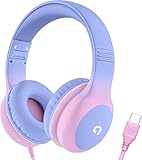
- 85dB Safe Volume Limit: Engineered with a 85dB volume cap to safeguard your child’s hearing. This feature ensures safe listening levels for music, videos, or learning apps, giving parents confidence that their kids’ ears are protected at all times.
- Adjustable Fit for Growing Kids: Designed for comfort, these headphones for kids come with an adjustable headband and slightly rotatable ear cups. Perfect for children of all ages, they provide a snug, comfortable fit for long hours of use at home or school.
- USB-C Connectivity for Modern Devices: Equipped with a USB-C plug, these headphones for school offer seamless compatibility with the latest tablets, laptops, and more. A future-ready choice for tech-savvy families.
- Tangle-Free Cord for Easy Handling: Say goodbye to messy cords! Our kids headphones with cord feature a durable, anti-tangle design, making them easy for kids to use and store without frustration—ideal for daily play or travel.
- Hassle-Free After-Sales Support: We stand by our product with dedicated customer service—contact us anytime for assistance, replacements, or refunds, ensuring your satisfaction is our priority.
USB-C can move the DAC and amplifier out of a noisy or underpowered host. That gives a manufacturer more control over the audio electronics and can provide a different output capability. It does not establish an audible improvement for every listener or every pair of headphones.
Onboard versus external conversion is a design trade-off
Android’s USB digital-audio guidance characterizes onboard conversion as simpler, less expensive and potentially more reliable when the components are equally reliable. An external audio peripheral can be designed for higher quality or more power, but adds another device, another firmware implementation and possible latency. Those are engineering trade-offs, not a universal ranking of USB-C over 3.5 mm.
Do not infer a resolution, noise or dynamic-range advantage from the connector label. A product must publish and implement the relevant specifications, and the entire system must preserve them. The reviewed technical material does not establish a general consumer-facing sound score, market-wide price advantage or universal audible difference.
Volume matching matters when you compare
If you compare two connections, match their playback level as closely as possible and use the same headphones, source and recording. A louder signal often sounds subjectively “better,” which can hide the effect of the connector. Also check whether one path applies EQ, loudness processing or other DSP that the other path does not.
Latency, power and port availability
Latency is implementation-dependent
A USB audio path includes host USB scheduling, the peripheral controller and the accessory’s audio processing. Android describes additional latency in an external USB-controller path as an architectural trade-off. The available evidence does not provide a controlled, universal latency comparison between USB-C and 3.5 mm, so a connector-only claim that one is always faster is not justified.
Rank #4

- 【Upgraded USB-C Connector for School】 Bywulanda kids headphones is special designed for a wide range of mobile devices and PCs using the type-c headphone jack (𝐏𝐥𝐞𝐚𝐬𝐞 𝐧𝐨𝐭𝐞: 𝐧𝐨𝐭 𝐜𝐨𝐦𝐩𝐚𝐭𝐢𝐛𝐥𝐞 𝐰𝐢𝐭𝐡 𝐔𝐒𝐁-𝐂 𝐜𝐡𝐚𝐫𝐠𝐢𝐧𝐠 𝐩𝐨𝐫𝐭). No need usb converter, hassle-free plug-and-play functionality. This wired kids headphones for school is follow connector new trend.
- 【94dB Safe Volume Limit】 To protect your kid’s delicate ears, you want headphones that aren’t only comfortable but can also provide effective hearing protection. With a volume limit at 94dB, the Type-C kids headphones for school can protect vulnerable and sensitive ears of kids while give parents a piece of mind.
- 【Stereo Sound】 With built-in 40mm drivers, so our kids headphones with cord emit a full balanced stereo sound, and our wired toddler headphones use high-quality audio chips and professional tuning technology to provide better sound quality. Clear and stable sound not only improves your child's listening experience but also protects their hearing health.
- 【Comfort Wear & Foldable Design】 The ultra-soft earmuffs and over-ear design allow getting the perfect and comfortable fit for your head shape. And the wired headphones' foldable design makes it easy to carry or store, perfect for traveling or school. Accompany your child anytime, anywhere.
- 【Generous Services】 We always put customers first, and we're proud to stand by the quality of our products. You are entitled to enjoy 24-hour Customer-friendly Support Service. Any questions please feel hassle-free to contact us.
For gaming, monitoring or musical instruments, look for a measured latency specification for the exact headset and application, and test the complete setup. Bluetooth-style latency assumptions should not be transferred to wired USB-C products without evidence.
USB-C accessories draw power
A digital USB-C headset or DAC obtains power from the host unless it has its own battery or another power arrangement. Most simple accessories are designed for bus power, but more elaborate DACs or active headsets can place greater demands on the port. Android notes that a host may not provide enough power for some peripherals.
A 3.5 mm headset normally draws no meaningful power from the audio jack beyond the tiny amount needed for an inline microphone circuit. That makes it useful when preserving battery life or keeping the USB-C port available is important.
Charging while listening may require extra hardware
If your device has one USB-C port, plugging in USB-C headphones occupies it. To charge at the same time, you need a hub or adapter with charging pass-through that explicitly supports USB audio. Compatibility, power delivery, physical clearance and audio controls can vary among pass-through accessories. Test the exact combination before relying on it for travel or work.
Microphones, calls and inline controls
Playback working does not prove that the microphone or buttons will work. Before buying, check for microphone input, phone-call support, volume buttons, play/pause, track navigation and mute behavior. These functions depend on the headset’s wiring or USB descriptors, the adapter and the operating system.
Best Value

- Hi-Res audio: Get the full advantage of digital Hi-Res 96kHz/24bit audio from the DSP chipset.
- JBL Pure Bass Sound: Hear clear, powerful JBL Pure Bass Sound from a pair of 32mm dynamic drivers.
- Wide compatibility: Just about every digital audio device uses USB-C connections now. So you can plug your JBL Tune 520C USB-C headphones into just about every device, including PCs, mobile phones, gaming devices, tablets, and laptops with USB-C input
- 3-button remote with microphone: Use the conveniently placed microphone to take crystal-clear calls on the fly. Or control your music playback, change the volume, or switch your EQ presets, all at your fingertips.
- EQ presets: Use the default EQ preset for great, well-rounded sound right out of the box. Select Bass to enhance the bottom end and add more energy and excitement to your music. Or choose Vocal to enhance the midrange and hear bright, clear vocal sounds.
The Android USB-C-to-analog adapter specification covers stereo analog output, optional microphone capture, headset-microphone detection, device-insertion detection and button-event translation. An adapter can therefore support a complete headset, but only if its implementation exposes those functions and the host recognizes them.
A product-specific example illustrates why connector counts matter: beyerdynamic reports that a 4-pin adapter works with its cited cable and Apple’s adapter, while a 3-pin adapter leaves headphone playback working but makes the microphone unavailable during phone calls. This is an example for that product and cable combination, not a rule that predicts every headset’s behavior.
- For calls, record a short test in the target app and listen for the headset microphone rather than the device microphone.
- Test volume and playback buttons with the operating system’s native player.
- On a dongle, confirm that the microphone is supported in both normal recording and phone-call modes.
- For a computer, check which input and output device the operating system selected after connection.
Which option fits your situation?
Choose 3.5 mm when simplicity and port freedom matter
- Your phone, tablet or computer still has a headphone jack.
- You already own compatible 3.5 mm headphones and want no dongle.
- You need to keep the USB-C port free for charging, storage or another accessory.
- You prefer a broadly established analog connection and do not need USB-specific processing.
The trade-off is that the host’s internal DAC and amplifier determine the analog output, and newer devices may omit the jack entirely.
Windows Errors? Fix Them Before They Spread
Repair common Windows errors and clear accumulated junk for a smoother, more stable PC - no reinstall needed.Free scan · no reinstallOutdated Drivers Are Slowing You Down
One free scan finds every outdated or missing driver and matches the right update for your exact hardware.Free scan · exact hardware matchChoose USB-C headphones for a direct digital connection
- Your device explicitly supports USB digital audio and you are comfortable using its USB-C port.
- You want the headset to contain its own DAC, amplifier, controls or DSP.
- You accept that microphone, buttons, power draw and software features are product-specific.
USB-C headphones are not automatically higher fidelity. Their advantage is the flexibility to put audio electronics in the accessory and to avoid a separate dongle.
Choose a USB-C-to-3.5 mm digital adapter to keep existing headphones
- Your device lacks a headphone jack.
- You like your current 3.5 mm headphones and want the least disruptive change.
- You have confirmed USB digital-audio support on the host.
- You select an adapter that explicitly includes digital-to-analog conversion.
This is often the most practical route, but verify microphone, controls, charging pass-through, cable length and connector durability before purchase.
How to select and set up an adapter
Use this buying checklist
- Identify the host. Record the exact device model, operating-system version and whether its USB-C port supports digital audio.
- Choose the conversion type. Select a digital USB audio adapter with an integrated DAC unless the device documentation explicitly confirms analog accessory mode.
- List the functions you need. Mark playback, microphone, calls, volume buttons, media controls and charging pass-through separately.
- Check power requirements. Confirm that the host can power the adapter and any connected headphones or active electronics.
- Check the physical design. Consider strain relief, cable flexibility, case clearance and whether the dongle blocks adjacent ports.
- Verify return or support terms. Compatibility can depend on a particular device and firmware combination, so a practical return option is useful.
Connect and test it
- Disconnect other USB audio devices and unlock the host.
- Plug the digital adapter or USB-C headset directly into the USB-C port.
- Start a familiar audio track and confirm that sound moves to the wired device.
- Open the operating system’s sound or call settings and select the connected headset for both output and input when necessary.
- Record a short microphone sample or place a test call.
- Press every inline button you plan to use and check volume, playback and track controls.
- If simultaneous charging is required, connect the pass-through accessory and retest audio, microphone and charging together.
Troubleshooting common failures
No sound from a USB-C-to-3.5 mm adapter
- Confirm the adapter is a digital-to-analog model, not a passive analog-only cable.
- Test the host with another known-compatible USB audio accessory.
- Remove a case or hub that may prevent the plug from seating fully.
- Restart the host with the adapter disconnected, then reconnect it after the system is running.
- Check for operating-system updates or manufacturer compatibility notes.
Playback works but the microphone does not
- Check whether the adapter advertises microphone capture, not only stereo output.
- Verify that the headset plug and adapter have matching contact and wiring requirements.
- Select the wired microphone explicitly in the call or recording application.
- Test with a different headset to separate an adapter issue from a headset-specific issue.
Buttons do nothing
- Confirm that the host and adapter support headset button-event translation.
- Try the native media app before testing a third-party app with its own control mapping.
- Check whether the headset’s controls require a proprietary application or driver.
The device stops charging when headphones are connected
- Use a pass-through adapter that explicitly supports USB audio and charging at the same time.
- Check the charger’s power rating and the pass-through accessory’s limits.
- Test charging during playback, calls and high-volume use; some combinations may reduce available power.
The adapter disconnects or sounds intermittent
- Inspect the USB-C plug and 3.5 mm socket for debris or mechanical looseness.
- Try the adapter without a hub or extension.
- Move the cable gently while playing audio; dropouts that follow movement indicate a physical connection problem.
- Compare another adapter and another pair of headphones to isolate the failing component.
What the technical specifications do—and do not—tell you
Android’s published USB audio and adapter documents define behaviors such as digital USB headset operation, stereo output, optional microphone capture, insertion detection and button events. Those requirements help establish interoperability; they do not rank every compliant product’s sound quality.
| Specification question | What it can establish | What it cannot establish by itself |
|---|---|---|
| Does the host support USB audio? | Whether a digital headset or DAC has a supported connection path | How the connected headphones will sound |
| Does an adapter contain a DAC? | Whether it can convert digital USB audio to the analog 3.5 mm output | That its noise, power or tuning will suit every headphone |
| Does the accessory support microphone capture? | Whether a compatible headset microphone can be presented to the host | That every plug wiring or call application will work |
| Does it support button events? | Whether supported controls can be translated to the host | That every application will interpret each button identically |
| Does it provide charging pass-through? | Whether charging and audio may share one USB-C port | That the combined setup will supply unlimited power or fit every case |
Bottom line for a purchase decision
Start with the device, not the connector. If your host has a working 3.5 mm jack, a conventional headset is the simplest way to keep USB-C available. If the host lacks a jack, a USB-C-to-3.5 mm adapter with a digital-to-analog converter lets you retain existing headphones, provided the host supports USB audio and the adapter supports the microphone and controls you need. USB-C headphones make sense when you want a self-contained digital accessory and have verified compatibility.
Choose based on the complete use case—compatibility, conversion location, microphone and controls, charging, power, fit and tuning. The USB-C or 3.5 mm label alone cannot predict sound quality.
Quick Recap
Product prices and availability are accurate as of the date/time indicated and are subject to change. Any price and availability information displayed on Amazon at the time of purchase will apply.

