
iTechGuides is reader-supported. When you buy through links on our site, we may earn an affiliate commission. As an Amazon Associate I earn from qualifying purchases. Learn more
Choose the UGREEN NASync DXP8800 Ultra if you need two built-in 10GbE ports, Thunderbolt 4, a newer processor, and room for up to 96GB of memory. Choose the Synology DS1821+ if Synology Hybrid RAID (SHR), DSM’s documented snapshot and backup tools, or a defined expansion path to 18 drives matters more than newer hardware. Synology currently lists the DS1821+ as discontinued, although DSM updates and technical support are marked full. Compare the complete system cost—drives, network equipment, memory, and expansion—not just the diskless enclosure price.
Both systems have eight SATA bays and two M.2 slots, but they target different priorities. The UGREEN has substantially faster built-in networking and newer hardware; the Synology offers a more established storage-management model and a documented DX517 expansion route. Neither specification sheet establishes a universal performance winner.
Quick answer: which one should you buy?
- Buy the UGREEN NASync DXP8800 Ultra for a new 10GbE workstation or server, large memory requirements, Thunderbolt 4 peripherals, or demanding multi-user file transfers. Its two 10GbE ports are included rather than an upgrade, and UGREEN lists an Intel Core 7 150U with a 96GB memory ceiling.
- Buy the Synology DS1821+ when SHR, DSM’s Btrfs snapshot and backup features, or Synology’s documented expansion ecosystem is central to your workflow. Its four-bay network arrangement is slower out of the box, but the PCIe slot supports optional 10/25GbE networking.
- Do not choose on bay count or advertised throughput alone. Both units have eight SATA bays and two M.2 slots. Real transfer rates depend on drives, clients, switches, cabling, protocols, and workload.
- Check availability before committing to Synology. Synology’s status page, accessed October 13, 2026, lists the DS1821+ as discontinued, with DSM updates and technical support marked full. Retail stock, price, and whether a listing is new or used were not established.
Specifications at a glance
| Decision point | UGREEN NASync DXP8800 Ultra | Synology DiskStation DS1821+ |
|---|---|---|
| Processor | Intel Core 7 150U, 10 cores and 12 threads, according to UGREEN’s product listing. | AMD Ryzen V1500B, four cores at 2.2GHz, according to Synology’s specifications. |
| Installed and maximum memory | 8GB DDR5 listed; expandable to 96GB. | 4GB DDR4 ECC listed; maximum 32GB (two 16GB modules). Synology recommends its own memory for compatibility and cautions that warranty or technical-support coverage may not be complete with non-Synology expansion memory. |
| Built-in networking | Two 10GbE Ethernet ports. UGREEN says they can be aggregated. | Four 1GbE Ethernet ports. The PCIe slot supports optional 10/25GbE networking. |
| High-speed and external I/O | Two Thunderbolt 4 ports, a PCIe Gen 4 x4 slot, an SD 4.0 reader, and HDMI listed up to 8K. | Four USB 3.2 Gen 1 ports, a PCIe slot, and two eSATA expansion ports. |
| Internal storage | Eight SATA bays and two M.2 NVMe slots. UGREEN lists Basic, JBOD, and RAID 0/1/5/6/10. | Eight SATA bays and two NVMe slots. Supported types include SHR, Basic, JBOD, and RAID 0/1/5/6/10. |
| Expansion | No named multi-bay expansion path is established in the listed specifications. | Two optional DX517 units can extend the system from eight to 18 drives. |
| Operating system and data tools | UGOS. A TechRadar review published October 10, 2026, reported that UGOS Pro did not offer hybrid RAID or ZFS at that review date; software can change. | DSM with documented Btrfs snapshots, file and folder restoration, self-healing, Hyper Backup, Active Backup, and Snapshot Replication. |
| Availability and listed price | Diskless US listing price of $1,779.99 when checked October 13, 2026; price and regional stock are volatile. | Discontinued according to Synology’s status page; current retail price and condition were not verified. |
Hardware values come from the UGREEN NASync DXP8800 Ultra listing, Synology’s DS1821+ product specifications, and the DS1821+ datasheet. They are manufacturer-listed specifications, not results from a controlled head-to-head test.
What’s actually slowing this PC down?
Pick the symptom - the matching free tool is one click away.
Processor and memory: newer hardware versus a proven platform
UGREEN’s Core 7 platform
The DXP8800 Ultra uses Intel’s Core 7 150U, listed with 10 cores and 12 threads, and ships with 8GB of DDR5 memory. UGREEN specifies expansion up to 96GB. That combination gives the UGREEN more stated CPU concurrency and memory headroom for virtual machines, containers, indexing, encryption, and several simultaneous services than the Synology’s listed configuration.
#1 Best Overall

- Note: When using this product, please first confirm that the hard drive loaded into this product is normal, otherwise it will lead to not out of the drive, such as loading more than one hard drive, it will only show one, can not confirm which one is bad, please load a hard drive, power on, out of the drive a, confirm that it is normal, turn off, and then load the second, in the power on, out of the drive two, to confirm that it is normal, and so on, one by one to load, until you find the The problematic hard drive. For example, if there is a problem with one of the 8 hard drives, only one drive will come out.If you have any questions, please contact me promptly.
- 【Reliable External Storage System for Individuals】The 3.5 hard drive enclosure supports 2.5/3.5inches HDD and SSD , max capacity up to 160TB( 20TB for each hard driveit's a ideal external hard drive enclosure for personal or enterprise using.
- 【No heat】The 8 bay hard drive reader built in Aluminum-Alloy materials and two 2.9 inch Fans.Maximize the security of your data. NOTE:Fan noise is around 40-50 decibels, not recommended if you are very sensitive to noise.
- 【Up to 5Gbps】This 8 bay enclosure equips with advanced chips and USB 3.0 output interface, Max 5Gbps under UASP control.Transfer 1G movie in 3-5 seconds with USB 3.0 Ports, which is 10 times faster than USB 2.0.
- 【Stable power supply】Equipped with DC 12V20A power adapter to provide stability for high-speed transmission.
Those specifications indicate capacity for heavier workloads; they do not predict a fixed speed advantage. A NAS can be limited by hard-drive I/O, network links, application design, or thermal and power limits long before all CPU cores are busy. Treat the 96GB figure as a maximum supported configuration, not as memory included in the $1,779.99 diskless price.
Synology’s Ryzen V1500B and ECC memory
The DS1821+ lists an AMD Ryzen V1500B with four cores at 2.2GHz, 4GB of DDR4 ECC memory, and a 32GB maximum using two 16GB modules. ECC can detect and correct certain single-bit memory errors, a characteristic some administrators value for long-running storage systems. Synology recommends its own memory for compatibility and notes that warranty or technical-support coverage may not be complete when non-Synology modules are installed.
For file serving, backup jobs, and DSM applications that fit within its resources, the older processor is not automatically a problem. The relevant question is whether your workload needs more concurrent compute or memory than 32GB, not which CPU name looks newer.
The Tool Desk
Outbyte PC Repair FREEClear out junk files and repair common Windows errorsFree Scan →Outbyte Driver Updater FREEScan for outdated or missing drivers - takes under a minuteDriver Scan →Networking and connectivity
When two built-in 10GbE ports change the design
The UGREEN includes two 10GbE Ethernet ports. UGREEN says they can be aggregated, which can help distribute traffic across multiple clients or provide redundancy when the switch and software are configured for it. Its product-page “20G” aggregate wording should not be interpreted as a guaranteed 20Gb/s transfer to one client. A single client, one cable, a 10GbE adapter, the switch, filesystem, protocol, and drives can each become the bottleneck.
To use those links, budget for a 10GbE-capable switch where needed, compatible client adapters, suitable cabling, and storage fast enough to sustain the workload. Two ports are useful only if the rest of the network can accept two 10GbE connections; otherwise the extra port remains unused or serves a separate network.
DS1821+ starts at 1GbE but has an upgrade route
Synology supplies four 1GbE ports on the DS1821+. They can serve multiple clients and support link aggregation where the switch and configuration support it, but they do not turn into a 10GbE connection for a single client. Synology’s specifications and datasheet describe optional 10/25GbE NIC support through the PCIe slot. That upgrade adds the card, installation, switch or direct-attach hardware, and potentially different cabling to the project cost.
Rank #2
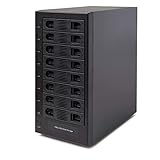
- Support All Brands Of 2.5 Inch And 3.5 Inch Sata Hard Disk Drive Up To 24TB Per Drive. (Does Not Support Raid And Nas Function)
- Smart Fan Function With Built-In Thermal Sensor Support Auto & Manual Mode With 3 Level Of Fan Speed
- Super Speed Usb3.0 5Gbps Connection Transfer Your Files In A Breeze. Supports Sata I/Ii/Iii(6Gb/S), Uasp And Usb 3.0(5Gb/S)
- Independent Control Switch For Each Drive Allows Drives To Be Powered Off Individually. Dissipates Heat Efficiently With Steel Housing & Quiet Fan
If you already own a 10GbE network, the UGREEN’s included ports simplify the initial build. If your current network is 1GbE and your traffic is mostly backups or office files, the Synology may avoid paying for capacity you will not use. Plan for future upgrades rather than assuming an unused port creates performance by itself.
Other I/O differences
The UGREEN provides two Thunderbolt 4 ports, a PCIe Gen 4 x4 slot, an SD 4.0 reader, and HDMI output listed up to 8K. Those connections can matter for direct-attached workflows, removable media, expansion cards, or a local display, but the practical benefit depends on the peripherals and applications you intend to use.
The DS1821+ provides four USB 3.2 Gen 1 ports, a PCIe slot, and two eSATA ports. The eSATA ports are part of Synology’s expansion design; the named path to more drive bays uses DX517 expansion units rather than a generic external disk shelf.
Drive bays, RAID choices, and capacity
Eight bays and two M.2 slots on both systems
Each NAS has eight SATA drive bays and two M.2 NVMe slots. The supplied specifications establish the slot count, but they do not establish identical roles, performance, or supported configurations for every M.2 use. Confirm the current software and hardware compatibility list before buying NVMe modules.
Both systems list Basic, JBOD, and RAID 0/1/5/6/10. RAID 0 can increase speed while providing no disk fault tolerance; RAID 1 mirrors data; RAID 5 and RAID 6 trade usable capacity for protection against one or two drive failures; RAID 10 combines mirroring and striping. The usable volume is always lower than the sum of raw drive capacities because of protection, filesystem overhead, and the unit’s reserved space.
Crashes, No Sound, or Screen Glitches?
Random freezes, missing sound and display glitches usually trace back to one bad driver. Find and replace yours safely.Free scan · under a minuteWindows Errors? Fix Them Before They Spread
Repair common Windows errors and clear accumulated junk for a smoother, more stable PC - no reinstall needed.Free scan · no reinstallSHR is the major storage-management distinction
The DS1821+ supports Synology Hybrid RAID (SHR), in addition to conventional RAID levels. SHR is designed to make mixed-capacity drive upgrades and replacement planning easier within Synology’s management tools. If your existing servers, procedures, or staff already depend on SHR, moving to a system that lists only conventional RAID levels can create migration and administration work.
Rank #3

- 8 Hot-Swap Drive Bays: This 8-bay NAS case supports both 3.5" HDD and 2.5" SSD hard drives. Featuring a convenient hot-swap function, you can add or replace hard drives anytime without shutting down the whole system. Ideal for photographers building media libraries, household video storage, and small businesses for file archiving.
- Dual Cooling Quiet System: Adopting an upper and lower separated independent air duct design, the heat generated by hard drives and the mainboard is dissipated separately without mutual interference. Equipped with 3 temperature-controlled silent fans, it maintains low temperature and low noise even under non-stop running.
- Wide Compatibility DIY Flexible Assembly: Most NAS enclosures come with strict limitations on motherboards, power supplies and CPU coolers. Our case is widely compatible with Mini-ITX & Micro-ATX motherboards, 1U / FLEX small power supplies, and CPU coolers with a maximum height of 58mm. It works perfectly with all mainstream low-power NAS mainboards, bringing you extremely high freedom for customized DIY assembly.
- Sturdy Steel Chassis With Indicator Lights: Made of full thick steel chassis for solid shockproof performance to protect your precious stored data. Each hard drive bay is equipped with dedicated power and read/write indicator lights, letting you monitor disk working status in real time. Front-panel USB 3.0 port plus power button are designed for easy daily peripheral plug-and-play and quick power control.
- You will get: A network attached storage Enclosures with accessories including 3 x mute back fans, 2 x back panel, 8 x hard disk stands, SATA data cable, various screws. ( Motherboard CPU and other accessories are not included )
UGREEN’s product listing documents conventional RAID types. A TechRadar review dated October 10, 2026, reported that UGOS Pro did not offer hybrid RAID or ZFS at that time. That is a dated software observation rather than a permanent promise about every future UGOS release, so check the current release notes before purchase.
What the advertised 272TB means
UGREEN advertises up to 272TB, calculated as eight 32TB SATA drives plus two 8TB M.2 SSDs. This is raw configured capacity from the 2026 product listing, not a guaranteed RAID-usable volume. A protected array will expose less capacity, and the result changes with the selected RAID level, filesystem, spare drives, and whether the NVMe devices are used for storage or another supported role.
Synology does not establish an equivalent maximum-capacity figure in the supplied specifications. Drive compatibility, individual disk limits, and the chosen array determine the practical result. For either enclosure, price the exact drive set and verify compatibility instead of multiplying the bay count by a headline disk size.
Expansion and long-term growth
Synology’s documented route to 18 drives
The DS1821+ datasheet, revision 006 from 2021, states that two DX517 expansion units can extend the eight internal bays to 18 drives. The expansion hardware is optional and must be budgeted separately. It also introduces additional enclosures, cables, power, and another component to monitor, so expansion is a capacity path rather than a free performance upgrade.
UGREEN’s growth planning
The DXP8800 Ultra has the same eight internal SATA bays and two M.2 slots, but the listed specifications do not name an equivalent multi-bay expansion system. If you expect to exceed eight hard drives, obtain written confirmation of the current supported expansion options before buying. Otherwise, plan on replacing drives with larger models, adding another NAS, or changing platforms later.
Software, snapshots, and backup workflows
UGOS and the current caveat about hybrid storage
UGREEN ships the DXP8800 Ultra with UGOS. The independent TechRadar review published October 10, 2026, characterized the hardware as an incremental update from the DXP8800 Plus and noted that UGOS Pro did not provide hybrid RAID or ZFS at the time of review. Because NAS operating systems are updated after launch, treat that statement as a date-specific description and verify the version you will deploy.
Rank #4
- !!!NOTE:When the 8-bay enclosure being used, there is at least one hard drive must be inserted into HDD1-HDD4, same goes for HDD5-HDD8, 2 HDDs is a minimun quantity to be inserted.Please read the instructions carefully before trying!!!Be sure to save a good backup of your data before setting up RAID, which will format your hard drive after setting up RAID!!!!!!
- NOTE: When using this product, please first confirm that the hard drive loaded into this product is normal, otherwise it will lead to not out of the drive, such as loading more than one hard drive, it will only show one, can not confirm which one is bad, please load a hard drive, power on, out of the drive a, confirm that it is normal, turn off, and then load the second, in the power on, out of the drive two, to confirm that it is normal, and so on, one by one to load, until you find the The problematic hard drive. For example, if there is a problem with one of the 8 hard drives, only one drive will come out.
- 【Reliable External Storage System for Individuals】The 3.5 hard drive enclosure supports 2.5/3.5inches HDD and SSD , max capacity up to 160TB( 20TB for each hard drive), Not compatible with WD 20TB hard drives, but supports Seagate 20TB hard drives.it's a ideal external hard drive enclosure for personal or enterprise using.Save space on your desktop or laptop.
- 【8 Raid Modes】This external raid enclosure supports CLONE, LARGE/ LARGE*2, NORMAL, RAID0*2, RAID5*2, RAID50, RAID00. NOTE:When replacing RAID, you need to go back to NORMAL/PM10 and set the desired RAID mode.Designing RAID may result in data loss. !!!Raid Mode Switching Method!!! Disconnect the power, use a screwdriver, toggle the paddle to the corresponding mode, press and hold the reset button, turn on the power, hold reset for ten seconds, the raid mode will be successfully switched.
- 【No heat】The 8 bay hard drive reader built in Aluminum-Alloy materials and two 2.9 inch Fans.Maximize the security of your data. NOTE:Fan noise is around 40-50 decibels, not recommended if you are very sensitive to noise.
UGREEN’s listed RAID choices cover the conventional levels shown earlier, but the product information does not document the same named snapshot, replication, and backup feature set as Synology’s datasheet. Before selecting it for business data, map each required function—scheduled backups, immutable or point-in-time recovery, file restoration, identity integration, and off-site copies—to a current UGOS application and test it with sample data.
Recommended Free Tools
DSM’s documented data-protection stack
Synology describes DSM as Synology’s unified operating system built for data management
in its DS1821+ datasheet. The same datasheet documents Btrfs snapshots, file and folder restoration, self-healing, Hyper Backup, Active Backup, and Snapshot Replication. These named tools can reduce the number of separate products needed for backup and recovery, provided they match your clients, licenses, and retention policy.
Snapshots are not a substitute for an independent backup: they live on the storage system and can be affected by deletion, encryption, hardware loss, or a site-wide incident. Use the DSM tools as part of a tested backup design with another copy and a recovery procedure. The value of DSM is the documented, integrated workflow—not a promise that every deployment is automatically protected.
Performance claims: how to read them responsibly
Synology’s DS1821+ datasheet reports 113,458 4K random-read IOPS and 2,312MB/s sequential write under Synology’s stated test conditions. Those are Synology-published figures from the 2021 revision 006 datasheet, not measurements made against the UGREEN in the same lab. They should not be used as a direct win or loss against the DXP8800 Ultra.
The two products use different CPUs, operating systems, drivers, storage layouts, network interfaces, and possible RAID settings. Your result will vary with drive model and count, SSD cache or NVMe role, client operating system, SMB or NFS settings, switch configuration, queue depth, and whether the workload is sequential media, small files, databases, backups, or virtual machines. Specifications can identify likely bottlenecks; they cannot replace workload-specific testing.
Quick wins for a faster PC:
Scan for outdated or missing drivers - takes under a minuteDriver Scan →Clear out junk files and repair common Windows errorsFree Scan →Price, availability, and the complete build cost
UGREEN’s listed price is for a diskless enclosure
UGREEN displayed a US price of $1,779.99 for the DXP8800 Ultra on October 13, 2026. The listing was diskless, so the figure excludes eight SATA drives, any NVMe modules, memory upgrades, and the network infrastructure needed to use 10GbE. Direct-store prices, regional stock, taxes, and promotions can change; verify them immediately before ordering.
Best Value

- Massive 8+2 Bay Storage Capacity: 8 hot‑swappable 3.5‑inch HDD bays + 2 dedicated 2.5‑inch SSD slots, paired with dual SATA backplanes, ideal for high‑capacity home NAS, media server and data backup builds.
- Motherboard Compatibility: Supports Micro‑ATX (245×245mm) and Mini‑ITX (170×170mm) motherboards, with 4 full‑height PCIe slots (GPU max 240mm length) for network cards and expansion hardware.
- Flexible Power & Cooling Design: Compatible with ATX PSU (≤170mm length, downward‑compatible with SFX/FLEX PSU with adapter); supports CPU coolers up to 55mm tall, with 4×12025 fan positions for strong heat dissipation.
- Sturdy & User‑Friendly Construction: Built with 0.8mm galvanized steel inner frame and cold‑rolled steel outer frame; magnetic front panel enables easy access, laser‑cut ventilation panels ensure long‑term stable operation.
- Complete DIY Package – The 8-bay NAS Case comes with all necessary accessories (HDD handles, screws, cable ties), allowing flexible DIY configuration. At 300mm (W) x 270mm (D) x 270mm (H), this mini tower fits comfortably on a desk or server shelf.
Discontinued status changes the DS1821+ calculation
Synology’s product-status page, accessed October 13, 2026, lists the DS1821+ as discontinued while showing DSM updates and technical support as full. A remaining unit may be new old stock, refurbished, or used, and the condition affects warranty, drive compatibility, and value. Compare the seller’s exact condition and return policy with the price of a current-generation alternative before treating a discounted DS1821+ as a bargain.
Build a total-cost worksheet
- Eight NAS-rated 3.5-inch SATA hard drives, or the smaller set you will install initially.
- Two NVMe modules if your selected software and workload support the role you need.
- Additional DDR5 or DDR4 ECC memory, using the platform’s compatibility guidance.
- A 10GbE or 25GbE NIC, switch, adapters, and cabling if the DS1821+ needs faster networking.
- Two DX517 units, cables, and power if you intend to reach the DS1821+’s documented 18-drive limit.
- Backup media or a second system, because RAID and snapshots do not protect against every failure.
The cheaper enclosure can become the more expensive system after drives, networking, expansion, and recovery requirements are included.
Which NAS fits common workloads?
Choose the UGREEN for a new 10GbE-heavy environment
Video editors, engineering teams, laboratories, and homelabs with 10GbE clients get two 10GbE ports without first buying a PCIe network card. Thunderbolt 4 can also simplify high-speed peripheral or workstation connections. Confirm that the switch, clients, cabling, and drive array can sustain the intended traffic; otherwise the ports will not deliver their headline link rate.
Choose the Synology for SHR-centered administration
If you routinely mix drive capacities, depend on SHR procedures, or want DSM’s documented snapshot and backup applications, the DS1821+ has the clearer fit. Account for its discontinued status and make sure the specific unit has the support and warranty coverage you require.
Choose the Synology when 18-drive growth is a requirement
The two-DX517 path is the only named route in the supplied specifications to expand either system to 18 drives. It is appropriate when a single DSM-managed storage pool and a known expansion plan outweigh the cost and complexity of extra enclosures.
Choose the UGREEN for unusually high memory needs
A workload that genuinely needs more than 32GB—such as several memory-hungry virtual machines or containers—has more stated headroom in the DXP8800 Ultra’s 96GB ceiling. Validate application support and memory compatibility before purchasing modules; maximum capacity does not guarantee that every service scales linearly.
Choose neither on a benchmark number alone
For ordinary file sharing, both can be appropriate when configured with suitable drives and backups. The decisive factors are your network, storage-management preference, expansion horizon, software requirements, and total cost. A specification-based verdict cannot tell you which array will be faster for your particular files or applications.
A practical buying and deployment checklist
- Write down the workload. Separate large sequential files, small office documents, backup repositories, databases, media serving, and virtual machines. Each stresses the NAS differently.
- Map the network. Record client link speeds, switch ports, cable categories, and whether you need one fast client or aggregate traffic from many clients.
- Select the storage layout. Decide how much fault tolerance and usable capacity you need before choosing RAID 5, RAID 6, RAID 10, SHR, or another supported type.
- Verify every drive and memory part. Check the current compatibility information for the exact NAS model, drive firmware, NVMe role, and memory module. For the DS1821+, note Synology’s warning about non-Synology memory support.
- Price the complete system. Add the diskless enclosure, drives, memory, NIC, switch, cabling, expansion units, backup target, taxes, and shipping.
- Test recovery before production. Create a sample backup, restore files, simulate a failed drive, and document who performs recovery. Do not treat a healthy RAID status as proof that backups work.
- Recheck software and availability at purchase time. UGOS features can change after the October 2026 review, and discontinued Synology stock can vary by seller and region.
Final decision
The UGREEN NASync DXP8800 Ultra is the stronger hardware-first choice: two integrated 10GbE ports, Thunderbolt 4, a Core 7 150U, DDR5, and a 96GB memory ceiling make it attractive for new high-bandwidth or compute-heavy builds. The Synology DS1821+ remains the more workflow-focused choice when SHR, DSM’s documented Btrfs and backup tools, or a supported path to 18 drives is worth accepting four 1GbE ports and an older processor. Because Synology lists the model as discontinued, buy it only after verifying condition, support, and price. For either system, decide from the full network, drive, software, and backup design rather than from bay count or an unmatched benchmark.
Quick Recap
Product prices and availability are accurate as of the date/time indicated and are subject to change. Any price and availability information displayed on Amazon at the time of purchase will apply.

