
iTechGuides is reader-supported. When you buy through links on our site, we may earn an affiliate commission. As an Amazon Associate I earn from qualifying purchases. Learn more
Ubuntu desktop images for RISC-V are now listed for Ubuntu 26.04.1, while the Ubuntu 26.10 desktop builds announced on October 9, 2026, are available for testing ahead of the planned October 15 release. Which image you can use depends on your board and its RISC-V ISA support; “RISC-V” alone does not guarantee compatibility.
What is available, and what is still forthcoming?
There are two separate release situations. Ubuntu’s 26.04.1 release directory lists a 3.6 GB desktop ISO named ubuntu-26.04.1-desktop-riscv64.iso. That listing establishes that desktop installation media is available for that release: Ubuntu 26.04.1 release directory.
In an announcement dated October 9, 2026, Ubuntu said its 26.10 (Stonking Stingray) RISC-V desktop builds were available for testing, with official images expected alongside the October 15 release. The announcement describes those builds as experimental; it is not the same status claim as the already-listed 26.04.1 ISO. Check the Ubuntu announcement for the 26.10 status and timing.
What’s actually slowing this PC down?
Pick the symptom - the matching free tool is one click away.
The work brings together Ubuntu Foundations and Desktop teams, including changes to image-building, the installer, Firefox and desktop snaps. The initial builds may not include the App Center, Prompting Client or other desktop snaps that are still being brought up for RISC-V.
#1 Best Overall

- Adapter between Micro SD Card and Arduino, ESP32, Raspberry Pi, or any micro-controller
- Communication Interface: SPI
- Input voltage: 4.5V~5.5V DC, interface voltage level: 3.3V or 5V
- Micro SD Card module for Arduino, ESP32, ESP8266, Raspberry Pi, or any 5V or 3.3V microcontroller.
- Tutorials for Arduino is provided
Which RISC-V boards can run Ubuntu Desktop?
Compatibility depends on the specific board, release and ISA profile. Canonical says Ubuntu 26.04 requires the RVA23S64 profile. Hardware that is not RVA23-ready continues to be supported by Ubuntu 24.04.5 LTS, according to Canonical’s Canonical-built RISC-V download page.
Use that page’s board and release listings to verify your exact hardware before downloading. Do not assume that an image for one RISC-V board will boot on another, or that an older board meets the requirements for Ubuntu 26.04.
Rank #2
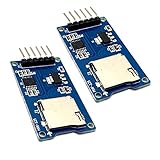
- Support Micro SD card, Micro SDHC card (high speed card).
- Through the file system and SPI interface driver, the MCU system can completethe reading and writing of files in the MicroSD card.
- On-board level shifting circuit, interface level can be 5V. Power supply is 5V, onboard 5V regulator circuit. Communication interface is standard SPI interface.
- Positioning holes: 4 M2 screws positioning holes with a diameter of 2.2mm, so the module is easy to install positioning, to achieve inter-module combination
- Package Included: 2pcs micro sd card module
How do I install Ubuntu on a RISC-V board?
- Confirm the board and release. Check Canonical’s supported board choices and ISA requirements on the Canonical-built RISC-V download page. Select media that explicitly matches your board.
- Read the board’s installation instructions. Check what removable media and flashing method the manufacturer specifies; Ubuntu’s instructions describe flashing the image to an SD or microSD card, depending on the board.
- Download and flash the matching image. Follow the board-specific steps to write the image to the card. A card is installation media, not proof that the image is compatible with the board.
- Boot and complete setup. Insert the prepared card and follow the board’s startup and Ubuntu installation instructions. If it does not boot, recheck the image, release, board model and ISA requirements against the official listing.
Can you run Ubuntu RISC-V in QEMU?
Yes. Ubuntu documents an experimental QEMU route for testing RISC-V Ubuntu. In its documented setup, a regular Ubuntu Desktop image is available, but GNOME takes more than 30 minutes to load. Ubuntu recommends Xubuntu Minimal with XFCE as a more suitable choice for emulation testing: Ubuntu’s QEMU RISC-V documentation.
That slow GNOME startup is specific to the documented QEMU environment. It should not be treated as a benchmark for Ubuntu on physical RISC-V hardware.
Rank #3

- Module: Micro SD card reader module, through the file system and the SPI interface driver, SCM system to complete the file to read and write MicroSD card.
- Specification: Voltage: 4.5V~5.5V DC; Communication Interface: Standard SPI; Interface Voltage Level: 3.3V or 5V.
- Feature: Small volume, Size:17.9x17.9mm/0.7x0.7in. 2 M2 screws positioning holes with a diameter of 2.2mm, so the module is easy to install positioning, to achieve inter-module combination.
- Applicable card type: Micro SD Card, Micro SDHC Card.The communication interface is a standard SPI interface, easy to connect to any device with SPI interface.
- Package includes: You will get 5 x Micro SD Card Adapter, 30 x Female to Male Dupont Cable.
What support comes with Canonical-built and partner-built images?
| Image type | Who builds and hosts it | Support and security updates |
|---|---|---|
| Canonical-built | Canonical | Canonical says Ubuntu components receive support and maintenance under its standard SLA. |
| Partner-built | Canonical partners, using Canonical’s tools and standard build processes | Ubuntu labels these images developer previews, not production-ready. They do not include Canonical security updates or support. |
Check the Canonical-built image page and partner-built image page for the image’s category and details. A partner image is not equivalent to a Canonical-built image in support or security-update coverage.
Quick Recap
Rank #4
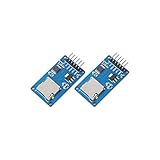
- ☆The module is a Micro SD card reader module, and the SPI interface via the file system driver, microcontroller system to complete the MicroSD card read and write files. Ar-duino users can directly use the Ar-duino IDE comes with an SD card to complete the library card initialization and read-write.
- ☆3.3V regulator circuit: LDO regulator output 3.3V as level converter chip, Micro SD card supply.
- ☆Level conversion circuit: Micro SD card into the direction of signals into 3.3V, MicroSD card toward the direction of the control interface MISO signal is also converted to 3.3V, general AVR microcontroller system can read the signal.
- ☆Micro SD card connector: yes since the bomb deck for easy card insertion and removal.
- ☆Positioning holes: 4 M2 screws positioning hole diameter of 2.2mm, the module is easy to install positioning, to achieve inter-module combination.
Product prices and availability are accurate as of the date/time indicated and are subject to change. Any price and availability information displayed on Amazon at the time of purchase will apply.

