
Do these 3 things before closing this tab:
1Fix the driver behind crashes, sound loss and screen glitches2Repair Windows errors before they cause bigger problems3Scan for outdated or missing drivers - takes under a minuteiTechGuides is reader-supported. When you buy through links on our site, we may earn an affiliate commission. As an Amazon Associate I earn from qualifying purchases. Learn more
Travel is becoming a proving ground for new payment systems because a single trip connects booking, payment, loyalty, identity checks and airport processing—often across companies and borders. The opportunity is a more connected journey; the test is whether systems can work together without compromising security, privacy or choice. Cards remain the leading reported preference, and digital credentials have not made physical documents or existing payment methods obsolete.
What is changing in travel payments?
Travelers are starting to encounter a broader mix of payment options alongside cards, including digital wallets and instant payments. In the International Air Transport Association’s (IATA) 2025 Global Passenger Survey, 72% of passengers said credit or debit cards were their preferred way to pay for travel, down from 79% in the 2024 survey. Digital-wallet preference was 28% in 2025, compared with 20% in 2024; instant-payment preference, including IATA Pay as an example, was 8% in 2025, compared with 7% in 2024. These are survey-reported preferences, not measured transaction shares or proof that cards are about to disappear. IATA’s 2025 survey announcement reports the later results; its 2024 announcement reports the earlier figures.
That shift matters because a travel payment is rarely isolated. A traveler may book online, apply loyalty benefits, pay in a chosen currency, verify identity, check in and pass through airport checkpoints. The same smartphone increasingly serves as the interface for several of these steps. IATA reported in 2025 that 78% of passengers wanted a smartphone combining a digital wallet, digital passport and loyalty cards for booking, payment and airport navigation. That is a statement of what respondents wanted, not evidence that one integrated system is already available everywhere.
Why travel puts payment innovation to the test
Travel exposes the seams between systems. A booking platform, airline, hotel, payment provider, loyalty program and border or airport authority may each handle a different part of the journey. A new payment method can work at checkout yet still create friction when it has to connect to refunds, loyalty records, identity checks, currency choices or a provider’s settlement process.
#1 Best Overall

- LIFETIME REPLACEMENT GUARANTEE – We individually test every HERO Neck Wallet in the USA before shipping. And every order comes backed by our lifetime replacement guarantee. If anything ever goes wrong we will send you a replacement absolutely free!
- HANDS-FREE TRAVEL POUCH – Our ultimate universal travel neck wallet conceals passports, IDs, credit cards, cash, iPhones (incl. 17 Pro Max without a bulky case), tickets, and valuables, keeping personal items hidden discreetly on the go.
- PROTECTIVE RFID LINING – Each unisex passport wallet features multi-RFID layers that shield credit cards, bank cards, passports and any other personal information from potential e-theft.
- SUPPORTS RUGGED ADVENTURES – We only use premium ripstop nylon fabric and heavy duty YKK zippers to make our passport travel wallets stronger, more durable, and more resilient for a lifetime of world-wide adventures.
- STREAMLINED ACCESSIBILITY – A stylish, easy-to-use design, that’s comfortable and lightweight. Our HERO Neck Wallet makes it super easy to add or remove items, including passports & large smartphones, for quick travel access.
This makes travel a more demanding proving ground than a one-step retail checkout. The question is not only whether a payment can be authorized, but whether it can fit into a multi-stage journey involving different organizations and, often, different countries. IATA’s contactless-travel article describes a proof of concept linking credentials and wallets with biometric identification on an international Hong Kong–Tokyo round trip. A proof of concept demonstrates a possible process; it does not establish universal availability or adoption.
Which payment options are travelers using or considering?
There is no single global preference. IATA’s passenger surveys describe regional differences: its 2025 account says Asia-Pacific travelers lead in wallet use, while European passengers are more cautious about digital services and sharing personal information. These are aggregate patterns, not rules for every traveler in a region.
| Payment option | What the evidence says | What it does not establish |
|---|---|---|
| Credit and debit cards | Preferred by 72% of passengers in IATA’s 2025 survey, versus 79% in its 2024 survey. | These preference figures do not measure the share of travel transactions paid by card. |
| Digital wallets | Preferred by 28% in IATA’s 2025 survey, versus 20% in 2024. | The figures do not show that wallet availability or use is uniform across markets. |
| Instant payments | Preferred by 8% in IATA’s 2025 survey, compared with 7% in 2024. IATA gives IATA Pay as an example. | The survey figures do not identify transaction volumes or adoption by every travel seller. |
| Other alternative payment methods | Phocuswright’s public summary discusses mobile payments, digital currencies and buy-now-pay-later options in the travel-payment landscape. | Its public summary does not provide the full report’s methodology or all 35 underlying figures. |
The survey years matter: IATA’s 2024 announcement reported 7% preference for instant-payment solutions, while the 2025 announcement reported 8%. IATA’s 2024 respondents most often cited convenience as a reason for choosing a payment method (70%), followed by benefits (39%) and security (33%). Those answers help explain why a method may appeal, but they do not rank payment products or determine which is best for an individual traveler.
Quick wins for a faster PC:
Scan for outdated or missing drivers - takes under a minuteDriver Scan →Clear out junk files and repair common Windows errorsFree Scan →Rank #2

- STYLISHLY SMALL, SLIM & DISCREET: Measuring just 3 1/8" x 4 7/16", our RFID front pocket wallet is designed to be super thin and exceptionally slim. Its modern, minimalist profile fits perfectly in your pocket, purse, or travel pack without adding bulk.
- SURPRISINGLY SPACIOUS: Though slim, it features 8 slots to easily organize your essentials. Comfortably holds your driver's license, credit cards, debit cards, and membership cards, keeping everything you need right at your fingertips.
- ADVANCED RFID BLOCKING: Our slim wallets for men and women are outfitted with advanced RFID SECURE Technology. They block electronic signals to keep your identity protected while you travel, shop, or explore, safeguarding you from digital theft.
- DURABLE & STYLISH FAUX LEATHER: Crafted from premium synthetic leather, this minimalist wallet sleeve combines a luxurious look and feel with everyday functionality. Its durable construction is designed to withstand the rigors of daily use, travel, and shopping.
- THE PERFECT UNISEX GIFT: With its sleek design and practical security features, this wallet is a popular choice for both men and women. It arrives ready for gifting, making it an ideal present for the frequent traveler, minimalist, or anyone in your life!
What does a more connected travel journey look like?
The ambition is to make the phone a reusable travel tool rather than a separate screen for each task. A wallet could be used at booking, while loyalty details and digital credentials help carry information into later stages of the journey. IATA’s 2025 finding that 78% of passengers wanted a combined smartphone experience points to demand for that kind of convenience. It does not mean the wallet, passport and loyalty functions are already interoperable across providers or accepted at every checkpoint.
Biometrics are another part of the experiment, especially at airport checkpoints. IATA reported in 2025 that half of surveyed passengers had used biometrics somewhere in their airport journey. In the same survey, 74% said they would be willing to share biometric information to avoid repeatedly presenting documents; among those unwilling, 42% said they might reconsider if privacy were assured. These are self-reported attitudes and experience, not an independent measure of system security or a guarantee that biometric processing is required or available on a particular trip.
IATA’s position is that cybersecurity must be built into the end-to-end transformation of booking, payment and air travel. Its contactless-travel material also identifies security, resilience and standardized digital identity as requirements. A digital process that fails during disruption, exposes sensitive data or cannot be recognized by another organization does not deliver a simpler journey.
Rank #3
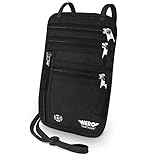
- LIFETIME REPLACEMENT GUARANTEE – We individually test every HERO Neck Wallet in the USA before shipping. And every order comes backed by our lifetime replacement guarantee. If anything ever goes wrong we will send you a replacement absolutely free!
- HANDS-FREE TRAVEL POUCH – Our ultimate universal travel neck wallet conceals passports, IDs, credit cards, cash, iPhones (incl. 17 Pro Max without a bulky case), tickets, and valuables, keeping personal items hidden discreetly on the go.
- PROTECTIVE RFID LINING – Each unisex passport wallet features multi-RFID layers that shield credit cards, bank cards, passports and any other personal information from potential e-theft.
- SUPPORTS RUGGED ADVENTURES – We only use premium ripstop nylon fabric and heavy duty YKK zippers to make our passport travel wallets stronger, more durable, and more resilient for a lifetime of world-wide adventures.
- STREAMLINED ACCESSIBILITY – A stylish, easy-to-use design, that’s comfortable and lightweight. Our HERO Neck Wallet makes it super easy to add or remove items, including passports & large smartphones, for quick travel access.
What is slowing adoption?
Integration is a central obstacle. Phocuswright’s public summary of The State of Global Travel Payments 2024 says travel businesses have been slow to adopt alternative payment methods largely because of technical and integration challenges. It also discusses settlement problems as part of the landscape. Because the full report is subscriber-accessible or paid, the public summary supports those broad points but not detailed claims about particular businesses, technologies or rates of adoption. Read Phocuswright’s public summary.
- Connecting systems: A provider may need to support a method across booking, servicing, refunds and settlement rather than only at checkout.
- Protecting data: Payment credentials and identity information require safeguards, while travelers’ comfort with sharing personal or biometric data varies.
- Maintaining choice: A method popular in one market may not match preferences or availability in another. Regional survey patterns make a universal default difficult to justify.
- Keeping processes resilient: Connected processing depends on reliable systems and common standards, particularly when several organizations and jurisdictions are involved.
For broader context, Visa’s 2025 payments outlook discusses real-time payments, digital identity, account-to-account payments, embedded finance and cross-border challenges. It is a payment-network company’s outlook, not independent evidence of travel-specific adoption.
Independent reader supportYour contribution helps us test, update, and keep practical guides available for everyone.How should travelers and travel businesses judge new options?
No payment method is a universal winner. Travelers can assess the practical fit for a particular booking and trip; travel businesses need to weigh the traveler experience against integration and operational requirements.
Rank #4

- SECURE YOUR WALLET FROM e-PICKPOCKETING: Prevent potential identity and financial theft through your contactless cards. This is the simplest and most effective prevention solution! Block RFID and NFC signals, protect your personal information, and enjoy peace of mind wherever your travels or business take you.
- JAMMING CHIP: An antenna and jamming chip makes up the main components of the card. The antenna will sense incoming radio waves and draw power for the chip to create a jamming signal. Lifetime usage as the card does not require battery.
- BROAD WORKING DISTANCE: With a 2.4” working distance, your entire wallet stays protected. The premium RFID blocking card helps secure cards within 1.2” on either side, providing reliable protection against electronic pickpocketing.
- ULTRA-THIN & COMPACT: At the size of a standard credit card and at only 0.03” thick, the card will fit into any wallet, purse or card case. Keep your wallet compact with no added bulk from this card. Best for travel, business, and everyday use.
- TEST THE CARD: Test the card is working at your local supermarket. At the self-service checkout machines, combine the card and a contactless card on the payment reader. Payment with the contactless card will be blocked and an error message should occur on the reader.
- Convenience: Does the method reduce steps at booking or during the trip? IATA’s 2024 survey found convenience was the most frequently cited reason for payment choice.
- Security and privacy: What protections apply to the payment, and what personal or biometric data is collected? A promise of speed is not a substitute for clear safeguards.
- Regional fit and choice: Is the option available for the traveler’s origin market, destination and chosen currency? Survey averages do not represent every traveler.
- Integration and settlement: Can the airline, hotel or seller support the method across its systems, including relevant operational and settlement processes?
What the evidence says—and what it does not
The available evidence supports a transition in which travelers express growing interest in wallets, instant payments and connected digital journeys, while cards remain the leading reported preference. It also shows interest in biometric processes alongside privacy concerns, and highlights integration as a practical barrier for travel businesses.
It does not establish that payment cards or physical travel documents are disappearing, that preference surveys equal transaction behavior, or that a contactless identity process works universally. The outcome will depend on whether providers and public authorities can make systems interoperable, resilient and trustworthy while preserving meaningful payment choice.
Quick Recap
Product prices and availability are accurate as of the date/time indicated and are subject to change. Any price and availability information displayed on Amazon at the time of purchase will apply.

