
Crashes, No Sound, or Screen Glitches?
Random freezes, missing sound and display glitches usually trace back to one bad driver. Find and replace yours safely.Free scan · under a minuteWindows Errors? Fix Them Before They Spread
Repair common Windows errors and clear accumulated junk for a smoother, more stable PC - no reinstall needed.Free scan · no reinstalliTechGuides is reader-supported. When you buy through links on our site, we may earn an affiliate commission. As an Amazon Associate I earn from qualifying purchases. Learn more
A broker-free investment tracker keeps record-keeping separate from brokerage access: you enter transactions or balances yourself, and the tracker works from the information you provide. That means it does not need your broker username and password for account syncing, but it also puts data entry, reconciliation, and safe storage on you. The right approach depends on how much manual work you will maintain and what you need the record to show.
What a tracker without broker connections actually does
“Doesn’t connect to your broker” describes how information gets into the tracker. It does not mean the tracker cannot total holdings or display a portfolio. A paper record, spreadsheet, or manual-entry app can all work without broker authentication; they differ in how much calculation and organization they provide.

A balance snapshot records what you hold at a particular time. It can answer questions such as how much of an asset you currently own, but it does not preserve the events that produced that balance. A transaction history records activity over time—such as purchases, sales, deposits, withdrawals, dividends, reinvestments, and fees—so you can compare the tracker with the activity shown by your brokerage.
The Tool Desk
Outbyte Driver Updater FREEScan for outdated or missing drivers - takes under a minuteDriver Scan →Outbyte PC Repair FREEClear out junk files and repair common Windows errorsFree Scan →Brokerage statements and trade confirmations should remain the records you use to verify activity. Investor.gov’s SEC guidance describes statements that may include transaction dates and prices, deposits and withdrawals, dividends and interest, reinvested distributions, realized gains or losses, and transaction costs. A personal tracker is a useful view of those records, not a substitute for them.
What you gain—and what you take on
Less credential sharing for this connection
If a tracker never authenticates to a brokerage account, it does not need the broker credentials for that connection. That removes one form of credential sharing. It does not establish that the tracker is anonymous or private: the information may still be stored on a device, in a cloud account, or by an app provider, and access, telemetry, and backup practices vary.
More control over what gets entered
Manual entry lets you decide which accounts and transactions to record. That can be useful when you want a consolidated view without granting a separate service access to brokerage accounts. The trade-off is that missing, late, or incorrectly entered information can make the view incomplete or misleading.
More responsibility for accuracy
You must enter activity, check calculations, and reconcile the tracker against statements and confirmations. Corporate actions, reinvested distributions, and changes to cost basis can complicate the record. Unless the tracker’s treatment of cash flows and those events is documented and verified, do not treat its performance figures or tax-related totals as authoritative.
Choose a record-keeping format you can maintain
| Format | Data-entry and calculation work | What to check |
|---|---|---|
| Paper notebook | You record activity and do the calculations yourself. | Use a consistent format for dates, asset identifiers, share counts, prices, and cash flows. Keep the record secure and compare it with account statements. |
| Spreadsheet | You create and maintain the layout and formulas. Formulas can total holdings, but the owner is responsible for their design and upkeep. | Check formulas against known statement values, manage versions and sharing, and protect the file and backups. The UK government notes that spreadsheets may contain personal or financial information, can expose hidden content when shared, and may include macros or code with security and maintenance implications. |
| Manual-entry app | You enter transactions; the app may automate rollups or visualizations. | Confirm supported transaction types, storage location, whether cloud sync is optional, export and backup options, calculation transparency, and costs. Claims about app capabilities should be checked against the specific product’s documentation; a vendor comparison is not independent product testing. |
No format is automatically the most secure or accurate. The relevant questions are who can access the records, how they are backed up, whether calculations can be checked, and whether you will keep entries current.
Rank #3
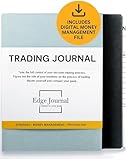
- FOR SERIOUS TRADERS: Track every entry, exit, position size, P&L, and setup with a structured layout designed for forex, stocks, options, futures, and crypto traders who want to identify what actually works in their strategy. NEUROSCIENCE-BASED DESIGN that encourages Growth Mindset and accountability
- TRADER PSYCHOLOGY FOCUS: Built on proven cognitive science principles, each page guides you through emotion tagging, bias recognition, and post-trade reflection to rewire reactive decision-making and build the disciplined mindset top-performing traders rely on
- COMPLETE 2026 TRADING LOG BOOK: Undated 12-month layout with performance summaries and goal tracking for day traders, swing traders, and long-term investors building consistent and serious results
- PERFORMANCE METRICS THAT DRIVE GROWTH: Dedicated sections for win rate, risk-reward ratio and strategy backtesting help you turn raw data into actionable insights, so every losing trade becomes a lesson and every winning trade becomes a repeatable system
- DIGITAL MONEY MANAGEMENT FILE INCLUDED : calculate your risk/reward ratio and win rate to find out whether you have a mathematical edge on the market, or not.
Build a record that can be reconciled
For each transaction, capture enough detail to compare it with the source record. The exact fields depend on your assets and the tracker, but a practical baseline is:
- Date and activity: transaction date and whether it was a purchase, sale, deposit, withdrawal, dividend, interest payment, reinvestment, fee, or other event.
- Asset and quantity: the identifier you use consistently and the number of shares or units involved.
- Price and cash amount: the trade price and the associated cash movement, when applicable.
- Costs and income: fees, commissions, dividends, and interest shown in the underlying records.
- Basis details: original purchase amount and relevant adjustments when you are tracking cost basis.
- Source and status: the account or statement the entry came from and whether it has been checked.
Investor.gov defines cost basis as “The original amount paid for a security, including the amount of reinvested dividends and capital gains, plus or minus certain adjustments.” The SEC also notes that not all adjustments may appear in reported basis. Keep source records for any adjustments and verify them rather than assuming a tracker’s basis figure is complete.
Use a repeatable entry and review routine
- Choose the scope. Decide which accounts and asset types you intend to include. Record the scope so that a partial view is not mistaken for a complete portfolio.
- Enter transactions from source documents. Use statements and trade confirmations, not memory, for dates, quantities, prices, cash flows, income, and costs.
- Reconcile on a regular schedule. Compare recorded activity and resulting balances with the relevant brokerage statements. Investigate discrepancies instead of changing totals simply to make them match.
- Record corrections transparently. Preserve enough information to identify an amended or corrected entry and its source, rather than silently overwriting history.
- Protect and back up the record. Limit access to people who need it, use secure account protections, and check that backups are available and recoverable.
Why fees belong in the tracker
Fees reduce the amount of money left in a portfolio to continue earning returns. The SEC Office of Investor Education and Assistance says, “These fees may seem small, but over time they can have a major impact on your investment portfolio.” Its July 23, 2025 bulletin illustrates the effect with a hypothetical $100,000 investment growing at 4% annually for 20 years: with annual fees of 0.25%, 0.50%, and 1.00%, the ending values are approximately $208,000, $198,000, and $179,000 — SEC Office of Investor Education and Assistance, 2025. These are hypothetical values under the bulletin’s assumptions, not forecasts or typical investor results.
To understand your own costs, compare account statements, trade confirmations, fee schedules, and disclosure documents. A tracker can only reflect costs that are actually entered and represented correctly.
Best Value

- Effective Budget Plan Book – Take control of your finances with the SUNEE budget account book. This all-in-one budget planner allows you to plan and track your income, expenses, savings, and financial goals. Its intuitive layout and easy-to-use sections help you stay organized and make smart decisions to reach financial success. Our financial planner also included a comprehensive guidebook with valuable tips and instructions to help you get the most out of your budgeting planner.
- Full-Page Calendars – Each month’s full-page calendar provides plenty of space to track paydays, bills due dates, appointments, and important events. No more cramped boxes or tight writing areas, you can easily plan and organize your schedule at a glance.
- Colorful Pages Layout and Tabs – This vibrant budget planner features a user-friendly design for easy navigation and organization. Each month includes dedicated budget pages to set financial goals, track income, and plan expenses. Additional sections like debt trackers, savings goals, and bill payment trackers make managing your finances a breeze. The colorful backgrounds on each page offer clear, instant visibility.
- Bonus 4 Stickers and Convenient Design – This monthly budget planner is built for convenience and durability. Water-resistant cover protects against spills, while the elastic band keeps everything secure, and the dual-sided pocket offers extra storage. Plus, we’ve included 4 adorable sticker sheets to personalize your planner and make budgeting more enjoyable. Experience a budget planner that combines practicality with lasting quality.
- UNDATED DESIGN & 1 YEAR USE - Undated finance books start with 1 page-financial goals, 1 page-Mind Map, 1 page-Financial Strategy, 1 page-Tactics, 2 pages-Important Dates, 4 pages-Bill Tracker, 4 pages-Saving Tracker, 8 pages-Debt Tracker, followed by 12 Months(10 pages per month, 1 unique color for each month). 2 pages-Christmas Budgeting, 2 pages-Yearly Summary, 2 pages-Check Register and 12 pages-Notes(dotted). It is UNDATED, so you could start at any time, suitable for 1 year use.
Protect the information even when no broker is linked
Investment records can reveal personal financial information. A spreadsheet stored locally, a cloud-synced file, and a third-party app have different access and backup arrangements; avoiding broker sync does not settle those questions. Before choosing a format or service, check who can access the data, where it is stored, whether synchronization can be turned off, how records can be exported, and how backups are protected.
For spreadsheets, review sharing permissions and hidden content before sending a file. Treat macros or other embedded code as something to inspect and maintain, not as harmless decoration. For any online account that holds financial information, the SEC’s April 23, 2026 investor bulletin recommends protecting accounts with strong passphrases, secure passwords, and passkeys where supported. That is general account-security guidance, not an evaluation of any particular investment tracker.
Decide whether manual tracking fits your needs
A broker-free tracker is most useful when you are willing to enter and verify information in exchange for keeping brokerage authentication separate from the tracking workflow. Before committing, check whether your chosen format can represent the activity you care about, whether you can trace a total back to source records, and whether you can maintain secure backups.
Quick Recap
- Choose a snapshot-only record if your goal is simply to note current holdings and you do not need a detailed account of how they changed.
- Choose a transaction history if you want to explain changes over time, reconcile activity, and include income and costs.
- Reconsider manual entry if you are unlikely to keep up with transactions or need calculations whose treatment of cash flows, reinvestments, and corporate actions has not been verified.
Product prices and availability are accurate as of the date/time indicated and are subject to change. Any price and availability information displayed on Amazon at the time of purchase will apply.

