
iTechGuides is reader-supported. When you buy through links on our site, we may earn an affiliate commission. As an Amazon Associate I earn from qualifying purchases. Learn more
No, Earth’s days are not becoming longer or shorter. The change is to civil timekeeping. On 20 May 2027, Coordinated Universal Time (UTC) will become continuous: clocks will stop receiving routine leap-second adjustments intended to keep them within one second of Earth’s irregular rotation. Earth will continue rotating at a variable rate, and the Sun will still determine observed sunrise, sunset and apparent solar time.
What was decided
At its 28th meeting in October 2026, the General Conference on Weights and Measures (CGPM) adopted Resolution 5 on the continuity of UTC. The resolution says continuous UTC becomes effective on 20 May 2027 and permits the absolute difference between UTC and UT1—the time scale based on Earth’s rotation—to reach 3,600 seconds, or one hour. The exact wording is in the BIPM Resolution 5 (2026).
UTC will remain generated from atomic time. The policy change removes the requirement for occasional one-second steps, allowing atomic civil time to drift gradually away from rotational time over centuries.
What’s actually slowing this PC down?
Pick the symptom - the matching free tool is one click away.
What is changing—and what is not
| Question | Answer after 20 May 2027 |
|---|---|
| Will a normal day stop being 24 hours? | No. “Day” can mean a civil 24-hour calendar day, an Earth-rotation day, or the daylight interval between sunrise and sunset. The resolution changes only the relationship between UTC and UT1. |
| Will Earth rotate at a fixed rate? | No. Earth’s rotation will continue to vary because of geophysical and atmospheric effects. |
| Will sunrise and sunset suddenly move? | No. Local sunrise and sunset follow Earth’s rotation, your location and the season. There is no one-hour jump in daylight on the start date. |
| Will leap seconds continue routinely? | No. UTC will be continuous rather than being periodically stepped to stay within one second of UT1. |
| How far may UTC and UT1 eventually separate? | The new maximum permitted difference is 3,600 seconds (one hour), rather than the former one-second target. |
Why leap seconds are being retired
Irregular steps are difficult for software
UTC is based on atomic clocks, while UT1 follows Earth’s changing spin. Under the old system, a leap second was inserted when needed to keep UTC and UT1 within one second. A one-second clock step is unusual behavior for operating systems, databases, distributed services and communication protocols that normally assume time advances continuously.
#1 Best Overall

- Atomic Wall Clock Never Need Setting: Atomic clock has a built-in receiver that automatically synchronizes itself with the WWVB radio broadcast by the US Government's National Institute (NIST) in Fort Collins, Colorado. The Atomic Clock will always be accurate to within one second as it receives daily WWVB updates. (No Backlight)
- Atomic Clock with Indoor/Outdoor Temp: The Wireless outdoor sensor transmits the outdoor temperature to the atomic clock. The sensor should be placed within 100ft of the clock. Also, clock has a built-in high-quality indoor temperature sensor so that you can read the temperature both indoor and outdoor
- Digital Wall Clock Large Display: Jumbo 2.5 inch Height Time Digital Display - Use as either a wall clock or as a desk clock, it is easy to read, easy to Use and easy to set up. This atomic clock has been designed with absolute simplicity in mind, you can also set it manually. Excellent clocks for seniors, suitable for anyplace in your home or office
- Atomic Clock Digital: 12/24 Hour time formats with accurate and clear second minute and hour display; 4 time zone to choose (PST, MST, CST, EST); auto daylight saving time; temperature display units in Celsius or Fahrenheit
- Digital Wall Clock Battery Operated: Both clock and outdoor sensor are supported by batteries only, no need to plug or charge (Batteries not included). The existed alarm features can wake you up in the morning or help you keep track of dates and days of the week to avoid missing any important meetings or appointments
Leap seconds had been inserted 27 times since the 1970s, with the last in 2016, according to a contemporaneous report by The Telegraph carried by AOL. The same report said the 2012 leap-second event was associated with crashes or other problems reported by Mozilla, Reddit, Foursquare, Yelp, LinkedIn, StumbleUpon, Linux and Java systems. Those are reported implementation incidents, not the result of a controlled comparative study. The report is available at AOL/The Telegraph (15 October 2026).
A negative leap second would be harder still
A positive leap second adds 23:59:60. A negative leap second would remove a second from a UTC day, creating a sequence that skips a label. No negative leap second has ever been applied. The CGPM resolution records a 2025 workshop estimate from the Consultative Committee for Time and Frequency and the International Earth Rotation and Reference Systems Service that the probability of needing one could reach 30% by 2035. The concern is not that a negative leap second is physically impossible, but that many systems are not designed for either kind of discontinuity.
Rank #2

- Atomic Clock Digital - The clock has a built-in receiver that automatically synchronizes itself with WWVB radio broadcast, which will set and update time automatically every midnight, no need to set manually. It has four time zones selectable: EST, PST, MST, CST.
- Digital Wall Clock Battery Operated - This digital clock is supported by 3xAAA battery (Not included). No wires make it can be placed anywhere; and the low battery symbol reminds you to replace the battery in time to avoid getting the wrong time due to low power.
- Digital Wall Clock Large Display - The LCD screen measures 6.2 in x 3.7 in and it displays time, indoor temperature, day and date. Each section is showed separately, allows you to read the content easily and quickly.
- Atomic Clock with Auto DST - With DST on, the time would go forward or backward one hour automatically in daylight saving time, no worry about time changing on that day. If for no need, it could also be turned off, then “AUTO DST” disappears from screen.
- Digital Alarm Clock - The alarm could be turned on or off according to your need, just click the button to set. When alarm is set on, there is a bell icon staying on screen. The icon will disappear if alarm is set off. When alarm goes off, just click any button to stop it on the day.
Metrologist Noel Dimarcq of the Côte d’Azur Observatory called the decision “a historical moment, a decisive step for UTC” and described it as an international reference time scale continuous for the next millennia. Dr Christian Bizouard of the International Earth Rotation and Reference Systems Service said, “When we apply leap seconds, there are always errors.” Both statements were reported by AOL/The Telegraph.
How the old and new systems differ
| Comparison | Previous UTC practice | Continuous UTC from 2027 |
|---|---|---|
| Synchronization target | Keep UTC within one second of UT1. | Allow UTC–UT1 separation up to one hour. |
| Operational behavior | Occasional one-second insertions or removals. | No routine leap-second steps. |
| Main technical risk | Systems mishandle an unexpected repeated or skipped second. | Long-term civil time gradually diverges from solar-rotation time. |
| Most affected users | Systems requiring sub-second coordination and robust leap-second handling. | Organizations that must monitor UTC–UT1 over long periods or explain the growing civil/solar offset. |
What the change means for people and technology
Everyday clocks
Phones, computers, wall clocks and calendars will still display familiar 24-hour civil time. Most people will not see a visible change on 20 May 2027. A radio-controlled atomic clock illustrates how consumer devices can receive atomic-time-based civil time; it does not measure Earth’s rotation or predict sunrise.
Rank #3
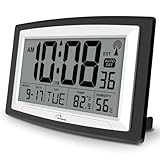
- Atomic Digital Clock Auto Set (No back light) - Using radio frequencies broadcast from NIST’s Colorado , the clock will automatically set to the correct time. Automatically adjusts to Daylight Savings Time while set the DST on.
- Atomic Wall Clocks Battery Operated with Alarm - This digital calendar alarm day clock required 3 “AA” long life batteries (Not included) for operation, no redundant wires, easy to use. Turn on the alarm clock before going to bed, it will wake you up in the morning.
- Clock with Temperature and Humidity - Excellent wall clocks for living room, office, bathroom decor,etc. Help you monitor indoor temperature and humidity to avoid cold. 12/24 hours formats with clear Hours, Minutes and Seconds display; 4 Time Zone to choose.
- Atomic Clock Large Display for seniors - WallarGe atomic clock has been designed with absolute simplicity in mind, you can also set it manually without any more ado. Wall clock or desk clock, large and clear digital display, easy to read.
- Digital Wall Clock with Accurate Date and Time - This digital calendar alarm day clock can help you keep track of dates, days of the week and times to avoid missing any important meetings, appointments or anniversaries, work well for work, study or travel schedule.
Critical infrastructure
Transportation, energy distribution, telecommunications and space projects often coordinate events across networks and locations. For these users, removing sporadic one-second steps makes timestamp handling more predictable. Operators still need a reliable UTC source, documented clock discipline and monitoring of the UTC–UT1 difference.
Sub-second applications
Trading, scientific instruments, navigation, satellite operations and other systems that compare measurements to Earth orientation cannot simply discard UT1. They will continue to obtain Earth-orientation information separately while using continuous UTC as the stable civil reference. Engineering documentation should state explicitly whether a timestamp is UTC, UT1 or another time scale.
Rank #4

- Atomic Clock with Backlight: Never Need Setting, a built-in receiver that automatically synchronizes itself with the WWVB radio broadcast, it will always be accurate to within one second as it receives daily WWVB updates. Three levels (OFF-LOW-HIGH) backlight helps you to know what time it is without turning the light on late at night
- Large Digital Wall Clock: 14 inches large display with 4.3 inches numbers make this digital wall clock easy to read and it's visible around the entire room, friendly to the elderly and the visually impaired
- Digital Wall Clock Battery Operated: The clock is supported by four AA battery (not included). No wires make it can be placed anywhere; and the low battery symbol reminds you to replace the battery in time to avoid getting the wrong time due to low power
- Digital Clock with Date and Day of the Week: This digital wall clock with backlight not only does it give you the time, you can also get the day, date and current indoor temp at just a glance. And the day and temp display could be chosen to display alone or in turns every 10s
- Multiple Display Formats: Large digital wall clock with backlight makes it easy to know the time, two different time and temperature formats (12/24H; /) are available for your convenience and preference
Will solar time eventually drift from clock time?
Yes, slowly. Because UTC will no longer be corrected to follow every fluctuation in Earth’s spin, the average position of the Sun in the sky at a given UTC time will change over long periods. The Telegraph/AOL report estimated an approximate civil-to-solar drift of 25 minutes every 500 years; that is a broad long-term estimate, not a forecast for a particular city or date. The drift is imperceptible in ordinary daily life but matters to future timekeeping conventions and astronomical applications.
What organizations should do before the transition
- Inventory time dependencies. Identify software, devices and services that parse UTC, UT1, leap indicators or the value 23:59:60.
- Separate time scales in data models. Label whether each timestamp is UTC, UT1, local civil time or another reference, rather than treating them as interchangeable.
- Remove assumptions about future leap seconds. Test schedulers, databases, message queues and monitoring systems without relying on a recurring leap-second event.
- Keep Earth-orientation feeds where needed. Scientific, navigation and space operations may still require UT1 and related Earth-orientation data even though civil UTC is continuous.
- Verify vendor and standards updates. Obtain transition guidance for operating systems, timing receivers, telecom equipment and satellite-control software, and test failover behavior before 20 May 2027.
The practical answer
The Sun is not losing its role in defining daylight, and Earth is not being forced to rotate to a new schedule. The international time standard is changing its priority: after 20 May 2027, UTC will favor a continuous, software-friendly atomic timescale and accept a slowly increasing difference from Earth-rotation time, up to one hour. Sunrise, sunset and the physical length of a day remain governed by astronomy, not by the UTC policy.
Quick Recap
Best Value

- [Automatic Time Updates] – The Atomic Time Feature conveniently allows the clock to sync with the WWVB radio transmission from Fort Collins, CO, for accurate time updates.
- [Classic design] – With unmatched attention to detail, the WT-3129B is highlighted by a distinctive matted 12-inch black frame with a silver bezel – a statement piece for any home setting.
- [5-Year Battery Life] – A quality set of 3 “AA” batteries will keep the clock running for up to 5 years – an impressive feat offering unparalleled convenience and peace of mind.
- [SIMPLE-SET] Simple adjustable switch to your Time Zone (4 different selections: PT-Pacific, MT-Mountain, CT-Central, ET-Eastern)
- [A Brand You Can Trust] – Family-owned and operated since 1983, La Crosse Technology is the world leader in Atomic Time and Weather Instruments. Designed in La Crosse, WI, our products have unmatched support resources, including printed setup guides, helpful video tutorials, and lifetime access to our USA-based tech support team.
Product prices and availability are accurate as of the date/time indicated and are subject to change. Any price and availability information displayed on Amazon at the time of purchase will apply.

