
iTechGuides is reader-supported. When you buy through links on our site, we may earn an affiliate commission. As an Amazon Associate I earn from qualifying purchases. Learn more
Best overall: The TP-Link Tapo P110M is the strongest all-around choice for most smart homes because it combines a compact design, Matter support, energy reporting, and compatibility with Alexa, Google Home, Apple Home, and Samsung SmartThings. PCMag named it its current best overall smart plug in its July 10, 2026 guide.
The right choice changes if you only need basic scheduling, want Thread and local operation, need several independently controlled outlets, or are buying for an outdoor location. This guide separates those use cases and explains the important trade-offs—especially the fact that Matter does not necessarily mean hub-free operation.
Testing note: The hands-on testing claims below are attributed to PCMag, WIRED, Engadget, and T3. They are not a claim that every product was personally tested by the author of this guide. Prices and availability are retailer snapshots and should be checked before buying.
Do these 3 things before closing this tab:
1Repair Windows errors before they cause bigger problems2Fix the driver behind crashes, sound loss and screen glitches3Clear out junk files and repair common Windows errorsQuick picks
| Best for | Model | Why it stands out | Important limitation |
|---|---|---|---|
| Most smart homes | TP-Link Tapo P110M | Matter, energy reporting, compact body, broad platform support | Costs more than a basic on/off plug |
| Simple automation and value | TP-Link Kasa EP10 | Small 2.4 GHz Wi-Fi plug with schedules and voice control | No Matter or energy-monitoring claim on the cited product page |
| Budget Matter plug | TP-Link Tapo P125M | Compact Matter plug with local control and broad ecosystem support | Requires a suitable Matter controller for Matter-based operation |
| Energy monitoring in the Kasa ecosystem | TP-Link Kasa KP125M | Matter plus real-time and historical energy data | Energy features can vary by smart-home ecosystem |
| Thread, privacy, and Apple Home | Eve Energy | Matter, Thread, energy measurement, and no Eve cloud account | Needs a Matter controller and Thread Border Router |
| Many individually controlled outlets | TP-Link Kasa HS300 | Six switched outlets, three USB ports, surge protection, and energy monitoring | Older product with model/version-specific end-of-life concerns |
| Smaller smart strip | TP-Link Kasa KP303 | Three individually controlled outlets in a smaller format | Older 2.4 GHz Wi-Fi product; not confirmed as Matter |
| Apple-focused power strip | Eve Energy Strip | Three independently controlled outlets, energy monitoring, and a premium build | More expensive and the tested configuration was limited to HomeKit |
Best smart plugs for 2026
Best overall: TP-Link Tapo P110M smart plug
PCMag’s current overall pick is the TP-Link Tapo P110M Mini Smart Wi-Fi Plug. It is a good default recommendation when you want more than a timer: the plug is Matter-certified, reports energy use, fits compactly behind furniture, and works across Alexa, Google Home, Apple Home, and SmartThings.
#1 Best Overall
- Surge protection: ETL-certified surge protection shields sensitive electronics and appliances from sudden power surges.
Matter is the main reason to choose the P110M over a cheaper basic Wi-Fi plug. It gives the device a path into multiple major ecosystems, while energy reporting helps identify how much power a lamp, fan, or other connected load is using. PCMag cited a $29.99 two-pack at the time of its July 10, 2026 publication; that figure is a dated price snapshot, not a permanent MSRP or guarantee of current availability.
The trade-off is value. If all you want is to turn a lamp on at sunset or switch a fan off after an hour, a simpler plug such as the EP10 may do the same job for less. Also confirm the features exposed by your chosen ecosystem: TP-Link notes that Matter platform support can vary by product feature and ecosystem.
Best simple, compact plug: Kasa EP10 smart plug
The Kasa EP10 is the better fit for basic on/off automation. TP-Link specifies 2.4 GHz Wi-Fi, remote control, schedules, timers, Away Mode, and compatibility with Alexa, Google Assistant, and Samsung SmartThings. Its compact shape is designed to leave the adjacent outlet usable when the EP10 is installed by itself.
WIRED has identified the Kasa Mini line as a favorite for straightforward automation. The EP10 makes sense for lamps, fans, seasonal decorations, and other equipment with a simple physical power switch. Leave that switch in the on position; the smart plug then controls the flow of power.
TP-Link rates the EP10 for up to 15 amps or 1,800 watts for general-use resistive loads. That rating does not make it suitable for every appliance drawing near the limit. Motors can have higher startup current, and heating appliances deserve additional caution. The cited EP10 documentation makes no Matter or energy-monitoring claim, so do not buy it expecting those features.
Best broad-ecosystem budget Matter plug: Tapo P125M Matter smart plug
The Tapo P125M is a compact Matter-certified Wi-Fi plug for shoppers who want broad ecosystem compatibility without committing to the Tapo app. TP-Link lists Apple Home, Alexa, Google Assistant, and Samsung SmartThings support, along with remote and local control, schedules, Auto-Off, and Away Mode.
WIRED’s April 2026 guide included the P125M among its favorites, highlighting its small size and the ability to set it up through a preferred Matter home hub rather than necessarily relying on TP-Link’s app. TP-Link’s launch material identified Amazon and TP-Link as sales channels and gave a historical 2023 launch MSRP of $19.99; neither figure should be treated as a current price.
Free tools Windows power users keep installed
One-click scans. No signup required.
The key caveat is infrastructure. A Matter device still needs a Matter controller—such as a compatible smart speaker, hub, or router—and the appropriate platform app. Bluetooth may assist with setup, but it is not the same thing as a controller that remains available for household or away-from-home operation.
Best Kasa plug for energy monitoring: Kasa KP125M energy-monitoring smart plug
The Kasa KP125M is the choice for readers who want Kasa branding, Matter compatibility, and energy data in a compact plug. TP-Link lists real-time and historical energy monitoring, remote control, schedules, Away Mode, and voice control through Alexa, Siri, and Google Assistant.
It is more informative than the EP10, not simply a newer version of it. Choose the EP10 for basic switching and value; choose the KP125M when seeing a device’s usage is important. Energy data can reveal standby consumption or show which devices use more power during a typical day, but the plug itself does not guarantee a lower electricity bill. Savings depend on what you learn and what behavior or schedules you change.
Check the interface before buying if a specific energy feature matters to you. TP-Link’s Matter documentation warns that support for individual features can differ between ecosystems.
Outdated Drivers Are Slowing You Down
One free scan finds every outdated or missing driver and matches the right update for your exact hardware.Free scan · exact hardware matchWindows Errors? Fix Them Before They Spread
Repair common Windows errors and clear accumulated junk for a smoother, more stable PC - no reinstall needed.Free scan · no reinstallBest privacy-oriented Thread plug: Eve Energy Matter smart plug
Eve Energy is the premium option for buyers who prefer Thread, local operation, and a privacy-focused design. Eve says the Matter-enabled plug works with Apple Home, Samsung SmartThings, Amazon Alexa, Google Home, and Home Assistant. It measures energy use and can show projected cost when configured with the relevant platform.
Eve also says the product has no Eve cloud, subscription, or registration requirement. That is a meaningful distinction for readers who prefer smart-home devices to operate locally rather than depending on a vendor account. Thread can also help create a low-power mesh network, provided the home has the necessary Thread infrastructure.
Do not interpret “no Eve cloud” as “no hub required.” Eve explicitly requires a compatible Matter controller and Thread Border Router for Matter operation. In the United States, Eve lists the plug at 120 volts, 60 Hz, and up to 15 amps or 1,800 watts. It is best for Apple Home, Thread, privacy, and energy-monitoring buyers who accept a potentially higher purchase price.
Best smart power strips
Best for six separately controlled outlets: Kasa HS300 smart power strip
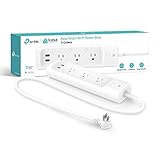
The Kasa HS300 is useful when a single plug is not enough. It has six individually controlled AC outlets, three USB charging ports, surge protection, energy monitoring, schedules, and Alexa and Google Assistant support. Each AC outlet can be switched separately, making it suitable for a desk, entertainment center, charging station, or holiday-light setup.
TP-Link specifies indoor 2.4 GHz Wi-Fi operation, a total load limit of 15 amps or 1,875 watts, and no hub requirement. The strip has a resettable circuit breaker that interrupts power when the load exceeds its capacity. Its USB ports are charging ports, not independently smart-controlled outlets, so do not count them as three additional remotely switchable sockets.
Rank #2

- EASY SETUP: Start usage in minutes by plugging in the smart extension cord and connecting via the Alexa app
- CONTROL ANYTIME, ANYWHERE: Manage your electronics from afar with the power strip with USB features; schedule appliances to turn on/off automatically or remotely to fit your lifestyle
- VERSATILE CONTROL OPTIONS: Use the multi outlet extension cord to control 6 outlets independently or group them for unified operation
- HUB-FREE SMART FUNCTIONALITY: Seamlessly integrate with Alexa using this smart power strip WiFi, create routines and schedules with ease using the Alexa app, no need for a hub. 6 Individually Controlled Outlets and 3 USB Ports
There is an important 2026 buying caveat: TP-Link’s U.S. lifecycle documentation contains HS300 entries with model- and hardware-version-specific end-of-life information and replacement language. That does not establish that every HS300 listing is unavailable, but buyers should verify current stock, the exact hardware version, warranty coverage, and support status before ordering. The HS300 is also a surge-protected power strip, not a UPS; it cannot keep equipment running during an outage.
Best smaller strip: Kasa KP303
The Kasa KP303 provides three independently controlled smart outlets and two always-on USB ports. It supports remote control, schedules, surge protection, Alexa, and Google Assistant. Its total rating is 15 amps or 1,875 watts, and TP-Link describes it as an indoor 2.4 GHz Wi-Fi product.
The KP303 is easier to place on a small desk, bedside table, or compact entertainment setup than the HS300. Pick it when three switched outlets are enough and you do not need the HS300’s six-outlet capacity or energy-monitoring feature.
Recommended Free Tools
The KP303 should not be described as a Matter product unless the exact hardware revision and retail listing confirm that capability. Like the HS300, it is an older Wi-Fi design, so check availability and support before purchasing.
Apple-focused strip: Eve Energy Strip
The Eve Energy Strip has three individually controlled outlets, energy monitoring, schedules, a child lock, overcurrent and overvoltage protection, surge protection, and a 6.3-foot cable. Eve’s U.S. support information lists 120 volts, 60 Hz, and a maximum 15-amp or 1,800-watt load.
Engadget tested the strip and praised its aluminum frame, physical LED buttons, individual outlet control, schedules, and energy monitoring. It also found the strip more expensive and limited to HomeKit in the tested configuration. That makes it most attractive to Apple-focused buyers who value the design and HomeKit integration more than low cost.
Do not automatically call the U.S. Eve Energy Strip Matter-compatible. Eve’s current documentation distinguishes newer Matter and Thread products from the older U.S. Wi-Fi strip. Confirm the exact retail model and firmware before assuming Matter support.
What about the Tapo P304M and P360?
These model names should not be treated as interchangeable. T3’s May 9, 2026 review of the Tapo P304M covered a four-outlet Matter strip with individual control, energy monitoring, surge protection, schedules, and compatibility with Apple Home, Google Home, Alexa, and SmartThings. However, that review was conducted in a U.K. electrical context using 230-volt equipment and U.K. pricing.
TP-Link’s U.S. site separately lists the Tapo P360 as a six-outlet strip with individual control, energy monitoring, three USB ports, voice control, schedules, and ETL-certified surge protection. The page also warns that some features may require software upgrades or subscriptions.
For a U.S. buying guide, verify the voltage, plug and outlet standard, safety certification, outlet count, availability, hardware version, and current retailer listing for either model. Do not transfer P304M specifications or U.K. pricing into a U.S. comparison table without confirming that the same configuration is sold there.
How to choose the right smart plug
1. Start with the appliance, not the smart-home platform
Smart plugs work best with devices whose power state is controlled by a simple physical or electronic on/off switch. A lamp, fan, seasonal light display, or some coffee makers may resume operation when power returns. The appliance must be designed to start or resume safely in that condition.
A smart plug is a poor match for equipment with a hold-to-run button, a soft power button that does not remember its state, or a control system that needs a startup sequence. If cutting and restoring power does not reliably produce the behavior you want, a smart plug cannot fix that limitation.
2. Decide whether energy monitoring matters
Energy-monitoring models such as the Tapo P110M, Kasa KP125M, Eve Energy, HS300, and Eve Energy Strip can show consumption by device or outlet. This is useful for finding standby loads, comparing usage, and deciding whether an automation is worthwhile.
Energy measurement is not the same as guaranteed savings. A plug can report usage, but it cannot make an inefficient appliance efficient. Also check whether your chosen platform displays historical data, cost estimates, or only real-time measurements.
3. Choose Wi-Fi, Matter over Wi-Fi, or Thread
| Technology | What it means | Good fit | Watch for |
|---|---|---|---|
| 2.4 GHz Wi-Fi | Connects directly to the home network and typically uses the manufacturer’s app or supported integrations | Simple installations and existing Wi-Fi households | Many smart plugs do not support 5 GHz-only setup networks |
| Matter over Wi-Fi | Uses Matter for cross-platform device control while the product communicates over Wi-Fi | Homes that may move between Apple Home, Alexa, Google Home, and SmartThings | A compatible Matter controller is still needed for Matter operation and remote access |
| Matter over Thread | Uses the low-power Thread mesh network with Matter as the control standard | Thread-equipped homes and buyers prioritizing local operation | Requires both a Matter controller and a Thread Border Router |
Matter is an interoperability standard, not a wireless connection by itself. Matter products can use Wi-Fi, Ethernet, or Thread, while Bluetooth may be used during setup. Engadget notes that a Matter controller—often a compatible smart speaker or hub—is needed for controller-based and away-from-home management.
What’s actually slowing this PC down?
Pick the symptom - the matching free tool is one click away.
For the models here, the EP10, HS300, and KP303 are cited as 2.4 GHz Wi-Fi products without a Matter claim. The P110M, KP125M, and P125M are Matter-certified products. Eve Energy combines Matter with Thread. Feature availability can still vary by ecosystem, product version, firmware, and the controller in use.
Rank #3

- 8-OUTLET SURGE PROTECTION: Safeguard your valuable electronics with 8 outlets, including 6 smart outlets for individual control and 2 always-on outlets for essential devices.
- 1200 JOULE SURGE PROTECTION: Rest assured that your devices are shielded from damaging power surges with surge protection up to 1200 joules.
- SMART CONTROL AND AUTOMATION: Conveniently control your smart outlets from anywhere using the Geeni app or voice commands via Amazon Alexa or Google Assistant.
- EXTENDED POWER REACH: A 6-foot cord provides ample reach to connect your devices, ensuring convenient placement and eliminating cord clutter.
- NO HUB REQUIRED: Seamlessly integrate the Surge Ultra into your smart home ecosystem without the need for a hub. Simply connect to your home Wi-Fi and start managing your devices right away.
4. Match the format to the number of loads
- One appliance: Use a smart plug.
- Several appliances that need the same schedule: A basic power strip may be enough, although it will not provide individual control.
- Several appliances with different schedules: Use a strip with independently switched outlets, such as the HS300, KP303, or Eve Energy Strip.
- A wall-mounted replacement: Consider a hardwired smart outlet or in-wall device rather than a plug-in accessory, and follow electrical-code and installation requirements.
- An outdoor load: Use a model specifically rated for outdoor weather exposure. None of the indoor models in the main recommendations should be treated as outdoor products.
Devices you should not connect casually
Do not treat a smart plug’s maximum number as a universal permission slip. Before connecting anything, check the smart plug’s voltage, total wattage, continuous-current rating, motor rating, environment rating, and the appliance’s startup current.
- Portable heaters and other high-power heating appliances: These can draw substantial current and create a higher-consequence failure if the plug, receptacle, or connection is unsuitable. Do not use a smart plug as a casual unattended-heater solution.
- Medical or safety-critical equipment: A network outage, controller failure, automation error, or relay failure can interrupt operation.
- Refrigerators, freezers, sump pumps, and similar essential equipment: Do not rely on a consumer smart plug as the only control for equipment where an interruption or missed restart could cause damage.
- Appliances requiring a manual hold-to-run control: Restoring power will not necessarily activate them.
- Loads close to the rating: Motors, compressors, and power supplies can have startup surges that are not obvious from their everyday wattage.
Never daisy-chain power strips. Surge protection also does not provide battery backup: neither the HS300 nor another surge-protected strip is a substitute for a UPS.
Setup checklist
- Read the load label. Confirm that the appliance and its startup behavior are suitable for the plug or strip. For a strip, calculate the combined load of everything connected to it.
- Confirm the environment. Use indoor products indoors and buy an appropriately weather-rated outdoor model for outdoor installations.
- Check the network. Many Wi-Fi plugs require a 2.4 GHz network during setup. A 5 GHz-only network or an overly restrictive guest network can prevent pairing.
- Identify controller requirements. A non-Matter Wi-Fi plug may operate through its manufacturer app without a separate hub. Matter products need a Matter controller for Matter setup and operation; Thread products also need a Thread Border Router.
- Install the manufacturer app or platform app as directed. For Matter products, use the platform you intend to keep as the primary controller. The P125M can use Bluetooth during setup, but Bluetooth is not a replacement for a Matter controller.
- Update and name the device. Apply available firmware updates, give each outlet a precise name such as Desk Lamp or Aquarium Fan, and assign it to the correct room.
- Test manual control first. Turn the outlet on and off locally and from the app before creating routines.
- Test the appliance after power loss. Unplug the smart plug briefly, restore power, and confirm that the connected device returns to the desired state without unsafe behavior.
- Create conservative automations. Start with a schedule or timer, then add voice routines or Away Mode after confirming that the appliance responds correctly.
Common problems and fixes
The plug will not connect
Check that the phone is on the required 2.4 GHz network, disable cellular data temporarily if the app has trouble handing off credentials, and avoid guest networks that block local device discovery. For a Matter product, confirm that the controller is compatible and online. For Eve Energy, also verify that a Thread Border Router is present.
The Tool Desk
Outbyte PC Repair FREEClear out junk files and repair common Windows errorsFree Scan →Outbyte Driver Updater FREEScan for outdated or missing drivers - takes under a minuteDriver Scan →The device appears in one app but not another
Matter is designed for cross-platform use, but commissioning and feature support depend on the controller and ecosystem. Recheck the manufacturer’s compatibility documentation, add the device through the intended Matter controller, and do not assume that every energy, scheduling, or cost feature will appear identically everywhere.
The appliance does not turn on when the smart plug does
Set the appliance’s physical switch to on and test it directly from a normal wall outlet. If it uses a soft power button, remembers a standby state, or requires a press-and-hold action, it may not be compatible with power-cut automation.
The strip shuts off unexpectedly
Unplug or switch off the connected loads and inspect the combined wattage. The HS300 and KP303 include a resettable protection mechanism, but repeatedly tripping a breaker is a warning to reduce the load and investigate the appliance or wiring rather than repeatedly resetting it.
Remote control stops working
For Wi-Fi products, check the router and the 2.4 GHz network. For Matter products, check that the controller remains online. For Thread products, check both the Thread Border Router and the Matter controller. A smart plug should not be the only way to operate a safety-critical device.
Quick wins for a faster PC:
Repair Windows errors before they cause bigger problemsFix Now →Fix the driver behind crashes, sound loss and screen glitchesFind Drivers →Clear out junk files and repair common Windows errorsFree Scan →Our recommendations in context
PCMag says it has installed smart-home devices in actual homes and evaluates features, interoperability, performance, and price. Engadget says it tested roughly a dozen smart plugs across four major ecosystems using lamps, lights, heaters, fans, schedules, routines, and voice control. WIRED reports years of smart-plug testing, while T3’s P304M review was conducted in the U.K. These distinctions matter: a publication’s hands-on result is useful evidence, but a U.K. 230-volt review cannot automatically establish that the same model is appropriate for U.S. homes.
For most U.S. households, the decision is therefore straightforward: select the P110M if you want the broadest blend of features; the EP10 if you need inexpensive basic switching; the P125M if budget Matter compatibility matters; the KP125M if energy data is central; and Eve Energy if Thread, local operation, and privacy outweigh price. Select a strip only when you truly need several separately controlled outlets, and verify the status of older Kasa models before purchasing.
Frequently Asked Questions
Do Matter smart plugs work without a hub?
Not necessarily. Matter is a control standard rather than a wireless connection. Matter devices generally need a compatible Matter controller, such as a smart speaker, hub, or router, for setup and ecosystem operation. Thread products such as Eve Energy also need a Thread Border Router.
Can a smart plug reduce my electricity bill?
A smart plug does not automatically reduce energy use. Models with energy monitoring can reveal standby consumption and help you create schedules, but any savings depend on the device and the changes you make. Avoid unsupported claims that a particular plug guarantees bill savings.
Free tools Windows power users keep installed
One-click scans. No signup required.
Can I use a smart plug with a space heater?
Do not use one casually. Check the plug’s continuous rating, the heater’s load, the receptacle, and the manufacturer’s instructions. High-power heating appliances create a higher-consequence electrical risk, and a smart plug should not be used as a blanket unattended-heater solution.
Will a smart plug work with a lamp?
Usually, yes, if the lamp has a physical on/off switch that remains in the on position after power is interrupted. A lamp that requires a touch control, electronic sequence, or manual button press may not restart when the plug supplies power.
Can I use an indoor smart plug outdoors?
No. Use a product specifically rated for outdoor weather exposure, and check its enclosure, outlet, cord, and load ratings. The indoor models in this guide should not be assumed to be weatherproof.
Is the Kasa HS300 a UPS?
No. The HS300 is a surge-protected smart power strip with individually controlled outlets. It does not provide battery runtime during a power outage and should not replace a UPS.
The Bottom Line
Bottom line: Choose the TP-Link Tapo P110M for the best balance of Matter compatibility, energy reporting, compact size, and ecosystem support. Choose the Kasa EP10 for simple lamp and fan automation, the Tapo P125M for budget Matter, the Kasa KP125M for energy monitoring, or Eve Energy for Thread and privacy. For multiple devices, the HS300 and KP303 offer individually switched outlets, but their older product status makes availability and hardware-version checks essential. Whatever you buy, match the product to the appliance, calculate the total load, and never confuse surge protection with battery backup.
Quick Recap
Product prices and availability are accurate as of the date/time indicated and are subject to change. Any price and availability information displayed on Amazon at the time of purchase will apply.

