
What’s actually slowing this PC down?
Pick the symptom - the matching free tool is one click away.
iTechGuides is reader-supported. When you buy through links on our site, we may earn an affiliate commission. As an Amazon Associate I earn from qualifying purchases. Learn more
Logseq’s file-based graph is the best starting point for an Everything-indexed vault. It preserves a folder of Markdown files while adding backlinks, block references, queries, embeds, tasks, PDF highlights, plugins and graph navigation. Choose Zettlr instead when long-form writing, project organization and citation tools matter more than block-level knowledge management. Choose Joplin when offline access and encrypted synchronization are more important than keeping the application’s data as ordinary files in the folder that Everything indexes.
The key decision is storage, not appearance. Test each candidate against a copy of your vault before committing, checking links, attachments, tags, frontmatter and search behavior.
Quick verdict
An Everything vault is, in practical terms, a folder of ordinary Markdown notes that the Windows file-search utility Everything can index. That requirement immediately favors applications that read and write those files in place. It also changes how you should judge synchronization: a service that stores notes in an application database may provide excellent offline access but will not behave like a directly searchable Markdown folder.
- Best linked-note replacement: Logseq file-based graphs. Its documentation covers opening an existing Markdown graph, backlinks, page and block references, embeds, queries, tasks, PDF highlights, knowledge graphs, plugins and Markdown or Org-mode files. Logseq’s documentation and its product site both describe a privacy-oriented, file-based workflow.
- Best writing and research workspace: Zettlr. Its official feature list includes open-source licensing, standard-compatible Markdown, full-text search, file tags, projects, citation integrations and graph view. See Zettlr’s feature comparison.
- Best offline-first and encrypted-sync option: Joplin. Joplin keeps data available locally and supports synchronization with Nextcloud, Dropbox, OneDrive and Joplin Cloud. Its encrypted-sync design is documented in the Joplin help center and end-to-end encryption guide, but this is a different storage workflow from a folder that Everything indexes directly.
- Technical alternative: Foam. Foam and similar VS Code- or Git-based Markdown tools can suit developers who already work in those environments. A 2026 comparison places Foam among open-source alternatives, but it is breadth evidence rather than a first-party feature audit; consult the comparison for that limited context.
What makes an Everything-indexed vault different
Obsidian alternatives are often compared on themes, plugins or collaboration. For this use case, begin with filesystem fidelity. The application should open the existing note folder, preserve Markdown text, and avoid forcing a one-way import into a proprietary database. That lets Everything continue finding notes by filename and content and keeps the folder usable from Explorer, backup software, scripts and other editors.
#1 Best Overall

- New and Improved Core: Features premium reusable paper, with improved pen to paper feel, spiral binding and sleekly re-designed, scratch-resistant cover. College-ruled sheets now include Smart Titles and Smart Tags to name and organize files efficiently.
- App-Enabled for Digital Organization: Scan and upload your written work directly to cloud platforms like Google Drive, Dropbox, OneNote, etc. and access your notes from anywhere. Use Smart Titles and Smart Tags to name and organize files efficiently.
- Write, Digitize, Erase, and Re-Write: Write notes with the included Pilot Frixion Pen, digitize effortlessly using the Rocketbook app, store in your preferred cloud service. When done, simply wipe the pages clean with a damp cloth and start fresh.
- Portable and Versatile Sizes: Available in two sizes—Letter (8.5 x 11 inches) and Executive (6 x 8.8 inches)—the Rocketbook Core is compact enough to fit into backpacks, purses, or briefcases. This notebook offers portability and versatility.
- Eco-Friendly Reusability: Designed with sustainability in mind, Rocketbook notebooks help reduce paper waste with a reusable alternative. Enjoy a paper-like notebook that can be used repeatedly, allowing you to save work and erase everything else.
Second, check how the app represents relationships. Wiki links, backlinks, block references and graph views are not interchangeable. A basic Markdown editor can preserve links without displaying incoming links; a knowledge-base application can display backlinks but rewrite paths or metadata during import. The safest candidate is the one that understands your current syntax without silently changing it.
Third, separate local search from application search. Everything may locate a file quickly, while the note application provides semantic features such as tags, backlinks, block queries or citation indexes. You want both layers to remain useful after migration.
Finally, treat synchronization as a separate decision. A file-native application can synchronize the folder through your normal file process, but conflict handling depends on that process. An app with a managed database may offer simpler encrypted sync while making the underlying notes invisible to Everything. Decide which property is non-negotiable before comparing features.
Quick wins for a faster PC:
Clear out junk files and repair common Windows errorsFree Scan →Scan for outdated or missing drivers - takes under a minuteDriver Scan →Repair Windows errors before they cause bigger problemsFix Now →At-a-glance comparison
| Application | Storage and Everything compatibility | Linked-note features | Search, tags and graph | Sync and encryption | Writing and citation tools | Best fit |
|---|---|---|---|---|---|---|
| Logseq file-based graph | Reads and writes Markdown or Org-mode files in a graph folder; this is the closest match for direct folder indexing. | Backlinks, page references, block references, embeds, queries, tasks, PDF highlights and knowledge-graph navigation are documented. | Application queries and graph navigation complement Everything; exact limits for a particular vault are not stated. | File-based and database workflows differ. Database sync is described separately as a paid or self-hostable capability; do not assume it applies to a file graph. | Strong for connected notes, tasks and block-level work; citation tooling is not the primary distinction in the cited documentation. | Readers who want the closest Obsidian-style graph while retaining Markdown files. |
| Zettlr | Uses standard-compatible Markdown files, making it a strong candidate for an Everything-indexed folder. | Graph view and file tags are listed; block-reference depth and query syntax are not stated in the feature comparison. | Full-text search, tags and graph view are documented. | Specific synchronization and encryption behavior is not stated in the cited feature list; use your existing file-sync method only after conflict testing. | Project support and citation integrations make it the writing-heavy choice. | Authors, students and researchers who need long-form composition and references. |
| Joplin | Markdown conversion is supported, but Joplin organizes content in its own notebook data model rather than acting as a transparent view of an arbitrary Markdown folder. | Notebook and note organization is central; Obsidian-style backlink and block-reference parity is not established by the cited help pages. | Search and tags are available in the application; Everything will not necessarily see the managed store as individual source notes. | Offline first; synchronization is documented for Nextcloud, Dropbox, OneDrive and Joplin Cloud. End-to-end encryption is enabled on one device, which creates a password-protected master key before encrypted data synchronizes. | Markdown conversion and cross-device note access are stronger reasons to choose it than graph depth. | People who prioritize local availability and encrypted sync over direct folder interoperability. |
| Foam | Local Markdown in a VS Code- or Git-oriented workflow, according to the 2026 comparison; exact behavior for your vault should be verified. | Designed for linked Markdown notes, but the cited comparison does not provide a first-party feature audit of backlinks, block references or embeds. | Depends heavily on the editor and extensions you configure; no comparable specification is stated. | Git or self-hosted synchronization is a trade-off noted by the comparison; encryption and conflict behavior depend on that setup. | Best for technical users comfortable with an editor, repositories and configuration. | Developers who prefer a code-centric workflow and do not need a polished all-in-one notes app. |
Logseq: the closest linked-note fit
Start with Logseq when the defining requirement is an Obsidian-like graph over files that Everything can still find. The file-based graph model lets you point the application at an existing Markdown collection instead of first converting every note into a managed database. The official documentation describes setup for an existing-Markdown graph, while the product site emphasizes Markdown files and privacy-first operation. Read both before changing a production vault: docs.logseq.com and logseq.com.
Rank #2

- New and Improved Core: Features premium reusable paper, with improved pen to paper feel, spiral binding and sleekly re-designed, scratch-resistant cover. Grid layout pages now include Smart Titles and Smart Tags to name and organize files efficiently.Create, Digitize, Erase, Re-Create: Capture ideas with the included Pilot Frixion Pen, digitize effortlessly using the Rocketbook app, store in your preferred cloud service. When done, simply wipe the pages clean with a damp cloth and start fresh.
- App-Enabled for Digital Organization: Scan and upload your written work directly to cloud platforms like Google Drive, Dropbox, OneNote, etc. and access your notes from anywhere. Use Smart Titles and Smart Tags to name and organize files efficiently.
- Write, Digitize, Erase, and Re-Write: Write notes with the included Pilot Frixion Pen, digitize effortlessly using the Rocketbook app, store in your preferred cloud service. When done, simply wipe the pages clean with a damp cloth and start fresh.
- Portable and Versatile Sizes: Available in two sizes—Letter (8.5 x 11 inches) and Executive (6 x 8.8 inches)—the Rocketbook Core is compact enough to fit into backpacks, purses, or briefcases. This notebook offers portability and versatility.
- Reusability: Designed with sustainability in mind, Rocketbook notebooks help reduce paper waste with a reusable alternative. Enjoy a paper-like notebook that can be used repeatedly, allowing you to save work and erase everything else.
What you gain
- Backlinks and page references: incoming links and page-level relationships are central to navigating a graph.
- Block references and embeds: you can connect to a specific block or reuse content without duplicating the original text.
- Queries and tasks: structured blocks support views that are difficult to reproduce in a plain editor.
- PDF highlights and knowledge graphs: useful when notes grow from reading and annotation rather than isolated documents.
- Plugins and two file formats: the documentation covers Markdown and Org-mode, so confirm which format your vault uses before opening it.
The file graph versus the database graph
Do not treat every Logseq mode as the same product. The database documentation describes standard-Markdown export, while database synchronization is documented as a separate paid or self-hostable capability. A database graph can therefore have different portability, conflict and indexing characteristics from a graph that reads your Markdown folder directly. If Everything indexing is the reason you are moving, select and test the file-based workflow first, and keep the database option as a separate decision.
Who should not choose it first
If your priority is polished long-form composition, citation management or a project-centric writing workspace, Logseq’s block-oriented model may feel less natural than Zettlr. If encrypted, managed synchronization is the deciding factor, evaluate Joplin instead. Those are storage and workflow differences, not defects that a theme can fix.
Zettlr: the strongest writing-oriented file-native option
Zettlr is the best alternative in this group when your vault is primarily a set of essays, reports, papers or research notes. Its official feature comparison lists open-source licensing, standard-compatible Markdown, full-text search, file tagging, project support, citation integrations and graph view: Zettlr features.
Recommended Free Tools
Why it suits an Everything vault
Standard-compatible Markdown keeps the underlying documents recognizable outside the application. That matters if you use Everything as a second search layer or need to open a note in another editor. Full-text search and file tags provide in-app organization without requiring a database conversion, while graph view supplies a visual way to inspect links.
Rank #3

- New and Improved Core: Features premium reusable paper, with improved pen to paper feel, spiral binding and sleekly re-designed, scratch-resistant cover. College-ruled sheets now include Smart Titles and Smart Tags to name and organize files efficiently.
- App-Enabled for Digital Organization: Scan and upload your written work directly to cloud platforms like Google Drive, Dropbox, OneNote, etc. and access your notes from anywhere. Use Smart Titles and Smart Tags to name and organize files efficiently.
- Write, Digitize, Erase, and Re-Write: Write notes with the included Pilot Frixion Pen, digitize effortlessly using the Rocketbook app, store in your preferred cloud service. When done, simply wipe the pages clean with a damp cloth and start fresh.
- Portable and Versatile Sizes: Available in two sizes—Letter (8.5 x 11 inches) and Executive (6 x 8.8 inches)—the Rocketbook Core is compact enough to fit into backpacks, purses, or briefcases. This notebook offers portability and versatility.
- Eco-Friendly Reusability: Designed with sustainability in mind, Rocketbook notebooks help reduce paper waste with a reusable alternative. Enjoy a paper-like notebook that can be used repeatedly, allowing you to save work and erase everything else.
Where it differs from Logseq
Zettlr’s documented strengths are documents, projects and citations rather than block-level queries and embeds. The feature comparison does not establish parity for Logseq’s block references, task queries or PDF-highlight workflow, so do not select Zettlr expecting those features to behave identically. Conversely, a writing-heavy workflow may benefit from Zettlr’s project and citation integrations more than from a graph-first interface.
Sync considerations
The cited feature material does not specify a particular synchronization or encryption service. Keep the vault in a location that your existing backup or file-sync process can handle, then test simultaneous edits and conflict files on a disposable copy. Do not assume that a Markdown-compatible application automatically resolves conflicts safely.
Joplin: offline-first notes with encrypted synchronization
Choose Joplin when the primary question is, “Will every device have my notes offline, with encrypted synchronization?” Joplin’s help center states: “Joplin is ‘offline first’, which means you always have all your data on your phone or computer.” The same documentation covers Markdown conversion and synchronization with Nextcloud, Dropbox, OneDrive and Joplin Cloud: Joplin help.
Free tools Windows power users keep installed
One-click scans. No signup required.
How its encryption workflow works
Joplin’s end-to-end-encryption documentation says you enable encryption on one device first. That step creates a password-protected master key; encrypted data then synchronizes to your other devices. Read the exact setup and recovery guidance at Joplin’s E2EE documentation before enabling it.
Rank #4

- New and Improved Core: Features premium reusable paper, with improved pen to paper feel, spiral binding and sleekly re-designed, scratch-resistant cover. College-ruled sheets now include Smart Titles and Smart Tags to name and organize files efficiently.
- App-Enabled for Digital Organization: Scan and upload your written work directly to cloud platforms like Google Drive, Dropbox, OneNote, etc. and access your notes from anywhere. Use Smart Titles and Smart Tags to name and organize files efficiently.
- Write, Digitize, Erase, and Re-Write: Write notes with the included Pilot Frixion Pen, digitize effortlessly using the Rocketbook app, store in your preferred cloud service. When done, simply wipe the pages clean with a damp cloth and start fresh.
- Portable and Versatile Sizes: Available in two sizes—Letter (8.5 x 11 inches) and Executive (6 x 8.8 inches)—the Rocketbook Core is compact enough to fit into backpacks, purses, or briefcases. This notebook offers portability and versatility.
- Eco-Friendly Reusability: Designed with sustainability in mind, Rocketbook notebooks help reduce paper waste with a reusable alternative. Enjoy a paper-like notebook that can be used repeatedly, allowing you to save work and erase everything else.
The trade-off for Everything users
Joplin’s notebooks and synchronization model are designed around the application’s local data store. Markdown conversion helps you bring notes in or take them out, but it is not the same as keeping an arbitrary folder continuously visible as individual source files. Everything may therefore find an exported copy while Joplin itself works from its managed store. If direct folder indexing is essential, Logseq or Zettlr should be tested first.
When Joplin is the better answer
- You need reliable offline access on computers and phones.
- You prefer a documented encrypted-sync workflow over managing file synchronization yourself.
- Your notes are organized as notebooks and documents rather than a deeply interlinked block graph.
- You accept that the application’s storage model is different from a transparent Markdown folder.
Foam and other technical Markdown tools
Foam belongs on a technical-reader shortlist rather than in the main recommendation. It is commonly used with VS Code and Git, and a 2026 comparison lists it alongside other open-source alternatives such as Logseq, Joplin, SilverBullet, Dendron and MarkText. That article discusses local Markdown and self-hosted-sync trade-offs, but it does not replace a first-party audit of Foam’s current features: 2026 open-source alternatives comparison.
Foam makes sense if your normal tools are an editor, a repository and command-line or Git-based review. You gain control over files and synchronization choices, but you also take responsibility for extensions, repository conflicts, mobile access and backup policy. For a nontechnical household vault, that operational cost can outweigh the appeal of a local Markdown stack.
How to choose without moving the real vault
Use a pilot folder. Copy the vault, remove anything sensitive if the pilot will be shared, and preserve the original as a read-only reference. The goal is not to prove that every feature works in the abstract; it is to discover whether your particular links, attachments, tags and frontmatter survive.
Best Value
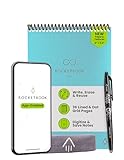
- New and Improved Flip: Features premium reusable paper, with improved pen to paper feel, spiral binding and sleekly re-designed, scratch-resistant cover. Lined and dot grid pages include Smart Titles and Smart Tags to name and organize files efficiently
- Write, Digitize, Erase, and Re-Write: Write notes efficiently with the included pen, digitize effortlessly using the Rocketbook app, and store in your preferred cloud service. When done, simply wipe the pages clean with a towel & water and start fresh
- Personalized note-taking: Designed for lefties and righties alike, this resuable steno style notepad features a top-bound spiral design. Write notes, lists or big ideas on reusable paper, lined on the front and dotted on the back for endless creativity
- Digital Organization: The Rocketbook app allows you to scan and upload your written work to cloud platforms like Google Drive, Dropbox, OneNote, etc., ensuring your notes are accessible from anywhere. Use smart titles and tags for easy organization
- High-Quality & Durable Materials: Crafted from premium reusable paper, Rocketbook Flip has a legal pad design, with top-bound spiral binding and waterproof cover. Lined and dot grid pages offer flexibility perfect for note-taking, ideation and brainstorming
- Inventory the current vault. Record the Markdown extension, link style, attachment folders, filename conventions, tags, YAML frontmatter and any embedded media. Note whether you also have Org-mode files or PDFs.
- Measure the search requirement. Pick representative note names, a distinctive sentence, a tag and an attachment filename. Confirm that Everything finds each item before migration so you have a baseline.
- Open the copy in Logseq, Zettlr and, if relevant, Joplin. For Logseq, use its existing-Markdown graph setup. For Zettlr, open the folder as a Markdown workspace. For Joplin, use its documented Markdown conversion or import path rather than pointing it at the live folder.
- Check relationships. Open notes with incoming links, outgoing links, headings, tags and any block references. Verify that the target resolves and that the original text has not been rewritten unexpectedly.
- Check attachments. Open images, PDFs and other files from notes. Confirm that relative paths still work when the pilot folder is moved to another location.
- Check metadata. Compare frontmatter, timestamps, filenames and tags before and after opening the copy. Keep a diff or backup if the application writes changes on first launch.
- Test search in both layers. Search inside the application, then search the same terms with Everything. A successful in-app result does not prove that the underlying file remains directly indexable.
- Test editing and recovery. Edit a disposable note, close the app, reopen it and inspect the raw Markdown. Create a deliberate backup and restore it to confirm that you can recover without relying on a single application.
- Test synchronization only after local fidelity passes. Use two devices or two separate copies, make non-conflicting edits, then test a conflict. For Joplin, configure encryption and synchronization according to its official help; for file-native apps, test the file-sync method you already use.
Migration notes by application
Moving to Logseq’s file-based graph
- Duplicate the vault and keep the original untouched.
- Confirm whether the notes are Markdown or Org-mode, then choose the matching graph format.
- Point Logseq’s existing-Markdown graph setup at the copied folder.
- Open a sample of ordinary notes, heavily linked notes, task pages and PDF-highlight notes.
- Inspect the raw files after Logseq has created or updated metadata. Keep any generated files inside the pilot until you know how your backup and Everything filters handle them.
- Only after the pilot passes should you consider making the original folder the active graph.
Moving to Zettlr
- Create a copy with the same directory structure as the source vault.
- Open that folder in Zettlr and let its file index complete.
- Test full-text search, file tags, project grouping, graph view and a citation workflow if those are reasons for switching.
- Open the same files outside Zettlr and confirm that Markdown remains standard-compatible.
- Set up backups or synchronization after testing edits from more than one location.
Moving to Joplin
- Export or convert a small, representative subset of Markdown notes first.
- Check notebooks, attachments, tags and links in Joplin before importing the rest.
- Choose a synchronization target documented by Joplin, such as Nextcloud, Dropbox, OneDrive or Joplin Cloud.
- Enable end-to-end encryption on one device, save the password-protected master-key credentials securely, and then add other devices.
- Keep an export of the original Markdown vault. It remains your direct Everything-indexed copy even while Joplin serves as the synchronized workspace.
Failure modes and fixes
Everything no longer finds notes
First determine whether the notes were moved into a managed database or whether Everything’s index simply has not caught up. Search for the original folder, inspect the raw files, and reindex or rescan according to your Everything configuration. If the application no longer stores one note per Markdown file, retain an exported Markdown copy or choose a file-native workflow.
Links open in the app but not elsewhere
This usually indicates an application-specific link syntax, a changed relative path or a renamed attachment folder. Compare the raw Markdown before and after migration. Keep paths relative, preserve filenames where possible, and repair a small sample before attempting a bulk conversion.
Attachments display as missing
Check whether the importer copied files, changed case, altered spaces or rewrote relative paths. Restore the original attachment directory in the pilot, then test a note after moving the entire pilot folder to a new location. A link that works only at the original absolute path is not portable.
Crashes, No Sound, or Screen Glitches?
Random freezes, missing sound and display glitches usually trace back to one bad driver. Find and replace yours safely.Free scan · under a minutePC Slower Than It Used to Be?
A free scan shows the junk files, broken settings and background clutter dragging Windows down - then fixes them in one click.Free scan · Windows 10 & 11Tags or frontmatter changed
Export a representative set and compare the metadata line by line. Do not mass-edit the production vault until you know whether tags are stored as inline text, frontmatter, application metadata or a combination. Preserve the original copy so you can roll back.
Two devices create conflicting files
Stop editing the same note on both devices, preserve every conflicting copy, and merge manually in a plain-text editor. File-native tools inherit the conflict behavior of the synchronization method; managed services such as Joplin’s documented sync have their own workflow. Test this before relying on synchronization for irreplaceable notes.
Decision guide
Choose Logseq if
- Your first requirement is a graph over Markdown files.
- You use backlinks, block references, embeds, queries or task blocks.
- You are willing to keep file-based and database workflows separate and test the one you actually need.
Choose Zettlr if
- You write long documents and want project and citation support.
- Standard-compatible Markdown and full-text search matter more than block-level queries.
- You want a file-native workflow but do not need Joplin’s managed encrypted synchronization.
Choose Joplin if
- Offline access on multiple devices is the top priority.
- You want documented synchronization and end-to-end encryption.
- You accept that the synchronized workspace is managed by Joplin rather than continuously exposed as the original Everything-indexed folder.
Choose Foam if
- You already live in VS Code and Git.
- You are comfortable configuring extensions, repositories, backups and conflict resolution.
- You prefer a technical, self-managed Markdown stack over a dedicated notes application.
Bottom line
For an Everything-indexed vault, test Logseq’s file-based graph first. It offers the most complete match for linked-note navigation while retaining Markdown files. Put Zettlr next when writing, projects and citations dominate your day. Put Joplin first only when offline availability and encrypted synchronization outweigh direct folder interoperability. Whichever path you choose, migrate a copy, verify raw files and links, and keep an exportable backup before changing the source vault.
Quick Recap
Product prices and availability are accurate as of the date/time indicated and are subject to change. Any price and availability information displayed on Amazon at the time of purchase will apply.

