
Do these 3 things before closing this tab:
1Fix the driver behind crashes, sound loss and screen glitches2Clear out junk files and repair common Windows errors3Scan for outdated or missing drivers - takes under a minuteiTechGuides is reader-supported. When you buy through links on our site, we may earn an affiliate commission. As an Amazon Associate I earn from qualifying purchases. Learn more
The Samsung HW-Q990F is the best Dolby Atmos soundbar system for most buyers in 2026 because it combines a full 11.1.4-channel layout, up-firing speakers, discrete rear satellites, a wireless subwoofer, room correction, and clear dialogue. However, it is not the right choice for every room. The JBL Bar 1000MK2 is easier to place, the TCL Q85H offers a less expensive 7.1.4 package, the Bose Smart Soundbar fits small spaces, and the Nakamichi Shockwafe Wireless is better suited to large rooms.
These are category-specific recommendations, not a claim that one soundbar performs identically in every home. Ceiling height and material, seating position, room size, furniture, speaker placement, and the quality of the Atmos source all affect the result. The selection follows the current RTINGS Dolby Atmos soundbar guide, updated August 10, 2026, alongside manufacturer specifications and the testing approaches described by What Hi-Fi? and TechRadar.
The six best Dolby Atmos soundbars at a glance
| Soundbar system | Best for | Configuration | Why buy it | Main limitation |
|---|---|---|---|---|
| Samsung HW-Q990F | Best overall | 11.1.4 | Complete home-theater package with rear speakers, four up-firing drivers, subwoofer, and room correction | Large, expensive multi-box system; the newer Q990H may be more attractive if newest features matter most |
| JBL Bar 1000MK2 | Best mid-range | 7.1.4 | Detachable, battery-powered rear speakers and a 10-inch wireless subwoofer | No 4K/120Hz passthrough and higher latency in many connection configurations |
| TCL Q85H | Best lower mid-range | 7.1.4 | Up-firing drivers in both the bar and satellites, HDMI input, and room calibration | Center and surround presentation can sound more closed-in than the JBL |
| Hisense AX5140Q | Best budget system | 5.1.4 | Four up-firing drivers, rear speakers, subwoofer, and adjustable channels at a lower tier | Bluetooth is the only wireless connectivity option listed by RTINGS |
| Bose Smart Soundbar | Best small soundbar | 3.0.2 | Compact bar under 28 inches wide with built-in Alexa and up-firing speakers | No included subwoofer or rear speakers |
| Nakamichi Shockwafe Wireless | Best for large rooms | 11.2.6 | Two subwoofers and large satellite speakers provide scale and broad bass coverage | Requires substantial space and uses manual room-dimension calibration rather than microphone correction |
Model names, regional availability, stock, promotions, and prices can change. Confirm the exact model and specifications for your country before purchasing.
Recommended Free Tools
What Dolby Atmos adds—and what it does not guarantee
Dolby Atmos is an object-based audio format. Instead of assigning every sound only to a fixed left, center, right, surround, or subwoofer channel, an Atmos soundtrack can describe sounds as objects moving through a three-dimensional space. Compatible equipment then renders those objects using the speakers available in the system.
That means a soundbar can decode Dolby Atmos without having dedicated height speakers. A basic bar may create a wider or taller virtual presentation, but a system with physical up-firing drivers and separate rear speakers has more hardware available to reproduce height and surround information. The up-firing drivers bounce sound from the ceiling, while rear speakers place effects behind and beside the seating position.
#1 Best Overall

- FULLY IMMERSIVE, CINEMATIC AUDIO THAT SURROUNDS YOU FROM ALL DIRECTIONS: Delivers sound from every angle —with 11 front and surround channels including rear speakers, 1 subwoofer channel and 4 up-firing channels —for a truly immersive experience.
- LEGENDARY 3D SOUND THAT COMES FROM AROUND AND ABOVE YOU WITHOUT MESSY CABLES: Surround yourself in legendary Dolby Atmos 3D sound —with or without an HDMI cable. Hear every distinct beat and pulse above and around you, just like in the movies.
- SAMSUNG TV AND SOUNDBAR SPEAKERS WORK TOGETHER FOR A MORE ROBUST, NUANCED SOUND: Provides a more immersive sound experience with Samsung TV and Soundbar speakers working together for more robust and nuanced sound. With compatible AI TVs, it enhances audio for even more clarity.
- SOUND CALIBRATED PERFECTLY FOR YOUR SPACE USING THE SOUNDBAR MIC: Enjoy stunning sound automatically calibrated to your room using sensors embedded into the soundbar. It analyzes your space and adjusts the audio -even optimizing bass -for clear sound and immersion.
- SMART WAYS TO CONNECT TO YOUR DEVICE: Connect your devices and control everything with our soundbar that integrates your favorite voice assistants and smart services, like Alexa built-in, Googlecast, Airplay 2 and more.
The bounce is highly dependent on the room. A reasonably flat, reflective ceiling can help; an unusually high, angled, textured, or acoustically absorbent ceiling can weaken the effect. The listener should also sit within the system’s intended listening area, with the up-firing drivers unobstructed. Manufacturer channel counts describe the hardware layout, not a guaranteed experience in every room.
Our six picks
1. Samsung HW-Q990F: best overall Dolby Atmos soundbar
Buy the Samsung HW-Q990F if you want the most complete plug-and-play home-theater package and have room for rear speakers and a separate subwoofer. RTINGS currently places it at the top of its Dolby Atmos recommendations. Its 11.1.4 layout includes discrete rear satellites, four up-firing drivers, a wireless subwoofer, and room correction. RTINGS’ testing summary also highlights strong bass and clear dialogue.
What’s actually slowing this PC down?
Pick the symptom - the matching free tool is one click away.
The important advantage is not just the channel-count number. The Q990F gives Atmos soundtracks multiple physical routes to the listener: front height effects from the bar, height and surround information from the rear units, and low-frequency effects from the subwoofer. That makes it a better fit than a single-bar solution for action films, games, and large-scale concert mixes where you want sound to extend around the seating position.
The Samsung HW-Q990F is also the strongest choice here when you want flexibility without assembling a receiver-and-speaker system. Its wireless rear speakers reduce cable routing, although each satellite still needs a suitable location and the system as a whole needs more floor or shelf space than a standalone bar.
Trade-offs: This is a large multi-box system, so measure the TV stand, wall area, rear-speaker positions, and subwoofer location before ordering. It is also worth distinguishing the Q990F from Samsung’s newer Q990H. Samsung’s 2026 Q990H specification sheet lists 11.1.4 channels, wireless up-firing rear speakers, Wireless Dolby Atmos, DTS:X, SpaceFit Sound Pro, and Q-Symphony support with compatible Samsung televisions. RTINGS nevertheless prefers the Q990F as the all-rounder because of its value; choose the Q990H if Samsung’s newer features, including Sound Elevation, matter more than the older model’s value proposition.
See RTINGS’ current Dolby Atmos soundbar recommendations and check Samsung’s regional specification sheet before comparing the F and H models. Prices and stock fluctuate substantially as newer model years arrive.
2. JBL Bar 1000MK2: best mid-range option
Choose the JBL Bar 1000MK2 when detachable rear speakers solve a layout problem. The system uses a 7.1.4 configuration, a 10-inch wireless subwoofer, room correction, and rechargeable wireless surrounds that can be removed from the main bar and placed behind the listener. The satellites are battery-powered, so you do not need to route a separate power cable to each rear position during normal use.
That design is particularly useful for renters, open living rooms, and spaces where permanent rear-speaker wiring would be inconvenient. You can dock the satellites on the bar when they are not needed and place them behind the seating area for movie night. JBL’s U.S. product page lists True Dolby Atmos, DTS:X, HDMI eARC, 4K Dolby Vision passthrough, a 10-inch subwoofer, 960W maximum output, and up to 10 hours of detachable-speaker battery life depending on content and volume.
The JBL is a convincing mid-range alternative to the Samsung because it still supplies physical height and rear channels, rather than relying only on virtual processing. RTINGS describes its Atmos capability as strong for the category.
Trade-offs: Gaming should be part of the buying decision. RTINGS reports higher audio latency across many connections and specifically notes that the Bar 1000MK2 cannot pass through 4K at 120Hz. If you have a PlayStation 5, Xbox Series X|S, or gaming PC and want 4K/120Hz video through the soundbar, connect the console directly to a suitable TV input or choose a system with passthrough that matches your complete setup. The JBL is also less fully featured than the Samsung for advanced home-theater connectivity.
Quick wins for a faster PC:
Fix the driver behind crashes, sound loss and screen glitchesFind Drivers →Clear out junk files and repair common Windows errorsFree Scan →Scan for outdated or missing drivers - takes under a minuteDriver Scan →Rank #2
- CERTIFIED REFURBISHED: This manufacturer-refurbished unit shows limited (if any) wear and has been fully tested to deliver the same reliable, like-new performance. It arrives with all essential components and is backed by a 90-day warranty for your peace of mind.
Best fit: buyers who want genuine rear Atmos effects but cannot or do not want to leave power cables permanently installed behind the sofa.
3. TCL Q85H: best lower-mid-range 7.1.4 system
The TCL Q85H is the lower-mid-range pick for shoppers who want a physically immersive package without moving up to the most expensive systems. It uses a 7.1.4 layout, with four up-firing drivers distributed between the soundbar and the wireless satellites. That arrangement supports overhead effects moving from the front of the room toward the back rather than concentrating all height hardware at the TV.
RTINGS considers the Q85H comparably capable to the more expensive JBL for Atmos content, though its center and surround presentation can sound more closed-in or muffled. It also offers fewer wireless music options. TCL’s U.S. product page lists Dolby Atmos, DTS:X, wireless surrounds, a wireless subwoofer with a 6.5-inch driver, AI Sonic room calibration, HDMI eARC, an HDMI input, AirPlay 2, and Bluetooth 5.1. The listed U.S. price was $649.99 when the research was retrieved, but that is not a current price guarantee.
The HDMI input is useful if you need to connect a source through the soundbar rather than using the TV as the only switching hub. TCL also lists VRR, ALLM, 4K HDR, and Dolby Vision passthrough on its U.S. page, but check the exact specifications and supported formats for your regional version.
Trade-offs: The Q85H is less refined out of the box than the JBL according to RTINGS’ comparison. Its sound can benefit from careful calibration and placement, and its wireless music ecosystem is more limited than some competitors.
Best fit: buyers who prioritize a real 7.1.4 speaker package, HDMI input flexibility, and a lower price tier over the JBL’s more polished presentation.
4. Hisense AX5140Q: best budget Atmos system
The Hisense AX5140Q is the budget recommendation for buyers who specifically want physical Atmos hardware rather than a basic soundbar that only decodes the format. Its 5.1.4 configuration includes four up-firing drivers, a subwoofer, and rear speakers—a substantial speaker layout for its class.
RTINGS says the AX5140Q can produce audible height effects and provides independent channel-level adjustment, EQ, and surround modes. Those controls matter because RTINGS also describes the default Atmos presentation as relatively quiet. You may need to raise the height or surround channels and adjust the EQ to suit your room and listening position.
Free tools Windows power users keep installed
One-click scans. No signup required.
Trade-offs: The soundstage is narrower than the TCL’s, the presentation is less sophisticated, and RTINGS lists Bluetooth as the system’s only wireless connectivity option. That makes it a weaker choice for people who want broad networked-music features or advanced source integration.
Do not automatically treat the visually similar Costco-exclusive Hisense AX700 as equivalent. RTINGS has not tested the AX700, so its performance should not be inferred from the AX5140Q solely from the apparent channel layout or product appearance.
Rank #3

- True 11.1.4Ch Full Surround: Fully immersive, cinematic audio that surrounds you from all directions | Wireless Dolby Atmos: Legendary 3D sound that comes from around and above you without messy cables
- Q-Symphony: Samsung TV and soundbar speakers work together for a more robust, nuanced sound | SpaceFit Sound Pro Plus: Sound calibrated perfectly for your space using the soundbar mic
- Cleans without Dripping: The non ammonia and alcohol free screen cleaning solution doesn't damage display screens | Removes Dust, Dirt, Fingerprints: 6.8oz 200ml spray liquid cleaner for TV's, monitors, tablets, phones, and glasses
- This Bundle Includes: Samsung HW-Q990F Q Series Soundbar 11.1.4 Ch Subwoofer with Rear Speaker (2025) | 1 Year Amber Protection in Addition to the Included Full 1 Year Manufacturer's Warranty. Intended for Residential Use Only. Exclusively Offered by Walt's TV | Amber Protection HDTV Screen Cleaner Kit
Best fit: cost-conscious shoppers who value four up-firing drivers, rear speakers, and a subwoofer more than premium refinement or extensive wireless features.
5. Bose Smart Soundbar: best small Dolby Atmos soundbar
The Bose Smart Soundbar is the best choice here when the entire system must fit in a small room, bedroom, apartment, or narrow TV cabinet. RTINGS identifies it as the best small Dolby Atmos soundbar it has tested. The bar is under 28 inches wide, uses a compact 3.0.2 configuration, includes built-in Alexa, and has up-firing and side-firing speakers.
It can create a passable sense of height and clear side-to-side movement without requiring a subwoofer or rear-speaker placement. That simplicity is its main benefit: there is one compact bar to position, one connection to make, and no satellite speakers competing for space behind the sofa.
Bose’s manual confirms Dolby Atmos support and recommends HDMI eARC or ARC for Atmos playback. Optical is available for standard audio, but it is not the preferred connection when Atmos is the goal. Connect the soundbar to the TV’s HDMI port labeled ARC or eARC, enable the TV’s external-speaker or bitstream output as applicable, and verify that the source app or device is sending an Atmos-compatible signal.
Trade-offs: The Bose cannot match the enveloping surround field of a larger system with dedicated satellites. It does not include a subwoofer or rear speakers, and it offers fewer upgrade possibilities than the Samsung, JBL, TCL, or Hisense packages. Its compact size is a deliberate compromise, not an indication that it delivers the same scale as an 11.1.4 system.
Best fit: listeners who want a substantial upgrade from built-in TV speakers but cannot accommodate a subwoofer and rear satellites.
Crashes, No Sound, or Screen Glitches?
Random freezes, missing sound and display glitches usually trace back to one bad driver. Find and replace yours safely.Free scan · under a minutePC Slower Than It Used to Be?
A free scan shows the junk files, broken settings and background clutter dragging Windows down - then fixes them in one click.Free scan · Windows 10 & 116. Nakamichi Shockwafe Wireless: best for large rooms
The Nakamichi Shockwafe Wireless is designed for large viewing areas and open-plan rooms where a small single bar can sound undersized. RTINGS lists an 11.2.6 configuration with two subwoofers and two large satellite speakers. Two subwoofers can distribute bass more evenly across a broad room, while the larger satellites help spread surround effects beyond a narrow central seating position.
This is the choice for scale. It makes sense when the listening area is physically large, the seating spans a wide section of the room, or an open connection to a kitchen or adjacent space makes bass and surround coverage difficult. It is not the choice for a minimalist TV stand or a compact apartment.
Trade-offs: The system requires considerably more space than the Bose, JBL, or a standalone bar. It also does not use microphone-based room correction. Instead, its setup uses manually entered room dimensions along with crossover and per-channel adjustments. That gives you control, but it makes initial setup more hands-on and places greater importance on accurate measurements and speaker positioning.
Best fit: owners of large or open-plan rooms who want maximum scale and output and are willing to spend more time on placement and calibration.
Rank #4
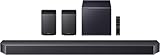
- Wireless Audio Enjoy your movies and music with Dolby Atmos audio without HDMI cable required.
- 23 speakers Enjoy the highest possible sound quality with Dolby Atmos thanks to 11 audio outputs, 1 bass amplifying subwoofer and 4 top channels for Dolby Atmos
- TV & Bar Sound...at the same time! Add a bar to your SAMSUNG TV and enjoy all speakers. Artificial intelligence will optimize the sound.
- SpaceFit Sound Pro Customize your sound using bar sensors that analyse the environment and adjust the audio content again.
How to choose the right one for your room
Start with the room, not the channel count
A 11.1.4 system is not automatically better for a small room. Extra speakers need appropriate positions, and a subwoofer needs a practical location. Conversely, a compact 3.0.2 bar may sound clean and effective in a bedroom but fail to create the envelopment expected in a large open-plan living room.
- Small room or narrow furniture: choose the Bose Smart Soundbar.
- Average room with space behind the sofa: choose the Samsung for the most complete package, the JBL for detachable surrounds, or the TCL for a lower-priced 7.1.4 alternative.
- Budget-focused room: choose the Hisense AX5140Q if up-firing height hardware and rear speakers are more important than wireless music features.
- Large or open-plan room: choose the Nakamichi Shockwafe Wireless, provided you have room for two subs and large satellites.
Check the ceiling before buying an up-firing system
Up-firing Atmos drivers work by reflecting sound from the ceiling. Before purchasing, check that the ceiling is not so high, angled, heavily textured, or acoustically absorbent that the reflection will be weak. Keep objects, shelves, and cabinet panels from blocking the drivers. Follow the manufacturer’s placement clearances rather than pushing the bar tightly into an enclosed TV cabinet.
If the TV is wall-mounted or the bar must be mounted, measure the TV’s lower edge, the soundbar’s height, and the up-firing-driver clearance. A soundbar wall mount or universal soundbar bracket may help solve a placement problem, but no particular mount is required by these recommendations; verify its weight rating and compatibility with the chosen model.
Decide whether you need rear speakers
Rear satellites create a more convincing surround field than a single bar can normally produce. They are particularly valuable for effects that move behind the listener, ambient sound in films, and games with directional audio. They also add installation complexity: the speakers need suitable positions, a power source in many systems, and enough space to avoid being blocked by furniture.
The Tool Desk
Outbyte PC Repair FREEClear out junk files and repair common Windows errorsFree Scan →Outbyte Driver Updater FREEScan for outdated or missing drivers - takes under a minuteDriver Scan →The JBL’s detachable battery-powered satellites are the most convenient when rear speakers are useful only occasionally. The Samsung, TCL, Hisense, and Nakamichi systems are better choices when you can leave dedicated rear speakers in place.
Match the connections to your TV, console, and sources
HDMI eARC is the preferred connection for Atmos from a modern TV. It can carry higher-bandwidth audio formats from compatible TV apps and connected devices. HDMI ARC may also support Atmos in some compressed formats, but the exact result depends on the TV, soundbar, source, and format. Optical is widely compatible for basic audio but should not be your first choice when Dolby Atmos is the objective; Bose specifically identifies HDMI eARC or ARC for Atmos playback on the Smart Soundbar.
For a console or gaming PC, check all three devices together:
- TV: confirm its HDMI port supports ARC or eARC and check whether it supports the required 4K, HDR, VRR, and ALLM features on the ports you plan to use.
- Soundbar: verify the number of HDMI inputs, video passthrough resolution and refresh rate, HDR formats, and audio latency.
- Source device: determine whether the console or player will connect directly to the TV or pass through the soundbar.
The JBL Bar 1000MK2 is the clearest warning in this group: RTINGS reports higher latency across many connections and no 4K/120Hz passthrough. The TCL Q85H’s U.S. page lists HDMI eARC, an HDMI input, VRR, ALLM, 4K HDR, and Dolby Vision passthrough. Those features are useful, but verify the exact regional model and do not assume that every HDMI port supports every listed format.
If your existing cable is working and your devices already negotiate the required video and audio formats, you may not need a replacement. If the chain requires a new high-bandwidth connection, an HDMI 2.1 cable or eARC HDMI cable can be appropriate; choose one that matches the required length and specifications rather than assuming a new cable fixes every compatibility problem.
Use a genuine Atmos source
The soundbar must receive an Atmos-encoded signal for Atmos decoding to occur. Look for the Dolby Atmos label in a supported streaming service, use a compatible player and disc when watching physical media, and check the TV or source-device audio output settings. A 4K Blu-ray player can be a useful source for readers who want high-quality Dolby Atmos movie sound, since 4K Blu-ray material is included in the comparative testing described by What Hi-Fi?, but the player is not necessary for everyone.
Streaming availability varies by service, title, subscription tier, device, and country. If the soundbar displays only PCM, Dolby Digital, or another non-Atmos format, troubleshoot the source and TV audio settings before concluding that the soundbar’s height speakers are ineffective.
Best Value

- ALL-IN-ONE DESIGN: Unlock audio all-around-you with this compact soundbar’s powerful 5-channel sound with Dolby Atmos; Built-in subwoofers deliver deep bass and all-in-one design makes for easy setup without sacrificing surround sound performance
- Q-SYMPHONY: Pair a Samsung TV with a Samsung Soundbar for a new level of powerful audio; Experience content like never before only with Samsung products; With Q-Symphony, your speakers work together to optimize all audio channels to operate as one¹
- WIRELESS DOLBY ATMOS: Skip the HDMI cables and enjoy truly elevated audio with Wireless Dolby Atmos; Experience captivating audio without the cable clutter²
- SMART INTEGRATION: Connect your devices and control everything with our sound bar that integrates your favorite voice assistants and smart services like built-in Alexa³, Chromecast⁴, Airplay 2⁵ and more
- SPACEFIT SOUND PRO: Get room-filling sound calibrated to your space, with a soundbar that analyzes your environment and automatically optimizes the audio accordingly for an accurate and clear sound
Setup checklist for better Atmos effects
- Place the bar centrally: align it with the TV and the main seating position. Do not hide up-firing drivers inside a cabinet.
- Keep the height path clear: remove shelves or décor that obstruct sound traveling upward.
- Position rear speakers symmetrically: place them behind or slightly to either side of the main seat according to the manufacturer’s guidance, with the drivers aimed as intended.
- Give the subwoofer options: start near the front of the room, then try another position if bass is uneven or boomy. The Nakamichi’s dual-subwoofer design is especially relevant in large rooms.
- Run room correction where available: systems such as the Samsung, JBL, and TCL use room-calibration features. The Nakamichi instead requires manually entered room dimensions and channel adjustments.
- Check the TV audio output: select the external HDMI ARC/eARC device and enable a compatible bitstream or passthrough setting where required.
- Test with known Atmos content: use a title that explicitly reports Dolby Atmos and listen for overhead movement, front-to-back transitions, dialogue clarity, and consistent bass.
- Adjust conservatively: if height effects are too quiet, raise the relevant channel level gradually. Avoid extreme settings that make the mix sound disconnected from the screen.
How these recommendations should be interpreted
RTINGS says it has tested more than 250 soundbars using multiple testing stages and teams. What Hi-Fi? says it compares Atmos soundbars with similarly priced rivals using television, streaming, and 4K Blu-ray content. TechRadar describes hands-on evaluation focused on sound quality, ease of use, wireless support, and HDMI passthrough. Those methods provide useful context, but published test results still cannot predict identical performance in every room.
For that reason, the labels in this guide describe the job each model is best suited to:
- Best overall means the most complete balance of performance, features, and configuration flexibility in the cited testing.
- Best mid-range emphasizes the JBL’s detachable rear-speaker design and strong Atmos capability without moving to the Samsung’s class.
- Best lower mid-range emphasizes the TCL’s physical 7.1.4 layout and HDMI features.
- Best budget emphasizes getting up-firing and rear-speaker hardware at a lower tier, with connectivity compromises.
- Best small means the best fit when compact dimensions matter more than maximum envelopment.
- Best for large rooms means the system is built around scale, broad bass coverage, and large satellite speakers.
Which Dolby Atmos soundbar should you buy?
Buy the Samsung HW-Q990F for the strongest all-around tested package. Choose the JBL Bar 1000MK2 when detachable rechargeable rear speakers make installation easier. Pick the TCL Q85H when you want a 7.1.4 system with HDMI input flexibility at a lower tier. Select the Hisense AX5140Q when budget is the priority but physical up-firing and rear speakers are non-negotiable. Get the Bose Smart Soundbar for a small room or narrow TV stand. Choose the Nakamichi Shockwafe Wireless when a large or open-plan room can take advantage of two subwoofers and substantial satellites.
Before purchasing, confirm the exact regional model, HDMI requirements, placement clearances, and availability. This guide reflects research retrieved August 11, 2026; prices, promotions, stock, and model-year lineups should be rechecked before publication and before monetized links are activated.
Frequently Asked Questions
Do I need ceiling speakers to hear Dolby Atmos?
No. A soundbar can decode Dolby Atmos without ceiling speakers. However, systems with physical up-firing drivers and rear satellites generally have more hardware available for height and surround effects. The quality of the reflection depends on ceiling height and material, speaker clearance, seating position, and room shape.
What’s actually slowing this PC down?
Pick the symptom - the matching free tool is one click away.
Is HDMI eARC required for Dolby Atmos?
Not always. Some systems and televisions can carry compressed Atmos over HDMI ARC, while HDMI eARC is the preferred connection for modern TVs and higher-bandwidth audio. Optical is suitable for standard audio but is not the preferred Atmos connection. Check the TV, soundbar, source, and format compatibility together.
Which soundbar is best for PS5 or Xbox Series X|S?
Check 4K/120Hz passthrough and latency before buying. The JBL Bar 1000MK2 is less suitable when you need the soundbar to pass through 4K at 120Hz because RTINGS reports that it lacks 4K/120Hz passthrough and has higher latency across many connections. Connecting the console directly to a compatible TV input may be a better arrangement.
Can a small soundbar really produce Dolby Atmos?
Yes, but the result is usually less enveloping than a multi-box system. The Bose Smart Soundbar uses a compact 3.0.2 layout with up-firing and side-firing speakers and can create a passable sense of height, but it does not include a subwoofer or rear speakers.
Are the Hisense AX5140Q and Costco AX700 equivalent?
They should not be assumed to be equivalent. RTINGS has tested the AX5140Q but not the Costco-exclusive AX700, so similar appearance or listed channel counts do not establish identical performance.
The Bottom Line
Bottom line: the Samsung HW-Q990F is the safest all-around recommendation, but the best Atmos system depends on the room and installation. Buy the JBL for detachable surrounds, TCL for lower-mid-range 7.1.4 value, Hisense for budget physical height hardware, Bose for compact spaces, and Nakamichi for large rooms.
Quick Recap
Product prices and availability are accurate as of the date/time indicated and are subject to change. Any price and availability information displayed on Amazon at the time of purchase will apply.

