
What’s actually slowing this PC down?
Pick the symptom - the matching free tool is one click away.
iTechGuides is reader-supported. When you buy through links on our site, we may earn an affiliate commission. As an Amazon Associate I earn from qualifying purchases. Learn more
Sealed, locally shielded habitats are far more practical than terraforming Mars for the first crews and early settlements. A habitat must hold air, heat, water and radiation protection around a limited living volume. Terraforming would require changing an entire planet’s atmosphere and climate. NASA analysis concludes that Mars does not contain enough accessible carbon dioxide for present-day technology to terraform it, while its surface pressure is less than 1% of Earth’s.
That does not make climate engineering meaningless as a long-term research question. It means settlement planning should begin with pressure vessels, buried or regolith-covered structures, reliable power, regenerative life support and local extraction of water and oxygen. A planet-wide atmosphere is not a prerequisite for the first human base.
What the two approaches actually mean
Terraforming Mars
Terraforming means altering Mars at planetary scale so that the surface can retain warmer conditions, a denser atmosphere and eventually environments more suitable for liquid water and human activity. The work would involve releasing or manufacturing atmospheric gases, changing heat retention, managing volatile loss and maintaining the result over geological timescales.
Do these 3 things before closing this tab:
1Scan for outdated or missing drivers - takes under a minute2Repair Windows errors before they cause bigger problems3Fix the driver behind crashes, sound loss and screen glitchesThis is not the same as warming one landing site or pressurizing a greenhouse. A local dome can be repaired or abandoned; a terraformed atmosphere would have to be created across a planet and protected from continuing atmospheric escape.
#1 Best Overall
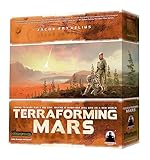
- Compete for different milestones and awards worth many VPS
- In Terraforming Mars, players control a corporation and compete to transform Mars into a habitable planet
- Will lead the way into humanitys new era?
- 120 Minutes Playing Time
Sealed and locally shielded habitats
A sealed habitat is a pressure vessel or connected set of modules that keeps an engineered atmosphere inside while Mars remains cold, dry and nearly airless outside. Structures may be metallic, inflatable with rigid restraints, excavated into the ground or covered with water and regolith. A transparent dome over an unpressurized area would not solve the problem: unless the dome is an engineered pressure vessel, the thin Martian atmosphere still cannot support people or stable surface water.
Habitats can be expanded in modules. Each addition increases floor area, storage or redundancy without requiring a change to the global atmosphere.
Why present-day terraforming is not feasible
Mars starts with too little pressure
NASA’s 2018 analysis describes the Martian atmosphere as less than 1% of Earth’s pressure and too thin and cold to support stable liquid water at the surface. Its conclusion is explicit: terraforming Mars is not possible with present-day technology.
The Tool Desk
Outbyte Driver Updater FREEFix the driver behind crashes, sound loss and screen glitchesFind Drivers →Outbyte PC Repair FREERepair Windows errors before they cause bigger problemsFix Now →Pressure matters independently of oxygen. Adding breathable oxygen to an atmosphere that is still too thin would not provide a sea-level-like environment, and an atmosphere with adequate total pressure would still need the right temperature, composition and protection from loss.
Known carbon-dioxide sources are insufficient
NASA’s atmospheric inventory estimate examined identified carbon-dioxide reservoirs, including polar deposits, minerals and soil. Processing all of them would raise pressure to only about 7% of Earth’s. That is a large increase from today’s atmosphere, but it remains far below the pressure needed for stable, widespread surface water and ordinary human habitation.
The estimate also describes a resource ceiling, not an engineering schedule. Mining, heating or chemically processing those sources would require an industrial system of planetary scale, and the resulting gas would still be vulnerable to Mars’ cold climate and atmospheric loss processes.
Rank #2

- Includes over 90 beautifully designed, multi-piece tiles and markers, making your Terraforming Mars sessions visually stunning and highly immersive for players
- Premium storage solutions keep your tiles, markers, and game components organized, reducing setup time and ensuring smooth, efficient gameplay every session
- Compatible with Terraforming Mars base game and expansions, perfect for veteran players seeking a complete, premium gaming and terraforming experience
- Enhances game nights with easy access to components, enabling players to focus on strategic moves and creative gameplay rather than setup or organization
- Ideal for collectors and strategy gamers, this Big Box is a visually impressive, practical addition to your Martian adventures, perfect for display or play
The atmosphere has already been lost before
NASA’s 2024 Curiosity reporting describes evidence that ancient Mars could support liquid water only intermittently in some periods. Solar wind and radiation removed much of the atmosphere Mars once had. Any future climate intervention would therefore have to account for continuing loss, not merely create a dense atmosphere once.
One NASA historical climate model scenario produced up to 4.5 °C of regional warming under ancient conditions. That result is useful for understanding past climate behavior, not a forecast that modern engineers can warm Mars by the same amount or make it habitable.
What a sealed habitat must provide
A Mars habitat replaces the missing planetary environment with controlled systems. The pressure boundary is only one part of the design.
- Pressure and gas control: airtight walls, valves, isolation zones, leak detection and a gas inventory that can be replenished.
- Thermal control: insulation, heaters, radiators and protection from large temperature swings.
- Air revitalization: removal of carbon dioxide, oxygen replenishment, humidity control and monitoring of trace contaminants.
- Water recovery: treatment of urine, humidity condensate and process water so that imported water is not consumed once.
- Power: continuous generation and storage for life support, heating, communications, pumps and maintenance.
- Radiation protection: shielding that reduces routine exposure and provides a protected location during solar-particle events.
- Fire and fault isolation: compartmentalization so a leak, fire or contaminated module does not endanger the entire settlement.
- Maintenance capacity: replacement parts, inspection tools and methods for repairing seals, plumbing, filters and power equipment.
Evidence that bounded life-support systems can be tested
Closed-chamber demonstrations
NASA’s Lunar-Mars Life Support Test Project placed four people in sealed chambers for 30 and 60 days. Regenerative physicochemical systems recycled wastewater into potable water and regenerated the cabin atmosphere. Wheat supplied approximately 25% of the crew’s oxygen in the cited tests. These were terrestrial demonstrations, not Mars deployments, but they show that air and water recycling can be evaluated in a finite, instrumented volume.
Surface-habitat reference concept
NASA’s surface-habitat reference concept combines metallic and inflatable elements. The initial sizing was for two crew members for up to 30 days, with consideration of four crew for up to 60 days. The concept also identifies in-situ resource utilization, or ISRU, as a route toward greater self-sufficiency. A reference concept is not a flight-ready settlement; it is an architecture for working through requirements and interfaces.
Quick wins for a faster PC:
Scan for outdated or missing drivers - takes under a minuteDriver Scan →Repair Windows errors before they cause bigger problemsFix Now →Fix the driver behind crashes, sound loss and screen glitchesFind Drivers →HERA analog
NASA’s HERA facility is a 650-square-foot closed habitat used for isolation, confinement and remote-operation studies, with missions of up to 45 days. It provides operational data about crew behavior, workload and system procedures. It does not demonstrate that a Mars habitat is ready for deployment, because it is an Earth analog with Earth-based logistics and protection.
Rank #3

- Terraforming Mars: Ares Expedition is a faster version of the original with an optional co-op mode
- For 1-4 players
- Ages 14+
- Game Time: 45-60 min
Radiation is a primary design constraint
Mars lacks Earth’s global magnetosphere and ozone protection. Galactic cosmic rays and solar-particle events can expose crews during transit and on the surface. Curiosity’s Radiation Assessment Detector measurements were used to estimate about 1 sievert for a representative Mars expedition, with roughly equal contributions from the major travel and surface phases in that calculation.
NASA human-performance guidance uses an approximate interplanetary exposure environment of 0.5 mSv per day. It also calls for planetary-surface systems supporting more than 60 days to remain below a 0.9 mSv-per-day effective-dose rate. These are design references, not a guarantee for a particular vehicle or habitat; actual dose depends on trajectory, shielding, solar conditions, time spent outside and the structure’s layout.
Practical shielding options
- Water: stores needed for drinking and life support can be placed around crew quarters, using hydrogen-rich material as shielding.
- Polyethylene and other hydrogen-rich plastics: can provide shielding while also serving structural or utility roles, although mass and fire-safety trade-offs remain.
- Bulk regolith: Martian soil can be piled over modules or used in berms, reducing the amount of shielding launched from Earth.
- Storm shelters: a compact, heavily shielded compartment gives the crew a refuge during intense solar-particle events.
Shielding adds mass, structural loads and construction work. A habitat therefore needs a site where excavation, berm building or material handling is practical, rather than simply the thinnest possible pressure shell.
Recommended Free Tools
Water ice helps a base, but does not terraform the planet
NASA identifies near-surface water ice as an attractive resource for survival and propellant generation. A site with accessible ice can support drinking-water production, oxygen and hydrogen manufacture, radiation shielding and fuel logistics. Extracting ice still requires prospecting, drilling, excavation, purification, storage and energy.
Water availability solves a local supply problem. It does not provide the missing global atmospheric inventory. Even if all accessible ice were used efficiently, it would not by itself create the pressure, temperature and long-term retention needed for a breathable planetary atmosphere.
ISRU priorities for an early settlement
- Survey candidate sites robotically for ice depth, concentration, terrain safety, sunlight and communications.
- Demonstrate extraction and purification at the chosen site before depending on local water for crew survival.
- Split water into oxygen and hydrogen when power, storage and equipment reliability support propellant production.
- Use atmospheric carbon dioxide for selected industrial feedstocks and fuel-production processes where the equipment is justified.
- Reserve imported supplies for critical spares, medicines, electronics and materials that local production cannot yet match.
Terraforming and habitats compared
| Decision factor | Terraforming Mars | Sealed, shielded habitats |
|---|---|---|
| Atmospheric mass | NASA estimates that processing identified Martian carbon-dioxide sources would reach only about 7% of Earth’s pressure. | Requires enough gas for the enclosed volume, with losses limited by repairs and resupply. |
| Energy and industrial scale | Planet-wide extraction, processing, transport and climate control would be required. | Industrial capacity can begin with one site and grow as power and equipment expand. |
| Time to first habitation | No defensible integrated schedule is established for global terraforming. | Short-duration sealed-habitat operation has been demonstrated in Earth analogs, while a Mars deployment still requires major development. |
| Reversibility | Planetary interventions would be difficult to reverse and could have effects beyond the intended area. | Modules can be isolated, repaired, relocated or abandoned without changing Mars globally. |
| Failure containment | A failure in a global climate intervention could affect the whole planet and would be difficult to correct. | Bulkheads, airlocks and storm shelters can confine leaks, fires or contamination to a section. |
| Radiation and thermal protection | A thicker atmosphere might alter thermal and radiation conditions, but the required global state is not available with current technology. | Protection is designed directly with water, polyethylene, regolith, insulation and dedicated shelters. |
| Resource dependence | Depends on enormous accessible volatile inventories and planetary-scale processing. | Depends on local ice, power, spare parts and progressively capable ISRU. |
| Biological and planetary-protection risk | Global environmental change could complicate the search for indigenous life and contaminate scientific sites. | Contained operations can preserve separation between Earth organisms, industrial areas and protected exploration zones. |
| Incremental construction | A partial atmosphere does not create a safe, self-sustaining surface for people. | Usable living space can be added module by module, with each module tested before occupation. |
How a practical settlement strategy would unfold
1. Select a site around resources and safety
Water-ice accessibility is a central criterion, but planners must also consider landing terrain, elevation, sunlight, dust, communications, thermal conditions and the ability to place shielding over living areas. A site that is rich in ice but impossible to land at or excavate may be less useful than a moderately supplied site with safer construction conditions.
Rank #4
- Jump start your Terraforming Mars sessions with Prelude, a focused expansion that gives each corporation powerful early cards, shaping your engine from the first turn and tightening the race to make Mars habitable.
- Draft and play unique Prelude cards that either accelerate terraforming milestones or boost your production engine, giving asymmetric openings and new paths to victory that reward planning and long term strategy.
- Add 5 new corporations and 7 project cards tuned to the early game, plus an additional solo challenge to reach 63 TR in time, increasing variety for repeat plays without adding complex rules overhead.
- Prelude integrates smoothly with the Terraforming Mars base game and any other expansion or variant, slotting into existing setups so dedicated players can refresh familiar maps and modules with minimal extra setup.
- Designed for 1–5 experienced or aspiring strategy gamers ages 12+, this expansion requires the Terraforming Mars base game and is ideal for groups who enjoy engine building, tableau growth, and deep replayability.
2. Build and test uncrewed infrastructure
Robotic systems would establish power, communications, weather monitoring, excavation capability and storage before people arrive. Pressure vessels, airlocks and life-support loops should be checked for leaks and performance while failures can still be repaired remotely.
3. Start with a small, heavily protected crew volume
The first occupied section should minimize exposed surface area and include a storm shelter, redundant air processing, emergency power and safe haven capacity. External work would be scheduled around radiation conditions and performed with suits, rovers and short travel routes.
4. Add local production only when it is dependable
Water extraction, oxygen production, regolith handling and construction can reduce supply demand, but each new plant adds maintenance and failure modes. Early bases should retain reserves from Earth until local equipment has operated long enough to establish dependable output.
5. Expand through separated modules
Connecting additional habitat, laboratory, greenhouse and workshop modules increases capability while preserving isolation. Pressure doors and independent environmental loops allow maintenance without depressurizing the entire settlement.
Independent reader supportYour contribution helps us test, update, and keep practical guides available for everyone.Can Mars be made breathable?
Not with the resources and technology established in the cited NASA analyses. Making an atmosphere breathable would require both adequate total pressure and an oxygen concentration that humans can tolerate, while also solving temperature, water stability, atmospheric loss and radiation problems. The identified carbon-dioxide inventory reaches only about 7% of Earth’s pressure even after complete processing, so adding oxygen would not fix the fundamental shortage of atmospheric mass.
Crashes, No Sound, or Screen Glitches?
Random freezes, missing sound and display glitches usually trace back to one bad driver. Find and replace yours safely.Free scan · under a minutePC Slower Than It Used to Be?
A free scan shows the junk files, broken settings and background clutter dragging Windows down - then fixes them in one click.Free scan · Windows 10 & 11Inside a sealed habitat, however, breathable air is an ordinary engineering target in principle. The challenge is continuous operation: carbon-dioxide removal, oxygen regeneration, leak management, fire control, contaminant monitoring and replacement of consumable or degraded components.
Best Value

- Enhance Your Terraforming Mars Experience: The Prelude 2 expansion introduces new Prelude cards and strategies, allowing players to customize their starting conditions and refine their approach to terraforming Mars.
- Expanded Strategic Options: With additional Prelude cards, this expansion provides more variety and depth, giving players new ways to start the game and adjust their strategies for a dynamic gameplay experience.
- Seamless Integration: Designed to complement the original Terraforming Mars game, Prelude 2 integrates smoothly and enhances the core game with fresh content that enriches every session.
- For 1 to 5 Players: Perfect for solo play or group sessions, Prelude 2 accommodates up to five players, making it a versatile addition that enhances the game for any number of participants.
- Ideal for Ages 12+: Suitable for players aged 12 and up, this expansion adds complexity and excitement to your Terraforming Mars games, offering a rewarding challenge for both new and seasoned players.
What could make habitats fail?
- Slow leaks: pressure loss may be hard to locate and can consume stored gas before repairs are ready.
- Power interruption: loss of heating or air processing can become life-threatening quickly, especially during a cold or dusty period.
- Radiation underestimation: inadequate shielding or an undersized storm shelter can expose crews beyond design limits.
- Dust contamination: abrasive, electrostatic dust can damage seals, filters, suits and machinery when brought through airlocks.
- Single-point failures: one pump, valve, processor or software controller should not be able to disable the entire life-support chain.
- Resource uncertainty: ice that is deeper, less pure or less continuous than surveys predicted can undermine water and fuel plans.
- Maintenance backlog: a system that works on arrival can still fail later if filters, catalysts, bearings or electronics cannot be replaced.
These risks favor compartmentalized habitats with spare capacity, local inventories and procedures practiced before an emergency. They also explain why a simple inflatable dome is not an adequate settlement plan by itself.
Which path is more practical at different horizons?
First crew and first outpost
Sealed habitats clearly win. Their requirements are severe but bounded: protect a small volume, recycle resources, generate power and use nearby ice and regolith. A failure can be isolated, and construction can proceed in stages.
Growing settlement
Habitats remain the practical architecture, with more underground or regolith-covered space, larger power systems, workshops and increasingly capable ISRU. Local production can reduce imports without requiring Mars to become globally habitable.
Distant planetary climate engineering
Terraforming can be discussed as speculative research, but no authoritative integrated schedule, total cost or probability of eventual success is established. The known carbon-dioxide inventory and Mars’ atmospheric-loss history make it an open scientific question rather than a settlement program.
Bottom line for planners
Build the environment people need instead of waiting for Mars to become that environment. The near-term sequence is robotic site surveys, water and oxygen ISRU, power and communications, protected pressure vessels, regenerative life support, radiation shelters and incremental civil engineering. Terraforming may remain a subject for atmospheric and planetary research, but it cannot substitute for a sealed habitat in the first generations of human activity on Mars.
Quick Recap
Product prices and availability are accurate as of the date/time indicated and are subject to change. Any price and availability information displayed on Amazon at the time of purchase will apply.

