
The Tool Desk
Outbyte PC Repair FREEClear out junk files and repair common Windows errorsFree Scan →Outbyte Driver Updater FREEScan for outdated or missing drivers - takes under a minuteDriver Scan →iTechGuides is reader-supported. When you buy through links on our site, we may earn an affiliate commission. As an Amazon Associate I earn from qualifying purchases. Learn more
Good tech-conference networking is a short, relevant introduction followed by genuine curiosity: say who you are, what you work on or care about, and why you attended, then ask a question that gives the other person room to talk. Exchange contact details only in a way that suits both of you, record the context while it is fresh, and follow up with a specific reference rather than a generic pitch.
You do not need to meet everyone or collect the most cards. A useful conference might produce one helpful peer conversation, a collaborator, a better understanding of a technical problem, or a scheduled follow-up. The etiquette below helps first-time attendees and people who dislike forced networking pursue those outcomes without acting aggressively.
Decide what a useful conference would mean for you
Networking is easier when “success” has a narrow definition. Before you arrive, choose one or two outcomes that fit your role and the event. You might want to learn how other teams handle a technology, meet peers in a similar career stage, find a potential collaborator, or arrange a later conversation with someone who has relevant experience. HIMSS’s February 19, 2025 professional-development guidance recommends targeting networking effort to career goals and preparing a clear value proposition for introductions.
Do these 3 things before closing this tab:
1Scan for outdated or missing drivers - takes under a minute2Clear out junk files and repair common Windows errors3Fix the driver behind crashes, sound loss and screen glitchesA value proposition does not have to be a sales claim. It can be a concise explanation of the perspective, project, or question you bring. For example: “I help a small operations team automate reporting, and I’m here to learn how other companies govern their data pipelines.” That tells a listener what you care about and gives them a natural way to respond.
#1 Best Overall
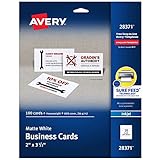
- Quality Cardstock: Crafted from white cardstock paper for printer, these custom business cards offer professional quality, making your business cards easily customizable and personal
- Sure Feed Technology: Get a reliable output for your blank business cards, Sure Feed Technology technology that reduces tmisalignments and jams so every detail is correctly printed on your custom cards
- Smooth, Clean Edges: With multiple precise cuts, these white cardstock business cards provide clean, smooth edges for easy separation, so your custom business cards maintain a professional appearance
- Customization: Use Avery business cards templates to design and print business cards that can be customized at home using card paper with an inkjet printer
- Crisp, Smudge-Free Printing: Compatible with inkjet printers, the white cardstock paper delivers crisp, smudge-free prints for business cards, allowing you to customize your designs on both sides
Research the event without overplanning it
Read the agenda and mark sessions, workshops, or roundtables that genuinely relate to your goals. Prepare two or three questions you could ask a speaker or another attendee. Cvent’s August 23, 2024 conference guide recommends pre-event research on presenters and attendees, while Esri’s conference advice emphasizes preparing questions and leaving a mix of sessions and downtime.
- Write down the names of presenters whose work you want to understand better.
- Choose questions that can be answered from experience, such as “What changed after you deployed that system?” rather than questions answered by a product page.
- Leave uncommitted time for hallway conversations, coffee lines, meals, and informal discussion after a session.
If a particular meeting matters, arrange it in advance. Stripe Atlas’s guidance for founders describes conference meetings as expected and says planning them beforehand is normal. A short calendar invitation with a proposed location and a clear reason is more considerate than trying to find someone at the last minute.
Use low-pressure opportunities
Approaching a stranger can feel less awkward when the setting supplies a reason to speak. Someone standing alone before a session, waiting for coffee, or looking at the same schedule is often open to a brief exchange. You can also ask an acquaintance to introduce you. Esri and Stripe Atlas both describe introductions through existing contacts as a way to lower the barrier to entry.
If a group is already talking, listen briefly at the edge. Join when there is a natural pause and connect your comment to the topic rather than interrupting with a self-promotion. If the group’s subject is not relevant to you, move on politely; not every opening is the right one.
How do I introduce myself at a tech conference?
Use a four-part structure: your name, your role or area of work, your reason for attending, and a question for the other person. Keep it conversational. HIMSS recommends explaining the value or perspective you bring instead of reciting only a job title.
Rank #2

- PERSONALIZED BUSINESS CARDS – Customize your business cards with your company logo and text. Perfect for business professionals, salespeople, small businesses, and more.
- EASILY CREATE YOUR OWN – Upload your logo, add custom text, and select a background color. Include important details such as your name, company name, title, address, phone number, or website.
- MULTIPLE QUANTITIES – Available in quantities ranging from 50 to 10,000 business cards. Choose the perfect amount to suit your needs.
- STANDARD SIZE – Each business card measures the standard 2" x 3.5".
- 16PT CARDSTOCK – Crafted from premium 16PT cardstock for a sturdy, professional finish that makes a lasting impact.
- Name: “Hi, I’m Priya.”
- Role or focus: “I work on reliability for a healthcare software team.”
- Reason for attending: “I’m here to compare approaches to incident response.”
- Question: “What brought you to this session?”
The entire opening can take 15 to 30 seconds. The question is important because it turns an announcement into a conversation. Adapt the wording to the setting instead of memorizing a speech.
Examples for common settings
- Before a session: “I’m Mateo, a product designer working on developer tools. I came to hear how teams are testing AI-assisted workflows. Have you attended this speaker’s sessions before?”
- After a talk: “I’m Lena; I manage cloud migrations for a nonprofit. The discussion about rollback plans was useful to me. Which part of the talk connected with your work?”
- In a coffee line: “I’m Jordan, a data engineer. I’m trying to learn more about governance practices at smaller companies. What are you hoping to get from the conference?”
- When you have a relevant project: “I’m building an internal tool for tracing service dependencies. Would it be useful to compare notes on how your team handles that?”
These are starting points, not scripts you must deliver word for word. A natural response and attentive listening matter more than polished phrasing.
PC Slower Than It Used to Be?
A free scan shows the junk files, broken settings and background clutter dragging Windows down - then fixes them in one click.Free scan · Windows 10 & 11Outdated Drivers Are Slowing You Down
One free scan finds every outdated or missing driver and matches the right update for your exact hardware.Free scan · exact hardware matchWhat do I say when networking at a conference?
Ask questions that fit what the person just said, then listen long enough to understand the answer. HIMSS suggests asking what someone hopes to accomplish at the conference, what they thought of a keynote, or what they do. Esri recommends questions about a recent project or a session the person liked.
Questions that invite a useful answer
- “What problem are you working on this quarter?”
- “What made you choose that approach?”
- “What did you learn from the last project?”
- “Which session has been most relevant to your work so far?”
- “Is there a technical trade-off you are still evaluating?”
Use follow-up questions to show that you heard the answer: “You mentioned migration risk; where did the biggest surprise occur?” Avoid turning the exchange into an interrogation. Offer a small, relevant detail about your own experience, then return the focus to the other person.
Keep the first conversation about connection, not extraction
The first meeting is generally a poor time to ask for a job or demand a referral. HIMSS specifically cautions against treating an introduction as a job request. At a vendor booth, staff are there to sell; if a solution is relevant, ask your product questions and learn who the appropriate contact is for a later discussion rather than raising employment questions there.
Rank #3

- FULLY CUSTOMIZABLE DESIGN: Click 'Customize Now' to choose from available templates or upload your own design, adding logos, text, QR codes, photos, and more to create a truly personalized business card.
- PREMIUM WATERPROOF MATERIAL: Crafted from high-quality 300 GSM copper-coated waterproof paper with a matte finish, each card measures 3.54 x 2.12 inches with neat, precise cuts that resist tearing.
- VIBRANT COLOR PRINTING: Advanced machine printing technology delivers sharp, clear patterns with fade-resistant ink, ensuring your design looks professional and polished every time.
- FLEXIBLE QUANTITY OPTIONS: Available in sets of 100, 200, 500, or 1000 cards; select quantities of 200, 500, or 1000 include a slim card case that holds 10–20 cards for easy portability.
- VERSATILE PROFESSIONAL USE: Ideal for offices, entrepreneurs, clubs, salons, tattoo artists, mechanics, and more; doubles as a thank-you card, gift card, coupon, or promotional card for any industry.
A founder or attendee can discuss a project or product when it directly relates to the conversation. Stripe Atlas notes that bringing a business card or laptop demo can deepen a relevant discussion. Offer context and invite interest: “I have a two-minute demo if that would help illustrate the issue.” Do not open a laptop and launch into an unsolicited presentation while the other person is trying to leave or attend a session.
Free tools Windows power users keep installed
One-click scans. No signup required.
Should I bring business cards to a tech conference?
Business cards are useful but optional. HIMSS, Stripe Atlas, and Esri all describe paper cards as a practical contact-sharing tool, while HIMSS also discusses sharing a LinkedIn QR code. Cvent notes that digital cards and event apps can support QR-based exchange. The right choice depends on the event’s setup and the other person’s preference.
| Contact method | Convenience | Preference and event setup | What makes it useful afterward |
|---|---|---|---|
| Paper business card | Immediately handable and usable without opening an app | Works when both people are comfortable exchanging cards; bring enough for relevant conversations | Write the person’s topic or promised action on the card or in your notes |
| Event app, digital card, or QR link | Can avoid carrying cards and manual entry when the event supports scanning | Use the conference’s tools when available and ask whether the other person prefers a digital exchange | Save the contact with the event and conversation detail, not just a profile link |
Offer your card after a relevant exchange, or ask, “What is the easiest way for us to stay in touch?” Do not press a card into someone’s hand or assume that accepting one is permission for marketing messages. Contact exchange is an invitation to continue a specific connection, not a subscription to repeated pitches.
Make contact details easy to use
Use a current email address, professional profile, or phone number that you actually monitor. If you use a QR code, check that it opens the intended profile and that privacy settings do not block the other person. If you receive a paper card, add a short note immediately: “observability panel,” “introduced by Sam,” or “send migration checklist.” Harvard Business Review’s February 4, 2016 advice describes scanning paper cards into smartphone contacts as one possible workflow; it is a workflow choice, not a requirement to use a particular app.
How to join a conversation without interrupting
Start with the context that is already available. At the end of a session, ask someone nearby what they thought of a specific point. In a small group, wait for a pause and say, “I heard you mention access controls; I’m working on a similar problem. May I ask how you approached it?” If the answer is no, or the group turns back to a private discussion, smile, thank them, and step away.
Rank #4

- Printable cardstock lets you design and print your own personalized business cards
- Our most premium business cards feature Clean Edge(R) technology so that cards snap apart easily and leave behind the smoothest cleanest edges of any printable business card available
- Optimized for inkjet printers for jam & smudge-free performance guaranteed. Add crisp text and vibrant images to both sides of the professional business cards.
- Personalize your white business card with your own design or choose from thousands of free templates and designs on the Avery site
- Ideal for professional-quality printable business cards gift cards gift tags coupons or customer loyalty cards; use the back for photos maps and notes
Someone who is alone is not automatically asking to be approached, so begin with a light, situational question and watch their response. Open body language, a reciprocal question, and an unhurried tone suggest interest. Short answers, frequent glances at a phone, or turning toward an exit suggest that you should let the interaction end.
How to end a conference conversation gracefully
Respect the other person’s time, especially near a session start or meal break. When the exchange reaches a natural stopping point, thank them and name a next step only if one is genuinely useful. Cvent recommends having an exit strategy, and HIMSS suggests following up later to schedule time when a deeper discussion is warranted.
Adaptable closing language includes:
- “I’ve enjoyed hearing about your deployment process. I’m going to catch the next session, but may I send you the checklist we discussed?”
- “You mentioned evaluating two monitoring approaches. Would a 20-minute call next week help us compare notes?”
- “I’m going to let you get to your meeting. What is the best way to send the article I mentioned?”
Do not promise a resource you cannot provide. If there is no clear reason to continue, a sincere “Thanks for the conversation; enjoy the rest of the conference” is a complete and courteous close.
Independent reader supportYour contribution helps us test, update, and keep practical guides available for everyone.How soon should I follow up after meeting someone at a conference?
Follow up while the conversation is still recognizable, but do not treat one deadline as a universal rule. HIMSS advises following up to schedule time after the conference. An EDUCAUSE Review practitioner’s September 2019 article recommends selecting a manageable group and attempting follow-up within 30 days; that 30-day suggestion is personal guidance, not a formal industry standard.
Use a selective, personal workflow
- Sort your contacts. Choose the people with whom you had a meaningful exchange or a clear next step. The EDUCAUSE contributor describes selecting three to five people as a manageable tactic; it is not a quota.
- Recover the context. Before sending anything, read your notes and identify the event, location, topic, and one detail the person shared.
- Complete the promised action. Attach the resource, introduction, answer, or link you offered. If you need more time, say when you expect to have it.
- Suggest a proportionate next step. Propose a short call, a relevant online discussion, or simply staying connected. Give the recipient an easy way to decline.
- Stop when there is no response. Stripe Atlas cautions against over-persistent online contact. One respectful reminder may be reasonable for a specific promised action; repeated pitches are not.
Sample follow-up message
Subject: Good discussion about service ownership at TechConf
Best Value

- Elevate Your Professional Image with Precision - Make a lasting impression in every business encounter with our Business Card Set. This comprehensive package includes 500 blank business cards in the standard 3.5x2-inch size and 50 printable perforated cards on 8.5x11-inch sheets. Each card, crafted from premium 250gsm cardstock, is a canvas for your professional identity.
- Versatility for Every Business Need - Meet the diverse demands of your business with our all-in-one solution. The set is perfect for quick, on-the-go exchanges, and printable perforated cards for a personalized touch. Whether you're a small business owner or a seasoned professional, this set caters to all your networking and promotional needs.
- Effortless Customization with Printable Perforated Cards - Unleash your creativity with the printable business cards included in this set. The perforated design ensures easy separation, allowing you to effortlessly showcase your brand, logo, and contact details. Ideal for business owners who value both convenience and customization.
- Premium Quality for a Professional Edge - Crafted from durable 250gsm cardstock, our Business Card Set guarantees a professional touch. The substantial weight of each card exudes quality and is compatible with both home and professional printers. Ensure your business cards leave a lasting impact with this premium paper.
- Complete Business Card Solution - Simplify your business card needs with our versatile and convenient Business Card Set. With 500 blank cards and 50 printable perforated cards, this set is perfect for entrepreneurs and professionals seeking a comprehensive solution. Elevate your networking and professional image with this premium business card collection, designed for success.
“Hi Noor, it was good meeting you after the reliability session on Tuesday. You mentioned that your team is defining ownership for shared services. Here is the incident-review template I said I would send. If comparing your approach would be useful, I’m available for a 20-minute call next week; no problem if your schedule is full.”
This message works because it identifies where you met, recalls a real detail, delivers the promised item, and makes a modest request. Replace every bracketed or generic phrase with the actual context; do not send the same note to everyone whose card you collected.
Common awkward moments and what to do
You forget someone’s name
Ask again plainly: “I’m sorry, I missed your name.” Repeat it once when you say goodbye and add a note immediately. Pretending to remember usually creates more discomfort than a brief correction.
Recommended Free Tools
You have nothing useful to offer
Curiosity is enough. Ask about the person’s session, project, or conference goal and listen. A useful exchange can be learning what another team tried, not presenting a resource or making an introduction.
The conversation becomes a sales pitch
Ask one clarifying question, state whether the issue is relevant to you, and set a boundary: “I’m not evaluating tools right now, but I’d be interested in your documentation on the deployment model.” If you are interested, ask who to contact after the event rather than agreeing to an open-ended sequence of messages.
You realize the connection is not a fit
End courteously without inventing enthusiasm: “Thanks for explaining your work. I’m going to look for the next session.” You are not obliged to exchange details with every person you meet.
You receive many cards and cannot remember them
Do not send generic messages to all of them. Sort the cards by the conversation notes, select the few relationships worth continuing, and discard or archive the rest according to your normal privacy practices.
Quick wins for a faster PC:
Repair Windows errors before they cause bigger problemsFix Now →Fix the driver behind crashes, sound loss and screen glitchesFind Drivers →Clear out junk files and repair common Windows errorsFree Scan →Quick Recap
A simple etiquette checklist
Before leaving for the event
- Define one or two outcomes that would make the conference worthwhile.
- Review the agenda and prepare two or three relevant questions.
- Arrange important meetings in advance.
- Choose whether to carry paper cards, use the event app, or offer a QR-based profile.
- Prepare a natural 15-to-30-second introduction.
During the event
- Approach people in realistic moments such as coffee lines, session transitions, and open groups.
- Ask a relevant question and listen to the answer.
- Share a project or demo only when the conversation makes it relevant.
- Ask how the other person prefers to exchange contact details.
- Record a name, topic, and promised action before moving on.
- Leave conversations before they become rushed or one-sided.
After the event
- Select meaningful contacts rather than messaging everyone.
- Send a concise, specific note that identifies the event and recalls a real detail.
- Deliver anything you promised.
- Suggest a realistic next step, or simply thank the person and stay connected.
- Do not convert a quiet inbox into repeated unsolicited pitches.
Product prices and availability are accurate as of the date/time indicated and are subject to change. Any price and availability information displayed on Amazon at the time of purchase will apply.

