
What’s actually slowing this PC down?
Pick the symptom - the matching free tool is one click away.
iTechGuides is reader-supported. When you buy through links on our site, we may earn an affiliate commission. As an Amazon Associate I earn from qualifying purchases. Learn more
Taskmaster is a cumulative-judging game. Players complete an agreed number of tasks, a Taskmaster decides each result, and the player with the highest total wins. A descending rank system is a useful default—four points for first place, three for second, and so on in a four-player example—but it is not an unbreakable television rule. The written task can add bonuses, penalties, team conditions, live-task rules or disqualification clauses, and the Taskmaster’s ruling is final.
What is the objective of Taskmaster?
The objective is to score more points than your opponents across an agreed number of tasks. Scores accumulate from task to task rather than resetting each round, so a contestant who performs consistently can beat someone who wins one spectacular challenge but places poorly elsewhere.


Before starting, the group should agree how many tasks will be played and how the winner will be determined. The official home-game rules also provide a trophy for the winner and prizes when a prize task is included. A “final” task can serve as the last scoring opportunity, but it is still the cumulative total that decides the champion.
How Taskmaster scoring works
The practical default: descending rank points
For a simple home game, award points in descending order of finish. The official rules give a four-player example: first place receives four points, second receives three, third receives two and fourth receives one. This approach is easy to record and rewards every placing.
#1 Best Overall
| Result in a four-player task | Example points |
|---|---|
| First | 4 |
| Second | 3 |
| Third | 2 |
| Fourth | 1 |
This is a convention, not a universal 5–1 television schedule. The number of competitors, the wording of the task and the Taskmaster’s decision can all change the allocation.
The Taskmaster may award points arbitrarily
The rules expressly give the Taskmaster the right to be arbitrary and to dish out points as they see fit. That discretion is part of the format’s comedy and unpredictability. A Taskmaster could reward an ingenious interpretation, give equal points, impose a penalty or ignore a conventional ranking when the task calls for it.
For a friendly home game, decide in advance how much discretion you want. A strict group can use rank points unless the card specifies an exception. A more theatrical group can allow subjective awards, provided everyone accepts that the Taskmaster’s word is final.
Points are controlled by the task text
Read the complete task before anyone begins. A card may state an exact bonus, penalty, time limit, team condition or disqualification trigger. If the wording awards five points to the sole successful player in a live challenge, that instruction takes precedence over a normal rank schedule. Do not assume every task uses the same number of points.
Who is the Taskmaster and what authority do they have?
In the official home-game rules, players rotate the judging role. The tallest player serves as Taskmaster for the first location task, then the role passes to the player on their left. The rules recommend giving everyone an equal number of turns where possible.
Rank #2
The Taskmaster does not compete or score points in the location task they are judging. They read the instructions, observe performance, resolve ambiguities and award points. Their decision stands even when another player believes a different interpretation would be fairer.
- Read immediately and clearly: the task instructions must be read aloud in full before the task starts.
- Keep tasks secret: competitors must not discuss the tasks with fellow competitors.
- Stay lawful: the rules prohibit breaking the law. Do not design or perform a challenge that requires trespass, theft, dangerous driving or other illegal conduct.
- Accept the ruling: “The Taskmaster’s word is final” is the central dispute-resolution rule.
For safety, a home Taskmaster should also stop any activity that risks injury or property damage. A funny task is not worth an accident, and a card’s wording does not override ordinary safety responsibilities.
Recommended Free Tools
Which kinds of tasks can appear?
Prize tasks
Players bring or create an item that fits the stated theme. The Taskmaster ranks the entries and the winner may receive the prize item, depending on how your game is arranged. Because the value and appeal of prizes can differ, state the theme and any spending limit before the round.
Location tasks
The official setup includes tasks in places such as the kitchen, living room, laboratory or garden. These are usually practical challenges involving objects, timing, construction or observation. The player serving as Taskmaster judges the task rather than competing in that location round.
Secret tasks
A secret task is designed to be discovered or completed without other competitors knowing the instruction. The official rules include a covert secret task. Keep the envelope, card or hiding place secure until the intended player can read it, and do not reveal the task through conversation.
Live tasks
Live tasks are performed in front of the Taskmaster and other players, often with instructions that change the scoring immediately. The task text might award a fixed bonus to the only successful player while penalizing everyone else. Read every condition aloud and have the Taskmaster track the order of actions in real time.
Team tasks
Televised tasks can be individual or team-based. Decide how teams are formed and whether every member receives the same score before starting. If the card specifies a team bonus or penalty, apply it exactly as written; otherwise, the Taskmaster should announce how a team result will be converted into individual totals.
Final video tasks
The official rules describe a final video task, and the boxed game includes video tasks from Alex Horne. A video task can be recorded and shown to the Taskmaster later, but the judging standard remains the same: the written instruction controls what counts as success.
How to run a Taskmaster game at home
- Choose the format. Decide whether you are using the official boxed game, homemade tasks or a mixture. Set the number of tasks, the number of Taskmaster turns and whether you will include a prize or final task.
- Set the player count. The official board game is designed for three to five players. With a larger group, use teams or run parallel heats and explain how scores will transfer.
- Assign the first Taskmaster. Under the official rotation, the tallest player judges the first location task, then the role moves left. Write the rotation down so no turn is missed.
- Prepare materials and boundaries. Gather the props, timer, paper, pens and any recording equipment. Check that the planned activity is legal and safe, and define rooms or outdoor areas that are off-limits.
- Read the task exactly. The Taskmaster reads the entire instruction clearly and immediately. Do not paraphrase away a condition, and do not allow competitors to confer about the task.
- Run the challenge. Enforce time limits, order of play, team assignments and any secret or live conditions stated on the card. The Taskmaster should note evidence needed for later judging, such as a finish time or completed object.
- Judge and explain the result. Award the points required by the task. If the task leaves room for judgment, give a short reason so players understand the decision, while remembering that the ruling is final.
- Record cumulative scores. Add each award to the running total immediately. A simple scoreboard with one column per task prevents arithmetic errors and makes the final standings clear.
- Rotate the role. Move the Taskmaster position to the next player for the next location task, aiming for equal turns.
- Declare the winner. After the agreed number of tasks, total the scoreboard. The highest cumulative score wins the trophy or agreed prize. If totals tie, use a tie-break task whose scoring is announced before it begins.
Television format, boxed game and homemade play
All three versions use the same core idea—unusual tasks judged by a Taskmaster—but they differ in control, equipment and consistency.
| Feature | Television format | Official boxed game | Homemade version |
|---|---|---|---|
| Who judges | A designated Taskmaster | Players rotate the role; the tallest player starts | Any agreed host or rotating player |
| Scoring | Task-specific awards, bonuses, penalties and disqualifications | Descending ranking is suggested, with arbitrary discretion allowed | Choose rank points, fixed awards or discretionary judging |
| Task styles | Individual, team, prize, live, secret and final challenges | Prize, location, secret and final tasks, including video tasks | Whatever the group writes, provided conditions are clear |
| Equipment | Production spaces and recording resources | Board, scoreboard pieces, wipe-clean pen, trophy and task cards | Household props, paper and a timer |
| Player count | Varies by episode | Three to five players | Set by the host; teams can support larger groups |
The boxed game is useful when you want prepared wording and a physical scoring system. Homemade play gives you more freedom but requires the host to write unambiguous instructions and anticipate loopholes.
Rank #4
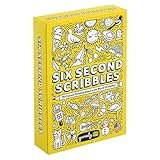
- CAN YOU DOODLE 10 MASTERPIECES IN A MINUTE? Six Second Scribbles challenges you to draw 10 things from a given category in 60 seconds. It’s as tricky as it sounds and leads to some brilliant, hilarious and often questionable art!
- 1000+ ITEMS TO DRAW ACROSS 100+ CATEGORIES! We’ve crammed a lot of content into a small box with categories ranging from nice and easy (food, animals, body parts) to almost impossible (tourist attractions, animated films, cheeses!)
- DRAW, DECIPHER, SCORE! All players draw their items at the same time, and when the minute is up you pass your scribbles to another player. They have to figure out what you’ve drawn and if they guess correctly, you both score points!
- THE ART OF SIMPLICITY! Six Second Scribbles is all about finding the perfect balance between quality and quantity. It’s amazing how fast a minute vanishes and how much can be conveyed with a rapid scrawl of a pencil… or how little!
- TEENY TINY PAPER! Six Second Scribbles comes in a small box, the size of four packs of cards, which contains small pencils and paper too. We love making small games. They are just as good for taking on the go as playing at home, and they use less of the world's natural resources!
What comes with the official board game?
The current product description lists a game board, rules sheet, scoreboard playing pieces, a wipe-clean pen, a Taskmaster trophy and 200 task cards. The cards include video tasks from Alex Horne, so the set can support challenges beyond a single room or table.
An official Board Game Expansion Pack is also listed with 40 new task cards, final video tasks, prize-selector cards and paper refills. Check the edition and regional availability when buying, because product contents and stock can change.
Independent reader supportYour contribution helps us test, update, and keep practical guides available for everyone.Common scoring disputes and how to prevent them
Assuming first place always receives five points
There is no single mandatory television table that makes five points the universal first-place award. Use the points printed or stated for that task. If no allocation is given, announce your chosen rank system before judging starts.
Ignoring a penalty or disqualification clause
A competitor may appear to finish first but still lose points or be disqualified for breaking a stated condition. Read the full instruction aloud, including text that appears after the main objective, and keep the card available during judging.
Quick wins for a faster PC:
Repair Windows errors before they cause bigger problemsFix Now →Scan for outdated or missing drivers - takes under a minuteDriver Scan →Clear out junk files and repair common Windows errorsFree Scan →Letting competitors negotiate after the result
Discussion can be entertaining before a ruling, but endless appeals undermine the rotation system. Give the Taskmaster authority, record the decision and move to the next task. If your group dislikes a particular ruling, change the house rule before the next game rather than rewriting a completed score.
Best Value
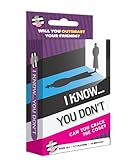
- Crack the Code in a Unique Deduction Card Game: "I Know... You Don’t" challenges players to unravel a secret rule based on clues provided by each card played. It's a deduction card game where observation, logic, and pattern recognition turn every round into a thrilling code breaking game, perfect for those who love a mental challenge.
- Engaging and Interactive for Groups: Designed for 3 to 7 players ages 10 and up, this family card game is ideal for game night, a party, or classroom brain-training activities. The interactive format and rotating gameplay make it a great thinking and icebreaker game for teens, adults, and families alike.
- Strategic Play with Three Ways to Win: Players choose between playing a card, playing multiple cards, or trading in their hand, with each decision being a critical piece of the puzzle. This strategy card game tests your ability to identify hidden patterns while outsmarting your friends.
- Five Levels of Difficulty for All Skill Levels: With secret rules ranging from simple to advanced, this puzzle card game is built for replayability and scalability. Whether you're introducing younger players or challenging seasoned code-breakers, this cognitive game adapts to the moment for consistent, engaging fun.
- Perfect for Travel, Parties, and Quick Play: Compact and fast-paced, "I Know... You Don’t" is a 10 minute game that’s perfect as a travel game, party game, or just a fun brain game for any occasion. Whether you're at a gathering or on the go, it's one of the best hidden information games for keeping minds sharp and players entertained.
Unequal judging turns
A player who judges every location task also misses chances to score. Use the leftward rotation and a written schedule, and count turns at the end of each round.
Vague homemade instructions
Specify what must be done, where it must happen, the time limit, what materials may be used, how success will be measured and what happens if a condition is broken. Ambiguity is acceptable only when the group intentionally wants the Taskmaster to exercise broad discretion.
An illustrative cumulative scorecard
The following example uses the official four-player descending convention for three ordinary tasks. It is an illustration, not a mandatory television allocation.
Crashes, No Sound, or Screen Glitches?
Random freezes, missing sound and display glitches usually trace back to one bad driver. Find and replace yours safely.Free scan · under a minuteWindows Errors? Fix Them Before They Spread
Repair common Windows errors and clear accumulated junk for a smoother, more stable PC - no reinstall needed.Free scan · no reinstall| Player | Task 1 | Task 2 | Task 3 | Total |
|---|---|---|---|---|
| Alex | 4 | 2 | 3 | 9 |
| Blair | 3 | 4 | 1 | 8 |
| Casey | 2 | 1 | 4 | 7 |
| Drew | 1 | 3 | 2 | 6 |
Alex wins this example through consistent placements rather than by winning the most individual tasks. If Task 2 had included a written five-point bonus for a sole successful player, add that bonus exactly as the card directs and then continue with the cumulative totals.
Bottom line for players and hosts
Use cumulative scoring, read every task verbatim, and treat the Taskmaster’s decision as final. Descending rank points make an excellent starting system, but the task text can override them with bonuses, penalties, teams, live conditions or disqualification. Rotate the judging role, keep tasks secret, stay within the law and agree your house rules before the first card is opened.
Quick Recap
Product prices and availability are accurate as of the date/time indicated and are subject to change. Any price and availability information displayed on Amazon at the time of purchase will apply.

