
The Tool Desk
Outbyte PC Repair FREERepair Windows errors before they cause bigger problemsFix Now →Outbyte Driver Updater FREEScan for outdated or missing drivers - takes under a minuteDriver Scan →iTechGuides is reader-supported. When you buy through links on our site, we may earn an affiliate commission. As an Amazon Associate I earn from qualifying purchases. Learn more
A PC that seems to reboot after morning startup may have restarted after a crash or power loss, resumed from sleep or hibernation, or received an intentional restart request. The timing alone does not identify the cause. First establish what state the computer was in, then compare the time of the restart with Windows event records.
First, identify what happened overnight
Before changing settings or replacing hardware, pin down the sequence. A restart after a full shutdown is different from a device waking unexpectedly, and either can look like a reboot if you only see the sign-in screen.
- Was the computer shut down, asleep, or hibernating overnight?
- Did you see a blue or black screen with a stop code, or did Windows return directly to the sign-in screen?
- Were open applications or unsaved work lost?
- Did the restart happen before sign-in, or after you logged in?
- What Windows version and computer model are involved?
Write down the approximate time and any recent changes, such as a Windows update, driver update, new hardware, or newly installed service. These details help you compare the event log with what you observed.
Check Windows events around the restart
Open Event Viewer and inspect the Windows System log around the time the computer appeared to restart. Look at each event’s source, timestamp, and details; an event ID by itself can be misleading because the same number can be used by different sources.
#1 Best Overall
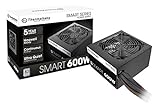
- Delivers 600W Continuous output at plus 40℃. Compliance with Intel ATX 12V 2. 31 and EPS 12V 2. 92 standards
- 80 PLUS Certified – 80% efficiency under typical load. Power good signal is 100-500 millisecond
- Supports (2) PCI-E 6 plus 2pin Connectors. Active (PFC) Power Factor Correction, MTBF: 100, 000 hours
- Industry Grade Protections: (OPP) Over Power Protection, (OVP) Over Voltage Protection, (SCP) Short Circuit Protection
- Hold up time is 16 millisecond minimum within 60 percent load. Input frequency range 50 - 60 in Hz
- Open Start, search for Event Viewer, and launch it.
- Expand Windows Logs, then select System.
- Use Filter Current Log or scan the entries around the estimated restart time. Check the source as well as the event ID.
- Open relevant entries and note their full details, especially the process, reason, stop code, or dump path where present.
| Event and source | What it can tell you | How to use it |
|---|---|---|
| 1074, commonly User32 | A process, application, or user initiated a shutdown or restart. | Inspect the process and reason fields; compare them with nearby update, application, or management events. |
| 41, Kernel-Power | Windows detected that the previous session did not shut down cleanly. | Treat it as evidence of an unclean shutdown, not as the root-cause verdict. It can accompany a hang, crash, or unexpected power loss. |
| 6008, EventLog | The previous shutdown was unexpected. | Use its time information alongside other records to establish when the interruption occurred. |
| 1001, WER-SystemErrorReporting | A bug-check record may contain a stop code and dump-file path. | Record the exact stop code and any named module; check whether the same error recurs. |
| 19, WindowsUpdateClient; 7045, Service Control Manager | These may show an update or service installation near the time of the restart. | Check timing and details. A nearby event is a lead to investigate, not proof it caused the restart. |
Microsoft’s Event ID 41 guidance explains that “This error could be caused if the system stopped responding, crashed, or lost power unexpectedly.” That event does not, by itself, distinguish among those possibilities. Microsoft’s event-log troubleshooting article describes useful patterns involving 1074, 41, 6008, and 1001, but it is written for Windows Server; use it as a diagnostic reference rather than assuming every detail applies to every Windows client version. See Microsoft’s Windows client Event ID 41 guidance and its unexpected-restart event-log guidance for Windows Server.
Choose the next step from the evidence
If an event records an intentional restart
For a 1074 entry, read the process and reason fields and check whether an update, application, or management tool acted at that time. A planned restart commonly has a 1074 record, while an unexpected shutdown can produce 41 and 6008. Nearby events can help focus the investigation, but timing alone does not establish cause.
Rank #2

- 80 PLUS GOLD CERTIFIED
- 10-year limited warranty, guaranteeing long term reliable operation
- Fully modular design
- ATX 3.1 & PCIE 5.1
If a bug check or stop code appears
Record the full stop code and any module named in the record, then see whether the same error appears on later mornings. Microsoft’s general guidance notes that an unexpected restart might be caused by a hardware device, its driver, or software. Its recommended diagnostic options include removing recently added hardware, trying Safe Mode, checking Device Manager, confirming adequate disk space, and installing available Windows updates. These are ways to narrow down a cause, not guaranteed fixes.
If new hardware was added before the failures began, shut down the computer, remove that hardware, and try again. If the problem is difficult to reproduce, start Windows in Safe Mode; if it does not recur there, that helps narrow the investigation. In Device Manager, look for devices marked with a warning and consider whether a driver changed shortly before the issue started. Check free disk space and Windows updates as applicable. Follow Microsoft’s blue-screen troubleshooting guidance and Safe Mode instructions for the Windows version in use.
Rank #3

- Delivers 500 Watt Continuous output at plus 40 degree. Compliance with Intel ATX 12 Volt 2.31 and EPS 12V 2.92 standards
- 80 PLUS Certified, 80 percentage efficiency under typical load
- Supports (2) PCI E 6plus2pin Connectors. Active (PFC) Power Factor Correction, MTBF: 100,000 hours
- Industry Grade Protections: (OPP) Over Power Protection, (OVP) Over Voltage Protection, (SCP) Short Circuit Protection
- High Quality Components
If you see Event 41 without a useful bug-check record
Event 41 confirms that Windows did not record a complete shutdown; it does not prove a failed power supply, a bad component, or any other single fault. Compare its timestamp with 6008 and surrounding events, and consider whether the machine froze, lost power, or crashed before Windows could record more detail. Avoid registry edits, firmware changes, or component replacement based only on Event 41.
If the computer may have woken from sleep or hibernation
If you left the computer asleep or hibernating, investigate wake history and power settings for that Windows version and hardware rather than treating the event as a confirmed reboot. Morning timing alone does not prove that a scheduled wake caused it.
Rank #4

- 80 PLUS GOLD CERTIFIED
- 10-year limited warranty, guaranteeing long term reliable operation
- Fully modular design
- ATX 3.1 & PCIE 5.1
Microsoft documents scheduled wake behavior for Windows 8 desktop PCs, including a “Regular Maintenance” task scheduled for 3:00 AM in that version-specific scenario. That example is not evidence that a current Windows system uses the same schedule. See Microsoft’s Windows 8 scheduled-maintenance guidance.
Quick wins for a faster PC:
Scan for outdated or missing drivers - takes under a minuteDriver Scan →Repair Windows errors before they cause bigger problemsFix Now →When Fast Startup is—and is not—a relevant lead
Fast Startup is relevant only if the observed behavior matches the specific shutdown or hibernation problem described in Microsoft’s Windows 10 and 8.1 article. In that feature, Windows saves the kernel session and drivers to a hibernation file during shutdown. A normal Restart, by contrast, performs a full boot cycle, so disabling Fast Startup is not a general fix for a computer that restarts unexpectedly. See Microsoft’s Fast Startup guidance for Windows 10 and 8.1.
Best Value

- 80 PLUS GOLD CERTIFIED: Delivering gold-level performance with 92% efficiency, ensuring effective power transmission to your components.
- Fully Modular Design: Unique dragon-pattern fully modular cables cut redundant wiring to tidy your chassis, improve airflow and optimize system heat dissipation. With dimensions of 150×150×86mm (5.91×5.91×3.39in), the PSU fits most mainstream ATX cases.
- Support ATX 3.1 & PCIe 5.1: Compliant with the ATX 3.1 standard to fuel high-performance PC components with stability, efficiency, and power spike resistance. Meanwhile, supporting PCIe 5.1 platform withstands 2x transient power excursions from the GPU.
- Dual-Colour 16-Pin Cable: The Dual-color dragon-pattern 12V-2x6 PCI-E 5.1 cable for modern high-end graphics cards. With yellow connector can easily show you whether the cable has been plugged in properly.
- RGB Silent Fan & RGB Lighting Model: This 140mm low-noise fan comes with a silent mode, it outperforms standard 120mm fans in terms of quietness, heat dissipation capability and durability. What's more, the psu features ARGB lighting model, allowing you to adjust the lights style according to your needs.
What to record before escalating
If the cause remains unclear, keep a compact record for the next incident or for a technician: Windows version, computer model, overnight power state, approximate restart time, whether work was lost, the relevant event IDs and sources, and any full stop code or named module. Include recent updates, driver changes, or hardware additions. This makes it possible to compare incidents rather than guessing from the word “reboot.”
Quick Recap
Product prices and availability are accurate as of the date/time indicated and are subject to change. Any price and availability information displayed on Amazon at the time of purchase will apply.

