
iTechGuides is reader-supported. When you buy through links on our site, we may earn an affiliate commission. As an Amazon Associate I earn from qualifying purchases. Learn more
Yes, a subwoofer can make sound on its own if it receives a compatible audio signal and has the required amplification—but it will reproduce bass, not a complete range of sound. It is not a replacement for speakers when you want ordinary music, intelligible dialogue, or general home-audio listening. A subwoofer is designed to extend or handle low frequencies as part of a larger system. Focal’s connection guide and Cambridge Audio’s bass-management guidance describe that role.
What happens if you use only a subwoofer?
You may hear low-frequency effects, bass notes, or a low rumble, depending on the signal and setup. Much of the sound that makes music, speech, and everyday audio recognizable sits outside a subwoofer’s intended low-frequency role, so a subwoofer alone will sound incomplete. It can be the only speaker connected and produce sound; it cannot function as a full-range listening system.
A powered subwoofer contains its own amplifier for driving its speaker driver, but it still needs an audio signal from a compatible source. A passive subwoofer has no built-in power amplifier and needs suitable external amplification. Neither type should be assumed to connect directly to any device: the source output and subwoofer input must be compatible. See Audioengine’s FAQ, Focal’s connection guide, and Focusrite’s setup guidance.
Recommended Free Tools
How to connect a subwoofer to your existing equipment
First identify the output on the source device and the input on the subwoofer. Follow the manuals for both pieces of equipment; connector shape alone does not guarantee compatibility.
#1 Best Overall

- POWERED SUBWOOFER FOR EXTRA BASS & PUNCH – 10-inch Dynamic Balance woofer and configured directed port provide accurate bass depth that brings music and movies alive. The perfect home theater subwoofer for small-to-mid size rooms. Waterproof : No
- LOUDER CLEARER SOUND EVEN AT HIGH VOLUME – Enjoy a thrilling balanced audio experience with rich, deep sound, even at low frequencies, when using the 10 inch subwoofer. BLENDS EASILY WITH ANY SPEAKER & plays demanding nodes without distortion
- DOUBLE THE AMPLIFIER POWER TO 100 Watts of Power with its in-built 50-watt RMS amp. Sophisticated engineering featuring best in class resonance-free driver materials makes this subwoofer with built in amp highly durable and FIT FOR EXTENDED USE
- EASY TO INTEGRATE WITH EXISTING SYSTEMS – Hook up this compact subwoofer to the receiver and upgrade your music sound instantly. Features continuously variable 80-160 Hz crossover and 40-160 Hz (-3dB) frequency response
- A sleek detachable grille on the front, speaker and line-level inputs, speaker-level outputs on the back, plus a Phase Toggle Switch for multiple subwoofers, make this home subwoofer cohesive and complete
AV receiver or home-theater processor
If the receiver has a labeled subwoofer or LFE output, it will commonly connect to the subwoofer’s matching LFE or compatible mono input. Check whether the receiver applies the low-pass filtering and bass management, and read the subwoofer manual for the selected input. For example, the JBL Cinema 300 manual says its LFE input bypasses the subwoofer’s built-in crossover and should be fed by a receiver or processor output that is already low-pass filtered. That is model-specific guidance, not a rule for every subwoofer.
Stereo receiver or integrated amplifier with a pre-out
A stereo amplifier’s pre-out or line-level output may connect to a subwoofer’s RCA line inputs when both manuals support that route. Focal describes using a two-channel amplifier’s pre-out with the subwoofer’s stereo RCA inputs. Verify that the output is the right type and that the subwoofer has a matching input before connecting: Focal’s connection guide.
Rank #2

- New twisted flare port contributes to clear and tight bass
- Advanced YST II (Yamaha Active Servo Technology II)
- 8” cone woofer
- Stylish addition to any room
- Dynamic Power: 100W (5 ohms)
Powered speakers
Some powered speakers can feed a self-powered subwoofer through a subwoofer output or another supported line-level connection. If the speakers lack a sub-out, a connection may still be possible on some models, but do not assume the speaker signal will be filtered. Edifier notes that in its no-sub-out setup, the speakers continue playing bass because they do not apply a low-pass filter to themselves. Equipment behavior varies, so check the instructions for your particular speakers and subwoofer. See Edifier’s guidance for powered speakers without a sub-out and Audioengine’s FAQ.
Do these 3 things before closing this tab:
1Scan for outdated or missing drivers - takes under a minute2Clear out junk files and repair common Windows errors3Fix the driver behind crashes, sound loss and screen glitchesAmplifier with no subwoofer or line-level output
A subwoofer with speaker-level inputs may work with an amplifier’s speaker terminals if both manufacturers support that arrangement. Klipsch describes high-level inputs for systems that lack an RCA subwoofer connection. Do not connect speaker outputs to RCA or other line-level inputs unless the equipment explicitly supports it or an appropriate compatible converter is used. Check Klipsch’s connection guidance and both manuals.
Rank #3
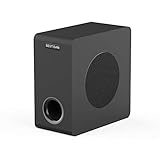
- THUNDEROUS BASS IN A COMPACT ENCLOSURE - Experience powerful, deep bass with a 35 Hz – 200 Hz frequency response from our space-saving 6.5" powered subwoofer. Ideal for home theaters, music streaming, and TV audio enhancement—no bulky equipment required for room-filling low end.
- ENGINEERED FOR DEEP, TIGHT BASS IMPACT - Boasts a high-rigidity 6.5" side-firing woofer, bass-reflex cabinet with bottom port, and internal bracing for reduced resonance. Delivers precise, smooth low-frequency punch you can feel, housed in a sleek black oak finish that complements any decor.
- UNIVERSAL CONNECTIVITY FOR SEAMLESS SETUP - Equipped with RCA, 3.5mm AUX, LFE inputs, and high speaker level inputs/outputs. Effortlessly pairs with home theater receivers, TVs, soundbars, and bookshelf speakers—optimized for enhanced bass reproduction in any audio system configuration.
- UPGRADE YOUR HOME THEATER EXPERIENCE - Elevate movie nights, sports events, and gaming with immersive, dynamic audio. Simply connect via standard 3.5mm/RCA cables to your AV receiver or soundbar, and transform your living room into a cinematic soundstage.
- OPTIMAL PERFORMANCE GUIDELINES - For best results, pair with devices outputting ≤850mV signal level to ensure stable operation. For seamless audio synergy, we recommend matching with BESTISAN soundbars or bookshelf speakers—designed to work together for balanced, high-fidelity sound.
Passive subwoofer
A passive subwoofer requires a suitable external amplifier; it cannot be powered by a line-level output alone. Match the amplifier to the subwoofer according to their manuals. Focusrite’s guidance discusses amplification for passive subwoofer and speaker setups: Connecting a subwoofer for stereo mixing.
Direct connection to a TV
Do not assume a TV has an output compatible with a subwoofer. Check the TV’s actual ports and documentation, then compare them with the subwoofer’s supported inputs. If the TV lacks a suitable output, you may need compatible intermediary equipment, such as a receiver or audio system; the right option depends on the devices and their available connections.
Rank #4

- 8" SPEAKER DRIVER - Delivers powerful sound with highly accurate bass to provide you with a better listening experience.
- LOW PASS FILTER WITH FREQUENCY RESPONSE DOWN TO 38Hz - Ensures that your woofer only plays sounds too low for your speakers to properly output. Supplement your speakers great high and mid-range with bass you can really feel.
- THICK MDF WOODEN ENCLOSURE - We use high quality, dense fiberboard materials that offer reduced acoustic resonance for better audio quality.
- AUTOMATIC STANDBY - Save on electricity with an auto standby feature that ensures the woofer is not unnecessarily using up power when it's not being used.
- ROBUST BUILD QUALITY - Crafted for durability and superior performance, ensuring long-lasting reliability in your audio setup.
What LFE, crossover, and bass management mean
LFE refers to the low-frequency effects channel encoded in some multichannel audio. Bass management is the system’s handling of low frequencies—for example, redirecting bass from channels or speakers that cannot reproduce it effectively. A crossover sets a frequency boundary for this routing or filtering. These terms are related, but they do not mean the same thing. Cambridge Audio explains the distinction in its bass-management guidance.
PC Slower Than It Used to Be?
A free scan shows the junk files, broken settings and background clutter dragging Windows down - then fixes them in one click.Free scan · Windows 10 & 11Outdated Drivers Are Slowing You Down
One free scan finds every outdated or missing driver and matches the right update for your exact hardware.Free scan · exact hardware matchWhich device performs the filtering depends on the specific signal path. On the cited JBL Cinema 300, the LFE input bypasses the subwoofer’s internal crossover; JBL says to use that input only with a receiver or processor output that is already low-pass filtered. MartinLogan similarly says its low-pass filter does not apply to LFE inputs, leaving that task to the AV processor. Consult the manual for the exact subwoofer and receiver rather than assuming a crossover knob or setting behaves universally: JBL Cinema 300 manual; MartinLogan FAQ.
Best Value

- [ Deep & Powerful 8-Inch Bass ]: Experience 35Hz deep bass with the T5s powered subwoofer, which features an 8-inch long-throw woofer and a powerful 70W RMS output (driven by Class-D amplifier). Perfect for home audio and home theater.
- [ Precision Control, Seamless Integration ]: Adjust the low-pass filter (30Hz–160Hz) and phase selector (0°/180°) to match any home stereo or active speaker setup.
- [ Slim Design, Low Distortion ]: This space-saving compact subwoofer fits into any spaces. The 18mm MDF cabinet with a front-firing driver and right-firing acoustic port minimizes resonance for clean, tight bass. Its wood grain finish and low-profile grille blend seamlessly with home decor.
- [ Smart & Energy-Efficient ]: Auto-standby saves power after 15 minutes of inactivity. The built-in amplifier ensures plug-and-play operation – no external receiver needed! Includes 3.5mm-to-RCA and RCA cables for instant setup.
- [ Two Connections ]: ① Sub out-equipped speakers/amps: RCA to T5s’ Signal In; main speaker connects directly to audio source. ② No sub out: Connect T5s in series (audio source → T5s’ Signal In → T5s’ Signal Out → main speaker). Note: For ②, main speaker requires LINE IN (Bluetooth/USB/optical/non-wired not supported).
Do not assume connecting a subwoofer changes what the main speakers receive. Cambridge Audio says that, for the integrated preamp, stereo receiver, or Evo products covered by its FAQ, using the subwoofer output does not change the main-speaker output. Other receivers may behave differently according to their bass-management settings, so check the relevant manual: Cambridge Audio’s explanation.
Check these points before connecting
- Source output: Identify whether your equipment provides an LFE/subwoofer output, a stereo pre-out or line output, or speaker terminals.
- Subwoofer input: Confirm it accepts the source’s signal through an LFE/RCA, stereo line-level, or speaker-level input as applicable.
- Amplification: A powered subwoofer has its own amplifier; a passive subwoofer needs suitable external amplification.
- Crossover responsibility: Determine whether the receiver or processor applies bass management and low-pass filtering, or whether the subwoofer’s own filter is used.
- Main-speaker behavior: Check whether the main speakers continue receiving full-range audio or receive a filtered signal; the answer varies by equipment and settings.
- Purpose: A solo subwoofer can demonstrate bass output or provide a low-frequency effect, but it is not a complete system for music or speech.
An RCA subwoofer or LFE cable is appropriate only when the source and subwoofer have matching, compatible RCA connections. Not every setup uses RCA: some supported systems use speaker-level connections, and passive subwoofers require amplification. Match the cable and signal path to the equipment labels and manuals.
Quick Recap
Product prices and availability are accurate as of the date/time indicated and are subject to change. Any price and availability information displayed on Amazon at the time of purchase will apply.
Quick wins for a faster PC:
Scan for outdated or missing drivers - takes under a minuteDriver Scan →Repair Windows errors before they cause bigger problemsFix Now →
