
iTechGuides is reader-supported. When you buy through links on our site, we may earn an affiliate commission. As an Amazon Associate I earn from qualifying purchases. Learn more
There is no universal winner. Brewery spent grain is a feedstock that must be converted into biochar, activated carbon or a modified adsorbent before it can be compared with commercial activated carbon. Removal depends on the contaminant, preparation method, water chemistry, contact time and operating design. Laboratory percentages are useful for screening, but they do not prove that an unverified material or household cartridge will make drinking water safe.
The short answer
Spent-grain-derived adsorbents can perform very well in controlled experiments. Recent studies report more than 99.7% methylene-blue removal, 99.8% hexavalent-chromium removal under acidic optimum conditions, and high adsorption capacities for some pharmaceuticals. Those results belong to particular materials and test protocols. They cannot be compared directly with one another or treated as a blanket claim that spent-grain carbon beats activated carbon.
“Activated carbon” is also not one material. It includes chemically activated carbon made from spent grain, physically or chemically activated carbons made from other feedstocks, and commercial granular activated carbon (GAC). A fair comparison must identify the exact precursor, activation chemistry, surface area, particle form and test water.
PC Slower Than It Used to Be?
A free scan shows the junk files, broken settings and background clutter dragging Windows down - then fixes them in one click.Free scan · Windows 10 & 11Outdated Drivers Are Slowing You Down
One free scan finds every outdated or missing driver and matches the right update for your exact hardware.Free scan · exact hardware matchWhat “spent grain” means in this comparison
Raw brewery spent grain is not a finished filter medium
Brewery spent grain is the solid residue left after extracting wort. In the studies relevant to water treatment, it is a starting biomass, not material that is simply poured into a filter. Researchers dry and thermally decompose it to make biochar, activate the char chemically or physically to create activated carbon, or add a modifier such as iron. The resulting products have different pores, surface chemistry, ash content and contaminant affinities.
#1 Best Overall

- [Replacement filters] Need filters for PT-07? Search for PF-01A or ASIN B086ZPR3WM on Amazon. Choose genuine Waterdrop filters for a precise fit and reliable performance. Please confirm your model before ordering
- [NSF certified filtration performance] The Waterdrop Lucid filtered water pitcher with lid has passed NSF/ANSI 42 and 372 certifications. Tested by a third-party lab, it helps reduce PFOA/PFOS, odor, iron, mercury, copper, and other metal ions. Note: This system DOES NOT lower TDS value. If you prefer a low TDS value, please choose the Waterdrop TDS Reduction Pitcher by searching PT-13W on Amazon
- [Quality daily water choice] The Waterdrop Lucid water filter pitcher with lid is designed for efficient daily filtration, making it a practical choice for apartments, kitchens, living rooms, dorms, and offices. It helps provide better-tasting drinking water for everyday use
- [Exceptional quality] This pitcher features a hands-free lid for automatic water dispensing without opening the lid, helping prevent dust accumulation for convenient and hygienic use. Its compact body is designed to fit most refrigerators. Product dimensions: 10" x 5" x 10.1"; please verify your fridge dimensions before ordering
- [5x longer lifespan & indicator] The filtered water pitcher has a filter lifespan of up to 200 gallons or 3 months, helping support longer daily use with efficient water flow. The LED indicator lets you check the filter usage status and reminds you when it is time to replace the filter
Biochar and activated carbon are related but distinct
Pyrolysis produces biochar. Activation develops additional porosity and reactive sites, often producing a much larger surface area. A spent-grain biochar made at one temperature therefore should not be treated as equivalent to potassium-hydroxide-activated carbon made from the same feedstock. Iron-modified biochar is a third material again: its chromium performance reflects both the carbon surface and the iron modification.
Commercial GAC is a comparison category, not a guarantee
A repository record for a 2018 study reports comparisons between activated carbon made from brewer’s spent grain and commercial Norit GAC 1240 and Filtrasorb F400. That makes commercial GAC a relevant benchmark category, but the record does not establish that a generic consumer cartridge, or either named product in every configuration, meets a drinking-water standard. Cartridge certification, bed depth, flow rate and replacement schedule still have to be verified for the intended contaminant.
Evidence at a glance
| Material or test | Reported result | Conditions and limits |
|---|---|---|
| Spent-grain biochar for methylene blue | 90.93% preliminary removal; more than 99.7% under optimized batch conditions | Study-specific dye test; not evidence for other contaminants or drinking-water safety. Surface area rose from 1.48 m²/g at 300 °C to 69.87 m²/g at 500 °C. |
| Spent-brewery-grain biochar for antibiotics | Higher single-solute adsorption in buffered distilled water; regeneration-cycle surface area increased from 281 to 462 m²/g | Fixed-bed tests with sulfamethoxazole, trimethoprim and ciprofloxacin. Wastewater and mixed-solute tests performed differently because of dissolved organic matter and solute interactions. |
| Iron-modified spent-grain biochar for Cr(VI) | 99.8% removal | Optimum reported at 7 hours, pH 3 and 2 g/L adsorbent. The acidic batch result is not a general field performance claim. |
| KOH-activated spent-grain carbon for carbamazepine | Surface area up to 1120 m²/g; maximum adsorption capacity up to 190 ± 27 mg/g | Values were reported in ultrapure water and cannot be assumed for ordinary source water. |
| Commercial GAC comparison | Commercial GAC was used as a comparator in a 2018 study record | No particular consumer cartridge was verified for potable use by the cited evidence. |
The underlying papers are the 2026 methylene-blue study, the 2026 fixed-bed antibiotic study, the 2026 iron-modified chromium study, and the 2018 repository record and 2020 carbamazepine abstract.
What’s actually slowing this PC down?
Pick the symptom - the matching free tool is one click away.
What the individual studies actually found
Dyes: strong removal, narrow target
A 2026 Desalination and Water Treatment study used brewery spent-grain biochar to remove methylene blue. It reported 90.93% preliminary removal and more than 99.7% removal under optimized batch conditions. The reported surface area increased from 1.48 m²/g when the biochar was produced at 300 °C to 69.87 m²/g at 500 °C.
These numbers illustrate why preparation matters: pyrolysis temperature changed a measured material property and the resulting adsorption behavior. Methylene blue is a laboratory dye, however. A high percentage for that molecule does not predict removal of antibiotics, chromium, pesticides or pathogens, and batch equilibrium does not show how a flowing filter will behave until breakthrough.
Rank #2

- Less than $25.99 per replacement filter WD-RF10(Search " B085G66JTZ "on Amazon), save over 50% of cost on subsequent use.
- [After Sales Assistance] Waterdrop Backs the WD-10UA's high-end technical performance with a comprehensive prorated performance service; should a quality issue arise with the filter, you can contact us. It is specifically designed for municipal tap water and can only be used with cold water sources. It is not suitable for well water or hot water.
- [Innovative Design] Only a cold-water source should be used to power the filter. Its twist-and-lock construction and push-to-connect fittings enable installation in three minutes, three second replacement, and safety-assuring integration. This filter comes with a 3/8" line that connects directly to US sinks' standard 3/8" feed water valves. The system is connected to 1/2" and 3/8" cold water pipes and faucets with the use of the 3/8"-1/2" convertor fitting.
- [Solve Clogging Problem] By upgrading the filtration area, our filter now provides a 20X increase in dirt adhesion area, enhancing filtration capability while minimizing the risk of clogging.
- [Filter Replacement and Long Lifespan] This system may be upgraded with a UF or a MZ filter to meet your water needs. It is compatible with several filters with various functions. Each system has a maximum service life of 12 months when used with municipal water, which is sufficient to cover the needs of an entire household. Before going on vacation, please Put the filters in separate sealed plastic bags, and store the bags in your refrigerator (NOT the freezer) to keep it fresh in 30 days.
Antibiotics: water matrix and mixtures change performance
A 2026 fixed-bed study tested spent-brewery-grain-derived biochar against sulfamethoxazole, trimethoprim and ciprofloxacin. Single-solute tests in buffered distilled water produced higher adsorption efficiencies than tests in wastewater or mixed-solute systems. The authors attributed the differences to dissolved organic matter and interactions among the antibiotics.
The same study examined microwave regeneration. Specific surface area rose from 281 m²/g in cycle 1 to 462 m²/g in cycle 3. Reported trimethoprim adsorption capacity increased 45% from cycle 1 to cycle 2 and 79% from cycle 1 to cycle 3. Those are results for that biosorbent, regeneration method and test sequence; they do not establish that repeated regeneration always improves every carbon or that regenerated media will retain contaminants safely.
Hexavalent chromium: an impressive result under acidic conditions
A 2026 study of iron-modified brewery spent-grain biochar reported 99.8% Cr(VI) removal at its optimum conditions: seven hours of contact, pH 3 and an adsorbent dose of 2 g/L. The material and iron modification are essential parts of that result. pH 3 is strongly acidic compared with many untreated waters, and the seven-hour batch contact time is not equivalent to the residence time in a household cartridge.
The study itself called for further practical wastewater research. A separate 2024 study of porous biochars derived from brewery waste also tested Cr(VI) in aqueous solutions and recommended additional work with real wastewater and column adsorption. Its findings are documented in the PLOS ONE article.
Carbamazepine: activated carbon can reach high laboratory capacity
An indexed 2020 study made biochars and activated carbons from spent brewery grains. Potassium-hydroxide activation produced materials with surface areas up to 1120 m²/g and reported maximum carbamazepine adsorption capacities up to 190 ± 27 mg/g in ultrapure water.
Rank #3

- ❄️【Authoritative Certifications】 - The filter is certified against NSF/ANSI 42 by IAPMO, filtering out 99% Chlorine, odor and improve water taste significantly. It also certified by European , Canadian CSA, BPA Free and Australian Water Mark. Only select products with authoritative certifications for your loved ones.
- ❄️️【HIGH CAPACITY】 The CTO carbon filter can filter up to 13000 gallons depending on water quality. Suggest to replace it every 3- 6 months for the average household for optimal performance depending on the use. Let it bring a wonderful cleaner water experience to your loved ones.
- ❄️️【COMPATIBLE FILTERS】 - The filter can be used in any standard 10” x2.5” RO Unit whole house filtration system and compatible with standard 10 inch X 2.5 inch filter models of DuPont WFPFC8002, WFPFC9001, SCWH-5, Whirlpool WHCF-WHWC, Pentek CBC-10, GE FXWTC, FX12P, GXWH20F, Culligan D-10A & D-10, Aquaboon CTO, Ace Hardware 84608, Apex IR-40, Cornelius COR10B1, COR10B5, Dupont DWC30001, PFC8002, WFDWC30001, WFPFC8002, WFPFC9001, 46942, EcoLab 9320-1002, Everpure CG5-10, DEV9108-15, Flotec TO1, ICEPURE CTO10.
- ❄️️【 HIGHER QUALITY FILTRATION】 - Carbon is well known for its unique absorbing ability, a pound of carbon is able to provide up 125 acres of filtering surface area. Our RO carbon filter is made of 100% coconut shell activated carbon block to filter most sediments, Sintering Technology ensures high absorbing capacity offers a much finer filtration of suspended particles and dirt.
- ❄️️【STRICT QUALITY CONTROL】 - All water filter home cartridge are produced under the ISO9001 standard and inspected under strict quality control. Each filter is produced through 34 production processes, 400PSI pressure test, 10,000 water hammer tests, and 6 independent tests.
“Maximum adsorption capacity” is a fitted laboratory value, not the amount a cartridge will necessarily hold in source water. Natural organic matter, competing pharmaceuticals, pH, ionic strength and flow can all change usable capacity. The abstract does not establish equivalent performance in a river, well, municipal supply or mixed wastewater.
Free tools Windows power users keep installed
One-click scans. No signup required.
Field evidence is broader than this one feedstock
A 2025 review examined 31 pilot-, field- and mesocosm-scale biochar studies. It found that effectiveness varied with biochar type, target contaminant and treatment technology. That review supports caution about scaling up biochar claims, but it is not a direct head-to-head trial of spent-grain carbon against commercial GAC. Read the review in the Journal of Environmental Management.
Why two adsorbents can give opposite results
1. The contaminant’s chemistry
Dyes, antibiotics, pharmaceuticals and metal ions interact with carbon through different mechanisms. A surface that attracts a charged dye may have a different affinity for a neutral pharmaceutical. Chromium removal can involve surface binding and reduction or precipitation associated with an iron modifier, rather than simple pore filling.
2. How the adsorbent was made
Feedstock, pyrolysis temperature, residence time, particle size and activation reagent determine pore volume and surface functional groups. “Spent grain biochar” is therefore an incomplete specification. A reproducible comparison should report the production temperature, activation method, washing procedure, moisture content, particle-size range and measured surface area.
3. Batch versus fixed-bed operation
Batch experiments mix a known dose with water until an apparent equilibrium is reached. A fixed bed passes water through a packed column and eventually develops a breakthrough front. A material can look excellent in a batch flask yet require an impractically deep bed or slow flow to protect treated water for the desired service period.
Rank #4
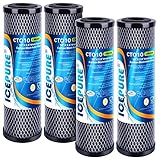
- [NSF/ANSI 42 Certified] This filter has passed the IAMPO NSF/ANSI 42, ensuring it effectively reduces chlorine taste and odor from your drinking water. Enjoy cleaner, fresher water with every sip, thanks to this trusted filtration standard
- [Superior Material] Most ICEPURE water filters meet European EC1935-2004 Regulations, Australian Water Mark, and BPA FREE. This kind of filter is recommended for tap water filtration. If your water source is well water, this filter may not achieve the filtering effect that you expect, because well water contains large particles such as mud and sand, which may clog the filter in a shorter time. If you need to treat well water, please search our other products: B08H7Z5VZ2, to achieve effective purification
- [Compatible Models] This filter can be used in any standard 10” x 2.5” RO Unit whole house filtration system, and is compatible with DuPont WFPFC8002, WFPFC9001, SCWH-5, DWC30001, PFC8002, WFDWC30001, 46942, Whirlpool WHCF-WHWC, Pentek CBC-10, GE FXWTC, FX12P, GXWH20F, Culligan D-10A & D-10, Aquaboon CTO, Ace Hardware 84608, Apex IR-40, Cornelius COR10B1, COR10B5, EcoLab 9320-1002, CG5-10, DEV9108-15, Flotec TO1, PUREPLUS CTO10. ICEPURE is an independent brand
- [Why ICEPURE] Trusted by 300M+ families globally, ICEPURE brings 26 years of expertise and 200+ patents to your home. Our advanced filtration technology ensures every drop is clean, fresh, and high-quality. Make the smart choice for your family's water safety—choose ICEPURE
- [Efficient Filtration] This filter is made with innovative Sintering Technology, which helps to remove 99% of chlorine, taste, and odor. This filter can remove finer particles and sediment. Delivering cleaner water that tastes great, and providing a wonderful drinking experience for your whole family. This filter has a life span of up to 13000 gallons, depending on your water quality. For optimum performance, we recommend you change the filter every 6 months based on water quality
4. Clean water versus real wastewater
Buffered distilled water contains fewer competitors than wastewater. Dissolved organic matter can occupy adsorption sites or block pores; mixtures can compete for the same sites. The antibiotic study directly observed higher efficiencies in cleaner single-solute tests than in wastewater and mixed-solute tests.
5. Contact time, pH and dose
Removal percentages are inseparable from the stated contact time, pH and adsorbent dose. The 99.8% chromium result required seven hours, pH 3 and 2 g/L. Changing any of those variables can change both removal and operating cost. A percentage without its conditions is not a transferable specification.
Spent-grain biochar versus activated carbon: practical trade-offs
| Decision factor | Spent-grain-derived biochar | Activated carbon, including activated spent-grain carbon |
|---|---|---|
| Feedstock and processing | Usually pyrolyzed brewery residue; properties depend strongly on temperature and process control. | Activation adds a chemical or physical treatment that can substantially increase porosity; the feedstock may be spent grain or another material. |
| Best-supported evidence in the cited studies | Dye, antibiotic and Cr(VI) experiments, including fixed-bed and modified-biochar work. | High surface area and carbamazepine capacity for KOH-activated spent grain; commercial GAC used as a comparator in a 2018 record. |
| Water conditions tested | Both buffered or distilled laboratory water and, for antibiotics, wastewater and mixed solutes. | The carbamazepine values were obtained in ultrapure water; the cited record does not verify a generic consumer cartridge. |
| Regeneration evidence | Microwave regeneration was evaluated in the antibiotic fixed-bed study, with reported increases through cycle 3. | No universal regeneration result follows from the cited studies; method and carbon type must be tested separately. |
| Potable-water conclusion | Not established by adsorption percentages alone. | Not established for unspecified media or cartridges; product-specific certification and monitoring are required. |
How to evaluate a material for a real treatment project
The following workflow is suitable for a researcher, engineer or treatment operator comparing media. It is not a recipe for making a household drinking-water filter from brewery waste.
- Define the target and the influent. Identify the contaminant, concentration range, pH, temperature, dissolved organic carbon, ionic strength and likely co-contaminants. “Contaminants” is too broad for a meaningful test.
- Specify the adsorbent completely. Record whether it is raw biomass, pyrolyzed biochar, activated carbon or a modified biochar. Document feedstock source, pyrolysis temperature, activation reagent, washing, ash content, particle size and surface area.
- Run a controlled screening test. Use a stated dose and contact-time series, include blanks and replicates, and measure the contaminant analytically before and after treatment. Keep pH and temperature under control instead of comparing percentages from unrelated papers.
- Repeat with realistic water. Test the actual source water or a defensible synthetic matrix containing dissolved organic matter and relevant competing solutes. The antibiotic results show why clean buffered water can overstate performance.
- Move to a column test. Measure empty-bed contact time, flow, bed depth, pressure drop and breakthrough. Report treated bed volumes or a breakthrough curve, not just the concentration at one batch endpoint.
- Check regeneration and disposal. Determine whether regeneration restores capacity, whether the process creates emissions or a concentrated waste stream, and whether the spent media can leach the captured contaminant. A regenerated bed is not automatically safe.
- Verify treated water independently. Use a laboratory method appropriate to the contaminant and detection limit. For drinking-water applications, check the applicable regulatory limits and certification requirements for the complete treatment device.
Operational and safety pitfalls
Do not put raw spent grain in a drinking-water cartridge
Raw spent grain is biodegradable biomass, not a validated adsorbent cartridge. It can introduce organic matter and microbes, shed particles and change water chemistry. The cited studies processed the material before testing; their results cannot be transferred to unprocessed brewery residue.
The Tool Desk
Outbyte Driver Updater FREEFix the driver behind crashes, sound loss and screen glitchesFind Drivers →Outbyte PC Repair FREERepair Windows errors before they cause bigger problemsFix Now →Do not read a removal percentage as a safety certification
Adsorption studies generally measure a selected chemical under defined conditions. They do not automatically test pathogens, disinfection by-products, metals released from the media, taste and odor, or every contaminant present in a source. A filter can reduce one analyte while leaving another unchanged.
Best Value

- ❄️ Recognized Certification - Food Grade Material Meets European EC1935-2004 Regulations, Australia Water Mark, REACH, BPA FREE Certified. The filter reduces up to 99% of Chlorine, sand, rust, sediment, color. This kind of filter is recommended for tap water filtration. ❄️If your water source is well water, this filter may not achieve the filtering effect you expect. Check out our another product. Search “B01N9024NF” for well water filtration.
- ❄️ Multi-Layer Density Tech - The whole house water filter is designed with density three PP layers and Coconut Shell Activated Carbon Layer to remove most contaminants and deliver great fresh water. The multi-layer density tech can capture impurities targetedly and have 30% longer service life than the other common type.
- ❄️ High Capacity - The filter can filter up to 30000 gallons depending on water quality. Suggest to replace it every 3- 6 months for the average household for optimal performance depending on the use. Let it bring a wonderful cleaner water experience to your loved ones.
- ❄️ Compatible Models - PUREPLUS whole house carbon water filter is premium replacement for any standard 10inch X 4.5inch pre-filtration filter models including GXWH35F, WRC25HD, GXWH40L, GXWH30C, GXWH38F, GNQH38S, GE FXHTC WRC25HD,WHKF-WHPCBB, RFC-BB and RFC-BB, WFHD13001, 4WH-HDGR-F01. The ge whole house water filter is compatible with any standard 10" x 4.5" heavy duty filter housing and most systems with 9.75" x 4.5" filters.
- ❄️ Why PUREPLUS - PUREPLUS has 20 years of expertise and 200 patents in the water filtration industry. Every year it provides filtration solutions to more than 200 million American households, our filters use advanced filtration technology to ensure high quality water. Trust us, make PUREPLUS your solution.
Watch for breakthrough
Adsorption sites fill over time. If a column is not sampled at the outlet, the operator may not know when the contaminant has begun passing through. Flow changes, temperature, pH and competing organic matter can shorten the useful run even when an initial sample looks excellent.
Treat spent media as a managed waste
Captured antibiotics, chromium or pharmaceuticals remain associated with the medium unless they are destroyed or safely recovered. Regeneration can transfer contaminants into a smaller, more concentrated stream. Disposal and worker-protection requirements depend on the contaminant and local rules.
Which option makes sense in common scenarios?
You are screening a low-cost material for industrial wastewater
Spent-grain biochar or a modified version can be a reasonable research candidate, especially where brewery residue is locally available. Start with the actual wastewater and a column test; do not select it from a dye percentage alone.
You need evidence for a specific pharmaceutical
Use a material and protocol tested against that pharmaceutical. The carbamazepine result supports investigating activated spent-grain carbon, while the antibiotic study shows that mixed wastewater can reduce apparent performance. Neither result substitutes for testing the compound and matrix you actually have.
You are treating Cr(VI)
Iron-modified spent-grain biochar is a candidate for investigation because one study reported 99.8% removal. Reproduce the pH, dose and contact time first, then test neutralized and real wastewater conditions and monitor chromium speciation and possible iron release.
You want safe household drinking water
Do not improvise with spent grain or unverified loose carbon. Choose a complete treatment device whose certification and performance claim cover the contaminant of concern, maintain the specified flow and replacement schedule, and test the source and treated water when risk warrants it. The studies summarized here do not certify any consumer cartridge.
Bottom line
Spent grain is a promising feedstock, not a universal replacement for activated carbon. Its processed products have produced impressive contaminant-specific results, including more than 99.7% dye removal, 99.8% Cr(VI) removal under acidic optimum conditions and high carbamazepine capacity in ultrapure water. Commercial GAC remains a relevant benchmark, but no single material wins across contaminants and water matrices. Select the adsorbent by target contaminant, preparation, realistic water chemistry, column behavior, regeneration plan and verified end-use safety—not by the largest laboratory percentage.
Do these 3 things before closing this tab:
1Scan for outdated or missing drivers - takes under a minute2Clear out junk files and repair common Windows errors3Fix the driver behind crashes, sound loss and screen glitchesQuick Recap
Product prices and availability are accurate as of the date/time indicated and are subject to change. Any price and availability information displayed on Amazon at the time of purchase will apply.

