
iTechGuides is reader-supported. When you buy through links on our site, we may earn an affiliate commission. As an Amazon Associate I earn from qualifying purchases. Learn more
For a typical home setup with standard 8-ohm speakers and a cable run of 50 feet or less, 16 AWG is a reasonable starting point. Choose thicker wire—such as 14 AWG—for longer runs or when lower-impedance speakers or higher current make resistance more important. Then check that the cable fits your equipment’s terminals and is suitable for its route, especially for in-wall installation.
What gauge speaker wire do I need for home theater?
Gauge is a measure of conductor thickness, and the numbering runs in reverse: a lower AWG number means thicker wire. For the same cable material and length, thicker wire has less resistance. That makes run length, speaker impedance and amplifier demand the main factors in choosing a size.
Crutchfield’s home-speaker guide recommends 16 AWG for runs of 50 feet or less to standard 8-ohm speakers, and suggests stepping up to 14 AWG for longer runs, high-current amplifiers or lower-impedance speakers such as 6-ohm or 4-ohm models. Treat this as practical guidance, not a guarantee for every amplifier and speaker combination; check their documentation for any specific requirements.
Do these 3 things before closing this tab:
1Clear out junk files and repair common Windows errors2Scan for outdated or missing drivers - takes under a minute3Repair Windows errors before they cause bigger problemsUse the actual cable route
Measure the path the cable will follow, not just the straight-line distance between the amplifier and speaker. Leave enough extra length to reach both sets of terminals without pulling the cable taut. A longer route can change which gauge is a sensible choice.
#1 Best Overall
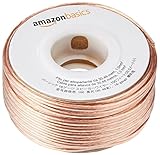
- IN THE BOX: 16 gauge speaker wire cable (100 feet)
- CLEAR AUDIO: Plastic jacket helps ensure high-quality undistorted signals to and from audio equipment
- CONVENIENT: Connects audio speakers to an A/V receiver or amplifier
- SIMPLE INSTALL: Black line on one side of wire indicates the polarity for a proper audio system set up
- EASY DISPENSING: Comes wrapped around a hard plastic spool for simple dispensing
When a manufacturer’s chart is more conservative
The 2019 manual for Monoprice’s HT-35 home-theater system gives a model-specific table with separate limits for 4-ohm and 8-ohm installations. Its listed maximum lengths are:
| Wire gauge | 8-ohm installation | 4-ohm installation |
|---|---|---|
| 18 AWG | 10 ft | 5 ft |
| 16 AWG | 20 ft | 10 ft |
| 14 AWG | 35 ft | 18 ft |
| 12 AWG | 60 ft | 30 ft |
| 10 AWG | 100 ft | 50 ft |
These are the HT-35 manual’s specific limits, not a universal chart. They are more conservative than Crutchfield’s broad 16-AWG guidance for short 8-ohm home runs. The HT-35 manual also advises using the heaviest gauge the connectors can accept, so terminal capacity may limit a theoretically thicker choice. Read the HT-35 manual.
Rank #2
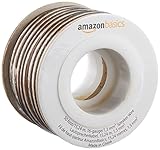
- IN THE BOX: 16 gauge speaker wire cable (50 feet)
- CLEAR AUDIO: Plastic jacket helps ensure high-quality undistorted signals to and from audio equipment
- CONVENIENT: Connects audio speakers to an A/V receiver or amplifier
- SIMPLE INSTALL: White line on one side of wire indicates the polarity for a proper audio system set up
- EASY DISPENSING: Comes wrapped around a hard plastic spool for simple dispensing
How to choose between 16, 14 and thicker wire
Crutchfield lists 16, 14 and 12 AWG among the common speaker-wire sizes. Choose by matching the cable to the specific run and equipment rather than assuming one gauge is best for all systems.
The Tool Desk
Outbyte PC Repair FREEClear out junk files and repair common Windows errorsFree Scan →Outbyte Driver Updater FREEFix the driver behind crashes, sound loss and screen glitchesFind Drivers →- 16 AWG: A reasonable baseline for a home run of 50 feet or less to a standard 8-ohm speaker, following Crutchfield’s guidance.
- 14 AWG: Consider for runs beyond 50 feet, lower-impedance speakers or higher-current use, subject to the amplifier and speaker instructions.
- 12 AWG or thicker: Consider only when the run and equipment guidance call for it, and verify that the amplifier and speaker terminals can accept the conductor.
When comparing two cables, check their conductor material and stated specifications as well as the gauge. Gauge alone does not establish a cable’s electrical performance or suitability for a particular location. For example, Belden’s 50977 product listing describes two stranded 2.5 mm² bare-copper conductors, a TPE jacket and a maximum conductor DCR of 8.62 ohm/km. Those are specifications for that cable, not properties to assume for every speaker wire. The catalog listing is dated 2024-02-15. See Belden’s 50977 specifications.
Rank #3

- PREMIUM SPEAKER WIRE [ Frosted Red/Black | 100-feet (30.5m) | 16 Gauge ] - Featuring a double conductor, this stranded wire is constructed from high-grade copper and aluminum. It is perfect for achieving outstanding audio performance, exceptional flexibility, easy stripping and great polarity identification.
- COPPER-CLAD ALUMINUM (CCA) - Made with an aluminum core and coated with a layer of copper, this cost effective speaker wire provides great conductivity with minimal signal loss.
- PERFECT FOR - Designed to provide adequate performance for any home theater system, car audio speakers or professional studio. It's a great choice for both DIY enthusiasts and professionals.
- SIMPLE INSTALLATION - Use this wire to easily connect your home theater or car audio speakers to any A/V receiver or amplifier.
- SOFTFLEX JACKET - Our wire is shielded with a soft and flexible jacket, which not only provides a great appearance, but also ensures maximum durability and easy installation.
How to install speaker wire safely and cleanly
- Measure and plan the route. Follow the path the cable will take and allow enough slack to connect it without tension.
- Check terminal limits. Confirm the maximum conductor size supported by both the amplifier and speaker. Choose a cable that fits; a thicker gauge is not useful if it cannot be connected securely.
- Identify the conductors. Many cables mark one conductor with a stripe, ridge or other feature. Use that marking consistently and match the plus and minus labels on the amplifier and speaker at both ends.
- Make clean connections. Ensure no loose strands can touch the neighboring terminal. Such a strand can bridge the terminals.
- Use plugs only if compatible. Banana or pin plugs can simplify connections and help contain strands, but they are optional and require terminals that support them.
The Monoprice HT-35 manual covers its system’s connections and gauge recommendations; consult the equipment documentation for the exact terminals and limits on your own components. HT-35 system manual.
What changes for in-wall speaker wire?
In-wall cable selection is about both conductor size and suitability for the route. A gauge recommendation does not establish that a cable is appropriate for concealed installation; check the cable’s specifications and applicable local installation requirements.
Rank #4

- 40 Feet (12M) of 16 Gauge Speaker Wire - Simply Great and Affordable Speaker Wire
- 74 High Strand Count (.15 OD) CCA (Copper Clad Aluminum) Quality Wire
- Soft and Flexible PVC Jacket Marked with Red Polarity Stripe
- Connects Power Amplifiers and Receivers to Speakers
- Small, Mini Pack for Almost any Audio Amplifier to Speakers Wiring
In common cable shorthand, 16/2 means two conductors, each 16 gauge, while 14/4 means four conductors, each 14 gauge. Crutchfield says 16 gauge suffices for runs under 50 feet and suggests 14 gauge for longer runs. Choose the cable for the actual route and verify its construction and installation suitability rather than relying on the shorthand alone. Crutchfield’s guide to hiding speaker and TV wires.
What’s actually slowing this PC down?
Pick the symptom - the matching free tool is one click away.
When a home speaker-wire chart does not apply
Car audio
Car installations have their own wire-sizing considerations, including run length and current demand. Crutchfield gives 14 AWG as an example for 100 watts to front speakers when the amplifier is in the trunk. The same page says factory speaker wire generally need not be replaced below 100 watts; treat that as retailer guidance, and check the vehicle and component manufacturers’ requirements before changing wiring. Crutchfield’s car-audio gauge guidance.
Best Value

- Low Voltage Wire : 16/2 gauge black and red speaker wire is ideal for low voltage applications such as 12V/24V DC circuit connections, home or car speakers, home appliances, single color LED light strip, lamps, automotive, boat etc
- Benefits of CCA Wire : CCA 12 volt wire combines the high conductivity of copper with the lightweight property of aluminum, offering a lighter and more flexible option; It is more cost-effective than copper wire, helping you save costs while delivering the similar functionality and reliability as copper wire
- Premium PVC Insulation : The PVC jacket of the 16 AWG 2-conductor wire is durable yet flexible, making it suitable for wiring in tight spaces; It boasts excellent anti-aging, moisture-resistant, and corrosion-resistant properties, along with heat and cold resistance, operating within a temperature range of -35°C to 105°C
- Wide Selection : In addition to 16 gauge, we also offer ultra-flexible 2 conductor parallel cables for 10 gauge,12 gauge,14 gauge,18 gauge,20 gauge Wire; You can purchase them with confidence
- Excellent Service : We adhere to the principle of prioritizing customer interests; If you have any questions, please do not hesitate to contact us, and we will respond to you within 24 hours
70V/100V distributed audio
Do not apply a home 4-ohm/8-ohm chart to a 70V/100V distributed system. The applicable wire guidance depends on the system configuration. A 2018 Monoprice commercial-amplifier manual supplies separate maximum-length tables for 4-ohm/8-ohm and 70V/100V installations; its limits apply to that model, not to every commercial system. Consult the commercial amplifier manual.
Final checks before buying
- Use the one-way cable route length, not an estimate based on room size.
- Check the speaker’s nominal impedance and the amplifier’s instructions.
- Choose a gauge that suits the run and current demand, then confirm the terminals can accept it.
- For concealed or specialized routes, verify the cable’s actual construction and location suitability.
- Keep polarity consistent and make sure no bare strand can contact an adjacent terminal.
Crutchfield’s general home guidance supports 16 AWG for a short run to an 8-ohm speaker, while manufacturer-specific instructions can call for thicker wire at shorter distances. Follow the requirements for the equipment and cable you are installing.
Quick Recap
Product prices and availability are accurate as of the date/time indicated and are subject to change. Any price and availability information displayed on Amazon at the time of purchase will apply.
Recommended Free Tools

