
Free tools Windows power users keep installed
One-click scans. No signup required.
iTechGuides is reader-supported. When you buy through links on our site, we may earn an affiliate commission. As an Amazon Associate I earn from qualifying purchases. Learn more
Short answer: the Solo Leveling anime keeps the manhwa’s central progression story and follows its broad direction closely, but it is not a panel-for-panel copy. The production team says it deliberately gives more psychological depth and screen time to characters besides Sung Jinwoo, reshapes compact webtoon chapters into a more dynamic television structure, and uses animation, voice acting, music and large-scale staging to expand the impact of action scenes. The Japanese and global releases also use different names and terminology.
Those are the changes that can be stated confidently from producer interviews and corporate documentation. A complete, reliable list of every cut, addition or reordered beat—and an exact anime-to-manhwa chapter handoff—requires checking each episode against the corresponding chapters. The available official material does not establish such a scene-by-scene catalogue.
Does the anime follow the Solo Leveling manhwa?
Yes, in its central story and progression premise. The anime adapts a South Korean web novel that was later turned into a WEBTOON/manhwa. The source credits are associated with Chugong for the original story, DUBU of REDICE STUDIO for the illustrations and h-goon for a screenplay credit. Aniplex and Crunchyroll co-produced the anime, with A-1 Pictures handling animation. The series began airing in January 2024; the producer interview cited here was published while the second season was airing in early 2025. Sota Furuhashi’s Aniplex producer interview and Sony’s Corporate Report 2025 both describe the adaptation as closely based on the WEBTOON.
The most important continuity is the emotional engine: a hunter who starts at the bottom gains the ability to level up, then confronts enemies and situations that were previously beyond his capacity. Producer Sota Furuhashi said the team wanted to preserve that fast-moving appeal. The anime therefore does not replace the basic “weakest hunter becomes extraordinarily powerful” progression with a different premise or a separate protagonist’s story.
#1 Best Overall
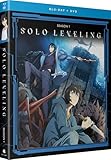
- Textless Opening & Ending Songs
- Promo Video Collection
- Character Video Collection
- The Leveling of Solo Leveling Documentary
- ...and more!
What “closely follows” means here
“Close” describes the adaptation’s broad direction, not identical execution. A webtoon delivers short, scrollable chapters built around sequential images, while television has to control episode openings, transitions, pauses, emotional turns and climaxes. The anime can hold on a reaction, move between characters, or use sound and timing to make a moment land differently without changing the underlying event.
Furuhashi explained that the source concentrates heavily on its protagonist and that directly transferring its compact chapter rhythm could feel repetitive or monotonous on television. The adaptation response was to add psychological depth for other characters and weave those perspectives into a more dynamic structure. His exact explanation was: “So, in the anime adaptation, we made sure to include the psychological depth of other characters and weave that into the story to create a more dynamic structure.” The full interview appears at Cocotame/Sony Music Group.
What did the Solo Leveling anime change from the manhwa?
The confirmed changes are primarily about emphasis, structure, localization and presentation. They are different from a confirmed rewrite of the central plot.
Recommended Free Tools
1. More perspective beyond Jinwoo
The manhwa’s storytelling is strongly centered on Sung Jinwoo. The anime broadens the frame by giving other characters additional psychological context and by integrating that material into the episode structure. That can make a television episode feel less like a sequence of upgrades and fights viewed exclusively through Jinwoo’s eyes.
This adjustment does not mean the anime abandons Jinwoo’s viewpoint or turns the series into an ensemble drama. It means supporting characters receive more room for motives, reactions and emotional pressure than a strict transfer of the webtoon’s compact focus would provide. The producers’ stated goal was to avoid monotony while retaining the source’s rapid progression.
2. A more dynamic television structure
Webtoon chapters are designed for scrolling and can end on a reveal, image or short beat that works differently from an episode break. The anime reorganizes emphasis so that scenes build toward television-sized openings, reversals and endings. The available producer comments support this broad structural change, but they do not identify a verified list of chapters that were moved or specific events that were removed.
When an adaptation gives a supporting character a reaction before returning to Jinwoo, that is best understood as a change in narrative emphasis unless an official episode-to-chapter comparison proves a larger alteration. The evidence does not justify labeling every expanded reaction as a new plot event.
The Tool Desk
Outbyte PC Repair FREEClear out junk files and repair common Windows errorsFree Scan →Outbyte Driver Updater FREEFix the driver behind crashes, sound loss and screen glitchesFind Drivers →3. Localized names and terminology
The Japanese and global editions do not use identical names. In the Japanese release, the protagonist is called Shun Mizushino; overseas audiences generally know him by the Korean name Sung Jinwoo. The production team recorded separate Japanese dialogue versions for domestic and overseas editions, with corresponding character names. Other place names and terms also received separate versions, and the anime’s status-screen text was standardized in English.
Rank #2

- Episode Previews
- Promo Videos
- Textless Opening & Ending Songs
Sony’s 2025 corporate report independently describes the same distinction: the global edition uses Korean names and terms, while the Japanese edition uses Japanese localization. This is a release and localization difference, not a change to the character’s identity, history or role in the story. A reader comparing subtitles, dubbed dialogue, a Japanese edition and an English manhwa can therefore encounter different names while still reading about the same person or place. Sony’s report and Furuhashi’s interview explain the naming policy.
4. Action is rebuilt for a moving screen
The manhwa represents combat through sequential panels, composition, color and the reader’s own pacing. The anime adds continuous movement, editing, voice performance, sound effects, music and timing. A pose that occupies one panel can become a held shot, a camera move, an impact frame and a reaction in animation. Those are meaningful changes in experience even when the fight’s broad sequence remains recognizable.
The producers also describe Jinwoo’s action becoming more extravagant as his level rises. In the second season, scenes involving the shadow army required substantial production time because many characters fight at once. That comment establishes the scale and workload of the animation; it does not prove that a particular shadow-army encounter was added, cut or placed in a different chapter order. Part 2 of the producer interview discusses the action and production demands.
Anime versus manhwa: the meaningful differences at a glance
| Comparison point | Manhwa/webtoon | Anime adaptation | What is confirmed |
|---|---|---|---|
| Narrative focus | Strong concentration on Jinwoo’s progression. | Additional psychological depth and perspective for other characters. | Confirmed by producer Sota Furuhashi. |
| Structure | Compact, scrollable chapters. | Material shaped into a more dynamic episodic structure. | Confirmed as an adaptation objective; exact reordered scenes are not catalogued. |
| Core premise | A lowest-ranked hunter gains the ability to level up and defeats increasingly powerful enemies. | The same progression remains the central appeal. | Confirmed by the producer interview. |
| Names | Edition-dependent naming, including Korean and Japanese releases. | Separate Japanese and overseas dialogue/name versions; English status-screen text. | Confirmed by producer comments and Sony’s report. |
| Action medium | Sequential comic panels, composition and reader-controlled pace. | Movement, editing, voices, sound, music and color. | Medium difference; not evidence of specific plot changes. |
| Large battles | Drawn ensemble action. | Animated scenes with many simultaneous characters, requiring substantial production time. | Production scale discussed for shadow-army scenes. |
| Episode-to-chapter mapping | Chapters are the source reference. | Episodes adapt portions of that material. | No verified continuation chapter is established by the cited sources. |
What stays the same in the story?
Jinwoo remains the progression engine
The adaptation’s stated aim is to preserve the release of watching a character move from the lowest rank toward power that earlier enemies made impossible to imagine. The anime’s added viewpoints support that arc rather than replacing it. Jinwoo’s gains, escalating challenges and increasingly spectacular abilities remain the organizing thread.
The adaptation is not documented as a wholesale rewrite
Nothing in the cited producer material supports a claim that the anime discards the manhwa’s central progression, changes Jinwoo’s underlying identity or substitutes a different final objective. It is more accurate to describe the anime as a close adaptation with expanded perspective and television-oriented pacing than as a new continuity.
Why the producers added character psychology
The reason is structural, not merely cosmetic. A webtoon can move quickly through short chapters because each scroll supplies a visual beat and the reader controls the pace. A television episode needs variation in intensity. If every segment repeated the same pattern of Jinwoo entering a fight, gaining an advantage and moving on, the rhythm could become predictable even when the source material is exciting.
Additional character psychology creates contrast. A supporting hunter’s fear, a rival’s response or a team’s uncertainty can give an episode a quieter beat before the next escalation. It also lets viewers understand consequences that a protagonist-focused sequence may pass over quickly. Furuhashi described this as weaving other characters’ psychological depth into the story, not as abandoning the original progression.
What’s actually slowing this PC down?
Pick the symptom - the matching free tool is one click away.
For viewers, the practical result is that an anime scene may spend time on a reaction or viewpoint that feels absent from the corresponding stretch of the manhwa. That difference alone should not be treated as proof of a changed plot. It is the adaptation’s chosen way to make the same broad material function as episodic television.
Rank #3

- Episode Previews
- Promo Videos
- Textless Opening & Ending Songs
- 68-page art book featuring Japanese cast & staff interviews, Shadow’s Daily Life Comic
- 4 exclusive art cards / Sticker sheet
Localization: why one character has two familiar names
Readers often assume that “Sung Jinwoo” and “Shun Mizushino” identify different characters. They do not. They are localized names for the same protagonist in different release editions.
Global edition
The global release uses Korean names and terminology, including Sung Jinwoo. This is the naming convention most English-speaking viewers and readers encounter.
Japanese edition
The Japanese release uses Japanese-localized names, including Shun Mizushino. The anime also recorded separate Japanese dialogue versions for domestic and overseas editions, so the difference can be heard as well as read.
Do these 3 things before closing this tab:
1Scan for outdated or missing drivers - takes under a minute2Clear out junk files and repair common Windows errors3Fix the driver behind crashes, sound loss and screen glitchesStatus-screen language
The anime’s status-screen text was standardized in English. That creates another visible distinction: a viewer may hear a localized name in dialogue while seeing English interface terminology on screen. These choices reflect distribution and localization strategy, not an alteration to the character’s place in the narrative.
How animation changes the experience of a fight
Comparing a panel sequence with its animated version involves more than checking whether every pose appears. The mediums control attention differently:
- Timing: animation decides how long a strike, pause or reaction remains visible; a comic reader controls the pause by turning or scrolling.
- Movement: the anime can show a continuous camera move, transformation or swarm attack instead of implying motion between still panels.
- Sound and voice: dialogue delivery, impact effects and music add emotional information that printed pages cannot reproduce.
- Color and lighting: animated color design can guide the eye across a crowded battlefield and distinguish powers or allies in motion.
- Scale: scenes with many simultaneous shadow soldiers become a production challenge because each moving figure must be staged, composited and timed.
The result can feel larger or more immediate even when the underlying encounter is familiar. The producer discussion of shadow-army battles supports this production explanation, but it should not be converted into an unsupported claim that the anime invented a particular battle.
What is not established about cuts, additions and reordered scenes?
There is no dependable, official episode-by-episode catalogue in the cited material that lists every omission, addition or rearrangement. That means several common online claims need qualification:
- An unmentioned manhwa scene cannot automatically be called “cut.” It may appear in a later episode, be folded into another sequence or be represented through a shorter visual beat.
- An expanded anime reaction is not necessarily a new plot event. It may be a visual or psychological elaboration of material implied by the source.
- A fight that looks different in animation is not proof that its narrative order changed.
- Fan-made change lists can be useful starting points, but they are not authoritative without checking the exact episode and chapter.
If you need a definitive scene comparison for a review, study guide or continuity question, verify the episode and chapter side by side before stating that a beat was removed or moved.
Rank #4

- Cartoon Characters This set contains 50 stickers featuring cute blue cartoon figures. With various expressions, poses, and accessory - matched looks, they bring a lively and fun atmosphere. Ideal for adding a touch of playfulness to your items.
- Premium Material Quality Made from durable vinyl, these stickers are waterproof, UV - resistant, and not easy to fade or tear. They can firmly stick to smooth surfaces like laptops, water bottles, phone cases, maintaining good condition for a long time.
- Versatile Application Scenarios Suitable for personalizing a wide range of belongings. Decorate skateboards, notebooks, luggage, or room walls.
- Easy to Apply and Remove Equipped with a user - friendly adhesive. Just peel off the backing and stick on clean, dry surfaces. When removed, they leave no sticky residue, ensuring no damage to the applied items.
- Share the joy of decorating with these lovely cartoon stickers.
How to compare an episode with the manhwa accurately
- Identify the exact release edition. Record whether you are watching the Japanese or global anime version and whether your book or digital copy uses Korean or Japanese-localized names.
- Use the episode’s ending as a boundary, not a chapter guess. Start with the chapters that contain the episode’s opening material, then check forward and backward for scenes that may have been combined.
- Separate plot from presentation. Note whether a difference changes an event, or only changes camera angle, timing, dialogue delivery, music, color or character emphasis.
- Mark viewpoint expansion. If the anime follows another character before returning to Jinwoo, classify that as added perspective unless it creates a demonstrably new event.
- Check names and terms against the edition. A different name may be localization rather than a continuity discrepancy.
- Record uncertainty explicitly. If the sources or side-by-side reading do not establish whether a scene was moved or omitted, label it unverified instead of presenting a guess as fact.
This method prevents the most common comparison error: treating every difference between a moving, voiced production and a scrollable comic as a story rewrite.
Where does the anime leave off in the manhwa?
The cited official material does not verify a precise chapter number for the anime’s continuation point. Because episode boundaries, editions and publication schedules can change, supplying an unverified chapter handoff would risk sending readers to the wrong place.
To continue safely, use the final completed anime episode as your reference, consult an official or licensed manhwa edition, and skim the surrounding chapters until you find the last fully adapted sequence. Then read forward far enough to account for scenes the anime may have expanded or shifted. This takes longer than relying on a single chapter number, but it avoids assuming that a television episode maps one-to-one onto a webtoon chapter.
Release and reading context
The anime was announced at Anime Expo in 2022. Crunchyroll’s premiere announcement identifies Yen Press as the English comic publisher and recorded a Volume 8 release scheduled for January 21, 2024. That date is historical publication context, not a statement about current stock, format or retailer availability. Readers buying a print edition to compare adaptation choices should verify the current volume, territory and format at the point of purchase. Crunchyroll’s announcement contains the cited publisher and volume context.
For production context, Sony’s 2025 corporate report identifies Aniplex and Crunchyroll as co-producers, A-1 Pictures as the animation studio and a global distribution/localization strategy. The same report calls Season 1 the “most-viewed new anime on Crunchyroll in 2024.” That is a platform-specific description attributed to Sony; it is not an audience count and does not mean the series was the most watched new anime across every service. Read the wording in Sony’s Corporate Report 2025.
Which version should you choose?
Choose the anime first if you want audiovisual impact
The anime supplies motion, performances, sound design, music and pacing chosen by the production team. It is the clearest way to experience the scale of Jinwoo’s later abilities and the logistical challenge of staging a large shadow army. It also includes the expanded psychological attention to supporting characters that the producers specifically designed for television.
Choose the manhwa first if you want direct control of pace
The manhwa lets you inspect panel composition, reread a reveal immediately and move through chapters at your own speed. It also makes the source’s compact structure visible, which helps explain why the anime needed to shape material into episodes.
Use both if adaptation differences are your main interest
Read the source passage after watching the relevant episode, or watch the episode after reading the matching stretch. Keep edition names consistent and separate confirmed plot changes from medium-specific presentation. A print English edition can be useful for side-by-side comparison, but verify its current availability and format rather than relying on the historical Volume 8 date.
Bottom line: what actually changes?
The anime changes how the story is delivered more reliably than it changes what the story is about. It preserves the core progression of a lowest-ranked hunter gaining the power to overcome stronger enemies, while adding psychological depth and perspective for other characters and arranging compact webtoon material into a more dynamic television structure. Localization creates separate Japanese and global names, including Shun Mizushino and Sung Jinwoo. Animation adds movement, voices, sound, music, color and the production burden of large ensemble battles.
Those confirmed differences are enough to explain why the anime can feel broader and more cinematic than the manhwa without being a different story. Claims about a specific cut, addition, reorder or continuation chapter should be made only after an episode-and-chapter comparison establishes them.
Quick Recap
Product prices and availability are accurate as of the date/time indicated and are subject to change. Any price and availability information displayed on Amazon at the time of purchase will apply.

