
The Tool Desk
Outbyte Driver Updater FREEScan for outdated or missing drivers - takes under a minuteDriver Scan →Outbyte PC Repair FREEClear out junk files and repair common Windows errorsFree Scan →iTechGuides is reader-supported. When you buy through links on our site, we may earn an affiliate commission. As an Amazon Associate I earn from qualifying purchases. Learn more
Choose a traditional deadbolt if you want dependable mechanical operation with no batteries, app or network account. Choose a smart deadbolt if keyless entry, temporary codes, remote status or integration with other devices will materially improve daily life and you are prepared to manage batteries, credentials and any connectivity the model requires. Neither category is automatically more secure: compare the specific lock’s certification and ratings, its fit on your door, the condition of the bolt and frame, and how you will enter and exit when electronics or keys are unavailable.
What the comparison actually means
A deadbolt is a locking mechanism, not a synonym for either “old-fashioned” or “connected.” The hardware can be operated mechanically with a key and thumb turn, or electronically with a keypad, phone, credential, motor and sometimes a network connection. BHMA’s consumer guidance lists electronic deadbolts alongside single-cylinder and double-cylinder deadbolts, so the practical choice is usually mechanical access versus electronic access and its additional features.
The lock is only one part of an entry assembly. Door thickness, backset, handing, existing holes, the strike area, the frame and the way the bolt extends all affect real-world performance. A well-rated lock that does not fit or align correctly can work poorly; replacing a lock does not establish that the entire door and frame can resist every attack.
Free tools Windows power users keep installed
One-click scans. No signup required.
Smart lock and traditional deadbolt differences at a glance
| Consideration | Traditional mechanical deadbolt | Smart deadbolt |
|---|---|---|
| Normal entry | Physical key; inside thumb turn on a typical single-cylinder model | Keypad, phone, credential, key or another method specified by the model |
| Power | No battery or external power for the lock mechanism | Batteries are normally required; the lock should document low-power warnings and a recovery method |
| Connectivity | None | May work locally, or may add Bluetooth, Wi-Fi, a bridge, an app or a home-automation platform |
| Temporary access | Requires sharing a key or changing hardware | Often supports codes or digital credentials, subject to the model’s controls |
| Remote status or control | Not available | Available only when the model and its connection support it |
| Account and app | Not required | May be required for setup or advanced features; check the manufacturer’s requirements |
| Typical cost direction | Mechanical locks are typically less expensive than electronic locks, according to manufacturer guidance | Usually a higher purchase price and possible battery, bridge or subscription costs; exact current prices vary by model |
| Failure fallback | Use the key and keep the bolt and frame maintained | Use the documented key, external power, code or other backup; the exact method is model-specific |
Security: what can and cannot be concluded
Use certification and category ratings, not the word “smart”
BHMA says its Secure Home certified products are tested for security, durability and finish. Its consumer ratings are Good (C), Better (B) and Best (A) in each of those three categories. They are separate grades, not one universal score. A model might therefore have different grades for security, durability and finish; read all three rather than collapsing them into a single “A-rated” claim.
#1 Best Overall

- 𝐅𝐥𝐞𝐱𝐢𝐛𝐥𝐞 𝐖𝐚𝐲𝐬 𝐭𝐨 𝐔𝐧𝐥𝐨𝐜𝐤: Unlock the way you want: app, passcode, fingerprint, physical key, or voice via Alexa/Google Assistant. Everyone in the family can choose what works best — convenience meets flexibility. Batteries are not included.
- 𝐔𝐧𝐥𝐨𝐜𝐤 𝐅𝐫𝐨𝐦 𝐀𝐧𝐲𝐰𝐡𝐞𝐫𝐞: Built-in Wi-Fi lets you lock and unlock your door remotely anytime, anywhere from your smartphone — no extra hub needed. Stay connected and in control, even when you’re at work or on vacation. Only support 2.4Ghz network. Keep the router and lock with 65ft for better remote control.
- 𝗩𝗼𝗶𝗰𝗲 𝗖𝗼𝗻𝘁𝗿𝗼𝗹 𝗥𝗲𝗮𝗱𝘆: Pair with Alexa or Google Assistant to unlock or lock with your voice. Great for when your hands are full or you're relaxing at home and still welcome who’s at the door. Note: Please log in to your own Google or Alexa account first before use Voice Control and make sure your network connection is stable.
- 𝗬𝗼𝘂𝗿 𝗙𝗶𝗻𝗴𝗲𝗿𝘀 𝗶𝘀 𝗬𝗼𝘂𝗿 𝗞𝗲𝘆: Just one touch unlocks the door instantly. No need to search for keys — Your fingers is your keys, perfect for busy mornings. Philips wifi lock store multiple prints for easy family access.
- 𝐂𝐨𝐝𝐞 𝐀𝐜𝐜𝐞𝐬𝐬 𝐌𝐚𝐝𝐞 𝐒𝐢𝐦𝐩𝐥𝐞: Create up to 100 custom passcodes for family, friends, or renters. Easily share unlimited one-time or scheduled codes to guests, cleaners, or deliveries— no need to be home to open the door.
Look for a model-specific Secure Home listing or other independently documented certification. BHMA states that products without its Secure Home label are not assured to have third-party certification under that program. Certification indicates testing against defined requirements; it is not a promise that a lock defeats every method of forced entry, bypass or attack on a complete door assembly.
Mechanical versus electronic does not decide the winner
Electronic access can remove some key-sharing problems and can provide audit or notification features, while a mechanical lock avoids batteries and connected accounts. Those are different trade-offs, not a category-wide security ranking. A smart lock with weak credentials, neglected updates or a poor installation can be a bad choice; a mechanical lock on a damaged frame can also be a weak entry point.
Evaluate the whole entry
- Confirm the lock’s certification and the separate security, durability and finish grades.
- Inspect that the bolt enters the strike cleanly without forcing the door.
- Check the door, jamb, strike area and mounting screws for looseness, splitting or damage.
- Follow the manufacturer’s installation and alignment instructions exactly.
- Do not treat a lock replacement as proof that the complete door assembly is secure; the available evidence here does not provide a comparative test of frames, strike plates or whole assemblies.
Deadbolt types and safe exit
Single-cylinder deadbolt
BHMA describes the single-cylinder deadbolt as “The most common deadbolt used for households.” Its consumer guidance specifies a keyhole on the exterior and a thumb-turn lock on the interior. This arrangement allows someone inside to unlock the door without finding a key, which is convenient for normal egress.
Double-cylinder deadbolt
A double-cylinder deadbolt requires a key on both sides. BHMA notes that this can make emergency exit more difficult. If a door has this configuration, establish where the key is kept, ensure everyone who may need to leave can reach it, and check local fire and building rules before installing or retaining it. Do not leave an interior key where an intruder could easily reach it through nearby glass.
Rank #2

- Effortless Entry, Lasting Clarity: Unlock in 0.5 seconds with Wyze Lock Bolt v2's fingerprint scanner. Its scratch and smudge-resistant tempered glass ensures reliable reads and maintains a pristine look.
- The Lock That Learns with You: Our AI smart lock learns from every touch, constantly improving to deliver faster, more accurate recognition over time. This eliminates failed scans and creates a seamlessly adaptive entry experience just for you.
- 8-Month Power with Emergency Backup: Includes 8 AA batteries for up to 8 months of use. If batteries die, the USB-C port lets you power it with any common power bank to unlock the door.
- Total Control in the Wyze App: Remotely check and manage your lock via built-in Wi-Fi. When paired with a Wyze Video Doorbell, unlock directly from the live feed to visually verify and welcome visitors instantly.
- Your Door, Your Way: Enjoy total unlocking freedom. Choose what fits your moment: fingerprint for speed, the app for control, a code for convenience, or the physical keys as a guaranteed backup. Experience ultimate flexibility and peace of mind.
Electronic interior release
Smart deadbolts vary: some retain an interior thumb turn, while others motorize or replace it. Verify that the interior operation is intuitive and that the lock cannot leave occupants unable to exit when a phone, app, battery or network is unavailable. Test the exit method with the door closed and with the household’s normal lighting conditions.
Will a smart lock fit your door?
Compatibility is a hardware question before it is a technology question. Compare the model’s requirements with your existing door preparation and do not assume that a standard-looking deadbolt opening is sufficient.
- Measure door thickness. Use the range in the installation guide, including any trim or escutcheon that affects the measurement.
- Check backset. Measure from the door edge to the center of the existing bore hole and confirm that the lock supports that dimension.
- Confirm handing and orientation. Some electronic assemblies learn or require left/right-hand setup; follow the model’s procedure.
- Inspect the existing preparation. Compare bore-hole sizes, edge-bore shape, mounting holes and clearance with the supplied template.
- Examine the bolt and strike alignment. The bolt should extend fully without lifting, pushing or pulling the door.
- Read the complete installation instructions. They may specify required clearances, adapter parts, a particular strike, or restrictions on unusual doors.
- Stop if the fit is nonstandard. A locksmith or door-hardware professional is an appropriate option when measurements, alignment or existing preparation do not match.
These checks apply to a replacement mechanical deadbolt as well. A smart lock adds motor and battery clearances, so friction that a key-operated lock tolerates may prevent reliable electronic operation.
How smart-lock power and connectivity work
Battery planning
Electronic locks need a power plan. Read the model’s instructions for battery type, replacement interval guidance, low-battery indicators and the precise emergency procedure. Manufacturer information for particular products may include battery indicators or notifications, but those alerts are not universal features.
Rank #3
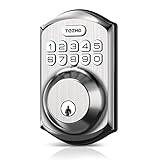
- Passcode Entry: This keypad lock offers 20 access codes for family use and a temporary code for single-use guest entry
- One-Time Code: A one-time PIN code can be set for door opening and will automatically be deleted after use
- Smart Locking: Features an automatic door lock that can be set to lock in 10-99 seconds (off by default) and one-touch auto-lock by pressing and holding any key on the keypad for 2 seconds
- Long Battery Life & Low Battery Indicator: Powered by 4 AA batteries (not included), lasts up to 365 days. A red light indicator alerts you when battery level drops below 15%
- Security Deadbolt: Provides reliable home protection with its sturdy aluminum alloy construction, weather resistance (IP54), durability, anti-peeping user code protection, low battery indicator, and solid lock cylinder.
- Enable every documented low-battery warning and keep replacement batteries available.
- Test the warning and backup method during installation rather than waiting for a failure.
- Record who can replace batteries and where the physical key or emergency power contact is stored.
- After replacement, operate the lock several times with the door open, then test again with the door closed.
If the battery dies, the outcome depends entirely on the model. Possible fallbacks include a conventional key cylinder, temporary external power contacts, a keypad that retains enough reserve power for one operation, or an interior manual release. Do not infer that a particular fallback exists because another brand or model has it; verify it in the manual before purchase.
Do you need Wi-Fi?
Not necessarily. Some locks provide local keypad or Bluetooth operation without home Wi-Fi. Wi-Fi, a bridge or another hub may be required for remote unlocking, remote status, notifications or integration with a wider smart-home system. Ask these questions before buying:
- Can the lock lock and unlock locally when the internet is down?
- Which functions require Bluetooth range, a bridge, Wi-Fi or a subscription?
- Can another household member use a code without creating an account?
- What happens after a router change, app sign-out or manufacturer service outage?
Connected-device security
CISA’s guidance for protecting a digital home applies to connected locks as part of the household network. Change default credentials, use a strong unique password, secure the Wi-Fi network, review app permissions and enable software or firmware updates when available. Limit account access to people who need it, remove former users and review activity notifications. These practices reduce avoidable account and network exposure, but they do not constitute a product-specific cybersecurity evaluation.
Access methods and household routines
When keyless entry solves a real problem
A keypad can help children, caregivers, cleaners or guests enter without receiving a physical key. Temporary or scheduled credentials can be useful when the model supports them and when you actively remove or expire them. Remote status can answer whether the door is locked, but only when the lock, network and service are functioning.
Rank #4

- 6 Ways to Unlock: Unlock with a touch for less than 1s with fingerprint lock. You can also open your front door lock via the eufy Security app, using the keypad or physical key, from Apple Watch, or use your voice with Alexa/Google Voice Assistant.
- 8 Months Battery Life: With 8 AA batteries, Smart Lock C220 runs around 8 months. Experience ultimate convenience and peace of mind with our long-lasting power solution. *May vary depending on the frequency of the lock being used.
- Self-learning AI: Fingerprint door lock recognition gets more precise with every touch, so you don't have to try agian and again to get in. Never be awkward or upset at unlocking the door.
- Control from Anywhere with Built-in Wi-Fi: No bridge required, you can control your wifi smart lock from anywhere via the eufy Security app. Easy setup.
- Integrated eufy ecosystem: If you have a eufy doorbell, you can add your wifi door lock to your routines and control devices together for keyless entry within the eufy Security app.
When a key is the better interface
A mechanical key is predictable for households that do not need shared codes, remote control or activity records. It avoids app onboarding, account recovery and battery warnings. You still need a sensible key-management plan: keep a spare accessible to an authorized person, avoid hiding it in an obvious location and rekey or replace the cylinder after an untrusted copy may exist.
Plan for guests and emergencies
Write down the normal and backup entry method in a secure household plan. Include what to do if a phone is lost, a code is forgotten, batteries are depleted, the internet is unavailable or the inside thumb turn is obstructed. Practice without disabling the lock’s safety features.
Independent reader supportYour contribution helps us test, update, and keep practical guides available for everyone.Cost and ownership trade-offs
Mechanical locks are typically less expensive than electronic locks, according to manufacturer guidance, but no current market-wide price or battery-life figure is established here. Compare the complete ownership cost instead of the shelf price alone.
Outdated Drivers Are Slowing You Down
One free scan finds every outdated or missing driver and matches the right update for your exact hardware.Free scan · exact hardware matchPC Slower Than It Used to Be?
A free scan shows the junk files, broken settings and background clutter dragging Windows down - then fixes them in one click.Free scan · Windows 10 & 11| Cost or effort | Traditional deadbolt | Smart deadbolt |
|---|---|---|
| Initial hardware | Usually lower than an electronic equivalent; exact price depends on certification, finish and design | Usually higher; exact price depends on access methods and connectivity |
| Installation | Simple when the existing preparation matches | May require additional alignment, adapters, setup and app pairing |
| Ongoing consumables | Normally none for the lock mechanism | Batteries; possibly bridge or other system components |
| Account or service dependence | None | Model-specific; advanced features may depend on an app, account, network or subscription |
| Maintenance effort | Lubrication and hardware inspection according to instructions | All mechanical checks plus battery, credential and update management |
Before purchase, verify current price, included parts, warranty, support period and update policy for the exact model. Retail availability and manufacturer features change.
Best Value
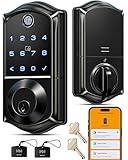
- Smart User Management: Our smart user management system empowers you to take full, remote control of your property access anytime, anywhere, via KK Home App; Designed with multi-tenant properties in mind, it provides a complete solution for authorizing users, managing their permissions; You can remotely grant access to new users, seamlessly change existing permissions, instantly pause access, or permanently delete it—all with a few taps; To ensure security and transparency, every entry is tracked in detailed activity logs, giving you a clear overview of who accessed your property and when
- 8-in-1 Smart Unlock & Locking: Unlock via fingerprint (Swedish FPC tech), App, authorized access, Fob card, code, code sharing, compatible with Alexa/Google Voice Assistant (* G1 Gateway required), or mechanical key for versatile use; Includes 5 locking methods: Auto lock (set 0–180 seconds directly in the app) + Fingerprint + Any Key + App + Mechanical Key; Ensures your door is always secure, offering unmatched flexibility and convenience
- Self-learning AI Fingerprint Recognition: Unlock your door in a blink with our advanced fingerprint system; Powered by a dedicated on-device AI chip, it verifies and grants access in under 0.2 seconds with 99.99% accuracy; Unlike ordinary locks, our AI continuously learns and refines its recognition patterns with each use, meaning accuracy improves over time; Let the whole family skip keys entirely; For ultimate control, you can add, rename, or delete fingerprints via the app, offering security and flexibility that redefine smart access
- 4 Password Modes & Intelligent Protection: Easily generate and share unlimited remote one-time codes for single use, unlimited remote duration codes for guests or sitters, permanent codes for family, and recurring codes for regular visitors—allowing for custom creation, one-click sharing, and instant deletion; The innovative Anti-Peeping Privacy Code feature lets you disguise your PIN by entering any numbers before or after the correct sequence, effectively preventing password leakage; Plus active intrusion defense that triggers real-time alarms and temporary lockouts on unauthorized attempts; This delivers ultimate access flexibility with complete security peace of mind
- On-Device Security with Proactive Alerts: Your access data — including entry records, user credentials, and fingerprints — is locally AES128 encrypted and stored directly on the lock, eliminating cloud leakage risks and ensuring complete privacy; Receive alerts for all door events and maintain visible, traceable activity logs; Enable “Silent Mode” to mute sounds quietly; When you're away, enable “Away Mode” to restrict access to your master credentials, the app, or physical keys only; This combination of encrypted local storage, smart notifications, and configurable control modes provides security that’s both robust and responsive to your life
Decision checklist: which type fits your home?
Choose a traditional deadbolt when most of these are true
- You want operation that does not depend on batteries, apps or a network.
- Everyone who needs access can manage a physical key.
- You do not need temporary codes, remote status or integrations.
- The existing door preparation suits a certified mechanical model.
- Simple ownership and a lower typical purchase cost matter more than automation.
Choose a smart deadbolt when most of these are true
- Keypad or phone entry would remove a recurring household problem.
- You need temporary, scheduled or revocable credentials.
- Remote status or control is valuable enough to justify connectivity and account management.
- You will monitor batteries, updates, permissions and backup entry.
- The exact model fits the door and documents a safe interior exit and recovery method.
Pause and resolve these issues before buying either
- The door is warped, the frame is split or the bolt does not align.
- Measurements do not match the manufacturer’s compatibility range.
- Occupants cannot reliably operate the proposed interior release.
- No one is responsible for keys, codes, batteries or account recovery.
- The product’s certification, ratings or backup-entry instructions are not documented.
Installation and first-week test plan
- Photograph and measure the existing setup. Record thickness, backset, handing and bore-hole layout before removing hardware.
- Read the model instructions end to end. Confirm parts, tools, clearances and any required app or hub.
- Install with the door open. Check that the bolt moves freely and that the interior release is obvious.
- Align the strike. Close the door slowly and verify full extension without forcing the panel.
- Complete electronic setup, if applicable. Create unique credentials, enable updates and configure only the permissions and notifications you need.
- Test every entry method. Try the primary method, the documented backup and the low-battery or external-power procedure.
- Test normal egress. Every occupant who may need to leave should practice unlocking from inside without a phone or network.
- Recheck after several days. Look for rubbing, loose screws, incomplete locking, missed notifications or credentials that should be removed.
If the lock binds, stops short of full extension or requires force, stop using it as the sole security measure until the alignment or installation problem is corrected.
Common problems and fixes
The smart lock will not lock completely
Open the door and operate the bolt. If it works open but not closed, inspect strike alignment, door sag and weather-strip pressure. Correct the mechanical fit before blaming the app or motor.
The app cannot connect
Determine whether the failure is local Bluetooth range, Wi-Fi, a bridge, account authentication or a service outage. Use the documented local or physical method instead of repeatedly forcing remote commands. Review credentials and permissions after restoring access.
Quick wins for a faster PC:
Repair Windows errors before they cause bigger problemsFix Now →Scan for outdated or missing drivers - takes under a minuteDriver Scan →The battery warning was missed
Confirm notifications are enabled and that the account receiving them is current. Keep a physical or external-power fallback available regardless; an alert is a convenience, not a guarantee of continued operation.
A key or code no longer works
For a key, check that the cylinder is not binding and that the door is not loading the bolt. For a code, verify that it has not expired, that the keypad is awake and that the user still has permission. Remove obsolete credentials and create a replacement rather than sharing a master credential.
The door cannot be opened from inside easily
Stop and review the lock’s interior release and the door hardware. A safe exit takes priority over convenience features. Double-cylinder arrangements deserve particular caution because they require a key on the interior.
Bottom-line recommendation
Buy the simplest certified deadbolt that matches your door and your household’s actual routine. That is usually a traditional single-cylinder model when mechanical reliability and independence are the priority. A smart deadbolt is justified when keyless credentials, remote information or integration will be used often enough to offset batteries, accounts, updates and connectivity. In either case, verify the specific model’s BHMA status and separate ratings, confirm door fit, protect the entry assembly and test both normal egress and the documented failure fallback before trusting the lock.
Quick Recap
Product prices and availability are accurate as of the date/time indicated and are subject to change. Any price and availability information displayed on Amazon at the time of purchase will apply.

