
Free tools Windows power users keep installed
One-click scans. No signup required.
iTechGuides is reader-supported. When you buy through links on our site, we may earn an affiliate commission. As an Amazon Associate I earn from qualifying purchases. Learn more
Samsung DeX and Android’s desktop windowing are related, but they are not the same product. DeX is Samsung’s Galaxy-specific desktop environment, built on Android multi-window behavior and extended with Samsung controls and integrations. Android desktop mode is the broader platform experience for running apps in resizable windows, including desktop sessions on a connected display where the device and software support it.
For most buyers, the practical choice is determined less by a theoretical winner than by four checks: your exact phone or tablet model, its Android and One UI version, the connection type you need, and whether your essential apps resize and accept a mouse and keyboard. A compatible Galaxy device may make DeX the simpler route. A supported non-Samsung phone or tablet may expose Android’s desktop windowing instead. Neither guarantees that every Android app will behave like a desktop application.
What is the difference between Samsung DeX and Android desktop mode?
Samsung DeX is Samsung’s implementation of a desktop-like workspace on compatible Galaxy phones and tablets. Samsung describes it as an extension of Android’s multi-window capabilities with additional Samsung integration. You can use windows, a taskbar-like control area, keyboard shortcuts, pointer input and external displays, depending on the device and DeX mode.
Windows Errors? Fix Them Before They Spread
Repair common Windows errors and clear accumulated junk for a smoother, more stable PC - no reinstall needed.Free scan · no reinstallOutdated Drivers Are Slowing You Down
One free scan finds every outdated or missing driver and matches the right update for your exact hardware.Free scan · exact hardware match“Android desktop mode” is a useful shorthand, but it can describe more than one Android feature. In this article it means Android’s platform desktop windowing and its connected-display desktop experience. Android’s implementation is designed for supported large-screen devices and phones that can start a desktop session on an external display. The manufacturer, Android release and device configuration determine whether that capability is present.
#1 Best Overall

- Premium aluminium 5-in-1 USB C Hub with 4K HDMI,5Gbps USB3.0,3.5mm Audio Jack,Type-C PD Charging/Data transfer,USB2.0.Maximize your USB-C device's capabilities
- 3.5mm Audio Jack,connect headphone and speaker.Support Microphone input.You can adjust the volume both on iPad Pro or in-line volume control on earphone/headset.Type C port not only deliver power at Max 60W,but also support USB-C headphone
- Mirror or extend your screen through HDMI output port and directly stream 4K@60Hz,1080P@60Hz,video to HDTV,monitors,or projectors for hassle-free presentations, conference calls,video streaming,home theater.Ideal for school,office,home,and game
- Extra 2 USB-A Port transfer speeds up to 5Gbps,transfer images,files,and videos in seconds.Allow you to connect phone,keyboard,mouse,thumb drive,camera,hard drive,etc.Please upgrade your iPad Pro to iPadOS 13 or above version to utilize any format of file transfer and more USB peripherals connection
- Wide Compatibility for Samsung Galaxy S25/S24/S23/S22/S21/S21 Ultra/S21+/S20/S20+/S20 Ultra/S10/S10+/S10e/S9/S9+/S8/S8+/Note20/Note10,Tab S9/S8/S7/S7+/S6,MacBook Pro 13''/14''/16'' M2/M1 , MacBook Air M2/M1,iPad mini 6/iPad Air 5/iPad Air 4/iPad 10/iPad Pro M2/M1
The overlap is substantial: both experiences let multiple apps appear in windows and are intended for pointer-and-keyboard work. The important difference is ownership and availability. DeX is a Samsung feature with Samsung-specific compatibility rules; Android desktop windowing is a platform capability that device makers expose on supported hardware.
| Comparison point | Samsung DeX | Android desktop windowing |
|---|---|---|
| Platform scope | Samsung’s Galaxy implementation, described as an extension of Android multi-window with Samsung integration. | Android’s desktop-like window experience on supported tablets and connected-display devices. |
| Window behavior | Apps may be resizable, fixed-size or unsupported, depending on their declared behavior and requirements. | Multiple apps can run in resizable windows with window controls and a taskbar on supported implementations. |
| External display | Wired and wireless display modes are available on compatible devices; wireless use depends on Miracast and device support. | A supported phone can start a desktop session on a connected display; a supported tablet can extend a session across displays. |
| Standalone tablet use | Available on select Galaxy tablets. Some newer workspace controls require Android 16 and One UI 8.0 or later. | Available on supported tablets, with behavior determined by the device’s Android release and implementation. |
| Best buying question | Does this Galaxy model support the DeX mode and connections you need, and do your important apps work well in it? | Does this device support desktop windowing or connected display, and are your key apps adaptive? |
How Samsung DeX works
DeX is a Galaxy-specific desktop layer
DeX does not replace Android. It presents Android apps in a desktop-oriented shell and uses Android’s multi-window framework underneath. Samsung adds its own workspace behavior and integration, so a Galaxy phone or tablet can feel more like a lightweight computer when connected to a monitor or, on selected tablets, when used on its own screen.
Compatibility is model-specific. Two Galaxy devices on similar Android versions can expose different DeX modes, and a feature documented for a US model may not be available on a model sold in another region. Treat Samsung’s current support page for your exact model as the authority rather than relying on an old device list.
External-monitor DeX
On a compatible Galaxy device, DeX can run on an external monitor or television through a wired connection. Samsung documents a standard USB-C to HDMI adapter as a way to start DeX. The adapter alone does not make every USB-C Galaxy device compatible: the phone or tablet must support video output and the relevant DeX mode.
Wireless DeX is also available on compatible combinations of Galaxy hardware and displays. Samsung’s documentation ties wireless display compatibility to Miracast support and lists model-specific exclusions. Ordinary wireless screen mirroring is not proof that wireless DeX will work; the display and the device must support the DeX connection.
Rank #2
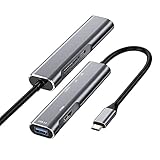
- USB C to 4K HDMI adapter designed with 4K HDMI Output,USB 3.0,SD/Micro SD Cards Reader,USB Type C PD Charging.Plug and play,no driver/software is needed.
- Enjoy PC-like experience for Samsung Galaxy via DeX mode.Enable you turn any place into a workplace and enjoy vivid video in huge TV or monitor anywhere.Ideal for school,office,home,and game.Please charge the hub by original Samsung charger when using DeX mode.
- USB3.0 Port speeds up to 5Gbps,transfer images,files,and videos in seconds.Allow you to connect phone,keyboard,mouse,thumb drive,camera,hard drive,etc. Quickly access your image/video throught bulit-in SD/Micro SD card slot.USB-C PD charging port allow delivers power at Max 60W.
- Wide Compatibility for Samsung S20/S20Ultra/Note20/Note10/Note9/TabS7/S7+/S6/S5,Nintendo Switch,2020/2018 iPad Pro/iPad Air 4,MacBook Pro/Air,Microsoft Surface Book 2, Surface Go, ChromeBook Pixel,most USB-C interface devices.
- Warranty of USB C Hub,you will get 1 year+6 months warranty.We provide free replacement and return term,we also provide you professional customer service & technical support within 24-hours.
Standalone DeX on tablets
Samsung documents standalone DeX on select Galaxy tablets, allowing the desktop workspace to run without an external monitor. Newer workspace functions are version-gated. Samsung’s workspace guidance identifies Android 16 with One UI 8.0 or higher for specified functions such as switching to standalone DeX from the Home screen and creating multiple workspaces on the supported tablets it covers. Those requirements should not be generalized to every Galaxy tablet or every DeX feature.
DeX for PC is a separate compatibility case
Samsung’s current US phone and tablet support guidance says DeX for PC is not supported on models running Android 15 with One UI 7 or later. This is different from using DeX directly on a monitor or television. If your plan depends on a Windows or macOS host, check that specific mode and your device’s software before buying cables or changing your workflow.
How Android desktop windowing works
Resizable windows are a platform capability, not a universal app promise
Android’s desktop windowing experience provides window controls, a taskbar and multiple resizable app windows on supported devices. Android’s large-screen guidance treats this as part of a broader adaptive-design model: apps should respond to available window size, screen density, keyboard input and pointer input rather than assuming a single phone-shaped screen.
Connected-display support adds another workflow. In an announcement dated March 3, 2026, Android Developers said connected-display support reached general availability with Android 16 QPR3. The announcement described a supported phone or foldable starting a desktop session on the external display while retaining the phone’s state, and a supported tablet extending the desktop session across screens. It named Pixel 8, Pixel 9 and Pixel 10 families and several Samsung device families at publication. That was a dated rollout statement, not a permanent universal compatibility list; check the current software and device support before depending on it.
Android’s Developer Relations Engineer Francesco Romano summarized the phone workflow this way: “When a supported Android phone or foldable is connected to an external display, a new desktop session starts on the connected display.” The word supported is decisive: Android desktop mode is not automatically enabled on every Android phone with a USB-C port.
Rank #3

- The Anker Advantage: Join the 80 million+ powered by our leading technology.
- Vivid Video: The HDMI adapter lets you connect to any TV or display with an HDMI port to stream video in up to 4K resolution.
- Plug and Play: Instantly turn your laptop’s USB-C port into an HDMI port, with no installation necessary. This product does not support charging or Power Delivery (PD).
- Premium Construction: A lightweight aluminum casing allows for greater heat dissipation, while the reinforced braided-nylon cable is designed to withstand the twists and tugs of daily use.
- Compatibility: Supports USB-C DP Alt mode, USB4, and Thunderbolt connections.
Phone, tablet and display behavior can differ
A phone may keep its normal interface on the handset while presenting a separate desktop session on a monitor. A tablet with desktop windowing may use its built-in display and an external screen as one extended workspace. Other devices may offer only windows on the tablet itself, or may not expose desktop windowing at all. Android’s platform documentation does not turn these into one identical experience across manufacturers.
App support: launching is not the same as working well
The most common mistake in a DeX-versus-Android comparison is treating an app that opens as an app that is desktop-ready. Both environments can apply compatibility behavior to apps that were designed for a fixed orientation, a phone-sized layout or touch-only interaction.
Samsung’s three practical DeX outcomes
| Outcome | What you see | Why it happens |
|---|---|---|
| Resizable window | The app can be enlarged, tiled or arranged beside other windows. | The app supports Android multi-window behavior and handles changing size, density and desktop input. |
| Fixed-size window | The app opens but its dimensions are limited or its layout remains phone-like. | The app declares fixed-orientation or fixed-size assumptions, or has not implemented robust resizing. |
| Unsupported app | The app cannot be opened in the DeX workspace or is blocked from the mode. | Its requirements or compatibility declarations prevent DeX from presenting it as a desktop app. |
Samsung’s developer guidance says a properly resizable DeX app should support Android multi-window, multiple display densities and mouse or trackpad interaction. An app that requires touch gestures, a sensor, a phone-only aspect ratio or an on-screen keyboard may launch yet remain awkward or incomplete with a pointer and physical keyboard.
Android’s adaptive-app expectations
Android’s guidance makes the same distinction. An adaptive app should respond to window size, changing display metrics and density, and external keyboard and pointer input. Android 16 compatibility behavior can override some orientation and aspect-ratio assumptions on large displays, but that compatibility treatment does not certify that the app’s interface is polished, that every control is reachable with a mouse, or that desktop workflows are supported.
How to test the apps that matter to you
- Make a short list of essential apps rather than testing the entire Play Store.
- Open each app in the intended environment: DeX on the actual monitor, or Android desktop windowing on the actual tablet or connected display.
- Resize the window from both a narrow and a wide shape. Look for clipped controls, forced portrait orientation, unreadable text or excessive empty space.
- Use a mouse or trackpad for navigation, selection, scrolling and drag-and-drop. Check whether important actions still require touch.
- Try the keyboard shortcuts and text-entry fields you expect to use. A phone-style app may accept typing but still lack desktop-friendly focus behavior.
- Repeat after an operating-system or app update. Compatibility can change when an app changes its manifest or when Android changes large-screen behavior.
Connecting a device: practical setup paths
Wired Samsung DeX on a monitor
- Confirm that your exact Galaxy model supports DeX over a wired display connection. Verify the model and regional software on Samsung’s current support documentation.
- Connect a compatible USB-C to HDMI adapter to the Galaxy device, then connect an HDMI cable from the adapter to the monitor or television. Samsung documents this adapter method; USB-C video output is not universal across Galaxy devices.
- Turn on the display and select the HDMI input used by the adapter.
- Accept the DeX prompt or select DeX when the device presents the available display mode. Labels and prompts can vary by One UI version.
- Pair or connect a keyboard and mouse if you need desktop input. Test pointer movement, scrolling and text entry before starting important work.
If the display remains blank, first check the monitor input and the adapter, then confirm that the phone supports video output and wired DeX. A charging-only USB-C accessory cannot carry a display signal.
Recommended Free Tools
Rank #4

- Versatile 3-in-1 USB C Hub: Upgrade your laptop's connectivity with the Acer USB C Hub. It offers a HDMI 4K@30Hz output port, a PD charging port (Charging function only), and a USB-A 3.0 port. Effortlessly mirror your iPhone or iPad screen to a TV, projector & monitor. Ideal for enhancing your home theater experience, optimizing office productivity, facilitating travel, and more.
- Ultra HD 4K Video Output: Enjoy high-definition visuals with the 4K@30Hz video output, whether you're watching videos, editing photos, or conducting multimedia presentations. Compatible with most HDTVs, monitors, projectors, and other devices with HDMI ports, offering vivid, clear video and pictures. 📌Note: USB-C port must support "DisplayPort Alternate Mode". NOT support Portable Monitor. Not HDMI Female Port.
- 100W Fast Powerful Charging: Tailored for rapid charging, the Type-C/Thunderbolt 3 port on this USB-C dongle has a maximum power delivery of 100W and is compatible with PD fast charging protocols. (📌 Note: Charging speed varies depending on the device, cable, and charger used. Please ensure the charger and charging cable are 45W or more for better charging. The USB-C port only supports charging host device)
- High-Speed Transfer: Seamlessly move files to and from your laptop at speeds of up to 5 Gbps through USB-A data ports, a remarkable 10 times faster than USB 2.0 (480 Mbps). (📌 Note: The USB A port does not support charging.)
- Impressive Compatibility: Encased in high-quality aluminum housing for enhanced durability and heat dissipation, this usb c to hdmi adapter offers wide compatibility with various devices, including laptops, tablets, and smartphones. Designed for use with MacBook Pro/Air, iPad Pro/Air, HP, Acer, Dell XPS, laptops, Surface, tablets, this USB-C adapter functions seamlessly across multiple operating systems, including Windows, ChromeOS, Linux, and macOS X 10.5 or higher. 📌Note: Not compatible with iPhone, iPad, iPad Pro (Lightning Port), Portable Monitor, Galaxy A/ Tab A series, GoPro Series, Motorola Phone, and Fire Tablet.
Wireless Samsung DeX
- Confirm that both the Galaxy device and the receiving display support the required wireless DeX or Miracast capability.
- Place the devices on the same wireless network when the model’s instructions require it, and enable the display’s wireless-display receiver.
- Open the Galaxy’s display or DeX controls and choose the compatible receiver. The exact menu name can differ by One UI release.
- Accept the pairing request on the display, then connect a Bluetooth or USB input device if the display session needs a pointer and keyboard.
Do not substitute ordinary screen mirroring for DeX. Mirroring may show the phone screen without creating the separate desktop workspace, and Samsung documents model-specific exclusions for wireless DeX.
Standalone DeX on a supported tablet
- Check that the tablet model supports standalone DeX and that the required One UI and Android versions are installed.
- Switch to the DeX workspace using the tablet’s DeX control. On newer supported tablets, Samsung documents additional workspace controls with Android 16 and One UI 8.0 or later.
- Arrange windows and connect a keyboard, mouse or trackpad if the tablet will replace a laptop for extended sessions.
Android connected-display desktop sessions
- Verify that the phone, foldable or tablet is on a release and hardware configuration that supports Android desktop windowing or connected display. Android 16 QPR3 reached general availability for connected-display support on March 3, 2026, but support remains device-dependent.
- Use the device’s supported wired or wireless display connection and select the external display when Android offers the desktop-session option.
- Wait for the desktop session to start, then connect a keyboard and mouse and test the apps you need. On supported phones, the handset can retain its own state while the desktop session appears on the external display.
Why will an app not resize in Samsung DeX?
Samsung’s developer FAQ treats this as a normal compatibility question, not necessarily a hardware fault. The usual causes are an app that is fixed-size, fixed-orientation or unsupported, or an app whose interface assumes touch input.
- The app declares a fixed orientation. DeX may preserve the developer’s portrait or landscape assumption instead of allowing arbitrary window dimensions.
- The app does not implement Android multi-window behavior. It may open in a constrained window or refuse to enter a desktop arrangement.
- The app depends on touch. A button, gesture or drawing surface may work only with direct touch even when the surrounding window opens.
- The app has density or layout problems. Controls can be clipped or poorly spaced when the display metrics change.
- The device or One UI version imposes a compatibility rule. A software update can change how large-screen assumptions are handled.
There is no reliable setting that can turn every fixed-size app into a well-designed desktop app. You can maximize the window if DeX permits it, try the app’s own tablet or desktop setting, or use a touch-capable display for workflows that genuinely require touch. If the app is essential, confirm its behavior on the exact device and software version before adopting DeX as your primary workstation.
Display, input and accessory requirements
Display connection
Wired DeX needs a compatible Galaxy device, a display with the relevant input and an adapter or cable that carries video. Samsung explicitly documents USB-C to HDMI adapters, but does not imply that every USB-C Galaxy device supports video output. Wireless DeX needs a compatible receiver and, where applicable, Miracast support.
Keyboard and pointer
A desktop workspace is most useful when apps accept a mouse or trackpad and a physical keyboard. Samsung’s DeX guidance specifically calls out pointer interaction and avoiding touch-only requirements. Android’s adaptive-app guidance similarly expects apps to handle external pointer and keyboard changes. An app can be technically compatible while still being frustrating if menus, drag handles or text fields are optimized only for touch.
Screen size and density
Moving from a phone to a monitor changes the available window size, density and display metrics. Apps that do not recompute their layout can show oversized controls, tiny text, clipped dialogs or large unused areas. These are app-design limitations, not proof that DeX or Android desktop windowing is malfunctioning.
Which option should you choose?
Choose Samsung DeX when
- You already own a Galaxy model whose current documentation confirms the DeX mode you need.
- You want Samsung’s documented wired, wireless or standalone-tablet workflow.
- Your key apps have been tested with a pointer, keyboard and resizable windows in DeX.
- You can accept Samsung-specific limits, including the current DeX for PC restriction on models running Android 15 with One UI 7 or later.
Choose Android desktop windowing when
- Your phone, foldable or tablet explicitly supports Android desktop windowing or connected-display sessions.
- You want the platform-level experience on a supported non-Samsung device or a tablet that extends a session across displays.
- Your software is recent enough for the capability, such as a supported Android 16 QPR3 connected-display configuration.
- You have verified that your essential apps adapt to the target window sizes and external input.
Use this four-question decision check
- What exact device and software do you have? Record the model, Android version and One UI version, then check the current manufacturer documentation.
- How will you connect? Decide between tablet-only use, a wired monitor, a wireless display or a PC-hosted workflow. These are separate compatibility cases.
- Which apps are non-negotiable? Test their resizing, pointer behavior, keyboard input and any touch-only functions.
- What accessories and display do you need? Confirm video output, adapter compatibility, receiver support and the input devices required for your work.
Limitations you should plan around
- There is no universal DeX or Android desktop-mode device list that remains correct across regions and software releases.
- Wireless screen mirroring and wireless DeX are not interchangeable.
- An app’s ability to launch does not establish that it is resizable, mouse-friendly or fully functional.
- Android’s connected-display rollout is device- and release-dependent, even after Android 16 QPR3 general availability.
- Available documentation does not provide a controlled benchmark, universal app-compatibility percentage or performance winner between DeX and Android desktop windowing.
The most defensible comparison is therefore practical: verify the exact hardware and software, select the connection method you will actually use, and test the apps and input devices that determine whether the workspace is useful.
Quick Recap
Product prices and availability are accurate as of the date/time indicated and are subject to change. Any price and availability information displayed on Amazon at the time of purchase will apply.

