
iTechGuides is reader-supported. When you buy through links on our site, we may earn an affiliate commission. As an Amazon Associate I earn from qualifying purchases. Learn more
Docker can host a searchable document archive and the components for chatting with documents, but they are separate jobs—not one magic container. Paperless-ngx ingests, OCR-processes and indexes files; its optional AI features can suggest metadata, retrieve similar documents and support document chat. If you want a separate chatbot interface, you can add a front end such as Open WebUI and connect it to a model backend. The key decisions are where files and AI requests go, how you persist the archive, and whether your hardware can handle local models.
What Docker is doing in this setup
Docker runs the applications and services; it does not itself manage documents or provide an AI chatbot. A practical arrangement has three distinct parts:
- Paperless-ngx: the document archive. Files arrive through a configured consumption directory, then Paperless processes and indexes them for searching.
- AI features or chat interface: Paperless-ngx has optional AI-assisted features, including document chat. Alternatively, a separate interface such as Open WebUI can provide conversational access to a model.
- Model backend: the software and model that generate AI responses. It may run locally, for example through Ollama, or be a hosted service.
These components can be combined in different ways; a separate chatbot UI is not required to use Paperless-ngx, and Docker does not automatically connect every component. Paperless-ngx describes its archive and document workflow at its official documentation, while its AI documentation explains the optional AI capabilities.
Recommended Free Tools
How documents get into the archive
Paperless-ngx watches a configured consumption directory. Put a digital file there—or arrange for another service to place it there—and Paperless processes it into the searchable archive. The exact storage paths depend on the Compose configuration. Its usage guide describes intake and processing.
#1 Best Overall

- PORTABLE SCANNER FOR USE ON-THE-GO — The fastest and lightest mobile single-sheet-fed compact document scanner in its class¹
- QUICK DOCUMENT SCANNING ― This Epson ultra-fast scanner scans a single page as quickly as 5.5 seconds²; Windows and Mac compatible
- VERSATILE PAPER HANDLING ― Portable scanner scans documents up to 8.5 x 72 in; Also easily digitizes receipts and ID cards to make accounting, bookkeeping, and organizing simpler
- INTUITIVE, HIGH-SPEED SOFTWARE — Epson ScanSmart Software³ is a smart tool allowing you to easily scan, review, and save; Stay organized easily with the help of this Epson scanner
- EASY SETUP — USB-powered connect to your computer for quick and simple scanning; No batteries or external power supply required to operate portable document scanner; Standard Connectivity: USB 2.0
A scanner can be part of the workflow, but it is not a prerequisite and does not necessarily connect directly to Paperless-ngx. The scanner or an additional workflow must save or transfer scans into the configured intake location. For a paper-heavy household or office, a duplex document scanner with an automatic document feeder may reduce manual handling; choose based on your volume and workflow rather than assuming a particular model is required.
Plan persistent storage first
Paperless-ngx’s Docker setup uses mounted directories for consumption and persistent application data. Review the setup guide before deploying, so your archive and application state do not depend on a disposable container filesystem. The setup documentation recommends PostgreSQL for new installations and provides an interactive Docker Compose installer.
Rank #2

- FAST SPEEDS - Scans color and black and white documents a blazing speed up to 16ppm (1). Color scanning won’t slow you down as the color scan speed is the same as the black and white scan speed.
- ULTRA COMPACT – At less than 1 foot in length and only about 1. 5lbs in weight you can fit this device virtually anywhere (a bag, a purse, even a pocket).
- READY WHENEVER YOU ARE – The DS-640 mobile scanner is powered via an included micro USB 3. 0 cable allowing you to use it even where there is no outlet available. Plug it into you PC or laptop and you are ready to scan.
- WORKS YOUR WAY – Use the Brother free iPrint&Scan desktop app for scanning to multiple “Scan-to” destinations like PC, Network, cloud services, Email and OCR. (2) Supports Windows, Mac and Linux and TWAIN/WIA for PC/ICA for Mac/SANE drivers. (3)
- OPTIMIZE IMAGES AND TEXT – Automatic color detection/adjustment, image rotation (PC only), bleed through prevention/background removal, text enhancement, color drop to enhance scans. Software suite includes document management and OCR software. (4)
OCR language settings should match the documents you expect to ingest. If the consumption directory is on a network-mounted filesystem, account for how that filesystem reports new files: the documentation notes that some systems, including NFS, do not provide inotify notifications, so polling may need to be configured.
Can you chat with documents in Paperless-ngx?
Yes, Paperless-ngx documents optional AI features, including document chat, AI-assisted suggestions and similar-document retrieval. They are off by default. When enabled, document content and metadata are sent to the backend you configure, so the model choice is also a data-handling choice. See the Paperless-ngx AI documentation for current configuration details.
Rank #3
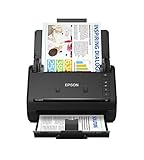
- FAST DOCUMENT SCANNING — Document scanner with feeder allows you to speed through stacks with a 50-sheet Auto Document Feeder (ADF); Efficient office scanner to help you scan more productively
- INTUITIVE, HIGH-SPEED SOFTWARE — Quickly scan with this desktop document scanner; Epson ScanSmart Software lets you easily preview scans, email files, upload to the cloud, and more; Plus, automatic file naming saves even more time
- SEAMLESS INTEGRATION — Easily incorporate your data into most document management software with the included TWAIN driver; Office document scanner integrates seamlessly with business workflows
- EASY SHARING — Duplex scanner allows you to scan straight to email or popular cloud storage2 services like Dropbox, Evernote, Google Drive, and OneDrive for simple storage and sharing
- SIMPLE FILE MANAGEMENT — Scanner allows the creation of searchable PDFs with Optical Character Recognition (OCR) and convert scans to editable Word or Excel files effortlessly; Designed for home and office document scanning
You can use a local backend such as Ollama or a remote hosted service. Local inference can keep processing on your own system, but you are responsible for operating the model runtime and supplying suitable hardware. A hosted backend reduces the need to run inference locally, but document content leaves your server and provider charges may apply. A self-hosted interface alone does not make requests local: the backend determines where the content is processed.
When a separate chatbot interface makes sense
Open WebUI is an optional chat front end, not a replacement for Paperless-ngx’s archive. It can connect to Ollama or compatible APIs. Docker also documents a Compose-based connection between Open WebUI and Docker Model Runner; its example uses port 12434. Treat this as a separate integration to configure, not a feature automatically enabled by installing Paperless-ngx. See the Open WebUI Docker quick start and Docker Model Runner integration guide.
Rank #4

- Scanner type: Document
- Connectivity technology: USB
- With Auto Scan Mode, the scanner automatically detects what you're scanning
- Digitize documents and images
Open WebUI’s quick start stores chats, users and settings in a persistent volume. It recommends pinning a specific version tag for a stable deployment; a floating tag such as main follows a rolling build. The same guide distinguishes GPU support for Open WebUI’s own embedding, reranking and speech components from GPU access for an Ollama model container. Do not assume that enabling one makes a GPU available to the other.
PC Slower Than It Used to Be?
A free scan shows the junk files, broken settings and background clutter dragging Windows down - then fixes them in one click.Free scan · Windows 10 & 11Outdated Drivers Are Slowing You Down
One free scan finds every outdated or missing driver and matches the right update for your exact hardware.Free scan · exact hardware matchFor security, use authentication appropriate to who can reach the interface. Open WebUI advises using a persistent secret key and warns that enabling single-user mode without authentication prevents later switching to multi-account mode. Docker’s Model Runner integration demonstrates authentication for a multi-user setup. A locally hosted web interface should not be treated as safe for public exposure without suitable access controls.
Best Value

- OUR MOST ADVANCED SCANSNAP. Large touchscreen, fast 45ppm double-sided scanning, 100-sheet document feeder, Wi-Fi and USB connectivity, automatic optimizations, and support for cloud services. Upgraded replacement for the discontinued iX1600
- CUSTOMIZABLE. SHARABLE. Select personalized profiles from the touchscreen. Send to PC, Mac, mobile devices, and clouds. QUICK MENU lets you quickly scan-drag-drop to your favorite computer apps
- STABLE WIRELESS OR USB CONNECTION. Built-in Wi-Fi 6 for the fastest and most secure scanning. Connect to smart devices or cloud services without a computer. USB-C connection also available
- PHOTO AND DOCUMENT ORGANIZATION MADE EFFORTLESS. Easily manage, edit, and use scanned data from documents, receipts, photos, and business cards. Automatically optimize, name, and sort files
- AVOIDS PAPER JAMS AND DAMAGE. Features a brake roller system to feed paper smoothly, a multi-feed sensor that detects pages stuck together, and skew detection to prevent paper damage and data loss
Local or hosted AI: choose by data flow and workload
| Consideration | Local model backend | Hosted model backend |
|---|---|---|
| Where document content is processed | On the local system when configured to use a local backend. | Sent to the configured provider, as Paperless-ngx warns for enabled AI features. |
| Privacy and data handling | Processing can remain local; you still need to manage the server and its access. | Provider handling applies because document content and metadata leave your server. |
| Usage fees | No hosted API usage fee is implied, though hardware and operating costs remain. | Provider charges may apply; the amount depends on the provider and its terms. |
| Hardware and response time | Depends on the model and local hardware; no universal minimum specification is established in the cited documentation. | Inference is handled remotely, reducing local model-compute needs; response time depends on the service and connection. |
| Setup and maintenance | You operate the model runtime and maintain the local deployment. | You configure a provider endpoint and account, and rely on the provider’s service. |
The privacy distinction is not “Docker versus cloud”; it is where the configured model backend processes the document. Paperless-ngx explicitly states that enabled AI features send document content and metadata to that backend. Check the backend and its data practices before enabling those features for sensitive records.
Hardware and performance expectations
Paperless-ngx supports ARM64 Docker images, including Raspberry Pi use, but its FAQ warns that OCR can be slow on lower-powered devices. OCR and local language-model inference are different workloads: a machine that can archive and OCR documents may still be unsuitable for a responsive local chatbot. The Paperless-ngx FAQ and setup documentation do not establish a universal minimum PC, memory, GPU or scanner specification, so select hardware for your document volume and model rather than relying on a blanket requirement.
A sensible deployment order
- Set up Paperless-ngx with Docker Compose. Use the official setup guidance, choose the documented database approach, and configure persistent data and media paths.
- Test intake and OCR before adding AI. Place a few representative files in the consumption directory and verify they are processed and searchable. Set OCR languages for your documents.
- Choose the AI data path. If enabling Paperless-ngx AI, select its configured backend with the privacy and hardware trade-offs in mind. Leave AI features disabled if you do not need them.
- Add a separate chat UI only if it solves a need. Follow the Open WebUI quick start for its Docker setup and persistent storage, then configure its connection to the model service. For Docker Model Runner, use the official integration guide.
- Secure and maintain the services. Configure authentication for the actual exposure of the interfaces, persist application data, and pin a specific Open WebUI image version when you need a stable deployment.
What this arrangement does—and does not—promise
This architecture can give you a Docker-hosted document archive plus optional AI-assisted retrieval or chat. It does not guarantee that every scan is automatically imported, that every question will be answered accurately, or that all model processing stays local. Those outcomes depend on the intake workflow, configuration, chosen backend and model. Treat the archive and OCR as the foundation; add conversational AI only after deciding what document data it may process.
Free tools Windows power users keep installed
One-click scans. No signup required.
Quick Recap
Product prices and availability are accurate as of the date/time indicated and are subject to change. Any price and availability information displayed on Amazon at the time of purchase will apply.

