
iTechGuides is reader-supported. When you buy through links on our site, we may earn an affiliate commission. As an Amazon Associate I earn from qualifying purchases. Learn more
RF noise can come from the environment, unwanted emissions, or the receiver’s own components. Which source matters depends on frequency, antenna and cable paths, receiver design, bandwidth, and the strength of nearby signals. Separating these causes is the first step toward understanding poor reception or choosing a useful fix.
What is RF noise?
ITU-R defines radio-frequency noise as “a time-varying electromagnetic phenomenon having components in the radio-frequency range, apparently not conveying information and which may be superimposed on, or combined with, a wanted signal.” Its current Recommendation P.372-18, approved September 8, 2026, describes external radio-noise backgrounds from 0.1 Hz to 100 GHz. The recommendation’s model concerns noise received through a reference antenna and feeder; it does not cover every way noise can enter equipment. ITU-R Recommendation P.372-18
RF noise is not the same as every unwanted signal. A single identifiable transmitter or spur is interference; many unresolved signals can combine into something that appears noise-like. In practical troubleshooting, it helps to distinguish three broad cases: external noise received by the antenna, interference coupled into equipment by other paths, and noise generated within the receiver.
What are the external sources of radio-frequency noise?
External noise includes natural emissions and human-made emissions. The amount that reaches a receiver varies with frequency, antenna pattern and location, nearby objects, and the path by which energy couples into the system.
#1 Best Overall
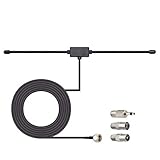
- Adhesive Mounting FM Radio Antenna 75 Ohm UNBAL FM Dipole Antenna with Universal Connector and Adapter,for Music System Indoor Radio Bluetooth Stereo Receiver AV Audio video Home Theater Receiver Tuner.
- Compatible with Yamaha, Sherwood, Pioneer, Panasonic, Onkyo, Sony, Bose Indoor Sound Radio Home Stereo Audio video Receiver, 75 ohm UNBAL.
- 10 feet / 3m Coaxial Extension Cable, Antenna Connector Interface: F Type Plug Connector; Included Connector Adapter: TV Female Socket Connector Adapter, 3.5mm Audio Plug Connector Adapter, TV Male Plug Connector Adapter;
- Easy to install; Adhesive Wall Mounting, Improves FM Radio Stereo Reception;
- Package List: 1 x Antenna, 3 x Connector Adapters;(As the Picture Shown)
Natural sources
- Atmospheric gases and hydrometeors, including precipitation-related effects.
- Lightning and other static electrical discharges.
- Radio emissions from the Earth’s surface, including land, ocean, and objects in the antenna beam.
- Celestial radio sources.
Human-made sources
- Electrical machinery, electronic equipment, and networks operating in aggregate.
- Power transmission lines, powerline communications, and wireless power-transfer systems.
- Industrial, scientific, and medical equipment.
- Engine ignition systems.
- Imperfectly shielded enclosures, transmission lines, and cables.
Practical examples near low-noise amplifiers include machinery, power lines, nearby transmitters or receivers, computers, digital circuits, and switching power supplies in the same equipment. These are examples, not a universal ranking of the most common causes. Analog Devices AN-940
How can noise reach a receiver without coming through its antenna?
Noise can couple through cables, equipment enclosures, power connections, nearby structures, or inadequate screening. Feeder balance and shielding also matter. These paths are distinct from the antenna-and-feeder path described by ITU-R’s external-noise model, so an external-noise category alone may not explain a real installation’s symptoms.
A useful diagnostic distinction is whether the unwanted energy is entering through the antenna or being conducted or radiated into the receiver or its wiring. The distinction matters because changing the antenna may not address interference entering through a power lead or poorly screened enclosure.
Windows Errors? Fix Them Before They Spread
Repair common Windows errors and clear accumulated junk for a smoother, more stable PC - no reinstall needed.Free scan · no reinstallOutdated Drivers Are Slowing You Down
One free scan finds every outdated or missing driver and matches the right update for your exact hardware.Free scan · exact hardware matchWhat noise is generated inside electronic components?
Intrinsic noise arises from physical processes in resistors and semiconductor devices. Its importance depends on component type, operating conditions, frequency, and circuit design.
Rank #2
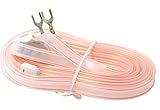
- T Shape, plug and play, easy to install and greatly improve FM Stereo Reception. 5.9 feet longer fm coax antenna cable make you receive more channels and radio stations, help you enjoy your life better.
- This 300 Ohm FM antenna provide a better radio solution for radio stereo receiver on your table top, home, office, garage, basement and so on.
- Stretch the end of the antenna as far as possible away from the device for the best reception.
- Fits all receivers with a clip or terminal FM socket. Before placing the order, please make sure your FM socket is the same as what we have mentioned.
- Package include: 1PCS antenna
Thermal noise
Thermal, or Johnson, noise comes from the thermal motion of charge carriers in resistance. It increases with resistance, absolute temperature, and bandwidth. As an illustration, Analog Devices gives about 4 nV/√Hz for a 1 kΩ resistor at room temperature; this is an example under those conditions, not a universal resistor value. Analog Devices AN-940
Shot and avalanche noise
Shot noise is associated with the discrete, random nature of current flow. Avalanche noise can arise in semiconductor devices that use avalanche processes. Their significance depends on the device and how it is biased.
Flicker and popcorn noise
Flicker noise, also called 1/f noise, becomes more prominent toward lower frequencies. Popcorn noise appears as abrupt, random shifts or bursts in offset or current. These semiconductor noise families do not affect every device or circuit in the same way. Analog Devices, “Managing Noise in the Signal Chain, Part 1”
What’s actually slowing this PC down?
Pick the symptom - the matching free tool is one click away.
Voltage or current noise density is commonly expressed per square root of bandwidth. Independent noise contributions combine as the square root of the sum of their squares, not as a simple arithmetic sum. If sources are correlated, their correlation must be accounted for. Analog Devices AN-940
Rank #3

- FM Coax Antenna :Impedance:75 Ohm;Connector:F-Type Male Plug;Length:4.9ft/150cm
- Easy to Use:The FM Coax Antenna Comes with F-Type Male Connector and The AM Loop Antenna comes with 2 Pins Bare Wire ,Easy to Install,Just Insert It Into the Antenna Port On The Back of the Stereo Receiver to Receive FM and AM Radio Signal
- Portable Designed:This FM Antenna and AM Loop Antenna is Very Portable,Can Provide a Better Radio Stations to your Home, Garage, Basement, Attic, Office, etc.
- Wide Application:This FM Stereo Antenna Cord Apply to Most Home Radio Stereo Receiver,Which Provide a Better AM Radio Solution for Stereo Receiver Radios
- More Choice:The 4.9ft 75 Ohm FM Antenna Coax Coaxial Cable can Make You Receive More FM Channels and Radio Station and The AM Loop Antenna with 2-Pin Bare AM Antenna With Fold-Out Base, Easy to Install, Help You Get More Stable AM Signal
How do phase noise and strong signals impair reception?
Oscillator phase noise describes small fluctuations in a signal’s phase in the frequency domain. It is expressed as noise power relative to the carrier in a 1 Hz bandwidth at specified frequency offsets. Phase jitter describes related behavior in the time domain; the two measures are related but are not interchangeable labels.
In reciprocal mixing, phase noise from a receiver’s local oscillator mixes with a strong nearby interferer, spreading some of that interferer’s energy into the wanted channel. A larger or closer interferer is more likely to cause trouble. This can degrade reception even when the wanted channel’s apparent noise floor seems low.
Strong signals can also push a receiver into nonlinear operation and produce intermodulation or other spurious products that fall in the wanted channel. In some receiver architectures, down-converting a signal below a device’s flicker-noise corner before adequate gain is applied can make 1/f noise significant. These effects depend on receiver architecture and operating conditions; they are not simply noise arriving at the antenna.
Do these 3 things before closing this tab:
1Clear out junk files and repair common Windows errors2Fix the driver behind crashes, sound loss and screen glitches3Repair Windows errors before they cause bigger problemsHow does RF noise affect sensitivity?
Noise limits how weak a wanted signal can be while still meeting a receiver’s detection requirement. Noise factor compares input and output signal-to-noise ratio under a defined input reference condition; noise figure is that factor expressed in decibels. The conventional reference temperature for the input termination is 290 K, and comparisons require specified frequency and measurement bandwidth. Mixer noise figures can use single-sideband or double-sideband conventions, so the convention and setup matter. Analog Devices, “System Noise-Figure Analysis for Modern Radio Receivers”
Rank #4

- Enhanced FM Reception: The fm antenna for stereo receiver ensures crystal-clear audio quality, perfect for home stereo systems and indoor radios.
- Easy Setup Design: Comes with a 5-meter coaxial cable and a retractable antenna for hassle-free installation and optimal placement.
- Strong Magnetic Base: Provides stable positioning on metal surfaces, ensuring consistent signal strength without slipping.
- Wide Compatibility: Works seamlessly with Pioneer, Onkyo, Yamaha, Marantz, Sherwood, and other leading stereo receiver brands.
- Exceptional Performance Indoors: Designed for digital HD radios and home theater setups, offering reliable signal even in urban environments.
For an idealized receiver at 290 K, a common sensitivity estimate is:
Required minimum SNR + 10 log10(noise bandwidth in Hz) + receiver noise figure − 174 dBm/Hz
The −174 dBm/Hz term is the thermal-noise density reference at 290 K. It is not a complete receiver noise floor on its own: bandwidth, receiver noise figure, and the required detection SNR all affect the estimate. Analog Devices, “High Performance Narrowband Receiver Design Simplified by IF Digitizing Subsystem in LQFP”
In a cascaded receiver, noise from early stages has a substantial effect on overall noise figure. That is why a low-noise amplifier is often placed near the front end. But adding gain is not automatically beneficial: a stronger signal at later stages can make blocker handling and linearity more important, while oscillator phase noise can still limit performance.
Best Value

- FM Telescopic Antenna Parameter:Impedance:75 Ohm;Connector:F-Type Male Plug;Length: 6.5" / 16.5cm; Extend length: 29.3" / 74.5cm
- Easy to Use:The 75 Ohm FM Antenna With F-Type Male Connector, Just Screw or Plug To The Antenna Socket, Very Easy to Install
- Portable Designed:This FM Antenna is Very Portable,Can Provide a Better Radio Stations to your Home, Garage, Basement, Attic, Office, etc.
- Wide Application:This FM Stereo Antenna Provide 75 Ohm FM Radio Solution for Radio, Apply to Most Home Radio Stereo Receiver,Which Provide a Better AM Radio Solution for Stereo Receiver Radios
- Make Life Better:The 75 Ohm FM Radio Antenna can Strong Signal, Make You Receive More FM Channels and Radio Station,Help You Get More Stable FM Signal, Stations for Stereo Receiver Radios
How can you identify the relevant noise source?
Start by deciding which path and mechanism best fit the symptoms. A receiver’s reported noise level alone may not distinguish external background noise from internal noise or a strong blocker’s effects.
- Check the path. Determine whether the symptom changes with the antenna connection or could be entering through a cable, power connection, enclosure, or other nearby structure.
- Consider frequency and location. External natural and human-made sources vary with frequency and surroundings. Indoors or near obstructions, one source or a small group of sources may matter more than an aggregate background.
- Look for strong nearby signals. A blocker can cause reciprocal mixing or nonlinear products even if it is outside the wanted channel.
- Consider receiver-generated noise. Noise figure, bandwidth, early-stage gain, oscillator phase noise, and low-frequency flicker behavior can all affect performance.
- Compare conditions consistently. Noise and sensitivity comparisons are meaningful only when frequency, bandwidth, input termination, temperature assumptions, and measurement setup are stated.
For a formal noise-figure measurement, the Y-factor method uses a calibrated RF noise source with two characterized noise-temperature states, conventionally produced by switching the source on and off. The source’s excess noise ratio (ENR) and the output noise power measured in both states are used to derive the device-under-test noise factor. The setup also requires an instrument to measure output noise power. A suitable noise source must match the frequency range, ENR, connector, calibration, and measurement setup. Analog Devices, “System Noise-Figure Analysis for Modern Radio Receivers”
Which receiver characteristics matter in a noise comparison?
Noise figure is only one part of receiver performance. For a meaningful comparison, assess the conditions and characteristics that can change the outcome:
Free tools Windows power users keep installed
One-click scans. No signup required.
- Input-referred noise or noise figure, with measurement conditions stated.
- Operating frequency and bandwidth.
- Antenna or source noise temperature.
- Gain and placement of each stage in the cascade.
- Linearity and dynamic range in the presence of blockers.
- Oscillator phase noise at relevant frequency offsets.
- Power, temperature, and measurement setup.
No single external source or receiver fault explains every case of poor reception. Lowering an amplifier’s noise figure can help in the right conditions, but it does not by itself resolve conducted interference, strong blockers, reciprocal mixing, or inadequate linearity.
Quick Recap
Product prices and availability are accurate as of the date/time indicated and are subject to change. Any price and availability information displayed on Amazon at the time of purchase will apply.

