
iTechGuides is reader-supported. When you buy through links on our site, we may earn an affiliate commission. As an Amazon Associate I earn from qualifying purchases. Learn more
To verify a seed-based provably fair game result, save the server-seed hash shown before play, the client seed, the round’s nonce or cursor, and the displayed result. After the server seed is revealed, check that its SHA-256 hash matches the saved commitment, then replay the game’s documented algorithm with the exact round inputs. The hash check and replay are separate: both are needed to confirm that the revealed seed matches its earlier commitment and reproduces the recorded outcome.
What you need to save for each round
Collect the round record before the active server seed changes or is revealed. Keep the original strings and values exactly as displayed; small differences in spelling, capitalization, separators, or round numbering can change the result.
- Server hash: the commitment displayed before the relevant game or seed pair is used.
- Client seed: the exact client-seed string, plus any seed version or rotation information shown.
- Round coordinates: the nonce and, if the game uses them, a cursor, round index, or other counter.
- Game details: the game mode and any bet-specific inputs that affect the draw.
- Displayed outcome: the precise history entry for that round.
Save a screenshot or export the game record when available. A record that omits the nonce, cursor, game mode, or relevant bet parameters may not be enough to reproduce the outcome.
How to verify a result
- Capture the pre-play commitment. Copy the server hash shown before the round or seed pair is used. Record the client seed and seed version alongside it.
- Record the round coordinates and outcome. Save the nonce and any cursor or round counter, game-specific inputs, and the result shown in the history. Do not assume that a nonce increments globally or resets the same way across games.
- Wait for the server-seed reveal. In the cited commit-reveal design, the server seed remains secret while it is in use. Once revealed, preserve its exact string and follow the game’s stated encoding rules.
- Check the commitment. Calculate SHA-256 over the exact revealed server seed and compare it with the server hash you saved before play. A mismatch means the revealed value does not match that commitment, provided the seed and hash were copied and encoded correctly.
- Replay the game’s documented algorithm. Use a verifier or implementation that matches the game’s published specification—not merely one that accepts the same three seed values.
- Compare the replay with the original record. Confirm that the recalculated value matches the history entry for the same game, seed, nonce, cursor, and inputs. Keep the verifier output with the original record.
What the algorithm must match
Seed-based systems are not all interchangeable. Before trusting a verifier, check the game’s specification or auditable reference implementation for each of the following:
#1 Best Overall

- Made of high quality transparent acrylic with glossy, polished finish. White pips are highly visible.
- Dimensions are 19*19*19mm and are accurate to .0001.
- Professional serialized as a set of 5 to prevent tampering.
- Grade AAA, these 19mm dice meet or exceed all exacting casino dice specifications for precision
- 5pcs red dices per set, wrapped in giftable golden foil.
- How seed strings are encoded and whether the commitment uses SHA-256 or another documented hash.
- Which value is the HMAC key, how the message is formed, and the order and separators used for its inputs.
- Where the nonce starts and how it increments, and whether the game also uses a cursor or round value.
- How output bytes become numbers, including range boundaries, rejection handling, or any modulo rule.
- How the resulting number is transformed into the game outcome, such as a dice value, card, multiplier, or position.
For example, the Provable.IO Core Library documents a particular construction: it commits to a server seed with its SHA-256 hash, then uses HMAC-SHA256 with the server seed as the key and a message containing the client seed, nonce, and round. Its library describes deriving floats from four bytes at a time and integers from 32-bit values, with rejection handling for unbiased integer ranges. Those details apply to that implementation; do not assume another game uses the same message format, byte conversion, or outcome mapping.
Using a verifier or replaying the result yourself
A game-specific or third-party verifier can make the calculation easier, while an open-source library or your own implementation lets you reproduce it directly. Whichever route you choose, check that the tool supports the exact game and seed format, documents its method, checks both the commitment and the outcome replay, and can reproduce its result from your saved round record.
Rank #2

- FOIL WRAPPED DICE SET - Add a professional edge to your dice games with these high-quality board game accessories, which are 19mm on each side and manufactured to strict standards for reliable use.
- PROFESSIONAL GRADE - These game dice are professionally serialized and accurate to .0001. These casino dice are transparent with razor edges, and the flush spots have a high polish finish for an attractive appearance and appealing feel.
- CASINO STYLE - These sleek sharp edge dice will be a stylish addition to your casino equipment. Use these professional dice during your weekly game night to make your living room feel like a Las Vegas getaway.
- HIGH POLISH FINISH - These transparent blue dice are manufactured from high-quality plastic material that is free from defects. The contrasting white markings are easy to read for improved functionality.
- PRODUCT DETAILS - Materials: Plastic. Dimensions: (L) 19mm x (W) 19mm x (H) 19mm. Set Includes 6 Die. Foil Wrapped. Color: Blue and White.
- For an online verifier: confirm whether it is independent of the operator and whether its methodology or source code is public. A verifier’s result is only as useful as its implementation and the inputs it received.
- For code-based replay: use the game’s published specification or an auditable reference implementation, and verify each input-formatting and conversion detail listed above.
- Before seed reveal: a verifier may show only a commitment or pending status. Provable.io says its full verification requires replay with a revealed seed and a matching commitment; that status terminology describes its own service.
For its own status definition, Provable.io’s verifier says a result is verified when the revealed server seed hashes to the pre-draw server hash and replay reproduces the recorded result. Its security explanation describes the recomputation process. A separate verifier, ProvablyFair.org’s verification page, explains its workflow, while its methodology page describes its audit approach. These pages explain their respective tools; they are not interchangeable proof that every game uses the same algorithm.
What a successful check proves—and what it does not
If the hash matches and replay produces the recorded outcome, the disclosed seed matches the earlier commitment and the documented algorithm reproduces that round’s record. That is a meaningful consistency check, but its scope is limited to those inputs and that calculation.
Rank #3
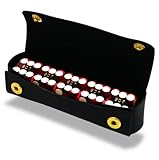
- GRADE AAA DICE: These 19mm precision dice meet or exceed all exacting casino dice specifications for precision. Dimensions are 19*19*19mm and are accurate to .0001 with razor edges.
- SERIALIZED: Professional serialized in gold stamping as a set of 5 to prevent tampering.
- LUXURY CASE: Comes with a black pu leather Luck Lab carrying case crafted to hold five dice to perfection.
- DICE GAMES GALORE: Perfect craps dice, poker dice, or many many more casino dice games.
- GOLDEN GIFTABLE: The dice are wrapped in giftable golden foil, 5 pcs per set. A perfect gift for any gaming enthusiast
It does not by itself establish that every round was recorded, that the published code is the code running in the live game, that the game is fair in every broader sense, or that an operator will honor a win. Those are separate questions that require evidence such as independent audits, complete records, and the applicable operator rules. Do not treat a matching replay as proof of operational conduct beyond the checks it actually performs.
Independent reader supportYour contribution helps us test, update, and keep practical guides available for everyone.Common verification mistakes
- Checking only the revealed seed’s hash: this confirms the commitment match, not that the game outcome was calculated from the recorded inputs.
- Using the wrong game mapping: a correct HMAC can still produce an apparently different result if the verifier applies the wrong byte conversion, range rule, or game-specific transformation.
- Guessing how counters work: nonce resets and increments can vary by game or seed rotation; use the documented behavior for that round.
- Trusting a result without the original record: retain the pre-play hash and exact round details so you can independently compare the replay with the displayed history.
- Generalizing one implementation: the Provable.IO example is a documented implementation, not a universal provably fair standard.
Provable.io’s explainer, “How to Generate Provably Fair Random Numbers,” is listed as published May 24, 2026 and updated September 28, 2026; its description of the method should be read as documentation of that implementation, not a rule for every operator.
Quick Recap
Rank #4

- Made of high quality transparent acrylic with glossy, polished finish. White pips are highly visible.
- Dimensions are 19*19*19mm and are accurate to .0001.
- Professional serialized as a set of 5 to prevent tampering.
- Grade AAA, these 19mm dice meet or exceed all exacting casino dice specifications for precision
- 5pcs violet dices per set, wrapped in giftable golden foil.
Product prices and availability are accurate as of the date/time indicated and are subject to change. Any price and availability information displayed on Amazon at the time of purchase will apply.
Do these 3 things before closing this tab:
1Scan for outdated or missing drivers - takes under a minute2Clear out junk files and repair common Windows errors3Fix the driver behind crashes, sound loss and screen glitches
