
iTechGuides is reader-supported. When you buy through links on our site, we may earn an affiliate commission. As an Amazon Associate I earn from qualifying purchases. Learn more
A printer’s low-memory warning usually means it cannot allocate enough internal resources for the current job—not that the printer is broken. The cause may be a complex document, stored printer resources, a driver issue, or a model-specific limitation. Start by recording the exact message and model, then try a smaller or simpler job before considering a memory upgrade.
What a low-memory warning means
Printers use internal resources to process pages, graphics, fonts, and other job data. A warning means the device cannot allocate enough resources for a particular task. The message alone does not establish that the printer has failed.
The details depend on the printer and job. HP’s LaserJet Pro guidance, for example, describes a “Memory is low. Press <OK>” message during copying, faxing, or printing, but not scanning. It lists complex graphics, downloaded fonts or macros, stored fonts, faxes or macros, and outdated firmware as possible contributors for that product family—not as universal causes for all printers. Other manufacturers document resource limits involving graphics, formats, bitmaps, fonts, or collation.
Recommended Free Tools
Symptoms can include an explicit warning, a job that stops or fails, incomplete details, or only one set of copies when collation cannot finish. Some printers may lower print quality to continue. If ordinary text prints but one complex PDF does not, that points to job or driver complexity as a possibility; it does not prove the printer is defective.
#1 Best Overall

- Speed: PC2-3200
- Form Factor: 144 pin Printer DIMM
- Lifetime Warranty
- Free Shipping
How to troubleshoot the warning
- Note the exact message and printer model. Error text matters: on HP devices, for instance, the low-memory message is distinct from certain 20.xx or 21.xx memory-failure or print-failure messages. Use the manual or the manufacturer’s support page for the exact model and region.
- Choose whether to continue or cancel. If the printer offers Continue or OK, continuing may skip pages or details. Use it only if an incomplete output is acceptable; cancel when accuracy and completeness matter.
- Retry with a smaller, simpler job. Split a large document into batches and simplify graphics or other complex content where practical. If a PDF is the problem, HP documents printing it as an image as a possible workaround for applicable situations. You can also try another driver if one is available and supported for your printer.
- Adjust quality only if the option is available. A lower quality or resolution setting may reduce processing demands, but it can affect the output. Use this only when the printer or driver offers it and the result is acceptable. Epson documents automatic quality reduction in one guide and suggests lowering quality or adding memory for a specific model; behavior differs among printers.
- Check stored printer resources. Unused graphics, formats, bitmaps, fonts, macros, or faxes may occupy resources on some models. Remove them only by following instructions for your exact device. HP’s LaserJet guidance describes clearing stored faxes and printer resources; Zebra’s ZD421/ZD621 guide identifies graphics, formats, bitmaps, and fonts as stored resource types.
- Restart and check firmware. Restart the printer if its manufacturer recommends doing so to clear temporary resources. Check for firmware updates on the official support page for the exact model and follow that model’s installation procedure.
- Escalate based on the manual. If the warning persists, check whether the printer supports memory expansion and which module it accepts. If it does not support expansion, or the problem continues after model-appropriate steps, contact the manufacturer or an authorized service provider.
Should you buy more printer memory?
Only consider an upgrade after simpler job and settings changes have failed and the printer’s manual confirms that memory is expandable. Buy only the module specified for the exact model; there is no universally compatible printer DIMM. Some printers do not support user-installed memory at all.
Use the manual or manufacturer support page to verify the supported module, installation method, and any capacity limits before buying. The available manufacturer guidance does not establish a universal compatibility list or current prices. If the printer is not expandable, or a verified upgrade would be more costly or difficult than professional service, ask the manufacturer or authorized service provider about the appropriate next step.
Rank #2

- Capacity 256MB
- Warranty: Lifetime
Why a factory reset should not be the first step
A reset can remove saved configuration as well as address settings-related issues. HP warns that restoring defaults can remove fax contacts, scan-to-email settings, and custom configurations. Before resetting, follow the exact model’s troubleshooting instructions and make sure important settings can be restored.
Quick Recap
Rank #4
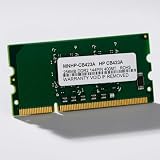
- HP Printer Compatibility: CB423A Compatible for HP Printers including P2015, P2055, and P3005 models
- Memory Specifications: 144-PIN DDR2 RAM module with low power consumption design for efficient printer performance
- Manufacturer Information: Manufactured by Simmtec, Inc., a trusted provider of memory upgrade solutions
- Printer Model Support: Designed specifically for HP LaserJet P2015, P2055, and P3005 printer series
- Memory Capacity: 256MB RAM memory upgrade to enhance printer processing speed and document handling capabilities
Rank #3
- Capacity 256MB
- Warranty: Lifetime
Product prices and availability are accurate as of the date/time indicated and are subject to change. Any price and availability information displayed on Amazon at the time of purchase will apply.

