
Do these 3 things before closing this tab:
1Scan for outdated or missing drivers - takes under a minute2Clear out junk files and repair common Windows errors3Fix the driver behind crashes, sound loss and screen glitchesiTechGuides is reader-supported. When you buy through links on our site, we may earn an affiliate commission. As an Amazon Associate I earn from qualifying purchases. Learn more
Short answer: Treat a preprint as provisional evidence and a peer-reviewed paper as evidence that has received additional expert scrutiny, not as a guarantee of truth. A preprint may change substantially, be withdrawn, or never appear in a journal. A published paper can still contain errors, misleading analyses, or conclusions that do not hold in other settings. Before trusting either, verify the version, inspect the methods and limitations, check disclosures and corrections, and look for reproducibility and independent replication.
The right choice depends on your decision. A preliminary result may be useful for understanding a fast-moving topic, while a medical, financial, engineering, or policy decision deserves converging evidence and a much higher standard of verification.

![Praxis Core Study Guide 2026-2027 - 5 Full-Length Practice Tests, 250+ Online Video Tutorials, Academic Skills for Educators Secrets for Reading 5713, Writing 5723, and Math 5733: [6th Edition]](https://m.media-amazon.com/images/I/51N4k9OLL+L._SL160_.jpg)
What is the difference between a preprint and a peer-reviewed paper?
A preprint is a research manuscript made publicly available before it has completed formal peer review. Authors can share it quickly, receive comments, and establish a public record of their work. The manuscript may later be revised, rejected, replaced by a substantially different version, or published under a different title. A preprint is therefore evidence of what the authors are proposing at a particular time, not a certification that the study meets a journal’s standards.
Quick wins for a faster PC:
Fix the driver behind crashes, sound loss and screen glitchesFind Drivers →Repair Windows errors before they cause bigger problemsFix Now →A peer-reviewed paper has been submitted to a journal and evaluated through that journal’s editorial process. Editors usually ask subject-matter experts to assess the study’s suitability, methods, analysis, clarity, and relevance. The authors may be required to revise the manuscript before acceptance. Peer review adds a quality-control step, but it does not reproduce the study, audit every calculation, or guarantee that the final conclusions are correct.
#1 Best Overall

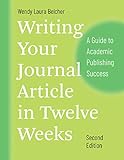
- Author & Edition: Written by Paul J. Silvia; this is the second edition (2018) of the popular guidebook.
- Purpose: Offers practical strategies to help academics overcome barriers to writing and increase productivity.
- Audience: Targeted at students, professors, researchers, and other academics across disciplines.
- Content Highlights: Addresses common excuses, bad writing habits, and provides methods to write, submit, and revise journal articles, books, and proposals.
- New Features in 2nd Edition: Updated tips for academic writing and a new chapter on writing grant and fellowship proposals.
| Question | Preprint | Peer-reviewed paper |
|---|---|---|
| Has an editor obtained formal reviewer reports? | Not necessarily; it is public before that process is complete. | Usually yes, although the exact review model varies by journal. |
| Can the content change? | Yes. New versions can alter methods, data, analyses, or conclusions. | Yes. Corrections, updates, and retractions can change the published record. |
| What does public availability establish? | That the authors released a manuscript on a stated date. | That the journal accepted the article after its editorial and review process. |
| Does it prove the findings are correct? | No. | No. Peer review is scrutiny, not a truth guarantee. |
| How should it be cited? | Identify it explicitly as a preprint and use its latest record. | Use the journal article and DOI when that version exists and is appropriate. |
Labels matter. A repository may show “preprint,” “accepted manuscript,” or “published article,” and those are not interchangeable. An accepted manuscript has passed a journal’s acceptance decision but may not yet be the final typeset version. A repository record can also retain an earlier preprint after a journal article appears, so check the date and links between records.
What peer review does—and does not—tell you
The International Committee of Medical Journal Editors (ICMJE) describes peer review as assistance to editors in deciding whether a manuscript is suitable for publication. Reviewers can identify unsupported claims, missing controls, unclear reporting, inappropriate statistics, and gaps in the discussion. Editors also judge whether the topic fits the journal and whether the work meets its policies.
“Peer review assists editors in deciding whether a manuscript is suitable for publication.” — International Committee of Medical Journal Editors
Special offer. See more information about Outbyte and uninstall instructions. Please review EULA and Privacy policy.
That role has limits. Reviewers normally see the authors’ submitted materials, not every laboratory notebook, raw instrument output, or private correspondence. They may miss a coding error, an undisclosed conflict, a statistical choice that looks reasonable but changes the result, or a limitation that appears only when another group tries the work. Journals differ in reviewer expertise, time, access to data and code, and standards of evidence. A prestigious venue is not a substitute for reading the study.
Publication also creates a version that can be corrected or retracted. A correction may fix a figure label or a numerical error without invalidating the main result; an expression of concern signals that a substantial issue is being examined; a retraction removes reliance on the article as part of the trustworthy scientific record. Check the article’s current status rather than assuming that an old citation remains valid.
A practical trust framework
Use the following criteria together. No single signal—journal name, download count, a statistically significant result, or a confident headline—can establish reliability on its own.
| Criterion | Questions to ask | Why it matters |
|---|---|---|
| Review status | Is it labeled preprint, accepted manuscript, or published article? Which journal and date are shown? | It tells you what level of editorial scrutiny has occurred. |
| Version history | What is the latest version? Did the title, sample, methods, analysis, or conclusion change? | Earlier social posts may describe an obsolete manuscript. |
| Study design | Is the design suitable for the question? Is it observational, randomized, laboratory, simulation, survey, or qualitative? | Design determines which conclusions are justified. |
| Methods and analysis | Could another researcher understand the protocol, exclusions, variables, and statistical model? | Opaque methods make selective reporting and errors harder to detect. |
| Uncertainty and limitations | Are confidence intervals, assumptions, missing data, and limitations reported? | Uncertainty shows how far the evidence can be generalized. |
| Statistical versus practical significance | Is the observed effect large enough to matter in the real setting, not merely unlikely under a null model? | A tiny effect can be statistically significant in a large sample and still have little practical value. |
| Data and code | Are the data, analysis scripts, materials, or preregistration available, subject to legitimate privacy or security limits? | Transparency allows others to inspect and rerun the analysis. |
| Conflicts and funding | Who paid for the work, and do authors disclose financial or professional interests? | Funding does not invalidate a study, but it can affect incentives and interpretation. |
| Corrections and retractions | Does the record show an erratum, expression of concern, or retraction? | The status may change how much weight the finding deserves. |
| Replication and convergence | Have independent groups obtained similar results using new data or methods? | Independent evidence is stronger than a single team’s claim. |
| Decision stakes | What happens if the claim is wrong? | High-consequence choices require more verification than casual reading. |
Step-by-step: how to check a paper before trusting it
- Identify the document type. Look at the landing page, PDF header, repository label, and journal record. Do not infer peer review merely because a manuscript has a DOI or appears in a search result. Record the posted or publication date and the version number.
- Find the latest record. Follow the repository’s links to newer versions and to any journal article. Confirm the DOI, title, author list, and publication status. If a preprint and article coexist, treat the article as the primary reference when it contains the same work.
- Compare versions. Check the abstract, sample size, inclusion criteria, outcomes, statistical model, figures, supplementary files, and conclusion. A changed title or abstract can conceal a changed analysis. If the published article differs materially, cite and discuss the version that supports your statement.
- Read the methods before the headline. Ask how participants or observations were selected, what comparison was used, how missing data were handled, which outcomes were specified in advance, and whether the analysis matches the design. For computational work, look for software versions, computational steps, and access to code or data.
- Interpret the result in context. Read effect sizes and uncertainty intervals, not only a p-value or a “positive” finding. Distinguish statistical significance from practical significance: a result can be statistically detectable yet too small to change a clinical, technical, or policy decision. Note whether the authors claim association, prediction, or causation; those are different statements.
- Check limitations and incentives. Read the limitations section and disclosures. Look for unmeasured confounding, small or unrepresentative samples, short follow-up, measurement error, selective attrition, and model assumptions. Record funding and relevant author relationships without treating either as automatic proof or disproof.
- Check the scholarly record. Search the article page for corrections, expressions of concern, or retractions. Confirm that quoted numbers and figures come from the current version. If the work is a preprint, check whether a peer-reviewed article was later published.
- Seek independent evidence. Look for studies from other groups, systematic reviews, negative results, and evidence using different data or methods. For a high-stakes decision, do not rely on one preprint or one journal article.
Why version control changes what you should trust
Preprints are snapshots in a moving record. An initial version might report a smaller sample, exploratory outcomes, or an analysis later replaced after reviewer questions. A subsequent version can improve the study, but it can also narrow the claim or reveal that an earlier interpretation was too strong. Save the date and version identifier whenever you quote a preprint.
ICMJE guidance says authors should ensure that preprints point readers to later versions, including the published article. Follow those links rather than assuming that a repository’s first PDF is current. If no later article exists, the preprint may still be useful, but its lack of subsequent publication is information you should state when the distinction affects the reader’s judgment.
When a preprint has been published in a peer-reviewed journal, cite the subsequent article when appropriate. The journal version may have a different title, author order, sample, or conclusion. Cite the preprint itself only when you are discussing its early release, a version-specific claim, or work that has not been published elsewhere.
How to read methods, limitations, and significance
Study design determines the claim
A randomized experiment can support stronger causal inference than an observational association when it is well conducted, but randomization does not fix poor adherence, attrition, or an unrepresentative sample. A survey can describe respondents’ answers without proving that a behavior causes an outcome. A laboratory or simulation result may establish a mechanism under controlled conditions without showing that it works in a real environment. Match the wording of the conclusion to the design.
Look beyond a threshold
Statistical significance answers a narrow question about compatibility with a model under specified assumptions. It does not tell you the size, importance, or durability of an effect. Examine the estimated effect, confidence or credible interval, baseline risk, absolute difference, and whether the interval includes effects too small to matter. A result can miss a conventional threshold and still be practically important, or pass it while being trivial.
Outdated Drivers Are Slowing You Down
One free scan finds every outdated or missing driver and matches the right update for your exact hardware.Free scan · exact hardware matchPC Slower Than It Used to Be?
A free scan shows the junk files, broken settings and background clutter dragging Windows down - then fixes them in one click.Free scan · Windows 10 & 11Test generalizability
Ask who or what was studied, where, and when. Results from a narrow population, a single device, or a particular dataset may not transfer to another setting. Limitations are not an apology; they define the boundary of a defensible claim. If the authors acknowledge that boundary, that is stronger reporting than an unrestricted headline.
Independent reader supportYour contribution helps us test, update, and keep practical guides available for everyone.Reproducibility and replicability are different checks
The National Academies distinguishes reproducibility from replicability. Reproducibility means obtaining consistent results with the same data, methods, computational steps, and conditions. A reader might rerun the authors’ code on the released dataset and recover the reported tables. Replicability means obtaining consistent results in an independent study using new data, often with a comparable design.
A paper can be reproducible but not replicable: the code faithfully reproduces an analysis that does not hold in a new sample. It can also be difficult to reproduce because data are confidential while still producing a replicable result through independent work. For computational claims, inspect whether code, environment details, and data-processing steps are available. For experiments or surveys, look for independent groups that repeated the protocol or tested the claim in another population.
When should you cite a preprint?
Cite a preprint when it is the source you actually used and no suitable peer-reviewed version exists, when you need to discuss the timing of an idea, or when the preprint contains material not present in the later article. Label it clearly as a preprint, include its version or posting date when available, and use the repository’s persistent identifier.
Free tools Windows power users keep installed
One-click scans. No signup required.
If a peer-reviewed article later appears, use that article for claims supported by the final publication. ICMJE advises that a citation should clearly indicate when the reference is a preprint and cautions authors about referencing preprints that were posted and never subsequently published in a peer-reviewed journal. That caution is not a ban: it means readers should know the status and evaluate the evidence accordingly.
Do not cite a preprint as though it were peer reviewed, and do not silently substitute a later article if its methods or conclusions differ from the version you read. In a literature review, explain the relationship between versions so readers can trace the record.
How much evidence is enough for a real decision?
| Situation | Reasonable approach |
|---|---|
| Learning about a rapidly developing topic | Read preprints for timeliness, but mark claims as preliminary and verify the version. |
| Choosing a product, workflow, or software method | Check methods, practical effect size, data availability, and evidence from more than one group. |
| Writing an article or academic paper | Prefer the peer-reviewed version when available; label and qualify any preprint citation. |
| Medical, public-health, financial, safety, or policy action | Require peer-reviewed evidence plus independent replication or converging high-quality sources; consult qualified professionals where appropriate. |
| Breaking news about an extraordinary claim | Do not treat a single preprint, viral summary, or press release as confirmation. Wait for methods, criticism, and corroboration. |
The higher the cost of being wrong, the more you should demand evidence that survives version changes, scrutiny, and independent testing. There is no universal reliability percentage separating preprints from peer-reviewed papers; a criteria-based judgment is more defensible than an invented score.
Quick Recap
Common mistakes and how to avoid them
- “It has a DOI, so it is peer reviewed.” A DOI identifies a record; it does not certify review. Check the document label and journal status.
- “Peer reviewed means proven.” Review is a filter, not replication. Read the methods, limitations, and later corrections.
- “The headline says significant.” Inspect effect size, uncertainty, baseline risk, and practical importance.
- “The first PDF is the study.” Version changes can alter the evidence. Use the latest linked record and note differences.
- “No replication means false.” Lack of replication means uncertainty remains; it is not automatic disproof. Seek independent tests and converging evidence.
- “Funding decides the answer.” Funding and conflicts are context for evaluating incentives, not a replacement for examining data and methods.
- “A published correction makes the paper useless.” Determine whether the correction is cosmetic, numerical, interpretive, or fundamental; a retraction is a much stronger warning.
A concise trust checklist
- Confirm whether the item is a preprint, accepted manuscript, or published article.
- Locate the latest version, DOI, and repository or journal record.
- Compare any preprint with the subsequent article.
- Read the design, methods, limitations, and uncertainty before the headline.
- Separate statistical significance from practical importance.
- Check data and code availability, funding, conflicts, corrections, and retractions.
- Look for reproducibility and independent replication.
- Match the evidence standard to the consequences of your decision.
Product prices and availability are accurate as of the date/time indicated and are subject to change. Any price and availability information displayed on Amazon at the time of purchase will apply.
The Tool Desk
Outbyte Driver Updater FREEFix the driver behind crashes, sound loss and screen glitchesFind Drivers →Outbyte PC Repair FREERepair Windows errors before they cause bigger problemsFix Now →
