
The Tool Desk
Outbyte PC Repair FREEClear out junk files and repair common Windows errorsFree Scan →Outbyte Driver Updater FREEFix the driver behind crashes, sound loss and screen glitchesFind Drivers →iTechGuides is reader-supported. When you buy through links on our site, we may earn an affiliate commission. As an Amazon Associate I earn from qualifying purchases. Learn more
A perovskite solar cell is a photovoltaic device that uses a light-absorbing semiconductor with a perovskite-type crystal structure. “Perovskite” describes a crystal structure and a family of materials—not a single element. The technology has achieved high efficiencies in research devices, but those results do not by themselves establish long-term outdoor reliability or commercial-scale production.
What “perovskite” means in a solar cell
In many solar cells, the perovskite absorber is a metal-halide material described by the simplified formula ABX3. A represents an organic or inorganic cation, B is typically a metal cation, and X is usually a halide such as iodide or bromide. Methylammonium lead iodide, written MAPbI3, is one example; researchers also investigate other compositions. The formula is a useful way to describe a common material family, not a claim that every perovskite solar cell has the same composition. The U.S. Department of Energy’s overview of perovskite solar cells describes the device and its materials.
How a perovskite solar cell works
Sunlight absorbed by the perovskite layer excites charge carriers. Other layers in the device selectively direct electrons and positive charges toward opposite sides, where electrical contacts collect them as current. The absorber is thin compared with the active crystalline-silicon material in conventional silicon cells, which is why perovskite photovoltaics are classified as thin-film technology. For general background on light-to-electricity conversion in photovoltaics, see the DOE’s solar photovoltaic cell basics.
What the device is made of
A typical device has a substrate or base, the perovskite absorber, charge-selective or transport layers, and electrical contacts. The order and design of these layers can vary with the architecture. In the DOE’s description of a production approach, precursor salts are mixed into an ink or deposited as vapor, a thin absorber film is formed on a base, and additional functional layers are added. To make a module, individual areas can be scribed and wired together; encapsulant and edge sealant help protect the device from weather. Manufacturing methods are still being developed, so this is not a single standardized production recipe.
#1 Best Overall

- Works Indoors & Outdoors - Generates power from ambient indoor lighting, window light, and sunlight
- Perovskite Solar Technology - Advanced photovoltaic material designed to capture more usable energy in low-light environments than traditional silicon panels.
- Built for Energy Harvesting - Ideal for powering or extending battery life in low-power electronics and IoT devices.
- Ultra-Thin & Lightweight - Compact form factor makes integration easy, even in space-constrained projects.
- Easy to Integrate - Simple wire output design for fast prototyping and product development.
Why researchers combine perovskite with silicon
Perovskite absorbers strongly absorb selected parts of the solar spectrum and can be processed as thin layers. One research direction is a tandem cell, which stacks a perovskite absorber with silicon so the two materials can capture different portions of sunlight. This is a device design intended to use the spectrum more effectively; the reported tandem efficiency is a research result, not proof of a commercially available product or a guaranteed cost advantage. NREL discusses the path and challenges for tandem cells in its report on perovskite-silicon tandems.
What the efficiency numbers do—and do not—show
Efficiency figures need context: a small laboratory cell, a tandem device, and a fielded module are not interchangeable. The DOE’s overview, accessed in 2026, describes research-device efficiencies above 26% for small-area perovskite cells and nearly 34% for perovskite-silicon tandems. It also recounts a historical rise from approximately 3% in 2009 to above 26%. These are research-device figures, not a commercial-module comparison or a statement of current record values.
Rank #2
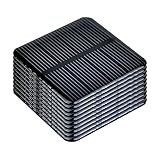
- 【Accurate power】All data are actually measured under the condition that the solar light is sufficient. In full sunlight, the voltage will be higher than 2V.
- 【Product Parameter】10Pcs Monocrystalline silicon solar panels;Power:2V 160mA;Size:1.96"x1.96";Epoxy resin AB glue, PCB+ glass fiber base plate
- 【Experience the fun of DIY】 Build your DIY powered models/solar toys / solar displays/Solar Powered String Lights.
- 【Widely used and Widely temperature range】Suitable for outdoor activities, emergencies and outdoor work. Power is continuously supplied even on cloudy days;Suitable for outdoor activities, emergencies and outdoor work. Power is continuously supplied even on cloudy days.
- 【High Conversion EffIciency】 Constructed of high-efficiency solar arrays,convert up to 21.5-23.5% of solar power into free energy.
A separate DOE research-directions page gives a dated record snapshot: 26.1% for a single-junction perovskite cell and 33.9% for a perovskite-silicon tandem, as of April 21, 2024. Those values describe that snapshot, not necessarily the current records. The same page reports that outdoor minimodules of roughly 25 cm2 measured 15–18% aperture-area efficiency and had not fallen to 80% of their initial efficiency after five months outdoors, as of April 22, 2024. That limited observation does not establish multi-decade product life or a commercial warranty. See the DOE’s perovskite research directions for these dated figures.
Quick wins for a faster PC:
Fix the driver behind crashes, sound loss and screen glitchesFind Drivers →Repair Windows errors before they cause bigger problemsFix Now →When comparing results, check the device area and architecture, whether the result is for a cell or module, the measurement date and verification, outdoor operating history, encapsulation and environmental reliability, and manufacturing scale. A champion result from a small cell should not be compared directly with a commercial module without accounting for those differences. NREL’s solar module efficiency table guide explains efficiency-table context.
Rank #3

- Lightweight and Portable Design: with its ultra-thin and lightweight construction, this solar panel is nice for those convenient situations; Although it's fragile and requires careful handling, its compact size makes transportation effortless, allowing you to harness solar energy wherever you are; Ideal for outdoor enthusiasts and travelers alike
- Powerful Polycrystalline Efficiency: equipped with 200 pcs of high efficiency polycrystalline silicon, this panel offers a potent energy output at 0.5V and 400mA, easily meeting your power needs; Experience up to 18% energy conversion, ensuring maximum solar energy utilization even on cloudy days
- Easy DIY and Customization: unlock your creativity with our solar cells, ideal for building DIY powered models, solar things, and displays; Easily adjust power and voltage by connecting in series or parallel, empowering you to tailor the output to your specific requirements
- Versatile Outdoor Application: engineered for versatility, this solar panel suits a variety of outdoor activities, emergencies, and work scenarios; Depend on continuous energy supply regardless of weather conditions, keeping your devices charged up and ready
- Seamless Connectivity: ensure correct connections with the color-coded design: blue side for negative (-) and the other side for positive (+); For enhanced power delivery, use solder strips, thus effectively stabilizing your solar projects for optimal performance
Why stability and scale remain challenges
Perovskite devices can degrade when exposed to moisture, oxygen, light, heat, applied voltage, or combinations of these stresses. Researchers must raise efficiency while also improving durability, reproducible manufacturing, and bankability. As NREL senior scientist Kai Zhu put it, “You ought to have high efficiency and high stability simultaneously. That’s challenging,” in NREL’s report on the path forward for tandem solar cells.
The DOE says perovskite photovoltaics are not currently commercially produced, primarily because operational lifetime remains limited. Accordingly, research-cell records and early outdoor observations should not be read as evidence of broad retail availability or proven long-term field performance. NREL also summarizes the technology’s status on its perovskite solar cells research page.
Quick Recap
Rank #4

- [HIGH DRIVING EFFICIENCY] This solar light control panel features high driving efficiency and long discharge time, providing a superior user experience.
- [DESIGNED FOR] Our solar lawn light control panel designed for use with 1.2V NiMH batteries, is for meeting your specific needs. This solar light control panel charging during the day, turning on the lights in the evening
- [DISCHARGE ] With a built-in 2V solar charging module, our solar light control panel offers various protective features, including , discharge , and constant current drive.
- [ MATERIAL] This solar lawn lamp control board kit is made of high-quality PCB material, our solar light control panel ensures durability and stability for long-term use.
- [PACKAGE INCLUDING] The package list has 2 x solar panel, 2 x light control board, 2 x battery slot, 2 x storage box, 1 x instruction manual
Product prices and availability are accurate as of the date/time indicated and are subject to change. Any price and availability information displayed on Amazon at the time of purchase will apply.
Do these 3 things before closing this tab:
1Scan for outdated or missing drivers - takes under a minute2Clear out junk files and repair common Windows errors3Fix the driver behind crashes, sound loss and screen glitches
