
PC Slower Than It Used to Be?
A free scan shows the junk files, broken settings and background clutter dragging Windows down - then fixes them in one click.Free scan · Windows 10 & 11Outdated Drivers Are Slowing You Down
One free scan finds every outdated or missing driver and matches the right update for your exact hardware.Free scan · exact hardware matchiTechGuides is reader-supported. When you buy through links on our site, we may earn an affiliate commission. As an Amazon Associate I earn from qualifying purchases. Learn more
There is no nationwide cheapest option. For an Indian factory, the defensible choice comes from comparing delivered electricity cost after every state charge, the facility’s load shape, capital or contract commitments, reliability needs, and the quality of the renewable claim. Rooftop solar usually suits a site with strong daytime demand and usable roof area; renewable open access can fit larger, predictable loads that need off-site generation; a utility green tariff is the simplest route when construction and operating work are more important than controlling the generation asset.
Use the framework below to compare all three on the same ₹/kWh basis. Obtain the current tariff order and open-access schedule for the relevant state and distribution licensee before approving a project.
The three procurement choices at a glance
| Decision axis | Renewable open access | Rooftop solar | Green tariff |
|---|---|---|---|
| Where electricity is generated | At an off-site renewable project, delivered through the grid | At the factory on an installed photovoltaic system | Through the distribution licensee’s supply portfolio |
| Main commitment | Power-purchase agreement or captive structure, plus regulated network and settlement charges | Capital expenditure or a lease/EPC contract for modules, inverters, mounting, protection and metering | Enrollment in a utility tariff or green-energy supply product |
| Load profile that generally fits | Large, predictable demand able to absorb contracted energy | Demand that overlaps solar production hours and has sufficient roof area | Any load where simplicity and limited construction responsibility matter |
| Primary operational work | Scheduling, forecasting, metering, banking and settlement | System maintenance, performance monitoring, safety and export management | Tariff enrollment, billing verification and renewable-accounting review |
| Important risks | Wheeling, cross-subsidy and additional surcharges, banking limits, curtailment and counterparty performance | Roof condition, intermittency, interconnection limits, export treatment, degradation and equipment replacement | Rate changes, eligibility, utility reliability and the rules governing renewable attributes |
These are procurement structures, not interchangeable products. Open access and a green tariff still rely on the distribution and transmission network; rooftop solar reduces purchases from that network only when the system is producing and the factory is consuming the energy.
What “cheapest” means for a factory
Compare delivered cost per kilowatt-hour, not the generator’s quoted energy rate. The delivered figure should use the same billing period and include energy, network, regulatory and financing effects for each option.
#1 Best Overall

- 【High Efficiency,Up to 30% Extra Power】 : SUNGOLDPOWER 560W Bifacial solar panel 16BB N-Type can generate extra energy up to 30% ,total peak power for one panel is about 728W because it can create power from both front and back!
- 【16BB Solar Cell】: Equipped with 16BB monocrystalline solar cell technology, this 560W high efficiency solar panel delivers superior current flow and reduced energy loss. The multi-busbar design enhances durability and improves performance in partial shading conditions.
- 【Flexible Angle Installation】: SUNGOLDPOWER solar panel SG560WBG can be mounted at various tilt angles without complex calculations. Suitable for ground mount, roof mount, RV solar setup, and off grid solar panel systems.
- 【30-Year Linear Power Warranty】: This 560W bifacial solar panel 2-pack is backed by a 30-year linear power output warranty and a 12-year material & workmanship warranty. Designed for long-term reliability, it ensures stable energy production for residential, commercial, and off-grid solar systems.
- 【Up to 30% Residential Clean Energy Credit】 You might be eligible for this tax credit if you own a solar PV system that was installed in the US between January 1, 2017, and December 31, 2034.
Open-access delivered cost
Start with the contracted renewable energy price, then add wheeling and transmission charges, scheduling and forecasting costs, banking charges, cross-subsidy or additional surcharge where applicable, metering, taxes and any balancing or deviation settlement. Deduct only the value of energy actually usable under the state’s banking and settlement rules. A low PPA rate can become expensive if the plant cannot absorb the contracted quantity or if banked energy expires.
Rooftop delivered cost
Level the project’s capital or lease payments, financing, insurance, operations and maintenance, inverter replacement, metering and interconnection costs over the energy the factory actually self-consumes. Treat exported electricity separately at the value allowed by the applicable net-metering, gross-metering, banking or export regime. Include degradation and the cost of restoring the roof or replacing equipment when those obligations fall on the customer.
Green-tariff delivered cost
Use the normal utility bill as the baseline and add the green-tariff premium or tariff component stated by the distribution licensee. The Ministry of Power clarification recorded by the Ministry of New and Renewable Energy says the green tariff should not exceed renewable average power-purchase cost plus a surcharge capped at 20% of average cost of supply. That is a regulatory ceiling formula, not a universal delivered price: the applicable tariff, taxes, demand charges and eligibility conditions remain jurisdiction-specific.
Quick wins for a faster PC:
Repair Windows errors before they cause bigger problemsFix Now →Scan for outdated or missing drivers - takes under a minuteDriver Scan →Clear out junk files and repair common Windows errorsFree Scan →Rank #2

- System Components:Delivers up to 10kW power output with 120V/240V single-phase split-phase support, making it suitable for smoothly running common household appliances. The system includes 5 × 590W solar panels with a total PV capacity of 2950W, capable of generating up to 11.8 kWh per day under optimal conditions, along with one 48V 314Ah portable LiFePO₄ battery offering 16.1 kWh of energy storage. Complete with necessary cables, this all-in-one solar solution is designed for convenient setup and reliable home power support.
- Upgraded Integrated Battery:ECO-WORTHY 48V 314Ah lithium battery combines advanced safety, high capacity, and smart system compatibility. It features a PACE 200A Battery Management System with multi-layer protection and dual breakers for reliable circuit safety. With a 16.076 kWh energy capacity and support for up to 15 units in parallel (up to 241 kWh), it delivers scalable and dependable power. A 7-inch full-color display, along with Bluetooth, Wi-Fi, and PC connectivity, enables convenient real-time monitoring. Designed to work seamlessly with mainstream inverters via RS485 and CAN communication, the battery also includes built-in wheels and handles for easy installation and mobility
- Keep Home Running 10kW:ECO-WORTHY 10kW AIO solar charge inverter features 48V DC pure sine wave output with 120V or 120V/240V split-phase support, delivering 10,000W continuous power and up to 20,000W peak output. Equipped with dual MPPT controllers, up to 200A battery charging, built-in WiFi monitoring, multiple charging and output modes, time-slot energy management, and comprehensive protection functions, it is compatible with AGM, Gel, Flooded, and lithium batteries, supports battery-free operation, and allows parallel connection of up to six units
- High Power Solar Panel:590W Mono-crystalline Solar Panel (Black). Low power loss in cell connection compared to conventional modules. Improved shading tolerance. Lower internal current, lower hot spot temperature. Heat-strengthened glass minimizes micro-crack impact.
- Shipping Notice: Due to its large size and weight, the 5pcs 590W solar panel/1pc 48V 314Ah battery is securely packed and shipped on a pallet using a truck to ensure safe transportation. Please ensure your delivery address can accommodate truck deliveries.
Use one comparison worksheet
- Monthly and annual kWh purchased from the grid.
- 15-minute or hourly load curve, including shutdowns and seasonal production.
- Contract demand, sanctioned demand, voltage level and current tariff category.
- For rooftop projects: roof area, structural capacity, shading, usable orientation, interconnection capacity and expected self-consumption.
- For open access: project location, contract tenor, contracted capacity, banking cycle, scheduling obligations and every state charge.
- For a green tariff: enrollment rules, tariff formula, term, renewable accounting and the utility’s reliability record.
- Taxes, duties, financing rate, escalation assumptions and the treatment of curtailment or outages.
Report a base case, a high-charge or low-generation case, and a case where production falls below forecast. A single payback number without these assumptions is not a reliable investment decision.
Renewable open access: off-site power through the grid
Green open access lets an industrial consumer contract for renewable electricity from an off-site generator or power-purchase arrangement while continuing to use the grid. The Ministry of Power notified the Electricity (Promoting Renewable Energy Through Green Energy Open Access) Rules, 2022 on 6 June 2022. A 2023 amendment summary states that a consumer may requisition green energy for part or all of its consumption and may make separate solar and non-solar requisitions.
How the physical and commercial flow works
- The factory estimates its demand and selects a renewable generator, power trader or captive/PPA structure permitted in the state.
- The parties contract for capacity, energy, price, term, scheduling responsibility, curtailment treatment and settlement of deviations.
- The generator injects electricity into the grid. The factory draws power at its approved connection, with the system operator and distribution licensee accounting for scheduled and actual quantities.
- Network, wheeling, banking, surcharge, metering and other regulated amounts are added under the applicable state orders.
- Monthly settlement reconciles scheduled energy, actual consumption, banked units, shortfalls, excesses and any deviation charges.
Banking is a design constraint
Unused banked energy is adjusted within the same banking cycle and does not roll into later cycles. Model the cycle against the factory’s production calendar, weekends, maintenance shutdowns and monsoon or seasonal demand. Contracting more energy than the site can use can turn an apparent discount into a stranded quantity.
Rank #3
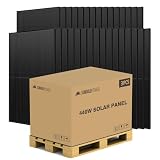
- 【High Efficiency N-Type Technology】SUNGOLDPOWER 440 Watt N-Type solar panels 16BB delivers superior performance with advanced N-Type cells and 16 busbar (16BB) design, offering up to 22.5% module efficiency and excellent low-light performance.
- 【High Shade Tolerance】SUN GOLD POWER 440W solar panels are made with half-cell technology,it improves the power output and performance of solar modules because they offer a higher shade tolerance due to unique wiring system and number of cells increases.
- 【Reliable & Durable】440 watt monocrystalline solar panel comes with black corrosion-resistant aluminum frame.Strong enough for winds of 2400Pa and Snowload of 5400Pa. Both IP68 junction box and IP68 connectors protect it from rain and storm perfectly.Backed by UL61730 certification for safety and quality.
- 【Wide Use and Warranty】Sungoldpower 440w mono solar panels work excellent with MPPT to charge 12V/24V/48V batteries by series or parallel.You can get 10 years workmanship warranty and 25-year linear performance warranty for these excellent solar panels.
- 【CEC Listed for Incentives】440W solar panels have California Energy Commission (CEC) listed, making it eligible for solar incentives and rebates in applicable regions—ideal for residential, commercial, and off-grid setups.
Open-access advantages
- Access to off-site renewable generation when the factory has little roof area or cannot install equipment at the load point.
- Potential to serve large, steady demand across multiple facilities, subject to the relevant approvals and settlement arrangements.
- Ability to specify a renewable mix or separate solar and non-solar requisitions under the 2023 amendment summary.
- No need for the customer to own the generating plant, although the customer takes on contract and regulatory obligations.
Open-access risks and questions to resolve
- Network charges: obtain the current wheeling, transmission and other applicable charges for the connection voltage and route.
- Surcharges: verify cross-subsidy and additional surcharges, exemptions and how they change with consumer category or project structure.
- Scheduling: identify who forecasts, submits schedules, manages deviations and pays penalties or balancing charges.
- Curtailment: define whether the buyer receives replacement energy, compensation or only the amount actually scheduled.
- Counterparty: check generator performance, security, termination rights, change-in-law provisions and credit support.
- Metering: confirm meter ownership, communication requirements, data intervals and the settlement authority’s process.
- Renewable claims: establish whether the customer receives the relevant environmental attributes and whether another party can claim them.
Open-access implementation checklist
- Collect the latest State Electricity Regulatory Commission order, distribution-licensee tariff schedule and open-access procedure for the facility’s state.
- Give the consultant or internal team the facility’s load curve, contract demand, voltage, annual kWh and proposed project location.
- Build a charge stack that shows each rupee per kWh and each fixed or demand-based charge separately.
- Simulate the banking cycle using actual production and shutdown dates; do not assume annual netting.
- Review the PPA, scheduling agreement and metering responsibilities with legal, finance and operations teams.
- Obtain approvals and test the first billing cycle against the contracted and scheduled quantities.
Rooftop solar: generating behind the factory meter
A rooftop system places photovoltaic modules, inverters, mounting, protection and metering at the facility. It reduces grid purchases when generation coincides with load. Surplus treatment depends on the state’s net-metering, gross-metering, banking or export rules, so a system sized for annual energy rather than daytime consumption can produce less value than expected.
The Ministry of New and Renewable Energy lists national guidelines for procurement of power from grid-connected solar PV projects dated 2 February 2024. Those guidelines do not replace the state interconnection and metering rules that determine what a particular industrial site may export or bank.
When rooftop solar is a strong fit
- The factory runs substantial load during solar hours, reducing the need to export energy.
- The roof is structurally sound, unshaded, accessible for maintenance and expected to remain available for the project term.
- The interconnection can accept the proposed capacity without costly upgrades or export restrictions.
- The owner can fund the system or accept an EPC, lease or other contract with clearly allocated performance risk.
Engineering and commercial checks
- Survey the site: verify roof loading, waterproofing, fire access, shading, corrosion exposure, orientation and usable area.
- Map the load: compare hourly production with process demand, shift patterns, weekend operation and seasonal variation.
- Confirm the connection: obtain the sanctioned demand, voltage, protection requirements, meter configuration and export limit from the distribution licensee.
- Select the commercial model: compare ownership, financed purchase, lease and EPC offers using the same assumptions for degradation, availability, insurance and replacement.
- Value exports conservatively: use the current state-approved credit or settlement value, not the retail energy rate, unless the rules explicitly allow that treatment.
- Set operating responsibilities: define cleaning, monitoring, inverter replacement, roof repairs, insurance, safety isolation and end-of-term removal.
Rooftop limitations
Solar output is intermittent and does not automatically reduce demand charges. A factory with a high evening or overnight load may still need most of its grid capacity. Roof repairs, dust, shading, inverter faults and interconnection outages can reduce generation. A robust model therefore separates self-consumed energy, exported energy and unavailable energy instead of multiplying annual irradiation by the retail tariff.
Rank #4

- System Components:Delivers up to 10kW power output with 120V/240V single-phase split-phase support, making it suitable for smoothly running common household appliances. The system includes 18 × 590W solar panels with a total PV capacity of 10620W, capable of generating up to 39.36 kWh per day under optimal conditions, along with two 48V 314Ah portable LiFePO₄ battery offering 32.2 kWh of energy storage. Complete with necessary cables, this all-in-one solar solution is designed for convenient setup and reliable home power support.
- Upgraded Integrated Battery:ECO-WORTHY 48V 314Ah lithium battery combines advanced safety, high capacity, and smart system compatibility. It features a PACE 200A Battery Management System with multi-layer protection and dual breakers for reliable circuit safety. With a 16.076 kWh energy capacity and support for up to 15 units in parallel (up to 241 kWh), it delivers scalable and dependable power. A 7-inch full-color display, along with Bluetooth, Wi-Fi, and PC connectivity, enables convenient real-time monitoring. Designed to work seamlessly with mainstream inverters via RS485 and CAN communication, the battery also includes built-in wheels and handles for easy installation and mobility.
- Keep Home Running 10kW:ECO-WORTHY 10kW AIO solar charge inverter features 48V DC pure sine wave output with 120V or 120V/240V split-phase support, delivering 10,000W continuous power and up to 20,000W peak output. Equipped with dual MPPT controllers, up to 200A battery charging, built-in WiFi monitoring, multiple charging and output modes, time-slot energy management, and comprehensive protection functions, it is compatible with AGM, Gel, Flooded, and lithium batteries, supports battery-free operation, and allows parallel connection of up to six units.
- High Power Solar Panel:590W Mono-crystalline Solar Panel (Black). Low power loss in cell connection compared to conventional modules. Improved shading tolerance. Lower internal current, lower hot spot temperature. Heat-strengthened glass minimizes micro-crack impact. [Professional Installation Required]To ensure safety and optimal performance, it is recommended to hire a professional installer. We provide online technical guidance (inquiries are welcome), but installation by non-professional electricians or novices is not recommended, as it may cause safety hazards and a loss of system performance.
- Shipping Notice: Due to its large size and weight, the 18pcs 590W solar panel/2pcs 48V 314Ah battery is securely packed and shipped on a pallet using a truck to ensure safe transportation. Please ensure your delivery address can accommodate truck deliveries.
Green tariffs: the simplest procurement route
With a green tariff, the customer remains supplied by its distribution licensee and elects a renewable-labelled tariff or green-energy product. The utility retains responsibility for generation procurement, network operation, billing and supply continuity under the applicable tariff framework.
What the 20% ceiling does—and does not—say
The Ministry of Power clarification recorded by the Ministry of New and Renewable Energy describes a ceiling of renewable average power-purchase cost plus a surcharge capped at 20% of average cost of supply. It does not promise that every utility will offer the same premium, that the tariff is fixed for the contract term, or that all industrial consumers are eligible. Confirm the current tariff order, enrollment process, term, demand charges, taxes and renewable-accounting treatment with the relevant distribution licensee.
What’s actually slowing this PC down?
Pick the symptom - the matching free tool is one click away.
Why an industrial buyer may choose it
- No rooftop construction, land acquisition, generator scheduling or PPA settlement for the customer.
- Useful where roof space, structural capacity or project capital is constrained.
- Operational simplicity for a plant that values a single utility bill and existing reliability arrangements.
- Potentially suitable for a partial renewable claim when the utility documents the accounting method and the customer’s entitlement to attributes.
Questions before enrollment
- Is the product available to the facility’s tariff category, voltage level and state?
- Is the premium a fixed surcharge, a pass-through formula or a periodically revised tariff?
- What renewable generation and accounting system backs the label?
- Does the customer receive certificates or other attributes, and are they exclusive?
- Can the customer leave the program, and are there minimum quantities or contract terms?
- How are outages, power quality, demand charges and ordinary supply complaints handled?
Choosing by facility profile
Choose rooftop solar first when
Daytime production is high, the roof is usable, exports have limited value and the organization can manage a physical asset or a clearly contracted service. The investment case should be based on self-consumption, not on a theoretical annual offset.
Best Value

- Household & Commercial High-Reach Cleaning – Designed for both professional and home use, this powerful but lightweight telescopic pole system delivers safer, faster, and more efficient high-altitude cleaning for windows, gutters, storefronts, solar panels, and multi-story buildings — eliminating the need for ladders and reducing risk.
- Optimized for Solar Panels & Delicate Surfaces – Effectively removes dust, bird droppings, snow, pollen, and stubborn debris to help restore PV panel efficiency and maximize performance while protecting glass and coated surfaces with no-scratch soft bristles.
- All-in-one Water-Fed Cleaning System – Complete cleaning solution includes water-fed brush, soap-dispenser, cobweb duster, and squeegee for superior exterior cleaning of windows, siding, gutters, conservatories, boats, vehicles and exterior walls.
- Streak-free Professional Results – the high-performance squeegee removes excess water for crystal-clear, streak-free finishes on glass and solar panels, delivering a spotless, professional-grade shine every time.
- Convenient Water Flow Control– Hose tap connection with adjustable water flow for efficient cleaning while conserving water and preventing overspray.
Investigate open access first when
Demand is large and predictable, on-site space is inadequate, and the organization has the staff or adviser needed for scheduling, settlement and regulatory compliance. The project must survive the full state charge stack and the banking cycle.
Use a green tariff first when
Speed, simplicity and avoiding construction outweigh the desire to control generation economics. This route is most defensible when the utility provides transparent renewable accounting, a clear tariff formula and acceptable reliability.
Combine options only after checking accounting rules
A factory can consider a portfolio—for example, rooftop solar for daytime self-consumption and another procurement route for remaining energy—but model the interactions. Rooftop exports, open-access schedules, utility supply and renewable attributes may be governed by different rules. Confirm that energy and environmental claims are not counted twice.
India’s regulatory picture is active and state-specific
National rules establish the green open-access framework, but the cost and mechanics at a particular connection are set through state orders, distribution-licensee procedures and applicable central regulations. The Ministry of Power’s Annual Report 2024–25 recorded 308 registered green open-access users and 38,607 approved applications representing 20,201.64 MU, with status at 31 December 2024. Those figures show adoption of the mechanism; they do not establish a price or savings level for an individual factory.
The Central Electricity Regulatory Commission maintains current renewable-tariff regulations. State notices also differ: Delhi’s 2024 green-open-access and net-metering notices illustrate why a national comparison cannot substitute for checking the facility’s own regulator and distribution licensee. Obtain the latest order before signing a contract because charges, eligibility, banking, metering and export provisions can change.
A defensible approval process
- Define the baseline: collect 12–24 months of bills, interval data, demand peaks, outages, tariff components and production schedules.
- Set the objective: lowest delivered cost, emissions reduction, a documented renewable claim, capital avoidance or a combination.
- Validate site and regulatory facts: confirm roof condition, connection capacity, state eligibility, project location and current orders.
- Request comparable bids: require suppliers to state energy price, fixed charges, escalation, term, taxes, curtailment, degradation, replacement and termination assumptions.
- Run scenarios: vary solar self-consumption, export value, open-access charges, banking utilization, generation availability, interest rates and tariff escalation.
- Check claims: document who owns renewable attributes, how they are retired or reported, and whether a utility or generator can make the same claim elsewhere.
- Approve controls: assign responsibility for meter data, monthly reconciliation, regulatory filings, safety, maintenance and contract renewals.
- Review after commissioning: compare actual generation, scheduled energy, banked units, exports, charges and renewable accounting with the approved model.
Bottom line
Do not publish or approve a national ₹/kWh winner. Rooftop solar offers direct control and can be economical when daytime self-consumption is strong; open access expands renewable procurement beyond the site but adds network, scheduling and settlement complexity; a green tariff minimizes physical and operational work but leaves the buyer exposed to utility pricing and accounting rules. Use the facility’s state, distribution licensee, voltage, contract demand, load curve, roof area and proposed project location to calculate delivered cost, risk and renewable-claim quality before choosing.
Quick Recap
Product prices and availability are accurate as of the date/time indicated and are subject to change. Any price and availability information displayed on Amazon at the time of purchase will apply.
Free tools Windows power users keep installed
One-click scans. No signup required.

