
Recommended Free Tools
iTechGuides is reader-supported. When you buy through links on our site, we may earn an affiliate commission. As an Amazon Associate I earn from qualifying purchases. Learn more
Most new fans should start with the manga if they want control over pacing, the densest route through Eiichiro Oda’s story, and an easy way to stop between chapters. Start with the anime if voice acting, music, color, sound and movement are the main reason you want to experience One Piece. A hybrid approach—manga for the main journey, anime for selected episodes and fights—offers the best balance for many readers. Waiting for Netflix’s separate THE ONE PIECE remake is another option, but its planned February 2027 premiere means it is not an available starting point in 2026.
The short answer: choose the format that matches your priority
There is no objectively superior version for every beginner. The manga is Oda’s original work, so it gives you the most direct path through the story and lets you decide how quickly each chapter unfolds. The television anime is Toei Animation’s adaptation, adding performances, music, color, sound effects and motion that can make major emotional or action scenes land differently.


Use this decision rule:
- Choose manga first for pacing control, story density, direct access to Oda’s panels, and the ability to sample a chapter quickly.
- Choose anime first for voice performances, music, animated action, visual atmosphere and the communal experience of watching a long-running show.
- Choose a hybrid route if you want the manga’s efficient story progression but also want to experience particularly important anime performances and set pieces.
- Wait for the remake only if beginning again from Chapter 1 in a newer adaptation matters more to you than starting now. Netflix’s THE ONE PIECE is planned for February 2027 and is not yet available at the time of writing.
What you are actually choosing
The manga is the source text
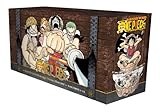
Eiichiro Oda created and draws the One Piece manga. Official VIZ catalog pages identify Oda as the creator and provide digital chapter access through VIZ and its MANGA Plus partner in supported locations. VIZ also lists collected editions, including One Piece (Omnibus Edition), Vol. 37, One Piece Box Set 5: Wano to Egghead and One Piece, Vol. 113. Availability of a particular chapter, volume or box set depends on your country and retailer.
Reading means you control the pauses. You can move through a short chapter in minutes, stop after a cliffhanger, reread a panel, or take a break between arcs without waiting for a weekly episode. Because the page is the original form of the story, visual composition, dialogue and panel order come directly from Oda’s work.
#1 Best Overall
- Viz Media
- Comes with secure packaging
- It can be used as a gift
The television anime is an adaptation by Toei Animation
Toei Animation produces the long-running television series. The anime follows the manga’s core narrative while translating still panels into timed scenes with voices, music, color, sound design, camera movement and animation. It can expand a moment, hold on a reaction, add transitions or include anime-original material. Those additions can make a scene more expressive, but they also mean the anime does not always move through the story at the same speed as the manga.
Toei announced in 2025 that, after a January–March hiatus, the series would move to a two-cour annual structure with approximately 26 new episodes per year beginning in 2026. The stated goal is to reflect the manga’s “content, rhythm, and pacing” more closely while retaining animation’s creative possibilities. Treat that as a release-format policy, not a promise that every episode will have identical pacing.
Manga and anime compared
| Factor | Manga | Anime | What it means for a beginner |
|---|---|---|---|
| Story authority | Oda’s original work | Adaptation of the manga | Choose manga for the most direct author-controlled route. |
| Pacing | You set the reading speed and can stop between chapters. | Episodes have fixed running time and adaptation timing. | Manga gives more control when stretched scenes would frustrate you. |
| Immersion | Panels, lettering and your own imagined timing. | Voice acting, music, color, sound effects and movement. | Anime is stronger if performance and audiovisual atmosphere drive your interest. |
| Coverage | Contains the source storyline in its original sequence. | Adapts the storyline and may expand scenes or add anime-original material. | Use manga when you want the least adaptation distance. |
| Sampling | A chapter is a small, flexible commitment. | An episode requires a scheduled block of viewing time. | Manga is easier to test and pause. |
| Access | Official digital chapters, print volumes and box sets; regional restrictions apply. | Licensed streaming availability varies by territory, service and catalog date. | Check the services and editions legally available where you live. |
| Social viewing | Readers can be at different points without sharing a runtime. | Weekly episodes create a shared viewing rhythm. | Anime may fit you better if watching along with friends is important. |
Why pacing is the central practical difference
People often describe the anime as having pacing problems, but that phrase needs context. A manga chapter can be read as quickly or slowly as you choose. An anime episode must fill a scheduled duration, and the production cannot consistently move faster than the source material without catching up to it. As a result, an adaptation may spend longer on a reaction, repeat information, extend a confrontation or use recap material.
The issue is not that every anime episode is slow. Some episodes deliver strong timing, choreography and emotional buildup. The trade-off is that you cannot compress a quiet episode into the few minutes you would need for the equivalent manga pages. Toei’s 2025 schedule announcement specifically said the future structure should follow the manga’s content, rhythm and pacing more closely; that reflects an effort to address adaptation rhythm, not a claim that earlier episodes should be discarded.
When manga pacing helps
- You want to move through setup quickly and spend more time on discoveries, fights or character moments that interest you.
- You dislike recaps or repeated reaction shots.
- You are catching up and want to stop at natural chapter or arc breaks.
- You read at a different speed from the anime’s fixed episode schedule.
When anime pacing is worth accepting
- You enjoy the anticipation created by an episode ending and returning the following week.
- A scene’s voice performance, score or sound design matters as much as its dialogue.
- You prefer seeing geography, motion and combat choreography rather than inferring them from still panels.
- You are watching socially and value a common episode-by-episode experience.
What the anime adds—and what it cannot replace
Performance and sound
Animated performances give characters distinct voices, pauses and vocal reactions. Music can turn a reveal into a larger emotional event, while sound effects establish the physical weight of a punch, ship, explosion or setting. Color and movement also clarify changes in location and action that a reader must mentally animate.
Expanded scenes and adaptation choices
Toei can hold on a facial expression, stage a transition, add connective material or broaden a confrontation. These choices may deepen a favorite moment, but they are still adaptation decisions. If you want to know exactly how Oda arranged the original scene, consult the manga rather than assuming every anime beat was on the page.
The manga’s strengths are not “lesser animation”
The manga is not merely a storyboard waiting to become an episode. Oda controls panel size, page turns, visual emphasis and the reader’s discovery order. A dramatic page turn can create a different kind of timing from a cut, musical cue or animated camera move. Reading also lets you linger on background details or compare panels without a scene continuing past you.
The Tool Desk
Outbyte PC Repair FREEClear out junk files and repair common Windows errorsFree Scan →Outbyte Driver Updater FREEFix the driver behind crashes, sound loss and screen glitchesFind Drivers →Three practical ways to start the manga
Digital-first
- Open the official VIZ or MANGA Plus service available in your location.
- Confirm that One Piece chapters are licensed for your territory; catalogs and free-access rules differ by region.
- Begin at Chapter 1 rather than jumping to a currently discussed arc.
- Read a small sample—several chapters or the opening story section—before deciding whether the page format suits you.
- Bookmark the chapter where you stop so you can resume without relying on an unofficial reading order.
Print-first
- Start with the first collected volume, or use an omnibus edition that contains the opening volumes.
- If you already know you want physical copies, compare the per-volume format with a One Piece manga box set for shelf space and the number of books included.
- Check the edition language, print quality and local stock before ordering; retail availability changes.
- Keep a note of the volume and chapter you finish so switching to digital later is straightforward.
How to read without turning it into a race
Set a stopping point that feels natural: the end of a chapter, a short group of chapters or the conclusion of a story section. The series is exceptionally long, so treating it as a marathon can make progress feel like an obligation. The manga’s main advantage is that you can change your pace whenever your attention or schedule changes.
Three practical ways to start the anime
Start at Episode 1
- Use a licensed streaming service that carries the series in your territory.
- Verify the available subtitles, dubs and episode range; catalogs differ by country, language and date.
- Begin with Episode 1 so character introductions and early relationships arrive in their intended order.
- Watch enough episodes to experience both the premise and the show’s normal rhythm before judging the entire adaptation.
- If a particular stretch feels slow, note the episode number and consider reading the corresponding manga section rather than abandoning the story.
Subtitles, dubbing and audio preferences
Your choice of subtitle or dub is a performance preference, not a different continuity. Select the track that lets you follow dialogue comfortably and notice the acting. If you switch tracks, keep the same episode position; localized dialogue can use different wording without changing the underlying scene.
How to watch a long series sustainably
- Use a weekly or several-episodes-per-week schedule instead of trying to clear hundreds of episodes at once.
- Stop at arc or episode boundaries so breaks do not feel like losing your place.
- Use the official episode synopsis when returning after a long gap, rather than relying on random recap videos that may include spoilers.
- Expect the available episode count and catalog to change. Toei said in a 2026 Elbaph announcement that the anime had surpassed 1,150 episodes when simulcasting resumed.
The hybrid route: manga for progress, anime for impact
Hybrid viewing is not a compromise you need to apologize for. It uses each format where it is strongest. Read the manga as your continuity anchor, then watch anime episodes for scenes whose voices, score, choreography or visual staging you particularly want to experience.
Rank #3

- One Piece Box Set 4: Dressrosa to Reverie: Volumes 71 90 with Premium
- ABIS BOOK
- VIZ Media LLC
A simple hybrid workflow
- Read from Chapter 1 and keep your current chapter number visible.
- When an important character entrance, emotional turning point or major fight interests you, identify the anime episode that adapts that material through the licensed service’s synopsis or episode guide.
- Watch that episode or group of episodes, then return to the next unread manga chapter.
- If an anime sequence expands beyond the manga, treat the added material as an adaptation choice and continue from your manga bookmark.
This route prevents the anime’s fixed runtime from controlling your entire progress while preserving the moments where animation contributes the most. It also makes switching less confusing because the manga chapter remains your reference point.
Do these 3 things before closing this tab:
1Repair Windows errors before they cause bigger problems2Scan for outdated or missing drivers - takes under a minute3Clear out junk files and repair common Windows errorsCan you switch from one format to the other?
Yes. The safest switch is to return to the beginning of the story section you most recently completed, rather than trying to match a single scene by memory. Anime episodes can combine material from multiple chapters, and a chapter can be spread across more than one episode. There is no universally reliable one-episode-to-one-chapter conversion.
Anime to manga
- Record the last fully completed anime episode.
- Find an official episode synopsis or guide that identifies the story section.
- Open the manga at the start of that section and read forward until familiar material ends.
- Continue from there, keeping in mind that expanded or anime-original scenes may not appear on the page.
Manga to anime
- Record the last chapter or volume you finished.
- Use an official episode listing to locate the adaptation of that story section.
- Start at the first episode covering it, even if you recognize the opening scenes; this avoids missing reordered or expanded material.
- Continue watching forward, and return to your manga bookmark if you decide the adaptation pace is not working for you.
Do not use an arbitrary online “skip list” as your continuity authority. Lists can be outdated, differ about what counts as essential and reveal future events through their labels.
Access, cost and commitment
Manga access
Official digital chapters may be available through VIZ and MANGA Plus in supported locations, while print readers can choose individual volumes, omnibus editions or box sets. The total price depends on country, edition, shipping and whether access is a purchase or a service benefit. The practical advantage is that you can sample a chapter or buy one volume instead of committing to a complete collection immediately.
Anime access
Anime availability depends on licensed services operating in your territory. Toei’s distribution information names Crunchyroll in EMEA and Netflix globally among outlets, but the exact catalog, subtitles, dubs, plan requirements and release timing still vary by country. Check the current listing where you live before choosing an anime-first plan.
Time commitment
Both formats require a substantial commitment because the story is long. The manga lets you convert spare minutes into progress and pause at any chapter. The anime asks for episode-length blocks of time, but its performed presentation may make that time feel more immersive. Do not choose based on an invented completion-time estimate; your reading speed, viewing habits and stopping points will determine the real commitment.
Should you wait for THE ONE PIECE remake?
Netflix’s separate THE ONE PIECE, produced by WIT STUDIO, is planned to begin again at Chapter 1. Netflix’s current listing describes its first season as approximately 50 manga chapters adapted into seven episodes, or around 300 minutes of material. The planned premiere is February 2027, so it is a future on-ramp rather than a way to start watching today.
Waiting makes sense if
- You want a shorter initial commitment than the existing television adaptation.
- You prefer a new production built around the opening chapters rather than a series that has already exceeded 1,150 episodes.
- You are comfortable postponing the story until the announced release window and accepting that schedules can change.
Starting now makes sense if
- You want to discuss the series with current readers or viewers.
- You want the original manga immediately or the existing anime’s established performances and music.
- You do not want a future remake to determine when you can begin.
The remake should be treated as another adaptation, not as a replacement that makes the manga or current anime irrelevant. Its announced format may offer a concise entry point, but later availability, episode structure and regional access should be checked when it launches.
Independent reader supportYour contribution helps us test, update, and keep practical guides available for everyone.How the 2026 release schedule changes the decision
The existing anime is no longer being described only by its historical weekly cadence. Toei’s 2025 announcement set out a two-cour annual model, with a January–March hiatus and approximately 26 new episodes each year from 2026 onward. Toei said the change is intended to bring future episodes closer to the manga’s content, rhythm and pacing while preserving animation’s distinctive storytelling tools.
That schedule may make anime-first viewing easier to follow for new fans who prefer a planned seasonal rhythm, but it does not erase the archive of earlier episodes or guarantee that every adaptation stretch will match your ideal pace. If you start the anime in 2026, distinguish the current production schedule from the already released back catalog.
Best Value
Common beginner mistakes and better fixes
Mistake: choosing based on an absolute “better” verdict
Fix: Decide whether your first priority is control and density or performance and spectacle. Your answer can change later.
Mistake: assuming the anime is always filler
Fix: The anime adapts the manga and may expand scenes or add anime-original material, but that does not make every episode nonessential. Evaluate a specific stretch instead of applying one label to the entire series.
Mistake: jumping into a current arc because it is popular
Fix: Start at Chapter 1 or Episode 1. One Piece builds character relationships, world rules and emotional stakes over a long sequence.
What’s actually slowing this PC down?
Pick the symptom - the matching free tool is one click away.
Mistake: switching at an exact episode number without checking coverage
Fix: Use the start of a story section as your handoff point. Episodes and chapters do not map perfectly one for one.
Mistake: buying an entire collection before testing the format
Fix: Sample official digital chapters or a single volume first. If physical reading suits you, then compare omnibus and box-set options.
Mistake: assuming access is identical everywhere
Fix: Verify your country’s legal chapter access, print edition, subtitles, dubs, episode range and plan requirements before spending money or committing to a schedule.
Mistake: treating a future remake as guaranteed timing
Fix: The planned February 2027 date is a release plan, not something available in 2026. Start now if you want the story now; wait only if the new adaptation’s format is your decisive preference.
Quick wins for a faster PC:
Repair Windows errors before they cause bigger problemsFix Now →Scan for outdated or missing drivers - takes under a minuteDriver Scan →Decision guide for different kinds of new fans
| If you identify with this | Best starting route | Why |
|---|---|---|
| “I get frustrated when a scene takes longer than necessary.” | Manga first | You control reading speed and can move directly through chapters. |
| “Music and voice acting are central to why I watch animation.” | Anime first | Performance, score, color and movement are the primary experience. |
| “I want the story quickly but also want to see famous fights animated.” | Hybrid | Read for progress, then select anime episodes for audiovisual highlights. |
| “I want a fresh, shorter adaptation and can wait.” | Wait for THE ONE PIECE | The announced first season starts at Chapter 1 and is planned for about 50 chapters in seven episodes. |
| “My friends discuss the weekly episode every week.” | Anime first | A shared episode schedule makes conversation and simultaneous viewing easier. |
| “I want to collect the original work on paper.” | Manga first, print edition | Volumes, omnibuses and box sets preserve Oda’s page format. |
| “I have only short, unpredictable reading windows.” | Manga first | A chapter or even a few pages can fit around your schedule. |
Final recommendation
For a typical new fan in 2026, begin with the manga at Chapter 1 through an official VIZ or MANGA Plus route, then use the anime selectively when you want voices, music, motion and performed action. Choose anime-first instead if those audiovisual qualities are the reason you are interested in One Piece and you enjoy a fixed viewing rhythm. Waiting for THE ONE PIECE is reasonable only when a planned 2027 re-adaptation is more appealing than starting with the available original manga or existing anime.
Quick Recap
Product prices and availability are accurate as of the date/time indicated and are subject to change. Any price and availability information displayed on Amazon at the time of purchase will apply.

