
iTechGuides is reader-supported. When you buy through links on our site, we may earn an affiliate commission. As an Amazon Associate I earn from qualifying purchases. Learn more
A passing Python test confirms only that the test’s assertions passed for the inputs and code path it exercised. It does not prove that a real client sends the same request or that the response clients receive matches your API contract. Compare the request, parsed input, application output, and final JSON response one boundary at a time.
Start by locating which payload is weird
First identify whether the mismatch is in the request sent to the API or the response returned by it. Save the exact expected and observed payloads, and label each one. Compare decoded values and structure rather than relying on printed representations, which can make different types look similar.
- For a request, capture the method, path and query, headers, cookies, and body.
- For a response, capture the status, relevant headers, and decoded JSON body.
- Check whether the difference is in a value, a field name, a missing or extra key, a nested object or array, or a type.
Check what the test actually proves
A test that checks only a status code can pass while the body is wrong. Review the assertions: do they verify the decoded body, required keys, nested shape, important value types, and headers that are part of the API contract? A test of an internal function may validate its return value without exercising the HTTP request and response boundary at all.
Crashes, No Sound, or Screen Glitches?
Random freezes, missing sound and display glitches usually trace back to one bad driver. Find and replace yours safely.Free scan · under a minutePC Slower Than It Used to Be?
A free scan shows the junk files, broken settings and background clutter dragging Windows down - then fixes them in one click.Free scan · Windows 10 & 11For a client-level test, construct a request and assert the response that a client would observe. FastAPI’s testing example checks both status and JSON content; its documentation also notes: “Note that the TestClient receives data that can be converted to JSON, not Pydantic models.” See FastAPI: Testing.
#1 Best Overall
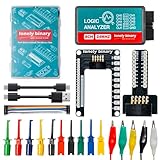
- 【High-Speed 8-Channel Analysis】Captures digital signals at up to 24MHz across 8 channels, enabling precise debugging of complex protocols like I2C, SPI, and UART—ideal for advanced STEM projects without the limitations of basic 4-channel models.
- 【User-Friendly Design】Base module and breakout board simplify connections to breadboards, microcontrollers, and other setups.
- 【Logic Level Expansion Board】Breaks out all 8 channels to 2.54mm male pins and pads for alligator clips, enabling flexible and secure connections in diverse projects.
- 【Logic Level Breadboard Adapter】 Easily connects the logic analyzer to breadboards, providing direct and convenient access to all 8 channels for prototyping and testing.
- 【Dual USB Connectivity】Comes with both USB-A and Type-C cables for universal compatibility with older PCs, modern laptops, and devices, ensuring hassle-free plug-and-play across Windows, Mac, Linux, and Ubuntu.
Make the test request match the real request
Compare the request made in the test with one made by the real client. The body’s encoding and headers matter, as do the method, path, query parameters, and cookies. In FastAPI’s TestClient, pass a mapping using json= for a JSON body; use data= for form data. Set relevant headers explicitly instead of assuming the test and deployed client supply identical ones. FastAPI documents these as distinct request inputs in its testing guide.
Verify Content-Type and request parsing
Record the request’s Content-Type and inspect what the application actually parsed. FastAPI’s default strict behavior checks that a JSON request body has a valid JSON content type, such as application/json. A missing or invalid header can therefore change how the body is handled.
Rank #2

- ✅ High-Performance 16-Channel Logic Analyzer: Cost-effective LA1010 USB logic analyzer with 16 input channels and 100MHz sampling rate per channel, featuring portable design and included KingstVIS PC software.
- 🌐 Real-Time Signal Visualization: Simultaneously capture 16 digital signals and convert them into clear digital waveforms displayed instantly on your PC screen for precise analysis.
- 🔍 Protocol Decoding & Data Extraction: Decode 30+ standard protocols (I2C, SPI, UART, CAN, etc.) to extract human-readable communication data, accelerating debugging.
- 🛠️ Multi-Application Tool: Ideal for developing/debugging embedded systems (MCU, ARM, FPGA), testing digital circuits, and long-term signal monitoring with low power consumption.
- 💻 Cross-Platform Compatibility: Supports Windows 10/11 (32/64bit), macOS 10.12+, and Linux – drivers auto-install, no configuration needed.
FastAPI documents strict_content_type=False as an opt-out, but it also explains the security rationale for the default. Do not disable strict checking as a generic payload fix; first establish that the client’s request is malformed or that the application has a specific, justified need to accept it. See FastAPI: Strict Content-Type checking.
Trace validation, conversion, and response shape
Compare the value before and after parsing and validation, then follow it through application logic and any response-model conversion or filtering. The stages vary by framework and configuration. If the application uses FastAPI with Pydantic, nested models can validate and convert nested data, and declared field types can affect the result.
Rank #3

- The logic for each channel sampling rate of 24M/s. General applications around 10M, enough to cope with a variety ofoccasions; 8-channel
- Sampling rate up to: 24 MHz , can be 24MHz. 16MHz, 12MHz, 8MHz, 4MHz, 2MHz, 1MHz, 500KHz, 250KHz, 200KHz, 100KHz, 50KHz, 25KHz;
- The logic for each channel sampling rate of 24M/s. General applications around 10M, enough to cope with a variety ofoccasions;
- Input voltage range: -0.5V to 5.25V; Input Low Voltage: -0.5V to 0.8V; Input High Voltage: 2.0V to 5.25V
- Input Impedance: 1Mohm || 10pF (typical, approximate); Crystal: +/-20ppm, 24MHz
- If duplicate items disappear, check whether the field is declared as a
set; sets remove duplicates. - If object keys look different, remember that JSON object keys are strings. Pydantic can convert integer-like keys for a typed mapping, but the JSON representation still has string keys.
- Check defaults and field names as well as values. A valid response can still have a shape or naming convention that differs from what a client expects.
FastAPI’s documentation covers nested models; Pydantic documents serialization and data conversion. Confirm the behavior against the versions pinned by your project rather than assuming every current documentation option applies to an older installation.
Inspect the final JSON serialization boundary
A Python value and its JSON representation are not always the same. In Pydantic’s JSON mode, for example, a tuple is serialized as a JSON array, and supported Python types are converted to JSON-compatible values. Unsupported values can raise PydanticSerializationError. Inspect both the in-memory value and the final response body to determine where the mismatch appears.
Rank #4
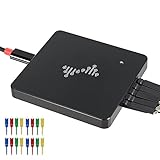
- 16 channels dual-mode support: ①Stream mode captures and transfers data in real time for long sample duration; ②Buffer mode captures and stores data temporarily for high sample rate
- USB 2.0 Type-C interface with up to 16G sample depth in stream mode
- Support for adjustable threshold and shielded wires for a better, cleaner waveform
- 256Mbits on-board SDRAM memory with multiple buffer modes
- Compatibility with WinXP-Win10, macOS, and Linux, supporting nearly 100 protocol decoders, and being open-source on Github
Some serialization errors surface only when a particular value reaches response serialization, rather than during ordinary input validation. Pydantic describes this as a possible production failure mode and identifies request-context instrumentation as a way to capture it. If the issue occurs only in production, capture the failing input and serialization exception safely, together with relevant request context. Pydantic’s serialization documentation includes details on JSON mode, model_dump_json(), and serialization errors. That page identifies some behaviors as new in v2.13, so check your installed and pinned version before using a particular API or relying on a specific behavior.
Quick wins for a faster PC:
Scan for outdated or missing drivers - takes under a minuteDriver Scan →Repair Windows errors before they cause bigger problemsFix Now →Fix the driver behind crashes, sound loss and screen glitchesFind Drivers →Turn the mismatch into a regression test
Once you know which boundary changes the payload, add an assertion at that boundary. A useful request/response regression test checks the contract rather than only an internal return value.
Best Value

- ★The logic for each channel sampling rate of 24M/s. General applications around 10M, enough to cope with a variety ofoccasions; 8-channel.
- ★Sampling rate up to: 24 MHz , can be 24MHz. 16MHz, 12MHz, 8MHz, 4MHz, 2MHz, 1MHz, 500KHz, 250KHz, 200KHz, 100KHz, 50KHz, 25KHz.
- ★Input voltage range: -0.5V to 5.25V; Input Low Voltage: -0.5V to 0.8V; Input High Voltage: 2.0V to 5.25V.
- ★Input Impedance: 1Mohm || 10pF (typical, approximate); Crystal: +/-20ppm, 24MHz.
- ★UART, SPI, IIC and other communication debugging, let you get twice the result with half the effort. 24M sampling rate, can automatically analyze UART, IIC, SPI and many other standard protocols.
- Construct the request as the real client does, including method, path and query, body encoding, headers, and cookies that matter.
- Assert the response status and relevant headers.
- Decode the response JSON and assert the exact keys, nested structure, and values or types that clients rely on.
- If serialization is the failure point, include a case that exercises the problematic value through response construction and serialization.
Keep the test focused on the intended contract: assert details that matter to clients without making irrelevant representation choices part of the API by accident.
Quick Recap
Product prices and availability are accurate as of the date/time indicated and are subject to change. Any price and availability information displayed on Amazon at the time of purchase will apply.

