
What’s actually slowing this PC down?
Pick the symptom - the matching free tool is one click away.
iTechGuides is reader-supported. When you buy through links on our site, we may earn an affiliate commission. As an Amazon Associate I earn from qualifying purchases. Learn more
Moon rocks contain small amounts of volatile elements and compounds, including hydrogen-bearing species, carbon, nitrogen, sulfur, fluorine and chlorine. Their chemical forms and amounts vary by sample and setting. “Locked in rock” means retained in or recorded by lunar sample material; it does not mean every rock contains free water or gas.
What counts as a volatile in a Moon rock?
“Volatile” describes how a substance behaves, not one particular ingredient: volatile elements or compounds can be driven off when material is heated. Lunar discussions include hydrogen, carbon, nitrogen, sulfur, fluorine and chlorine, as well as other elements such as sodium, potassium and noble gases. NASA’s historical technical reference treats these in its discussion of volatile elements, while a NASA-hosted review identifies H, C, N, F, S and Cl as magmatic volatile elements.
In this context, “locked in” is shorthand for volatile material retained in, measured from, or recorded by a sample. Evidence can come from bulk rock, volcanic glass, minerals, melt inclusions, soil, or gases inferred from volcanic materials. It is not a claim that every lunar rock contains liquid water or a pocket of gas.
Free tools Windows power users keep installed
One-click scans. No signup required.
What do lunar samples actually show?
Apollo rocks and soils have been analyzed in laboratories, providing direct evidence of lunar volatile material. NASA’s overview also discusses orbital observations and the LCROSS impact, which exposed material from a permanently shadowed region. These observations concern distinct reservoirs: volatiles associated with the lunar interior and volcanic materials are not the same evidence as surface soil or polar deposits. NASA describes the source, chemical form, abundance, distribution and movement of lunar volatiles as continuing areas of investigation. See NASA’s Volatile Cycles overview.
#1 Best Overall

- 【Solar System】: DIY your own sun earth moon orbital rotation model with this creative kit. Seasonal plate that shows the names, order, and dates of the four seasons and the twenty-four solar terms in the traditional Chinese calendar. night, seasons, solar eclipse, lunar eclipse and moon phases .
- 【Usage Scenarios】: Great for Geology & Earth Sciences Teaching, School project also Great gift for your children over 6 years old, it cultivates children's interest in space science. Earth orbiting around the sun, and moon orbiting around the earth showing planetary orbit.
- 【To Demonstrate Seasons and Solar and Lunar Eclipses】: 1)Rotate the Earth to show how the Earth's rotation and orbit around the Sun create seasons; 2)To demonstrate a solar eclipse, move the Moon between the Earth and the Sun, blocking the Sun's light and casting a shadow on the Earth; 3)To demonstrate a lunar eclipse, move the Moon into the Earth's shadow, creating a tint on the Moon.
- 【Easy to Assemble 】: Updated Instruction 1)Wrench the connecting nut to the seasonal plate; 2) Insert the axe to the slot, put the two screws to the corresponding holes, then tighten the screws; 3) Get the “solar system” aligned correctly: Set the handle with the pointer on the summer solstice, adjust the position of the Earth so that the sun shines directly on its Tropic of Cancer; 4)Assemble the gears upper and underneath with the black peg;Put the sun’s metal wire in the hole on the lever.
- 【Size Information】100% brand new and high quality. Size(LxWxH): Approx. 38 x 20 x 28 cm / 15.20 x 7.87 x 11.02 inch.
The amount and composition cannot be reduced to one universal figure for “Moon rock.” They vary with sample and geological setting, and a measured elemental abundance in a rock is different from the relative composition of gas reconstructed from volcanic products. The reviewed sources do not establish a single concentration table that can be applied across lunar rock types.
What volcanic material tells us about lunar gases
A 2024 review by Varnam, Hamilton, Aleinov and Barnes examines mare eruption products from 4.0 to 1.2 billion years ago. It identifies high-titanium glass beads returned by Apollo 17 as the basis for the most reliable estimates of lunar volcanic volatile composition. In those reconstructed gases, hydrogen is the most abundant element by mole, with sulfur third after hydrogen and oxygen. That ranking describes inferred volcanic gas, not the bulk composition of every Moon rock.
Rank #2

- The model is an excellent way to illustrate Earth's rotation, the planet's revolution around the sun, the seasons of the year, and the orbit of our moon - all in one!
- This device can serve to illustrate to a young child that Earth spins on its axis, that the moon orbits Earth every 28 days, and the Earth orbits the sun once a year,Can help child's astronomy class better understand moon phases, eclipses, season, etc.
- You can learn about the 24 Solar Terms used by farmers in China,It's pretty easy, it comes in English.
- There is a raised button on the sun model, Remove the wire and push the button, the sun will give out light.
- Note: This item will be interesting to kids who are starting to get excited about astronomy, but It is not suitable for rigorous astronomy scientific research!
The review expects hydrogen to occur mostly as molecular hydrogen (H₂) under the oxygen fugacity predicted for lunar magma. Its chemical form matters: H₂ is more readily lost to space, whereas water (H₂O) could freeze and persist in permanently shadowed polar regions. The review is “Composition and speciation of volcanic volatiles on the Moon,” published in Icarus in 2024.
Why the Moon is volatile-poor, but not volatile-free
NASA describes lunar rocks as containing small amounts of elements that vaporize when heated. The relative depletion is consistent with formation models in which a high-energy event allowed some vaporizing material to escape. It does not show that every volatile was lost: sample studies and evidence from surface reservoirs establish that volatile material remains in more than one lunar setting. NASA outlines this formation context in its Moon Formation overview.
Rank #3

- Dynamic Orbital Motion: The Eisco Sun, Earth, and Moon Orbital Model features a gear-driven mechanism that simulates realistic orbital motion. This interactive globe lets you explore planetary dynamics with precision and detail
- Illuminated Solar Display: A 12V light bulb illuminates the Sun, enhancing the model's visual appeal. This feature makes the Sun-Earth-Moon model with light ideal for demonstrating the interplay of light in our solar system
- Eclipse Alignment Explained: This model allows you to demonstrate solar eclipses by showcasing how the Sun, Moon, and Earth align. It's a powerful tool for understanding these celestial events through hands-on exploration
- Calendar-Based Learning: The month-labeled base connects each celestial position to the calendar year. This feature helps you track Earth's rotation and revolution over time, making the Earth-Sun-Moon orbiter model an educational asset
- Structured Study Guide: The included guide contains three structured activities to deepen your understanding of the solar system. These exercises provide a comprehensive learning experience, enhancing Science kit Earth-Sun-Moon system engagement
Keep the different lunar reservoirs distinct
- Interior and volcanic material: endogenous volatiles associated with lunar rocks, magma, glass and eruption products.
- Surface and regolith: material in soil and at or near the surface, with contributions and processes that are not interchangeable with interior composition.
- Permanently shadowed regions: cold-trap settings where some species, including water ice, may persist. A polar deposit is a surface reservoir, not proof that all rocks contain water.
Origin can also differ by element and material. A historical NASA technical reference reports that most carbon in lunar soils is solar-wind-derived, while carbon in rocks is indigenous. That finding is specific to carbon in those materials; it should not be generalized to every volatile element. For broader context on lunar materials, see NASA’s Moon Composition page.
Quick Recap
Best Value

- Assemble & Explore 3-D Paper Models to Investigate Key Science Concepts
- Perfect for Use at Home or in the Classroom
- Includes Extensive, Illustrated Background Information & 1 Set of Model Templates
- Satisfies Next Generation Science Standards
Rank #4
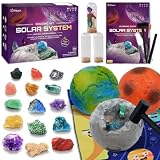
- BREAK OPEN YOUR OUTER SPACE ADVENTURE: Discover this 3-IN-1 gemstone dig kit with 15 unique rocks, minerals, and crystals hidden within plaster planets of EARTH, MOON, and MARS. Young geologists can break open these mini worlds to unearth precious gems for kids and engage in space mining exploration for hours of fun
- INCLUDE A MESS-FREE PLANET MAT: This gem mining kit for kids includes a durable, easy-to-clean tablecloth with a vibrant solar system design, perfect for keeping your space clean during gemstone excavation. Its detailed planetary map also serves as an educational guide to the solar system for kids
- 3 DISPLAY JARS FOR TREASURE COLLECTION: As a special surprise, this rock digging kit includes 3 specimen display jars, turning the dig into a treasure hunt for kids! Kids can store, sort, and show off their favorite gems and crystals, building their very own rock collection display and keeping every unearthed treasure safe after the excavation
- FUN & EDUCATIONAL STEM TOYS: This space science kit for kids 6-8 provides a kid-friendly, full-color Learning Guide with vivid illustrations of the solar system, plus rock types, hardness levels, and fun facts for all 15 gemstones, offering hands-on geology for kids with rocks and minerals that's both fun and informative
- PERFECT SCIENCE GIFT FOR KIDS AGES 6-12: Ideal for birthdays, holidays, and Christmas, the PIBEX solar system gemstone dig kit for kids is not just a toy, but a gateway to learning about space, geology, and archaeology. Perfect science gifts for boys and girls who love space toys, excavation kits for kids, family activities, or space-themed parties
What cannot be concluded from the evidence
- There is no defensible single ppm value for all volatile elements in all Moon rocks based on the sources discussed here.
- The hydrogen ranking in reconstructed volcanic gas is not a ranking of elemental abundance in all lunar samples.
- Evidence for polar volatiles does not mean that polar ice is contained in ordinary rock samples.
- The presence of volatiles does not erase the Moon’s relative depletion, and depletion does not mean complete absence.
Product prices and availability are accurate as of the date/time indicated and are subject to change. Any price and availability information displayed on Amazon at the time of purchase will apply.

